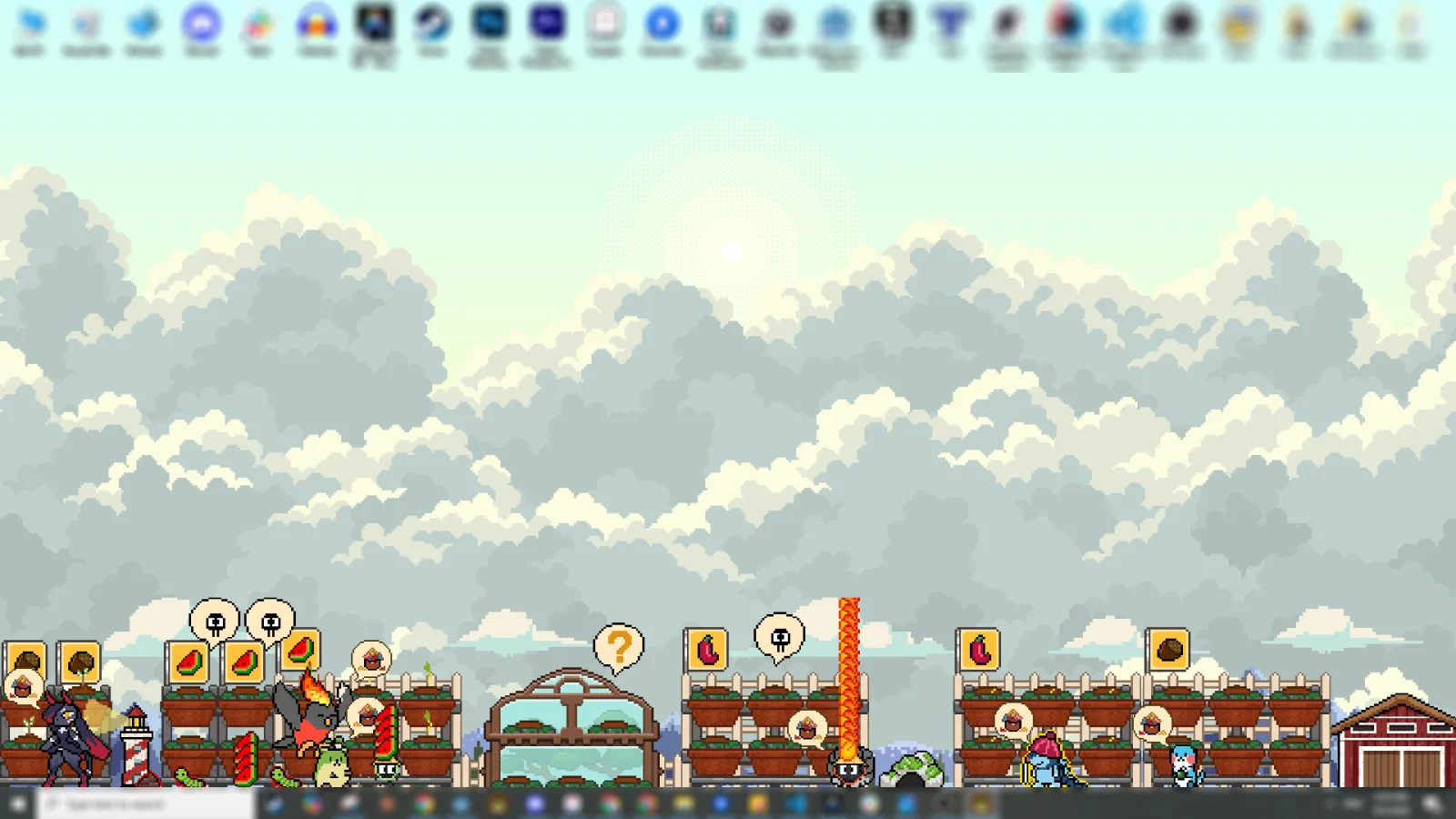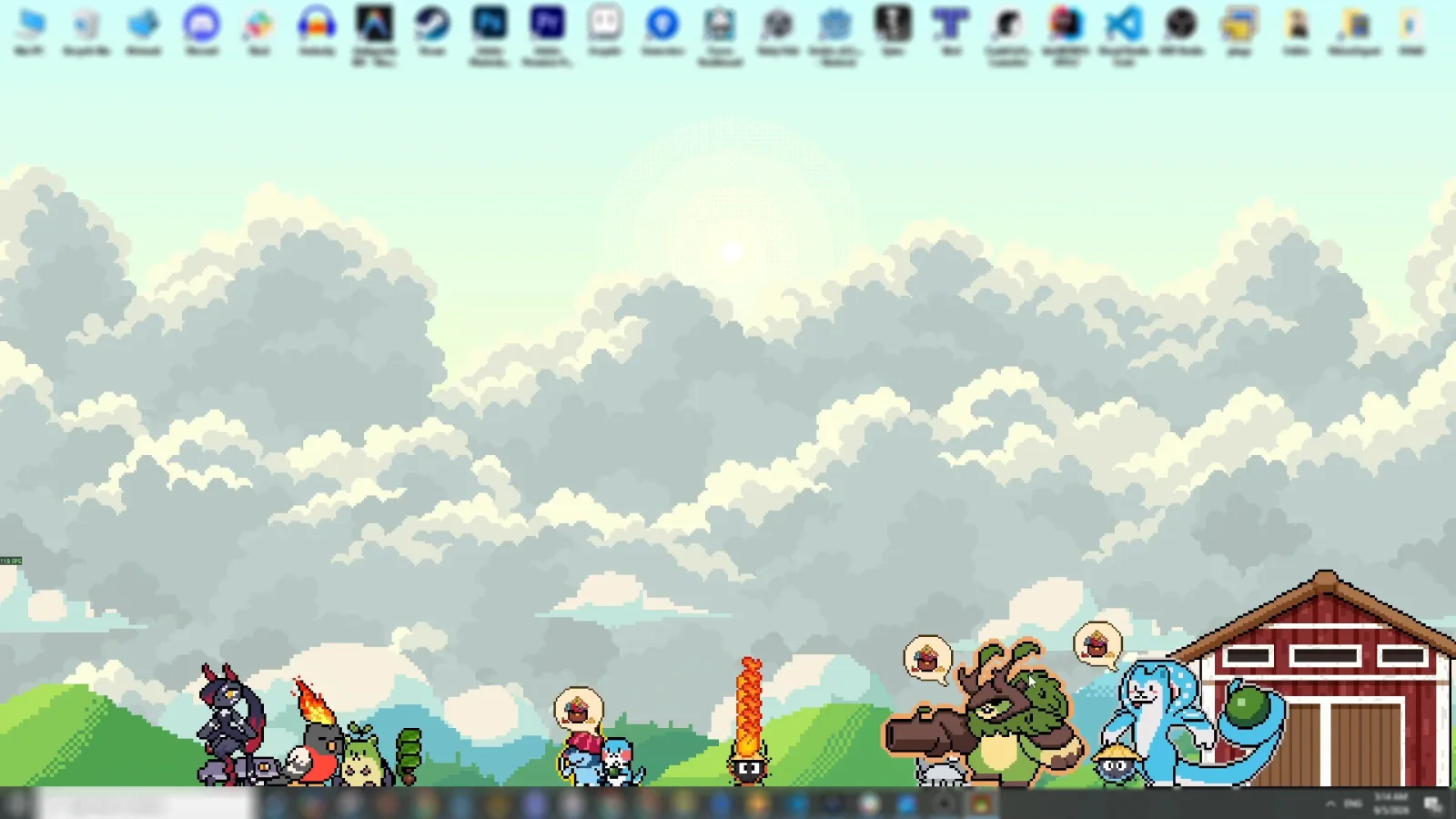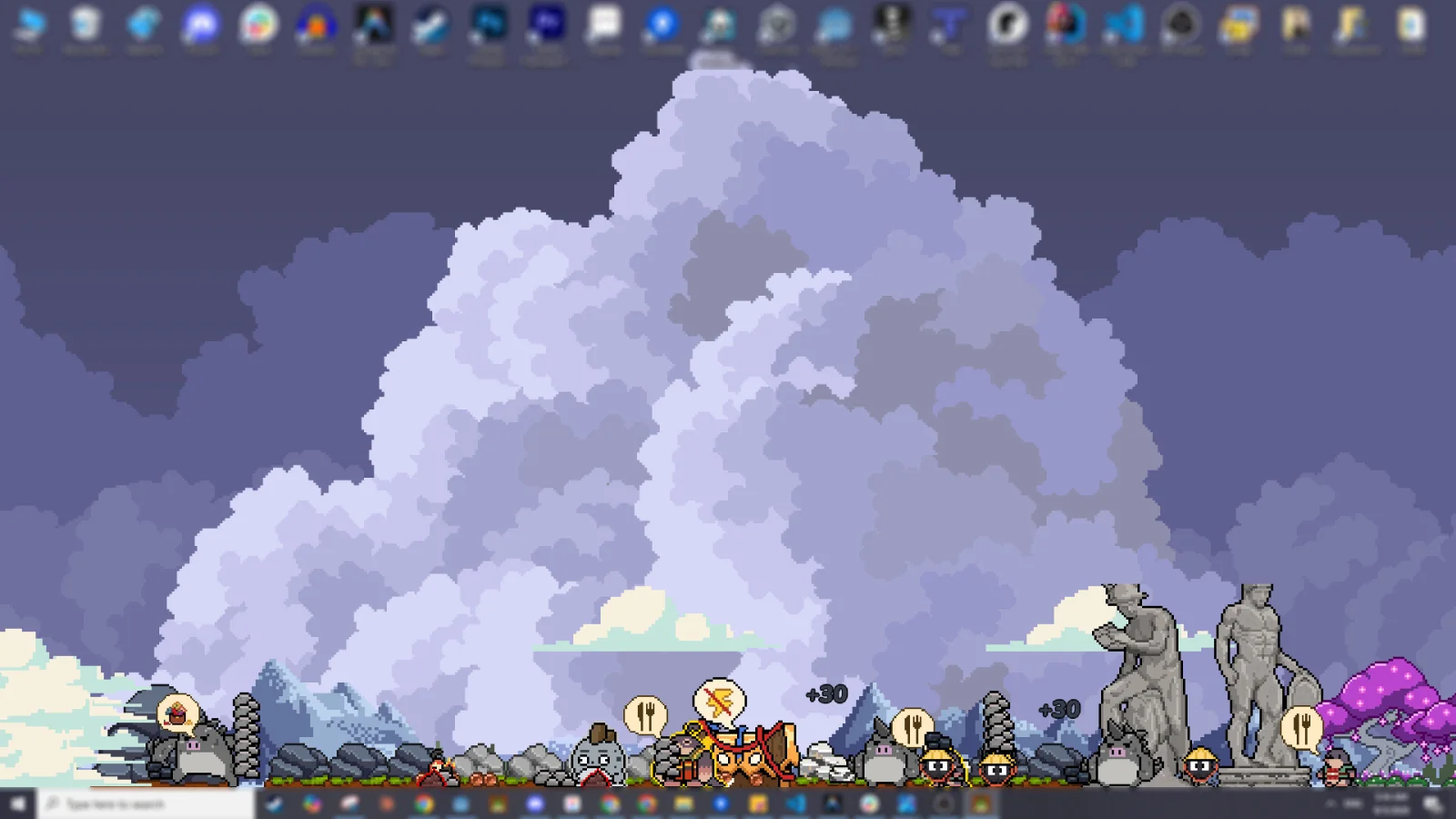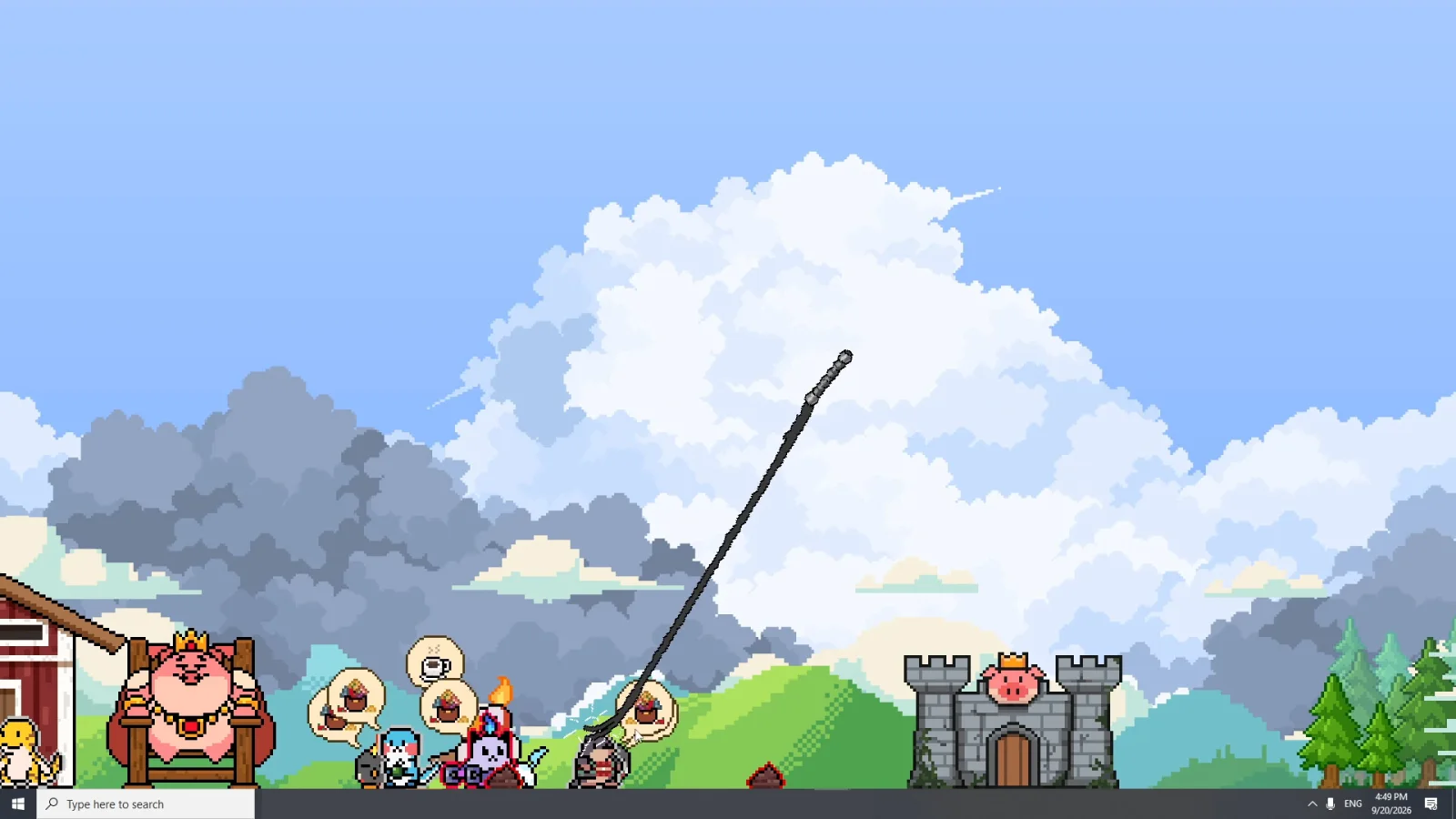
WinMon proposes an unusually particular place for an idle farming and creature-management game: not at the center of a dedicated play session, but at the edge of the desktop while other computer activity continues. That is not simply a presentational twist. It changes the meaning of nearly every listed system. A conventional management game can occupy the whole screen, request sustained concentration, and expect players to spend long stretches comparing resources, construction options, and output figures. A desktop companion must earn each glance it receives. It shares room with work, messages, browsing, creative tools, and all the ordinary business of using a PC.
The practical challenge is attention. A miniature farm that quietly makes progress can feel companionable because it adds a small, persistent world to a routine. Yet that same persistence can become demanding if its visual signals are noisy, its decisions are too frequent, or its priorities are hard to read. WinMon’s stated mix of creature assignments, resource processing, machines, buildings, evolution, and long-term progression therefore raises a design question more interesting than raw feature volume: can a system with many moving parts remain intelligible in brief encounters?
Its official framing adds another tension. The visual premise is a cozy creature-run farm, while the language around labor, quotas, and productivity leans into workplace satire. Those ideas can pull against one another in productive ways. Cute workers and compact fields may make managerial terminology seem knowingly ridiculous. Alternatively, the productivity vocabulary could make the farm’s apparent comfort feel conditional, asking players to notice how quickly companionship is translated into output. The premise establishes room for that contrast; it does not establish how sharply the game develops it through writing, interface presentation, or mechanical consequences.
A game for the edge of attention
The desktop-companion form gives passive progression a different value from passive progression in a full-screen incremental game. In the latter, waiting may be an intentional rhythm: collect resources, select upgrades, then leave the program running or close it until the next check-in. A companion designed to coexist with other activity needs a lighter social contract with the player. Ideally, a glance should answer basic questions quickly: Is the farm moving? Is something blocked? Is a decision worth making now? Can this be ignored until later?
Interface clarity is consequently more than a convenience. It is part of the game’s relationship to the player’s time. A visible idle worker, a resource shortage, a completed construction task, or a stalled machine can be useful information if the cause and possible response are easy to understand. A crowded field of equally urgent symbols, changing values without explanation, or repeated prompts that do not lead to meaningful choices could have the opposite effect. The design has to distinguish between information that invites thought and information that merely asks for maintenance.
That demand becomes especially important in a game that combines idle progression with management. Idle design benefits from allowing the operation to function with limited intervention. Management design benefits when decisions about staffing, priorities, and infrastructure produce legible differences. If the farm becomes self-sustaining too quickly, its professions and buildings might risk becoming decorative labels around automated accumulation. If each chain requires constant fine adjustment, the desktop premise may lose the unobtrusive quality that makes it distinctive. The most promising conceptual middle ground would let routine labor continue while reserving player attention for changes in direction: what to expand, which constraint to address, and which creatures should define the operation.
That is a conditional reading of the design rather than a claim about how WinMon functions in practice. Still, it identifies the standard that matters most for the concept. The issue is not whether a game has enough systems to fill a screen. It is whether those systems can present a meaningful decision in the small intervals between everything else a PC user might be doing.
Professions need readable relationships
WinMon lists eight professions: Seeder, Waterer, Lighter, Miner, Lumberjack, Builder, Engineer, and Alchemist. The names suggest a broad movement from tending a farm toward gathering materials, making infrastructure, operating machinery, and transforming resources. Seeder and Waterer evoke cultivation; Miner and Lumberjack point toward extraction; Builder and Engineer imply expansion and technical construction. Alchemist suggests a conversion or refinement role. Lighter is less self-explanatory from its name alone, making clear explanation particularly important if its role is meant to matter within the larger system.
The strongest possible version of this arrangement would make each profession meaningful through dependency. A player could see that a missing input is slowing a machine, recognize which assignment or building might improve that condition, and understand the consequence of changing course. In that model, specialization is not just an attribute printed beside a creature. It becomes a way of reading the farm’s present needs and shaping its future capacity.
The listed presence of nearly 30 machines and buildings gives that dependency idea a potentially substantial stage. More structures can create satisfying milestones when each one changes a relationship among materials, labor, processing, and goals. But a construction count alone cannot tell readers whether the choices are strategically distinct, how costs relate to benefits, or whether new structures reframe old decisions. A lengthy building list can support layered planning; it can also amount to a sequence of increasingly expensive purchases. Those are different design outcomes, and the available feature outline does not settle which one applies.
The repairable Fusion Core is similarly intriguing as a stated focal object. Repairing something implies a broader project beyond simple accumulation, and a central machine could give the farm an organizing purpose. Yet its requirements, effects, and wider role are not established here. It should be read as a possible anchor for the game’s systems, not evidence of a particular narrative structure, endpoint, or progression sequence.
For a desktop game, the important question is whether any such network can be understood without forcing players to parse a maze of numbers. A dashboard that treats every creature only as a productivity unit might reinforce the satirical language but flatten the collection fantasy. A presentation that makes creatures recognizable while showing what their assignments enable could hold both sides together. WinMon’s premise has room to make care and efficiency visibly intersect rather than pretending they are separate concerns.
Creature collection beyond the number of forms
The feature list includes 94 creature forms across 31 evolution lines, as well as eight elements, five power tiers, four quality grades, and 19 personality traits. This is a large vocabulary for creature identity. A WinMon may potentially be understood through multiple overlapping categories instead of one straightforward level or rarity label. But abundance is not automatically distinction. Counts do not reveal whether elements change assignments, whether grades meaningfully affect decisions, whether personalities have practical consequences, or whether evolution presents trade-offs instead of a simple route upward.
That uncertainty is where the collection layer becomes critically interesting. In a game that also frames creatures as workers, evolution can carry a different implication from evolution in a combat-focused collector. If advancement is primarily tied to efficiency, it could sharpen the game’s workplace satire by making growth inseparable from output. If elements, traits, and forms influence compatible roles or priorities, the roster could encourage players to think about creatures as particular individuals within a wider operation. Neither interpretation can be assumed. Both illustrate why the creature layer should be judged by the identity it creates, not the size of its catalogue.
Personality traits have an especially important theoretical role. They could be expressive flavor, a modest modifier, an assignment constraint, or a source of unexpected combinations. Each approach creates a different relationship between player and creature. A system that lets personality complicate pure optimization could support the companion fantasy: a creature is not merely a worker icon, even if it contributes to production. But any complication also needs to be readable. In an ambient desktop setting, too much hidden variance or too many exceptions could turn charm into bookkeeping.
Progression has to change perspective
WinMon also names 52 skill nodes, 28 Prestige nodes, and a later Revolution system. That sequence communicates an ambition for long-tail progression: initial improvement, advancement beyond an earlier threshold, and another framework beyond that. This is a familiar attraction of incremental management games. A small operation can acquire new ambitions over time, and an established routine can be reconsidered through later choices.
Yet the crucial issue is not simply how many progression layers are listed. It is whether each layer changes the player’s relationship to the farm. Skill nodes could potentially support a favored direction in production. Prestige could potentially make earlier decisions worth revisiting. Revolution could potentially establish a fresh context for established systems. The available description does not specify reset rules, permanence, unlock conditions, or trade-offs, so none of those possibilities should be treated as confirmed. The design test remains clear: later progression should ideally provide a new question, not only a larger number.
This matters more in a game meant to remain present over time. A returning player needs to be able to identify what changed, what became possible, and what deserves attention now. If later layers clarify the farm’s evolving purpose, they could make ongoing interaction feel rewarding. If they only add counters and currencies alongside existing ones, the same small desktop footprint could begin to feel administratively crowded. The companion format makes interpretability a long-term concern, not merely an onboarding concern.
Comfort, routine, and the joke inside optimization
WinMon’s workplace language gives its production loops a specific thematic frame. The satire could remain light, functioning as a comic contrast between tiny creatures and oversized business rhetoric. It could also become more pointed if the game asks players to confront the gap between affectionate collecting and relentless optimization. What matters is not that the setting uses words such as quotas or productivity. It is whether the systems, presentation, and creature identities give those words a consequence beyond decoration.
A related question appears in this feature on routine labor as a game system: when repetitive work becomes play, framing affects what players are asked to notice. In WinMon’s case, the friction between companions and workers could be the point. The farm does not need to reject optimization to make that tension visible. It may instead be able to expose how optimization changes the way a player sees a cute, persistent world.
IndieLab’s public update history includes late-September bug fixes and UI adjustments. That establishes post-release update activity, but it does not by itself establish the present technical state of the game, the scope of any individual change, or whether all reported concerns have been addressed. From a design perspective, UI adjustments are particularly relevant to a desktop-companion premise because the game’s ability to communicate priorities in limited space is central to its stated identity. The details of those adjustments, however, should not be overstated beyond what the update history confirms.
Who the concept may suit
WinMon’s declared ingredients may be most appealing to players drawn to desktop idlers, creature collection, and incremental management as connected interests. The central appeal is the prospect of a small farm that remains nearby rather than demanding an uninterrupted session, while still presenting professions, infrastructure, and evolving creatures to revisit periodically. Players receptive to a lightly satirical view of labor and efficiency may find the tonal contrast appealing as well.
Players seeking a self-contained adventure built around continuous attention may be less naturally aligned with the premise. That does not make a claim about content volume or quality. It follows from the stated desktop-companion identity: the game is organized around coexistence with a computing routine rather than the replacement of that routine for a fixed period.
WinMon’s listed systems create a set of worthwhile design questions rather than a settled verdict. Can passive progression leave room for choices that matter? Can creature identity survive the pressure to optimize output? Can a dense production network be clear at a glance? Can later progression add perspective instead of paperwork? The answer rests on how the game connects its many parts. Its most distinctive idea is not any individual machine, trait, or profession, but the attempt to make a cozy farm and a miniature workplace occupy the same corner of the desktop.