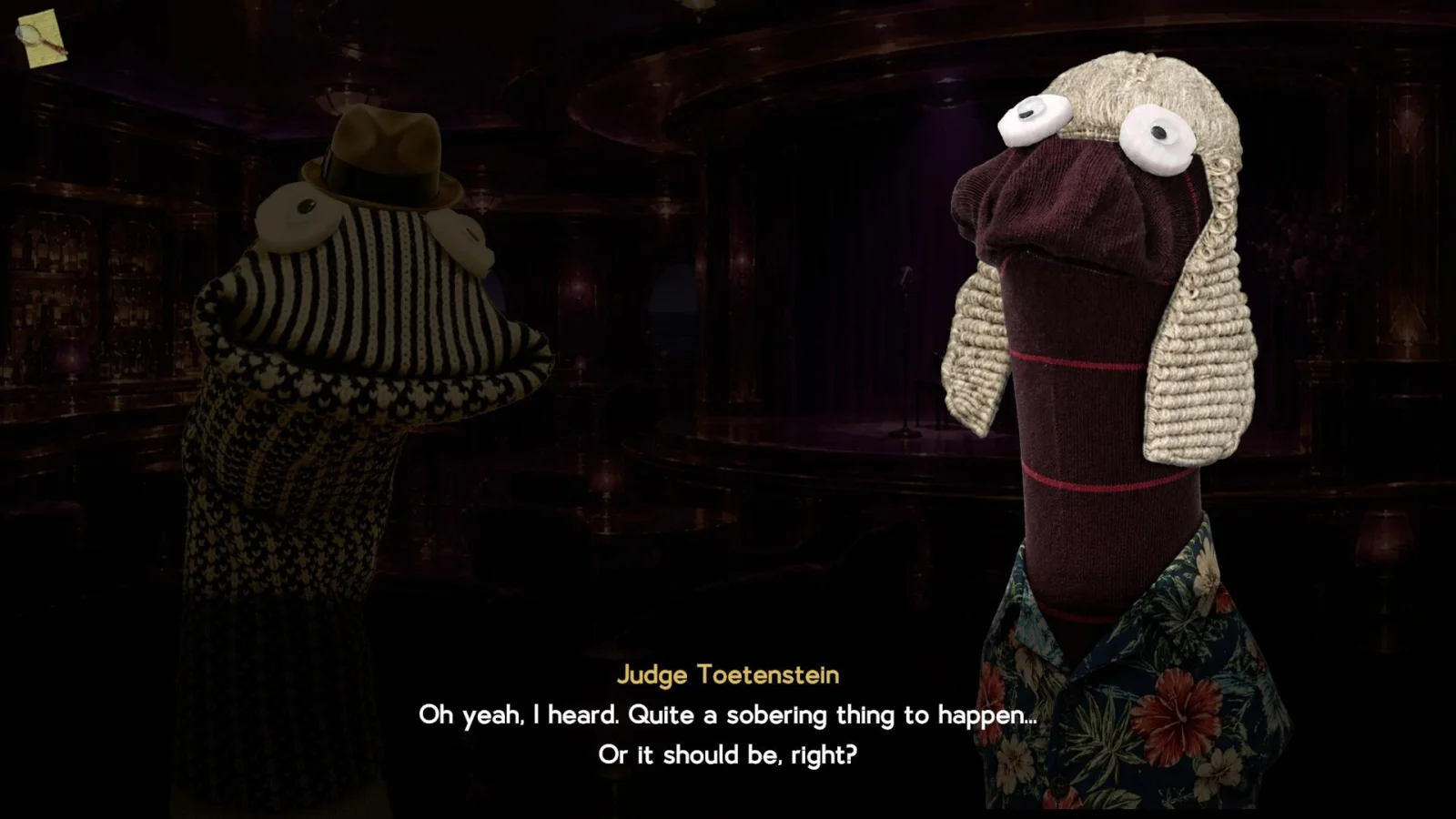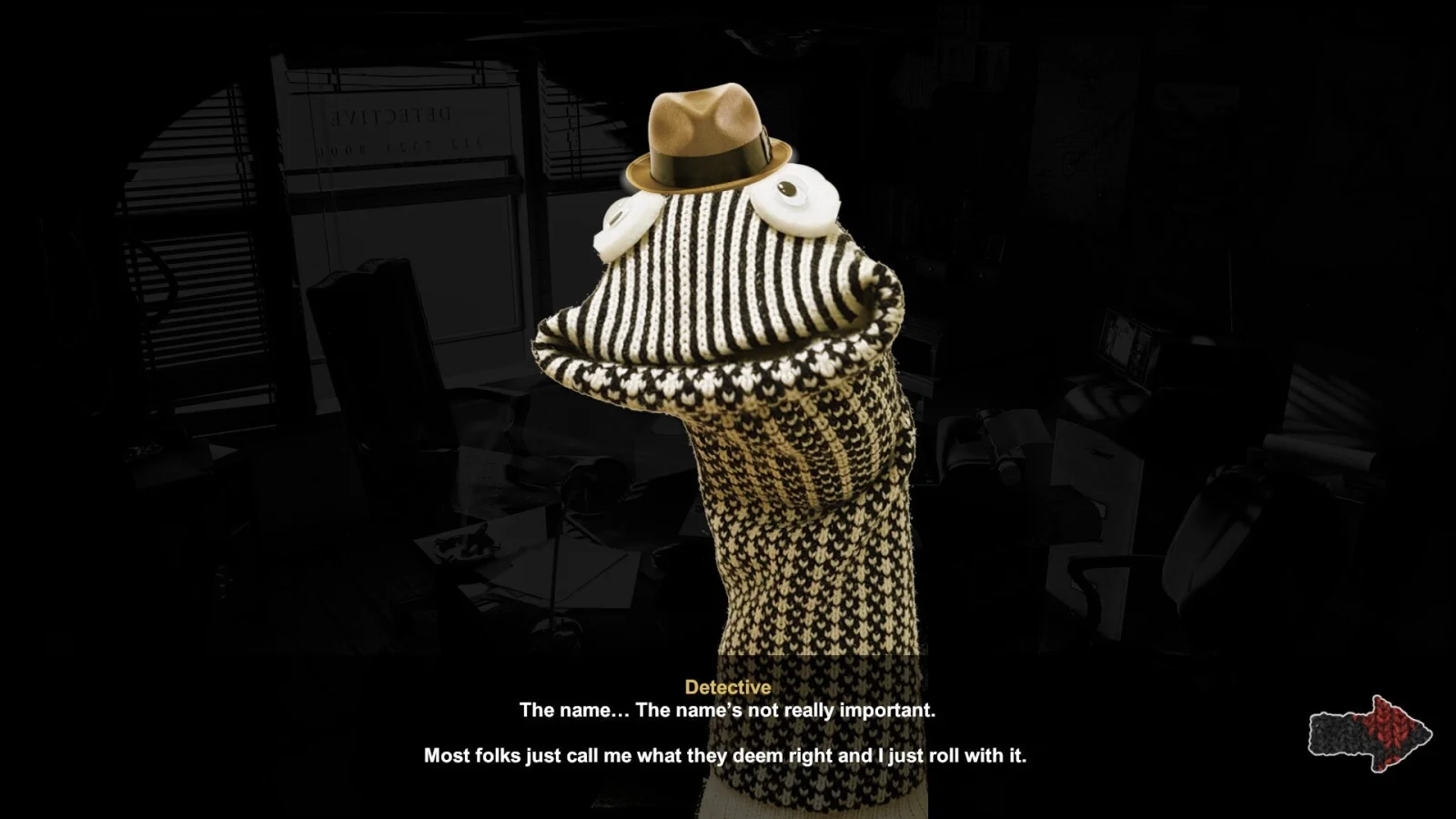
Sockpuppet Noir is an upcoming single-player detective adventure for Windows PC from LizardFactory, planned for release on September 25, 2026. That date is a plan rather than a guarantee and could change before launch. The announced premise is unusually clear, however: players are set to investigate the corrupt city of New Drawer as private detective Frank Sockowski, in a noir-flavoured mystery presented with filmed physical socks rather than conventionally animated characters.
The available details outline an intended structure and a particularly distinctive presentation. Sockpuppet Noir is advertised as combining familiar detective-business verbs—questioning people, inspecting scenes, recording evidence, connecting information, and identifying a suspect—with an intentionally tactile visual joke. Its cast is made from real sock puppets filmed against green screen and inserted into the game. That is a specific production choice, not simply a setting populated by fictional sock characters, and it gives the project an identity before any individual case or puzzle has been revealed in depth.
The game originated as a Global Game Jam 2021 prototype and has since been expanded into the planned release. That background fits a concept built around an immediately readable collision of ideas: sock puppets, noir language, and murder investigations. The announced commercial version is expected to contain three separate murder cases with different characters and themes, alongside more than twenty fully voiced sock-puppet characters. How those cases play, how difficult their deductions prove, and whether their conclusions feel persuasive are all questions for the finished release. For now, the useful point is that the developer is presenting a multi-case detective adventure rather than a single isolated mystery.
A private eye in New Drawer
Frank Sockowski is the announced player character, a private detective operating in New Drawer, a city described as corrupt. The name establishes the project’s wordplay at once, but the detective framing provides more than a punchline. The activities described for Frank include interrogating characters, examining crime scenes with a magnifying glass, gathering gossip at a local bar, assembling clues, and ultimately arresting a suspect.
Those actions form the outline of a recognisable investigation loop. A player might find a detail at a crime scene, pursue its implications through conversation, hear a useful rumour at the bar, and return to their collected information with a stronger sense of who to question next. That is a conditional reading of the announced systems rather than confirmation of a fixed sequence. The descriptions do not establish how freely cases can be approached, how clues unlock leads, or whether every conversation is equally central to a solution. Still, the advertised actions are directed toward reasoning and information management rather than merely using a detective setting as decoration.
The three murder cases give that loop room to vary in principle. Different casts and themes could help distinguish one investigation from another, while recurring locations or procedures could give the overall game a stable rhythm. Yet no relationship between the cases has been announced. They could be connected, self-contained, or arranged in another way entirely. There is likewise no confirmed basis for judging their plots, emotional tone, length, puzzle complexity, or the degree to which players will be asked to make deductions for themselves.
A mystery game is often at its strongest when each activity has an intelligible role in a chain of reasoning. Crime-scene inspection can establish a fact. An interrogation can expose a contradiction, corroborate a statement, or add context to a name. Gossip can supply a lead that needs verification rather than immediate acceptance. A notebook can retain these pieces long enough for the player to compare them. Sockpuppet Noir’s announced tools point toward that kind of structure. Whether the final version makes those links understandable without turning them into automatic answers remains an important open question.
The advertised investigation loop
The magnifying glass is the most direct of the announced investigative tools. A dedicated close-examination action could make attention itself part of the detective fantasy, rather than leaving crime scenes as scenery around a dialogue-driven story. In a satisfying implementation, the important question is not only whether an object can be spotted, but what its discovery changes. It might raise an issue with an alibi, introduce a new person of interest, suggest a motive, or point toward another location or question.
The announcement confirms that players will examine crime scenes with a magnifying glass, but not the design of the evidence challenges around it. There is no established information about the kinds of objects players will inspect, whether observations require interpretation, or how discoveries are recorded and used. That absence does not diminish the relevance of the tool; it simply means its eventual importance will depend on execution. A magnifying glass can be a memorable expression of detective work if its use is connected to the wider case rather than treated as a routine search prompt.
Interrogation is equally central to the stated concept. With over twenty fully voiced sock-puppet characters advertised, conversations appear positioned as a significant part of the experience. A large cast could give a detective story scope for conflicting accounts, social connections, memorable suspects, and witnesses who return across a case. It also creates a practical need for players to keep track of who said what and why a particular statement matters.
The local bar is specifically described as a place to gather gossip. That detail distinguishes information gathering from formal questioning. Gossip may be incomplete, biased, self-serving, or simply mistaken, which makes it a potentially useful fit for a game about sorting evidence from implication. The final game could use the difference between a rumour and a verified fact to encourage careful interpretation. That possibility should not be mistaken for a confirmed deduction rule: the available description does not say how gossip feeds into clues or how its reliability is communicated. Even so, a designated social space for leads gives New Drawer an announced role beyond crime scenes and interviews.
The advertised endpoint of arresting a suspect gives each investigation a clear dramatic direction. It suggests that the game is built to move toward a conclusion instead of ending merely because every room has been visited. What it does not establish is how an arrest is chosen. Players may be asked to select a suspect, marshal evidence, complete deductions, or follow some other structure. It is not known whether an incorrect accusation is possible or what conditions lead to success. The arrest should therefore be understood as a promised culmination of the detective premise, not proof of a particular accusation system.
A notebook for facts and player theories
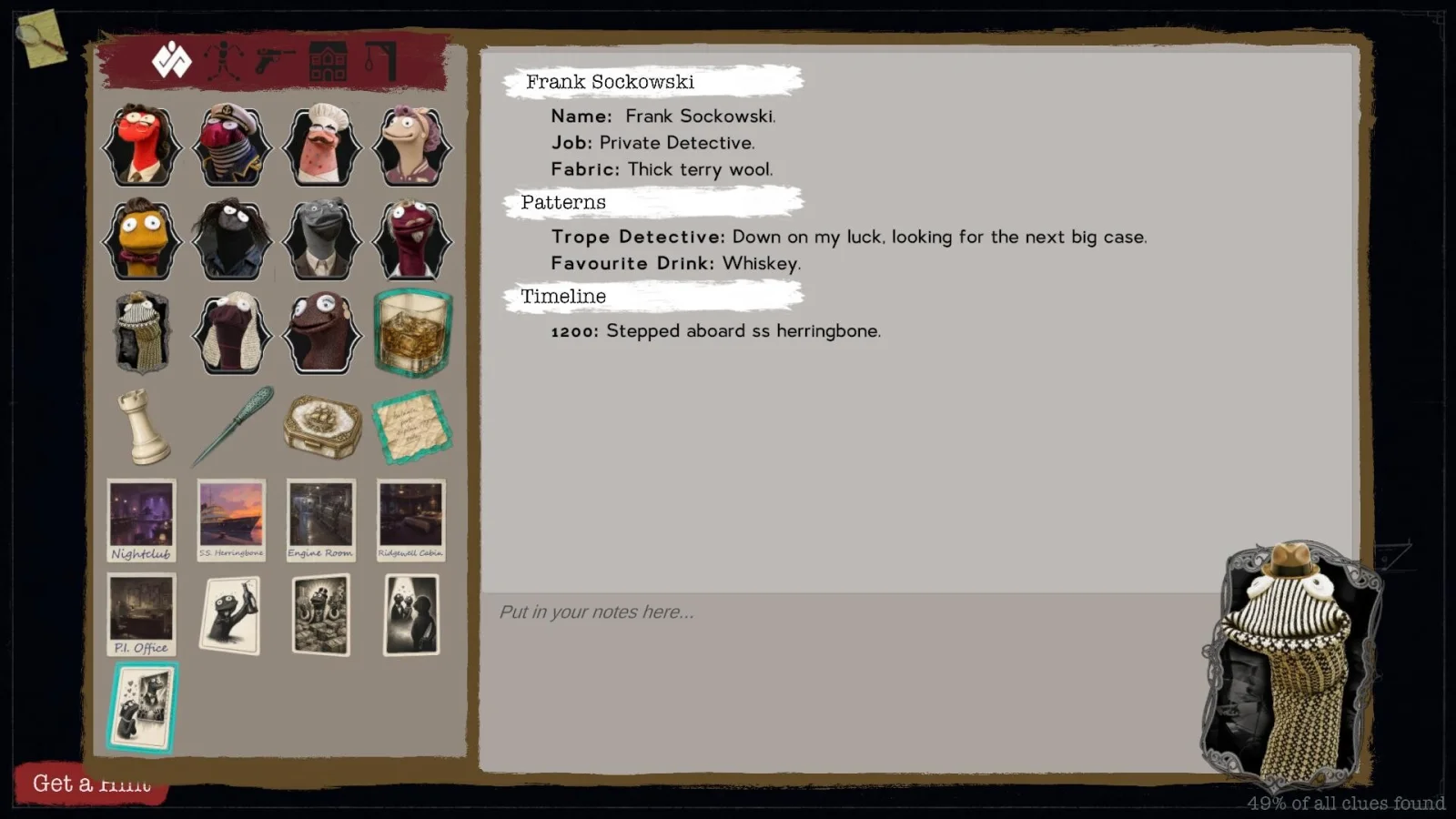
Sockpuppet Noir’s dynamic notebook is advertised to collect important facts while also allowing player notes. That pairing has practical appeal for an adventure centred on conversations, scene examination, and clues. Automatically retaining major information could reduce the chance that a player loses a necessary detail after a break between sessions. Personal notes, meanwhile, could give players a place for their own suspicions, timelines, names, and apparent contradictions.
That distinction matters because detective stories invite audiences to form theories before they know the answer. A game-provided record can preserve what has been established, while a player-authored note can separate a personal hunch from the facts that inspired it. Used well, the notebook could support reasoning without pretending to perform all of that reasoning on the player’s behalf. It could also make an intentionally comic presentation compatible with a more methodical process of following leads.
Its usefulness will depend on unannounced details. The final interface will need readable entries, intelligible organisation, and enough context for a note or fact to remain meaningful later in a case. Player notes depend on how convenient they are to enter and retrieve. Automatically added facts depend on their selection and wording. None of those qualities can be assessed from the announced feature list alone, but the notebook addresses a genuine pressure point for mystery adventures: the investigation is less satisfying if progress depends on recalling an old detail that has become difficult to locate.
The notebook may be particularly helpful alongside the planned three-case structure. If the cases introduce different characters and themes, a persistent record could help prevent the growing collection of information from becoming unwieldy. This does not confirm that the notebook sorts material by case, that all cases share continuity, or that characters recur. It only reflects the practical value of an advertised tool designed to retain facts and accept player observations in a game built around multiple investigations.
Physical socks and filmed performances
The presentation is Sockpuppet Noir’s clearest separation from a conventional detective adventure. The developer says its puppet cast consists of physical socks filmed against green screen and inserted into the game. The material object is therefore part of the intended on-screen result. This approach could give the game a deliberately handmade texture that suits its comic title while contrasting with the hard-boiled language of private detectives, corruption, and murder cases.
That contrast is potentially the project’s most promising creative tension. Noir commonly depends on atmosphere, visual emphasis, and the sense that characters or places are concealing something. A cast of physical socks can lean into absurdity without automatically preventing mystery or mood. The final balance will depend on composition, editing, performances, voice work, and the clarity of scenes during actual investigation. The announced production method does not establish whether the completed game will play as broad comedy, sincere mystery, or some mixture of both.
What it does establish is a visual identity that is difficult to confuse with a generic detective game. A handmade approach can make even small details feel distinctive if the game keeps characters, locations, and relevant evidence legible. Conversely, an investigation format places practical demands on every visual flourish: players need to understand what they are looking at, what can be inspected, and what information has significance. Sockpuppet Noir’s eventual success will partly rest on how well it reconciles that clarity with the intentional silliness of its central image.
An optional microphone feature
The optional microphone feature is another direct connection between the player and the puppet concept. LizardFactory advertises that speaking into a microphone will make the sock puppets move their mouths while the player speaks. The established advertised behaviour is responsive mouth movement. As the feature is optional, it is presented as an additional way to engage with the puppet framing rather than a stated requirement for everyone.
For players inclined to embrace the premise, this could be a charming invitation to become a temporary puppeteer. It shifts the joke beyond simply watching sock characters act: the player’s own speech can be reflected in their movement. Others may reasonably prefer conventional input, may not have a microphone available, or may simply want to focus on the case. Making the feature optional is meaningful in that context, because it leaves room for both approaches.
The practical quality of the feature remains for the released game to demonstrate. The announcement does not define its responsiveness, whether it has a function beyond visual novelty, or how it relates to conversations and the wider investigation. Its appeal may be primarily personal rather than mechanical. That is not necessarily a weakness. A feature can be worthwhile as an optional bit of performance play when it fits a game’s identity as closely as this one appears to fit Sockpuppet Noir.
Planned PC release and the questions ahead
The planned Windows PC version is listed with English interface, audio, and subtitles, as well as achievements and cloud saves. Those are the currently advertised release details, alongside the September 25, 2026 planned date. They describe the intended PC configuration, but the most consequential qualities of a detective adventure still await the completed game: clue logic, puzzle design, interface clarity, writing, voice performances, pacing, and the relationship between the three cases.
For readers looking for adjacent adventure-game coverage, see our point-and-click anthology assessment. This is not a direct comparison; it is simply a relevant route to another assessment of an adventure-oriented game.
As announced, Sockpuppet Noir has a coherent and memorable identity: Frank Sockowski investigating New Drawer, three planned murder cases, a filmed sock-puppet cast, and an evidence-oriented collection of activities built around observation and conversation. The notebook and microphone option stand out because they address different sides of that identity. One could help players manage investigative information, while the other could invite them to participate in the puppet joke.
If the final release makes its clues readable, its cases purposeful, and its handmade presentation compatible with actual detective work, it could offer an offbeat PC mystery with a genuinely recognisable voice. Until then, Sockpuppet Noir is best considered an upcoming game with an unusually specific advertised design and several crucial questions that only the finished investigations can answer.