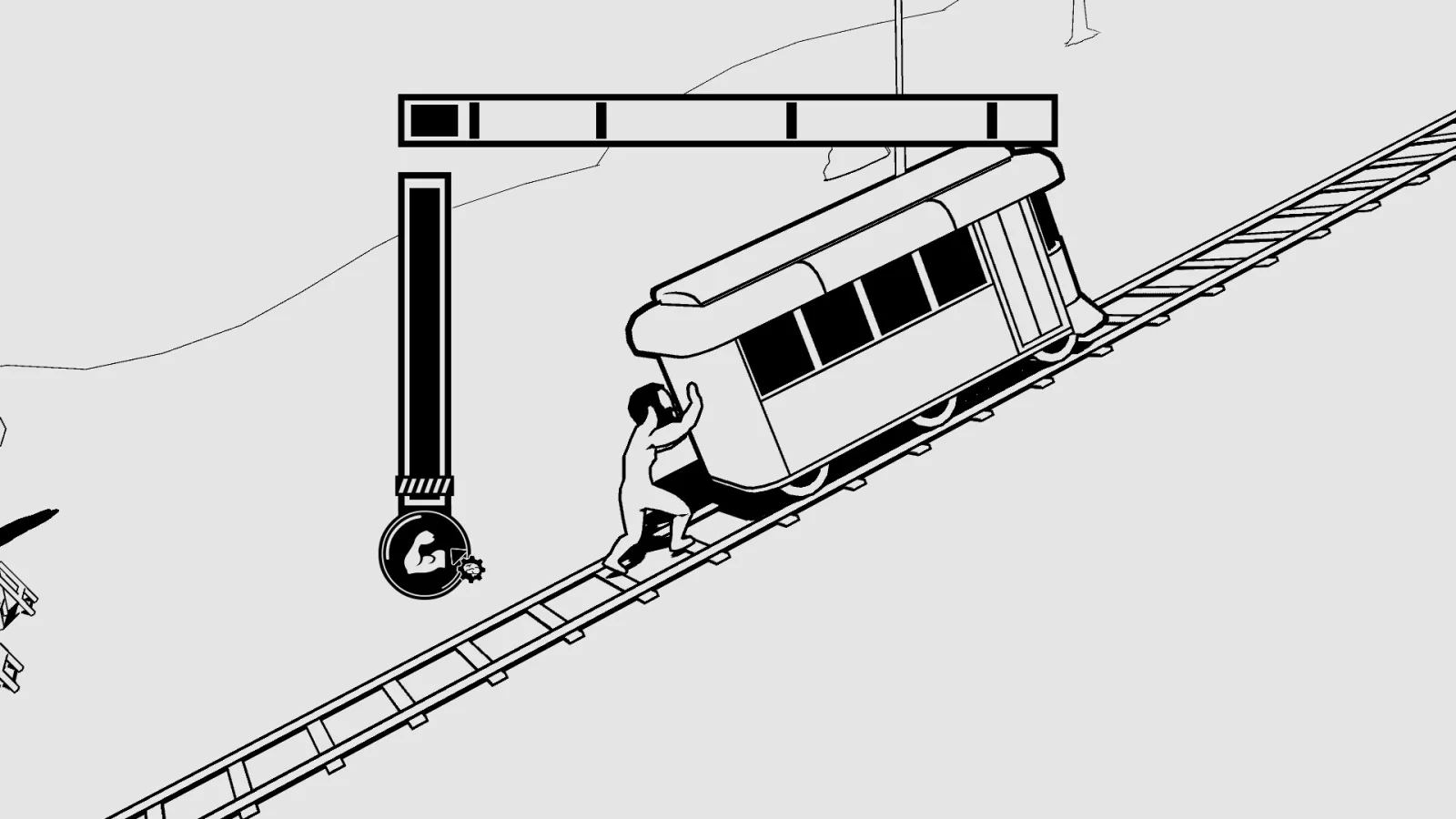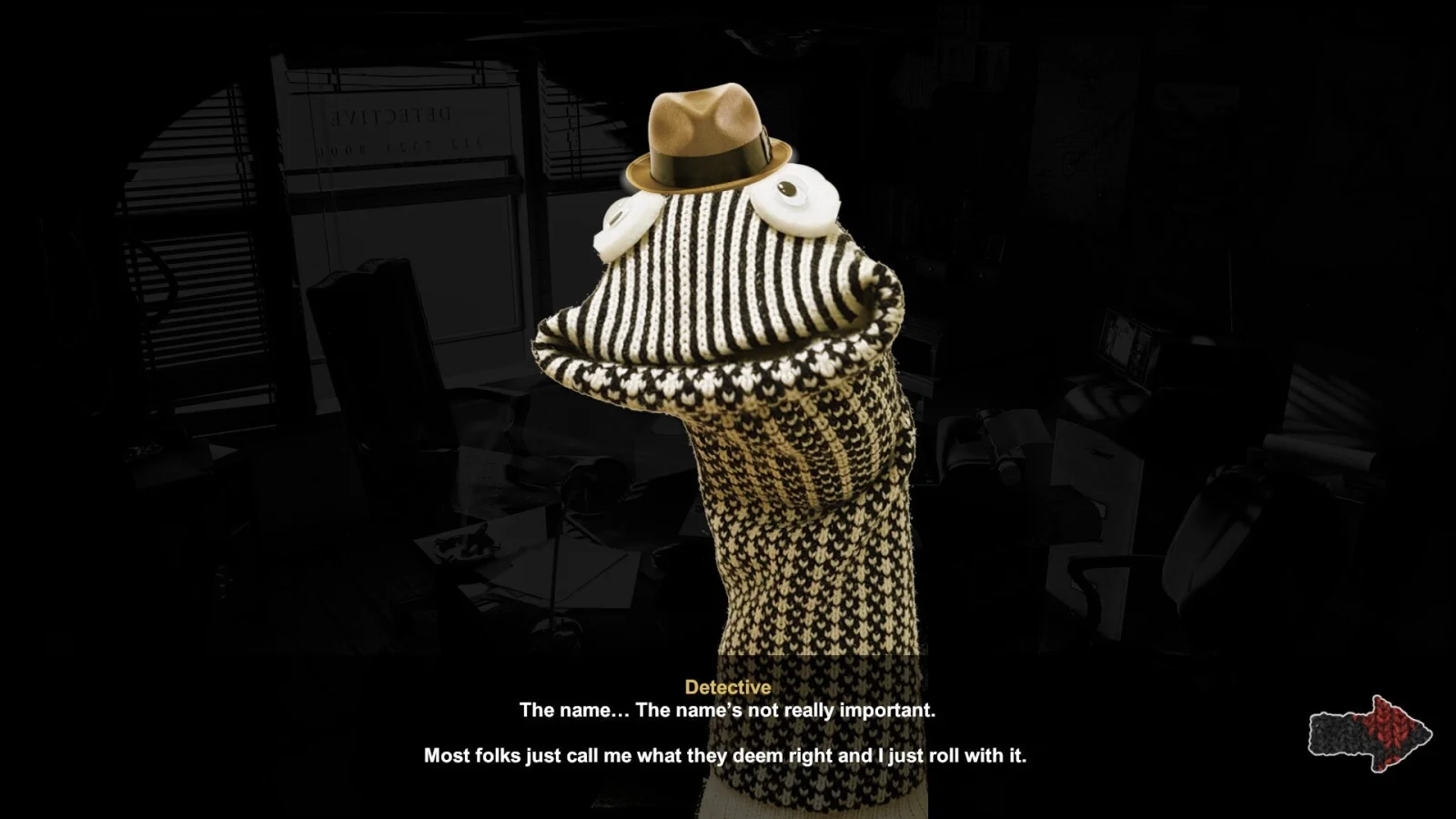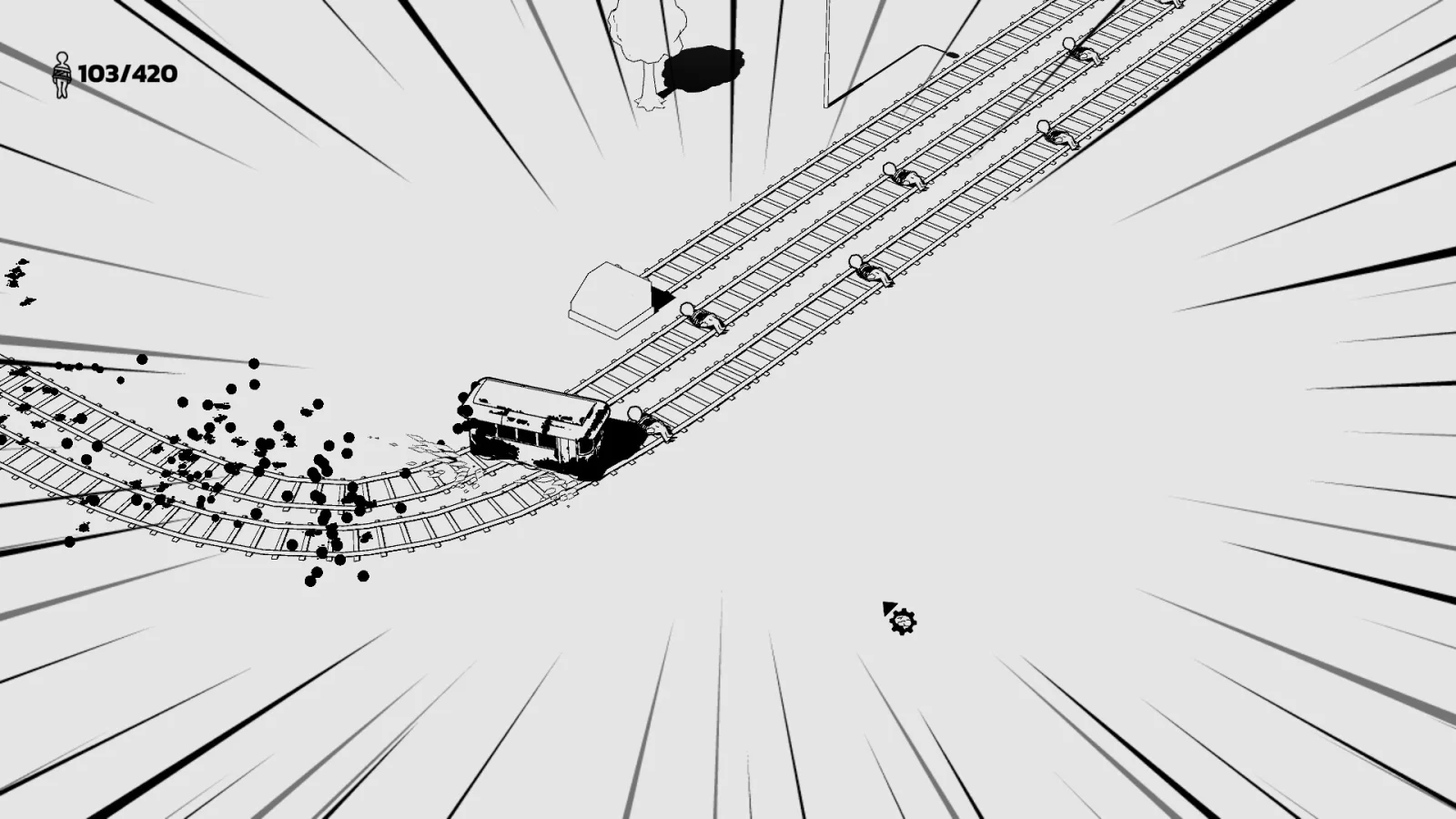
The Trolley Solution is a released Windows PC game from developer byDanDans and publisher The Bueno Interactive, launched on September 12, 2025. Its official Steam description presents a focused, unusual premise: a single-player compilation of point-and-click minigames inspired by Philippa Foot’s trolley-problem thought experiment. The advertised structure is concrete. Players are promised the original dilemma, 20 additional variations, and 20 corresponding minigames.
That framing matters because the trolley problem arrives with a great deal of cultural baggage despite its compact setup. In its best-known form, the thought experiment asks whether someone should intervene to redirect a runaway trolley, trading one outcome for another. It is memorable because it turns moral reasoning into an immediate, uncomfortable decision with limited information and no clean result. The Trolley Solution does not present itself as a lecture, textbook, or extended philosophical simulation. The developer instead describes humorous interpretations and explicitly jokes that playing may not teach useful philosophy. The supported expectation, then, is an absurd comic anthology that borrows ethical pressure as a prompt for interactive jokes.
A familiar dilemma is a useful comic engine
The trolley problem is especially adaptable because the audience already recognizes the basic shape of the question. There is a threat, an intervention, and an impossible calculation. Once players understand that template, variations can alter assumptions, escalate the framing, or take the setup in a deliberately strange direction without requiring a long dramatic introduction. Comedy can emerge from the collision between a famously grave discussion topic and a game willing to treat its premise as a springboard for playful interaction.
That does not mean every comic use of a moral thought experiment automatically becomes insightful, nor does the official description promise a rigorous treatment of ethical theory. It does suggest a clearer and more modest appeal. The game can use recognition as shorthand: a player understands the reference point, then sees what happens when the familiar problem is transformed into a new prompt. For an audience that enjoys dark humor, surreal premises, or the idea of philosophy-adjacent jokes, that setup is more immediately legible than a conventional puzzle game’s abstract rules.
The format also makes room for contrast. A single extended dilemma usually relies on sustained context and increasingly detailed consequences. An anthology of minigames can instead make each variation its own compact proposition. The value of the structure, in principle, is not that it can settle the trolley problem. It is that it can repeatedly reframe a recognizable question and invite a new kind of response. The official count of 20 variations establishes breadth of premise, while the matching count of 20 minigames indicates that these are intended as interactive scenarios rather than a merely written list of jokes.
What the point-and-click anthology format supports
Steam describes The Trolley Solution as a compilation of point-and-click minigames. That is a meaningful genre label, even if it does not define the details of every activity. Point-and-click interaction generally places emphasis on selecting, inspecting, and applying actions through an interface rather than on demanding reflex execution. Within this game’s stated premise, that approach can suit the material: it turns a hypothetical question into something the player must actively address, rather than simply read.
More importantly, an anthology differs conceptually from a sustained ethics simulation. A sustained simulation would ordinarily invite expectations of a continuing world, accumulating consequences, persistent relationships, or a systematic model of moral choices. None of those features are established by the store description here. The Trolley Solution’s advertised identity is instead built around individual variations and corresponding minigames. Its likely unit of interest is the scenario: what this version of the dilemma asks, how its interaction expresses that question, and where the joke lands.
That distinction helps set appropriate expectations. Prospective players should not approach the official description expecting a comprehensive course in consequentialism, a branching moral epic, or proof that every choice is meant to carry long-term narrative weight. They can reasonably expect a single-player collection whose defining thread is a famous ethical setup repeatedly redirected into comic point-and-click form. The difference is substantial. One model asks the player to inhabit a moral system over time; the other uses moral language and moral discomfort as a common theme for discrete interactive pieces.
The anthology model can be a strength for players who prefer variety over a single elaborate ruleset. Each advertised variation has the potential to reset the premise and preserve the feeling that the next idea may depart from the last. Conversely, players looking primarily for one deep mechanical loop should note that the official pitch foregrounds a collection of minigames, not a unified simulation. This is not a judgment on the quality of either approach. It is a practical reading of what the store page chooses to emphasize.
Humor, discomfort, and audience fit
The central audience question is less about familiarity with philosophy than comfort with the tonal premise. The trolley problem concerns harm, responsibility, and forced choice. Turning that material into humorous interpretations creates an intentionally awkward contrast. Some players may be drawn to the irreverence precisely because it exposes how strange the standard setup becomes when treated literally or pushed into unusual territory. Others may find the topic too bleak, too blunt, or simply too associated with classroom debate to enjoy as comic material.
The developer’s joke about not learning useful philosophy is useful expectation-setting. It signals that the game does not position itself as an authority on the traditions surrounding Foot’s thought experiment. The appeal is better understood as philosophical pop culture made interactive: the trolley problem is the shared reference, while the minigames are the delivery system for variations on that reference. A player does not need to agree with any particular ethical framework to understand why the dilemma has become such a durable cultural shorthand.
This also gives The Trolley Solution a specific kind of accessibility. The original question is simple enough to recognize quickly, and the premise does not require players to arrive with specialist vocabulary. Yet simplicity should not be confused with seriousness of purpose. The game’s own pitch points toward jokes and reinterpretations, so its philosophical material functions as a foundation for tone and situation rather than as a promise of academic depth.
PC and Steam context
The game is available on Windows PC through Steam and is listed as single-player. Steam also lists 13 achievements, trading cards, cloud saves, and leaderboards. These are useful pieces of platform context, although they should be read for what they establish. Achievements provide listed goals on the service, cloud saves support retaining compatible save data through Steam, trading cards are Steam collectibles, and leaderboards provide a listed comparative feature. Their presence does not, by itself, define the shape of the minigames or establish how any specific scenario is structured.
Language support is broader than an English-only release. Steam lists English plus 11 additional languages for interface and subtitles. That is a significant practical consideration for a game whose premise depends on recognizing scenario changes and jokes; players can check the current store listing for the exact language presentation that matters to them.
The game has also received post-launch updates, but the supplied information does not establish precisely how those updates affect the current set of minigames. For buyers, the most reliable snapshot remains the present Steam page: it identifies the platform features, listed language support, and the game’s core advertised counts. Store pages can change, particularly around supported features and updates, so those details are best confirmed at purchase time.
What the official pitch promises—and what it does not
The strongest reason to consider The Trolley Solution is the clarity of its hook. It has a recognizable source dilemma, an announced total of 20 variations beyond the original, and 20 corresponding point-and-click minigames. That is a precise proposition for anyone who wants a compactly framed game centered on absurd ethical hypotheticals.
At the same time, the pitch should be taken on its own terms. It supports expectations of a humorous single-player anthology, not assumptions about a continuous plot, elaborate moral simulation, or a definitive philosophical argument. The potential charm lies in seeing how many directions a famously narrow question can be pushed while retaining enough of its original shape to stay recognizable.
For a broader look at a different PC assessment, see WARSHIFT 2 PC Assessment: An Ambitious RTS-Action Hybrid That Depends on Clarity.
The Trolley Solution is therefore best approached as a deliberately offbeat concept game. Its store description makes a straightforward promise: interactive trolley-problem variations, presented as point-and-click minigames and treated with humor. Players interested in that exact collision of ethical shorthand, absurdity, and bite-sized interaction have a clear basis for deciding whether the premise is for them.