Echo Weaver takes a familiar exploration-game framework and gives it a clever, demanding twist: progress is not mainly about receiving powers, but about realizing which powers and routes were available from the beginning. That distinction sounds small on paper. In play, it makes the game’s best revelations feel less like loot drops and more like intellectual breakthroughs.
You control the titular Weaver through a large, continuous map in a mysterious setting. Exploration gradually fills out that map, while a recurring calamity sends the player back to the beginning every few minutes. The loop is not a total erasure. Map progress remains, as does the player’s understanding of the world, its shortcuts, its puzzles, and the character’s potential. Echo Weaver’s central wager is that knowledge can be a more satisfying form of advancement than a permanently expanded inventory. Much of the time, it wins that bet.
Knowledge Is the Real Upgrade Tree
The Weaver carries a boomerang-like glaive, used primarily for puzzle-solving and, less often, to attack enemies. Combat is not presented as the main attraction, since enemies are relatively scarce. Instead, the glaive becomes part of a wider language of discovery. The game’s key abilities are not necessarily handed over as conventional unlocks. Players can learn that actions they could perform all along are possible, then work out the procedures that make those actions useful.
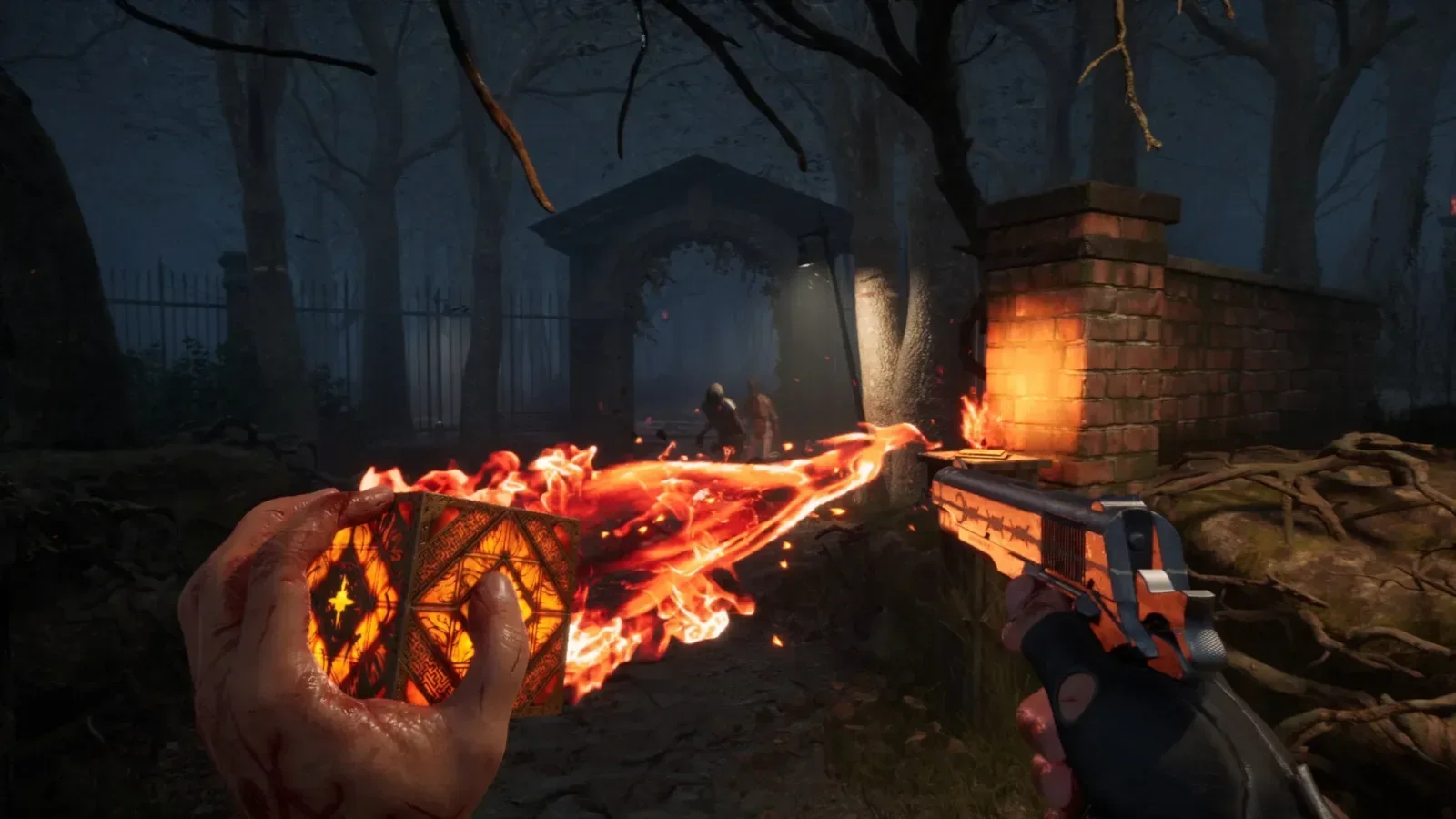
One stated example is setting the glaive on fire: this is available from the outset, but understanding how to do it comes later. That approach reframes a standard progression beat. Rather than saying, “the game has granted permission to proceed,” Echo Weaver asks the player to recognize that the permission was already there, hidden behind incomplete understanding.
This is where the game earns its strongest sense of satisfaction. Learning a new interaction does not merely open a gate; it alters how earlier spaces are read. A blocked path may become a clue. A previously meaningless feature may turn into part of a route. Shortcuts can reveal themselves not because the world has changed, but because the player has learned how to see them. That makes the map feel like a constructed puzzle box rather than a checklist of locked doors.
The result should appeal particularly to players who enjoy connecting observations across a world, retaining information between attempts, and testing a hunch without being constantly directed. For a similarly puzzle-centered perspective on a world built around spatial mysteries, see Quern - Undying Thoughts PC Design Feature: A Closed-Portal Island Puzzle Mystery.
A Loop That Can Feel Like Momentum or a Wall
The time loop gives Echo Weaver both its identity and its most persistent friction. When the player is piecing together a puzzle, recognizing a shortcut, or reaching an area with enough time left to investigate, the loop creates urgency without making failure feel wholly punitive. Keeping map progress and learned information matters enormously here. A reset may end a particular excursion, but it does not wipe out the larger project of understanding the game.
That design also produces a compelling alignment between character and player. The Weaver’s knowledge broadly tracks what the person holding the controller knows. There is an elegant thematic fit in discovering an ability, route, or solution and then carrying that awareness into the next cycle. The game treats memory as a resource, and it invites players to become more efficient not through stronger statistics but through clearer thinking.
However, a knowledge-driven structure can be generous only as long as the next insight feels attainable. Echo Weaver sometimes leaves players without the puzzle solution they need, making the loop feel less like a productive cadence and more like a timer running down while they search for a missing premise. Aimless wandering is an understandable risk in a game that trusts the player so heavily, but that trust does not always translate into useful direction.
The option to manually reset is sensible within the broader design. If little time remains, beginning a fresh loop can be more practical than waiting for the calamity. Yet it can also feel emotionally awkward. Choosing to reset in the middle of an investigation may resemble surrendering just when curiosity is at its highest. The mechanic is functional, but it does not always soften the disappointment of being forced to abandon an almost-solved thought.
Exploration Thrives; Precision Platforming Does Not
Echo Weaver’s most significant weakness is its jumping. Basic leaps serve general exploration well enough, but the game asks more from movement during demanding platforming sequences. Thickets of thorns and long pits can drain health and, crucially, precious time. In those sections, jumping reportedly lacks the precision or feel required to make repeated attempts consistently satisfying.
This is not a minor issue because the time loop magnifies every platforming error. Missing a difficult jump can cost health, derail the route, and consume the minutes needed to reach a checkpoint. The low point is reaching the end of a complicated gauntlet only for the loop to close before that checkpoint is secured. The game is built around trying again with better knowledge, but mechanical frustration is different from the productive frustration of an unsolved puzzle. One inspires another theory; the other can simply make a repeat attempt feel unfair.
Players who enjoy strict platforming challenges may still find value in mastering these stretches, but they should know the movement is described as solid for broad traversal rather than especially satisfying under high-precision pressure. Those who mainly want exploration and problem-solving will likely find the platforming’s most punishing moments a regrettable interruption to the game’s better ideas.
Ambition With Some Technical Fraying
There are also reported bugs involving areas failing to load properly after fast travel. These issues are described as distracting rather than as a complete breakdown of the experience, but they matter in a game where route planning and timing are already central. Fast travel ought to support efficient experimentation. If a destination does not load correctly, it adds an avoidable layer of uncertainty to an experience already designed around uncertainty of a more rewarding kind.
Still, Echo Weaver’s ambition is clear. It takes a recognizable exploration structure and reorients its rewards around player comprehension. The game does not appear interested in making every step comfortable or obvious; it wants the player to study its systems and eventually see its world differently. That philosophy produces real highs when a previously opaque action clicks into place.
Who Should Enter the Loop?
Echo Weaver is best suited to patient, curious players who can tolerate detours, failed theories, and a degree of self-directed exploration. Its most attractive promise is not combat escalation but the feeling of becoming fluent in a world that initially seems unreadable. Players who value sequence knowledge and route optimization may also be drawn to the idea of revisiting the game with an understanding of abilities and shortcuts from the start.
It is a less natural recommendation for players who want frequent explicit rewards, smooth precision platforming, or reliable forward momentum every session. The loop can turn an interrupted run into a useful lesson, but it can also interrupt an exciting line of inquiry. Likewise, the game’s platforming demands occasionally expose movement that does not seem built for the harshest obstacles.
Even with those caveats, Echo Weaver’s design is distinctive because it makes discovery feel earned in a deeply personal way. The important revelations are not merely stored on a character sheet. They are stored in the player’s own understanding. When that understanding finally turns confusion into a route forward, the game delivers the rare pleasure of making its audience feel genuinely clever.