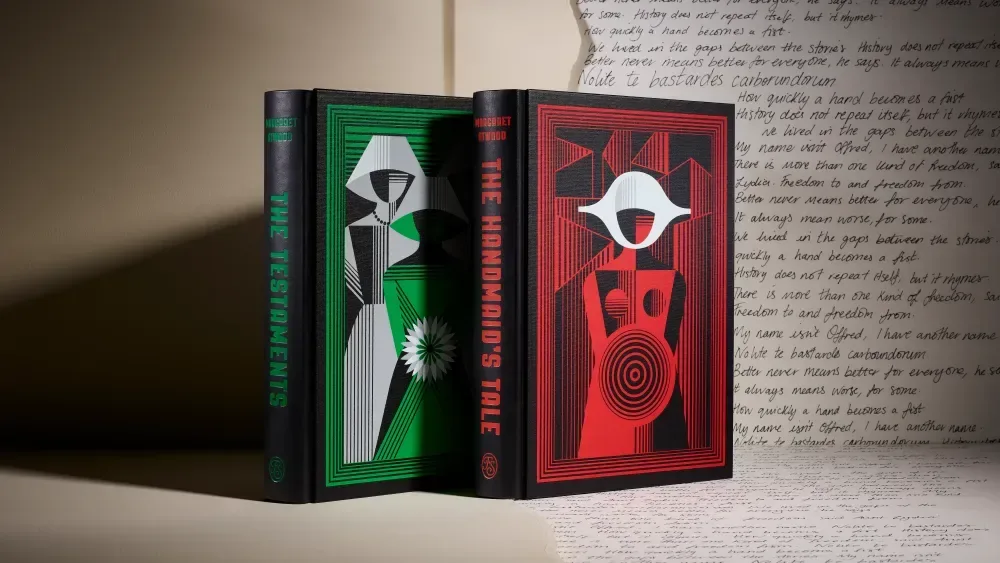
Margaret Atwood’s Gilead novels are returning in a new limited-edition format built for readers who regard a book as both a text and a physical art object. The Folio Society will release a boxed pairing of The Handmaid’s Tale and The Testaments on November 3, limited to 750 copies and priced at $760.
The set brings together Atwood’s 1985 dystopian novel and its 2019 sequel in a clamshell presentation box designed by Italian illustrators Anna and Elena Balbusso, known collectively as the Balbusso Twins. Each copy will be signed by the artists. Atwood has supplied a new introduction, while novelist Naomi Alderman has written a new foreword.
That combination matters because this is not simply two familiar novels given matching jackets. The stated focus is on an illustrated interpretation of Gilead’s imagery, political presentation and historical atmosphere, with the books positioned as a coordinated collectible edition rather than individual reading copies.
What the $760 edition includes
The core proposition is straightforward: two novels, a bespoke box and a small print run. But the details help explain why this edition belongs in the premium-book-collecting lane.
- Edition size: 750 copies.
- Signature: every copy is signed by Anna and Elena Balbusso.
- Contents: The Handmaid’s Tale and The Testaments.
- New written material: an introduction by Margaret Atwood and a foreword by Naomi Alderman.
- Artwork: newly created illustrations by the Balbusso Twins.
- Production: printing by Grafiche Veneziane in Venice, followed by leather binding from Italian bookbinder Graphicom.
- Presentation: a clamshell box designed by the Balbusso Twins.
- Release: November 3, exclusively from the Folio Society.
In book-collecting terms, a clamshell box is a protective presentation case that opens on a hinge, rather than a simple slipcase that a book slides into. It gives a two-volume collection a more intentional display and storage format while helping shield the books from light, dust and shelf wear. That is particularly fitting for an edition whose two novels are meant to be considered together.
The word limited should also be read precisely here. It establishes a fixed production quantity of 750 sets; it does not automatically establish future resale value. Rarity can be important to collectors, but demand, condition, completeness and the long-term audience for an author’s work all remain separate questions.
Why the illustration choice is central to this release
The Balbusso Twins previously illustrated a Folio edition of The Handmaid’s Tale in 2012. Their return now extends their visual treatment to The Testaments, turning the project into a fuller engagement with Atwood’s Gilead novels rather than a one-book revisit.
Their process combines traditional media—pencil, watercolor, gouache and tempera—with digital techniques. Gouache is an opaque water-based paint, while tempera is a paint medium associated with a matte, layered finish. Those material choices can produce a very different visual character from a purely digital illustration workflow: hand-drawn marks, painted surfaces and controlled opacity can sit beside digital refinement.
Related coverage includes Margaret Atwood’s Gilead Novels Get a 750-Copy Signed Folio Box Set.
The artists have described their approach as a “surrealist nightmare,” an apt framing for a fictional state in which power is performed through symbols, uniforms, ritual and controlled language. The release does not claim to remake the novels as graphic narratives. Instead, it gives their atmosphere a new visual frame—one that can influence how readers encounter scenes, motifs and the culture of Gilead before and between passages.
Atwood’s new introduction addresses Gilead’s visual language and its historical influences. She notes that the artwork recalls the color palette and mood of the 1930s and 1940s, a period she connects to the rise of major dictatorships. That connection is important background for the illustration program: the imagery is not decorative in a vacuum. It is designed to engage with the novels’ interest in propaganda, slogans, presentation and the way authoritarian systems make ideology visible.
“Those who lack power always see more than they say,” Atwood writes of the visual dimension of The Handmaid’s Tale.
That observation offers a useful lens for the edition. In Gilead, looking, being watched and learning to interpret outward signs are inseparable from survival. An illustrated edition has the unusual challenge of adding images to a book already deeply concerned with who gets to see, define and control appearances.
The two books at the center of the set
The Handmaid’s Tale, first published in 1985, imagines the Republic of Gilead as a totalitarian society that strips women of fundamental rights and assigns people rigid social roles. It became one of Atwood’s best-known works and was later adapted as a Hulu series starring Elisabeth Moss.
The Testaments, published in 2019, returns to Gilead and won the Booker Prize. Putting the two novels in one purpose-built box gives the sequel a different context from a standard standalone purchase. The collection presents them as companion works in an expanding fictional world, while the new illustrations create a common visual vocabulary across both volumes.
Alderman’s foreword frames Gilead as more than a distant fictional construction, describing it as a force trying to push back into the world. That is a literary interpretation rather than a product feature, but it helps explain why Atwood’s novels continue to invite elaborate new editions decades after the first book’s publication.
A release date with added political resonance
The set arrives on November 3, the day of the 2026 U.S. midterm elections. All 435 House seats and roughly one-third of the Senate will be decided that day. The scheduling puts a high-end edition of novels about authoritarian power, gendered control and public ideology alongside a major electoral event.
It is worth separating the confirmed fact from interpretation. The release date coincides with Election Day; no additional motive for selecting that date has been established here. Even so, readers are likely to notice the parallel given the subject matter of the books and the edition’s emphasis on Gilead’s political visual language.
What collectors should weigh before buying
This release is clearly aimed at a narrower audience than a conventional paperback or ebook. Its $760 price, artist signatures, leather binding, bespoke case and 750-set cap put it in the category of a deluxe literary object. That makes it most relevant to readers who value the craftsmanship and interpretive artwork as much as access to the stories.
For prospective buyers, the practical questions are less about whether the novels are culturally significant—they are—and more about what this particular edition offers them:
- Are the illustrations the draw? The Balbusso Twins’ artwork is the defining differentiator from an ordinary two-book set.
- Does artist-signed matter to you? These copies are signed by the illustrators, not described as signed by Atwood. That distinction should be understood before purchase.
- Do you want both works as one collection? The case, coordinated design and new front matter make the set especially suited to readers who want the Gilead novels displayed and read together.
- Can you preserve a premium physical edition? Leather-bound volumes and a presentation box reward careful handling and storage. Completeness—including both books and the clamshell—is part of the object’s appeal.
- Are you purchasing for reading, display or collecting? There is no wrong answer, but being clear about the purpose can prevent a luxury edition from becoming an expensive substitute for a simpler reading copy.
The broader collecting appeal is in the meeting point of literary legacy, illustration, bookmaking and constrained supply. It is the same appeal that makes lavish editions of major genre and literary titles attractive as shelf pieces: the object adds a material interpretation to a story people may already know. For a related look at how physical artifacts and fandom shape each other, see our coverage of George Lucas’ museum and the films left behind after retirement.
The Folio Society has previously issued deluxe editions of books including George R.R. Martin’s A Game of Thrones, Madeline Miller’s The Song of Achilles and Alice Walker’s The Color Purple. This Gilead collection follows that same premium-edition approach, but its two-book structure and returning artists give it a particularly unified identity.
For fans of Atwood, illustrated-book collectors and readers interested in the visual machinery of Gilead, the key details are now simple: 750 artist-signed sets, $760, and a November 3 exclusive release through the Folio Society.