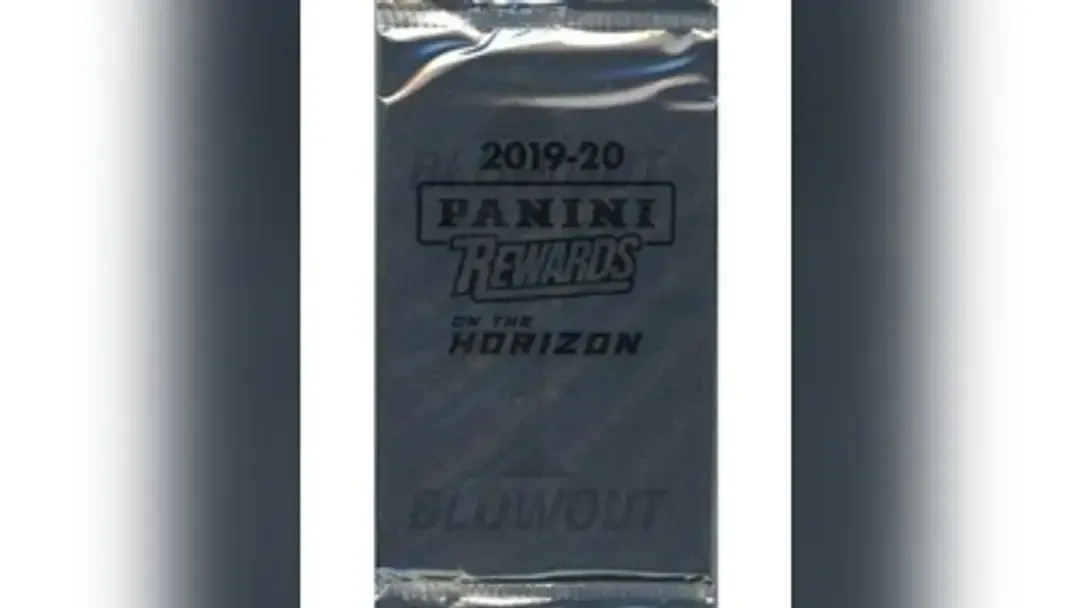
Some sports-card sets are built around the ritual of ripping a box. Panini On the Horizon took a very different route. The 2020 release was distributed through Panini Rewards rather than conventional hobby or retail channels: collectors redeemed 4,000 points for a two-card pack. There were no hobby boxes and no retail blasters to chase.
That distribution model matters because it makes On the Horizon a closed, 50-card multi-sport checklist with an unusually concentrated group of modern names. Patrick Mahomes, Tom Brady, LeBron James, Stephen Curry, Cristiano Ronaldo and Lionel Messi all appear, alongside a deep basketball contingent and selected baseball and hockey players. It is a set rooted in the 2019 and 2020 seasons, but its appeal is not simply a roll call of stars. The graded population figures point to an additional complication: high-grade examples have been difficult to produce.
Across the set, PSA has graded 2,687 cards, with 211 receiving PSA 10s. That total does not establish how many cards were printed or remain ungraded, so it should not be treated as a complete census of supply. It does, however, offer a useful view of the cards collectors have chosen to submit and the condition results those submissions achieved.
A rewards-only release, not a typical pack product
On the Horizon’s original route to collectors is central to its identity. A collector needed Panini Rewards points, then exchanged 4,000 of them for a two-card pack. That differs sharply from a normal release, where sealed boxes enter the market through stores and distributors and can be opened in large quantities over time.
For more context, explore Galaxy Watch 4 and Watch 4 Classic Miss One UI 9 Watch: What Support Ending Means.
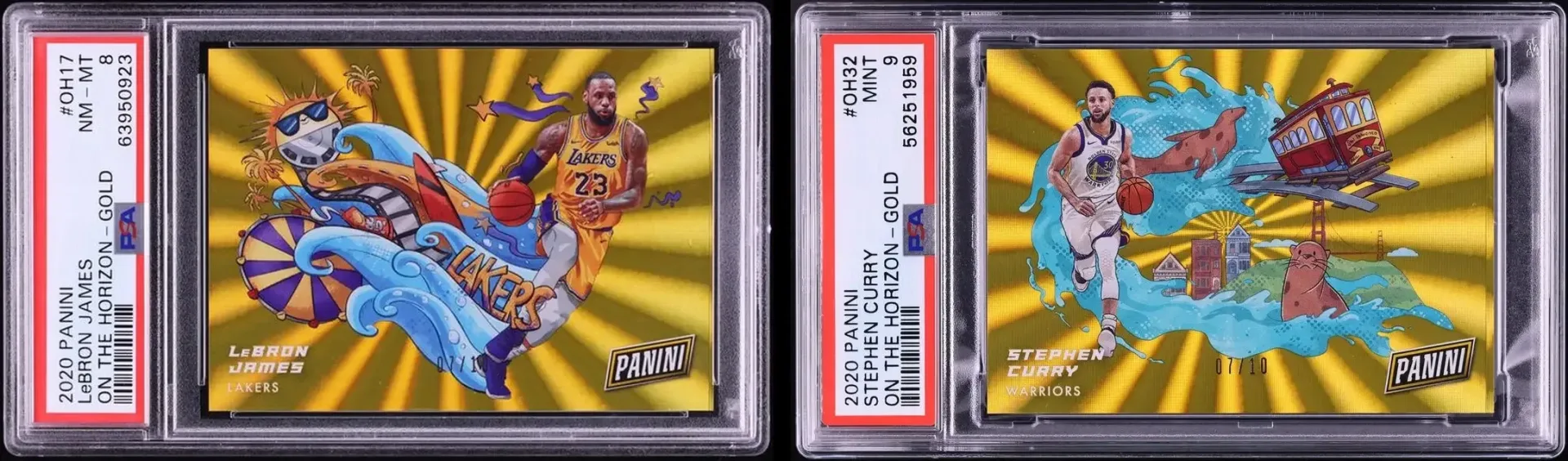
It also changes how collectors should think about scarcity. A rewards-only mechanism can limit the audience that initially obtains packs, but it does not by itself reveal the exact number of cards issued. The more concrete scarcity markers in this checklist are its parallels: every player has a Gold version numbered to 10 and a Green one-of-one.
In card terminology, a parallel is an alternate version of a card, usually differentiated by color, finish or another design treatment. A card marked /10 is serial-numbered to 10 copies, while a 1/1 denotes a single stated copy. Those print-numbered editions are not the same thing as the base card, and grade populations for one version should never be casually applied to another.
The checklist spans five sports. Football accounts for 15 cards; basketball is the largest section with 20. Soccer has three players: Christian Pulisic at OH-46, Cristiano Ronaldo at OH-47 and Lionel Messi at OH-48. Baseball and hockey round out the release, with the baseball and hockey content described as unlicensed. Notable baseball names include Mookie Betts, Mike Trout, Ronald Acuña Jr., Yordan Alvarez, Vladimir Guerrero Jr., Bryce Harper, Pete Alonso and Alex Bregman. Kaapo Kakko and Vitali Kravtsov represent hockey.
What PSA population data can, and cannot, tell collectors
A PSA population report counts cards graded by PSA, grouped by card and grade. It is valuable evidence, but it is not a master inventory. Cards may be raw, graded by another company, still sealed in packs, unsubmitted, or submitted more than once. The report therefore measures recorded grading activity and outcomes, not every surviving copy.
The distinction is particularly important for a rewards issue like On the Horizon. A low graded count can be consistent with scarcity, but it can also reflect a smaller submission pool. Conversely, a high count can indicate collector attention rather than a larger print run. Grade distributions are most useful when read as a condition signal: among the examples PSA saw, how frequently did gem-mint results appear?
In PSA’s scale, a PSA 10 is the top grade commonly called “gem mint,” while a PSA 9 is mint. Neither designation is a direct measure of a player’s importance, and neither makes a card automatically more desirable than every lower-graded example. But condition can be especially consequential for modern cards whose centering, corners, edges and surfaces are closely scrutinized.
The overall On the Horizon result—211 PSA 10s out of 2,687 PSA-graded cards—works out to roughly 7.9% of the graded population. That broad number should not be used to predict the odds for an individual player or parallel, because each card’s submitted sample is different. Still, it frames why collector attention has turned to the set’s condition profile rather than its star power alone.
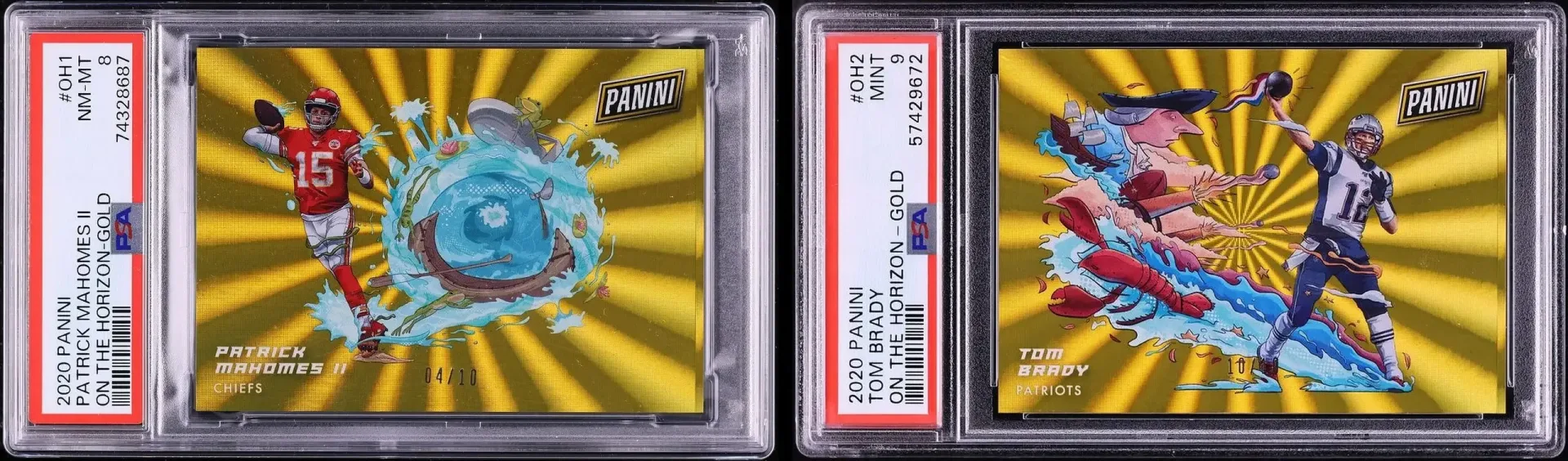
Mahomes and Brady: heavily examined gold cards, no PSA 10s
The first two card numbers belong to Mahomes and Brady, a notable start for the football portion of the checklist. Brady’s base card is the second-most-graded card in the entire set. The data become more striking in Gold.
For both Mahomes and Brady, nine of the ten numbered Gold copies have been graded by PSA, yet neither player has a PSA 10 recorded for that parallel. Brady’s Gold population includes three PSA 9s, while Mahomes has two PSA 9s. The known PSA outcomes for their Green one-of-ones are also below gem mint: Brady’s is a PSA 9 and Mahomes’ is a PSA 7.
That does not mean a PSA 10 Gold can never exist. It means none appears in the reported PSA population at this point, despite an exceptionally large share of each stated ten-card Gold run having been submitted. For collectors, that is a more meaningful observation than a generic claim that a /10 is rare: it combines the stated limitation with a nearly complete run of recorded PSA submissions.
LeBron’s exceptional Gold result and Curry’s low gem rate
Basketball supplies 20 of the 50 cards and includes Giannis Antetokounmpo, Luka Dončić, Zion Williamson, Ja Morant and Kevin Durant in addition to James and Curry. LeBron is OH-17, immediately after Giannis at OH-16.
LeBron’s base has been graded 86 times, producing 13 PSA 10s. The Gold parallel is the standout result. Four LeBron Gold /10 copies have been graded, and two are PSA 10s. He is the only player on the checklist reported to have two Gold /10 PSA 10s. His Green 1/1 has received a PSA 9.
That is a highly specific distinction. It does not mean LeBron’s Gold is easy to grade—half of a four-card sample is far too small to support such a conclusion. Instead, it identifies a rare pairing of a tightly numbered parallel and two gem-mint entries in the PSA report.
Curry, at OH-32, tells a different story. His base card has 92 PSA-graded copies: 53 PSA 9s and five PSA 10s. Five out of 92 is a 5.4% PSA 10 rate. Of six graded Curry Gold copies, five are PSA 9s and none is a PSA 10. The Curry Green 1/1 does not appear in the PSA population list, which is not proof that it has never surfaced; it only means there is no corresponding PSA population entry.
For collectors deciding between base and parallel cards, these figures reinforce a practical rule: evaluate each player and each version independently. Curry’s base, Gold and Green entries have different reported populations and cannot be collapsed into one “Curry rarity” figure.
Ronaldo and Messi lead a compact soccer section
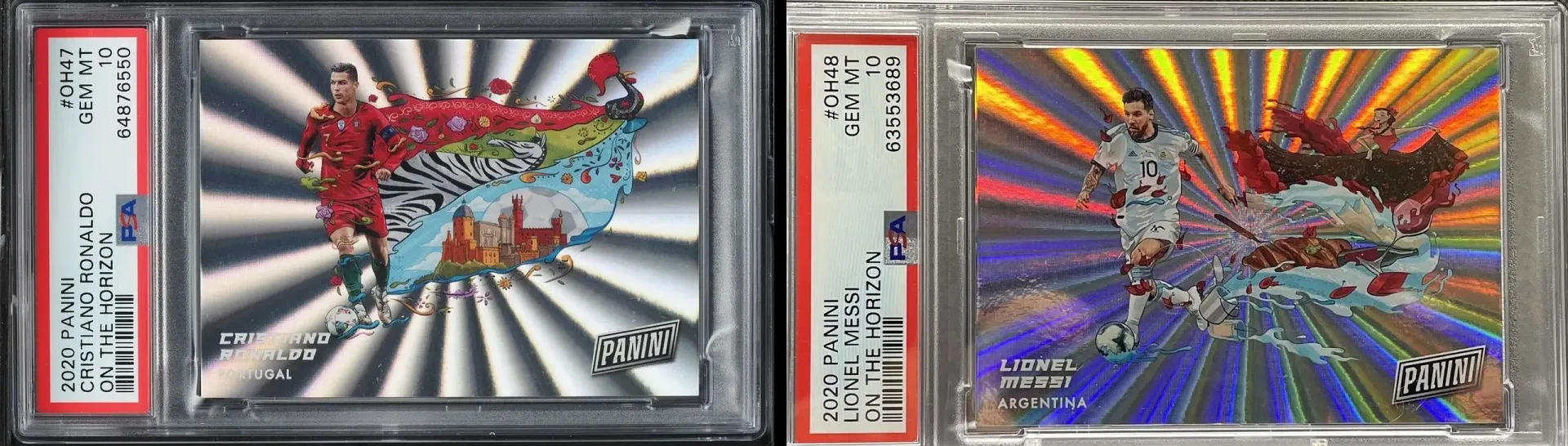
The soccer segment is only three cards deep, but it includes two of the most internationally collected athletes in the set. Messi’s base card is the most graded On the Horizon card, with 107 PSA examples. Seventy-one are PSA 9s and nine are PSA 10s.
Ronaldo’s base has 95 PSA-graded copies: 66 PSA 9s and 16 PSA 10s. Those 16 PSA 10s are the most reported for any base card in the checklist, ahead of LeBron’s 13. The contrast is instructive. Messi has the largest submitted base-card population, while Ronaldo has the highest PSA 10 count among base cards; those are different measures and answer different questions.
The Gold results are severe for both players. Across Ronaldo and Messi, 11 Gold /10 copies have been graded, all receiving PSA 9s. Ronaldo’s Green 1/1 is PSA 9, while Messi’s Green 1/1 is PSA 7.
Reported sales underscore how card version and condition need to be stated precisely. Recent raw base-card sales cited for Ronaldo, Messi, Brady, Mahomes and Curry were $851, $459, $1,675, $760 and $1,071, respectively. There was no recent raw LeBron sale cited, but a PSA 9 copy sold in September for $1,350. These are individual reported sales, not an appraisal or a guarantee of a current market level. A raw card and a graded card are not directly interchangeable, and the same player’s Gold or Green parallel is a separate market entirely.
The broader checklist and a sensible collecting approach
On the Horizon also captures the early career attention around players such as Morant and Dončić. Their grading counts exceed those of both Curry and Mahomes: Morant has 96 graded copies and Dončić has 94. That is a reminder that population counts often reflect collecting and submitting behavior as much as the hierarchy of athletes on a checklist.
For anyone pursuing this set, the most useful starting point is to define the target before shopping: a player collection, a sport-specific run, the 50-card base checklist, Gold parallels, or the Green one-of-ones. Those are radically different pursuits in availability and budget. A collector should also verify the card number, parallel name, serial numbering where applicable, and whether a stated grade is from the same card version being compared.
- Base card: the standard, non-parallel version of the player’s card.
- Gold /10: a Gold parallel limited to ten stated copies.
- Green 1/1: the single Green parallel for that player.
- Population: the number of examples recorded as graded by a particular company, not total production or total surviving supply.
- Gem rate: the share of graded submissions receiving the top gem-mint grade; it is a historical grading outcome, not a guarantee for any raw card.
On the Horizon’s strongest case is unusually clear: a small, rewards-only 50-card issue brought major names from five sports into one checklist, while its PSA results show that top grades are often elusive. The set’s long-term popularity remains uncertain, as every collectible market does, but the factual appeal is already easy to identify. Collectors are not only looking for stars. They are looking at the unusual route by which these cards entered the hobby, the numbered hierarchy around them, and the gap between merely finding a card and finding one that grades at the top.