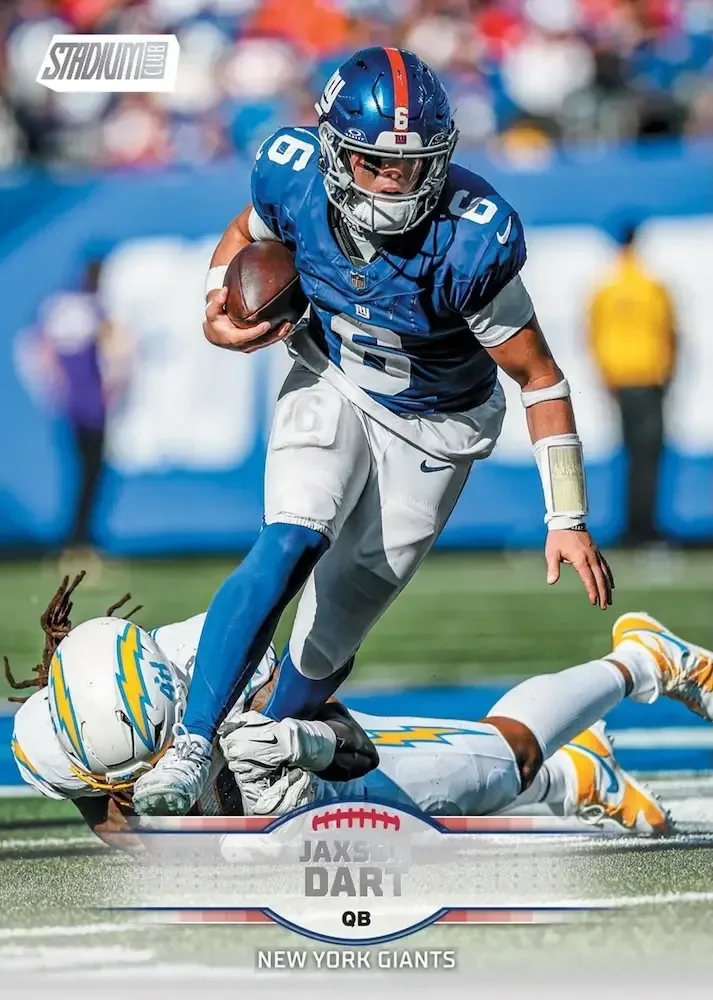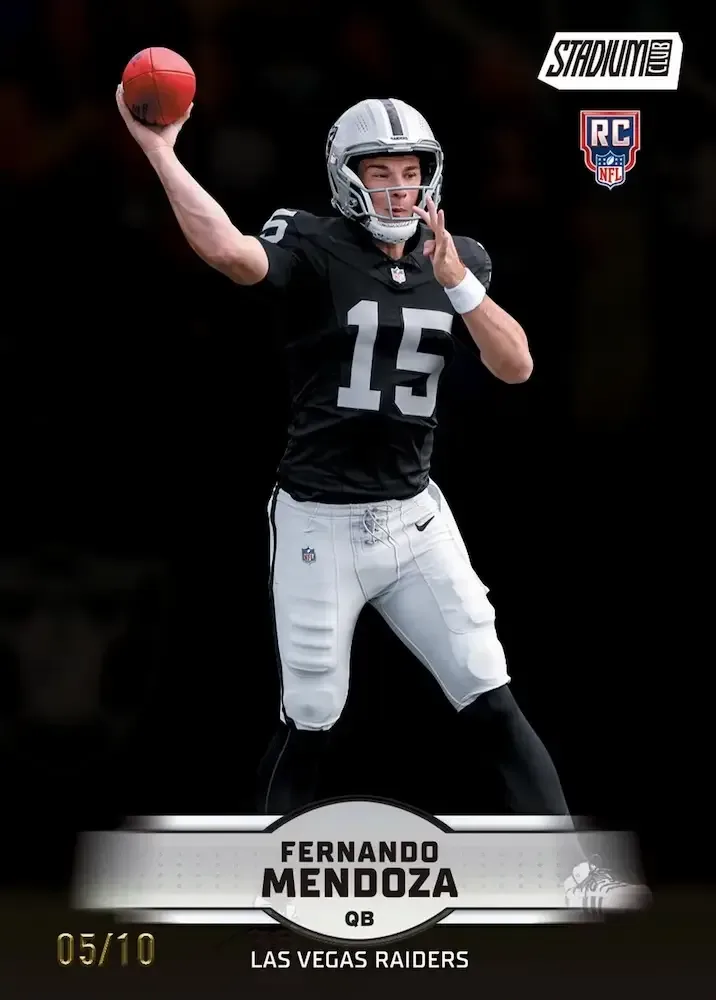
Topps is bringing Stadium Club Football back for 2026, ending an 18-year absence for a card line built around photography rather than the dense, information-heavy look often associated with sports cards. Pre-orders are scheduled to open on November 9. For now, the company has shown numbered design variations, including a Fernando Mendoza Black parallel numbered to 10, along with a Jaxson Dart base-card design.
The return is notable not simply because football has another licensed release on its calendar, but because Stadium Club occupies a distinct place in the Topps family. Its identity has historically been image-led: full-bleed photographs run to the outer edges of the card, while UV-coated stock is intended to give those pictures extra visual pop. The format puts the action, atmosphere and framing first. In an era where card checklists can be defined by colors, serial numbers and hit odds, that aesthetic is the appeal.
Collectors should temper excitement with patience, though. The currently available information does not establish a full checklist, box configuration, print run, autograph program, memorabilia-card program, retail configuration or pricing. Numbered examples have been revealed, but a preview of a few cards is not the same thing as a complete product breakdown. Anyone considering a pre-order will want to watch for those details before treating the release as fully defined.
A photography-first brand comes back to football
Stadium Club began in 1991 as a baseball brand and became associated with cards that seek out images different from the conventional posed portrait or tightly cropped game shot. Its full-bleed approach is simple in concept: rather than surrounding the photo with a large border or heavy graphical frame, the image fills the front of the card. The result can make a card feel more like a sports photograph in miniature, provided the selected image does the work.
That design philosophy matters for football. The sport offers dramatic subjects—movement at the line, sideline reactions, celebrations, pre-snap focus and stadium-scale scenes—but a football card still has to balance photography with player identification and set branding. Stadium Club’s appeal is that it tends to make the image the central feature rather than merely a backdrop for names, foil and statistics.
The cards use UV-coated stock. In practical terms, a UV coating is a finish cured with ultraviolet light. On a trading card, it can create a smooth, polished surface and help colors and contrast appear more pronounced. It is a production choice tied to presentation, not an automatic rarity marker. A collector assessing any particular card should separate its finish from the factors that establish scarcity: serial numbering, stated print information and the product’s eventual checklist.
Topps has expanded Stadium Club beyond its baseball origins over time, with versions tied to Champions League, WWE and UFC. Football’s return, arriving shortly after confirmation of a Stadium Club Basketball revival, makes the brand’s broader return to major U.S. sports especially clear. Basketball is coming back after 19 years away, while football returns after 18.
What the early card reveals do—and do not—tell collectors
The Fernando Mendoza Black card is numbered /10. That serial number means the specific parallel is limited to 10 copies, an example of a numbered variation rather than an indication that every Stadium Club Football card will be this scarce. The Jaxson Dart card shown so far is identified as a base card, which generally means it represents the standard version of the design within the set.
That distinction is useful for newcomers. A base card is the foundation of a set: the primary player-and-design combination from which alternate versions may branch. A parallel is a variation of that card, usually differentiated through color, finish, pattern, numbering or some combination of those elements. A Black /10 is therefore both a parallel and a numbered card. It is not automatically the rarest possible version unless the finished product says so.
Stadium Club is also associated with Beam Team, described as a coveted SSP within the brand. SSP is hobby shorthand for “super short print,” a label commonly used for inserts produced in especially limited quantities. Importantly, “SSP” does not itself provide a universal numerical print run. Unless a card is numbered or a manufacturer gives explicit production information, collectors cannot turn that label into a precise count.
For buyers, that makes the next round of official product information unusually important. A final checklist would show which players are in the base set and inserts. Pack and box details would explain how cards are distributed. Images of additional parallels would clarify whether the revealed Black /10 is one stop in a larger color ladder or part of a smaller selection. Until then, the most reliable takeaway is narrow: Stadium Club Football is returning, pre-orders start November 9, and early visuals point to the brand’s familiar clean, photo-centered styling.
Why timing matters in the 2026 football card calendar
Stadium Club Football is entering an already active 2026 licensed football-card schedule. Topps Flagship Football arrived August 21, providing an early route to cards of rookies including Fernando Mendoza, Drew Allar and Ty Simpson. Bowman Football followed with NFL and collegiate players combined in the same product for the first time. Topps Heritage Football then returned after last appearing in 2015, while Topps Holiday Football is already available.
Several more releases sit close to the Stadium Club pre-order date. Bowman Football Sapphire Edition and Bowman U Best Football are due this week, with Bowman U Best positioned as the season’s first college-only release. Topps Inception Football is scheduled for November 6. That sequence gives collectors different product identities to consider within a short stretch: flagship presentation, prospect-oriented Bowman branding, retro-styled Heritage, seasonal Holiday cards, the premium-leaning Sapphire treatment, college-only Bowman U Best and Inception’s separate identity.
Stadium Club’s practical point of difference should be its visual treatment. That does not make it inherently better for every type of collector. Someone building rookie quantities may prioritize a product’s checklist, cost and distribution. Someone focused on low-numbered cards will need to compare confirmed parallel details. A collector who wants cards with strong photography may find Stadium Club’s core proposition more persuasive than a product designed around a heritage template or a prospect-driven brand identity.
The crowded schedule also argues against assuming that a familiar name tells the whole story. “Stadium Club” conveys an established visual legacy, but the 2026 football edition still needs to be judged on its own finalized contents. Collectors should consider a pre-order as a commitment to a partially revealed product, not a purchase supported by a completed checklist and configuration sheet.
A brand return with a reason to read the fine print
The reappearance of Stadium Club also arrives after a recent issue involving 2025 Stadium Club Baseball. Topps apologized after promotional material referenced guaranteed Chrome cards, then updated designs that no longer carried that guarantee. The episode does not define the forthcoming football release, and there is no stated connection between the two products. It does, however, reinforce a straightforward collecting habit: preserve the exact product details presented when ordering, and revisit official listings if details change.
That is especially sensible when early reveals emphasize design samples. Card companies often disclose visual elements before every pack-level or box-level detail is public. Collectors can distinguish between what is visible and what is confirmed. At this stage, the visible facts include the football return, the November 9 pre-order start, a numbered Fernando Mendoza Black /10 and a Jaxson Dart base design. The unconfirmed territory includes the wider card population and purchasing structure.
For sealed-product buyers, the difference affects expectations. A serially numbered card shown in a preview confirms that a low-numbered variation exists; it does not establish how often it appears, whether there are other low-numbered variants, or what a box is designed to yield. For singles collectors, the return may be more straightforward: wait for cards to enter the market, then target the player, photo, insert or parallel that fits the collection instead of taking on the uncertainty of sealed product.
The broader collecting conversation is busy well beyond sports cards, as seen in other recent collectible releases. Stadium Club Football’s particular hook, however, is more focused: it restores a familiar Topps visual language to licensed football cards after a long gap.
What to watch between now and pre-orders
- Complete checklist: Early images establish Mendoza and Dart card designs, but they do not show the full player selection.
- Parallel structure: The Black /10 confirms one numbered version. Further information should clarify the rest of the variation lineup.
- Beam Team’s status: The insert is closely tied to Stadium Club and described as an SSP, but collectors will want confirmation of its role in the football product.
- Configuration and odds: These details matter for assessing a sealed purchase, particularly when the product is marketed with rare inserts or numbered parallels.
- Final product language: Given the earlier Stadium Club Baseball change, purchasers have a good reason to verify current descriptions at the point of ordering.
For now, 2026 Topps Stadium Club Football is best viewed as a significant brand revival with a deliberately incomplete first look. The return supplies football collectors with a photography-led alternative in a rapidly filling release calendar. The next disclosures will determine how much of Stadium Club’s famed identity carries into its new football chapter—and, just as importantly, how collectors can realistically chase it.