Jim Brown’s football cards are a compact record of an extraordinary athlete’s playing career. Brown was a dominant NFL force from 1957 through 1965, while his college background at Syracuse stretched beyond football: he also played lacrosse, track and basketball. That unusually broad athletic legacy helps explain why his vintage cards carry meaning beyond the standard appeal of an old player portrait.
The five cards below are ranked by the reported top sale for each issue, not by an assertion that one design, set or grade is universally better than another. That distinction matters. Vintage-card prices are highly dependent on the precise copy sold, its stated grade, the venue and the moment of sale. A card that has a six-figure high-water mark can still exist in other grades and conditions that occupy a very different part of the market.
Still, the results draw a clear outline. Brown’s 1958 Topps rookie is the headliner, with a reported $360,000 sale. The 1959 Topps follows at $205,200, then the 1964 Philadelphia at $117,585.60. The 1961 Fleer and 1962 Topps cards round out the group with reported best sales above $54,000 and $33,000, respectively. For collectors, that is a useful reminder that a player’s key cards can come from several sets and eras—not just the rookie issue.
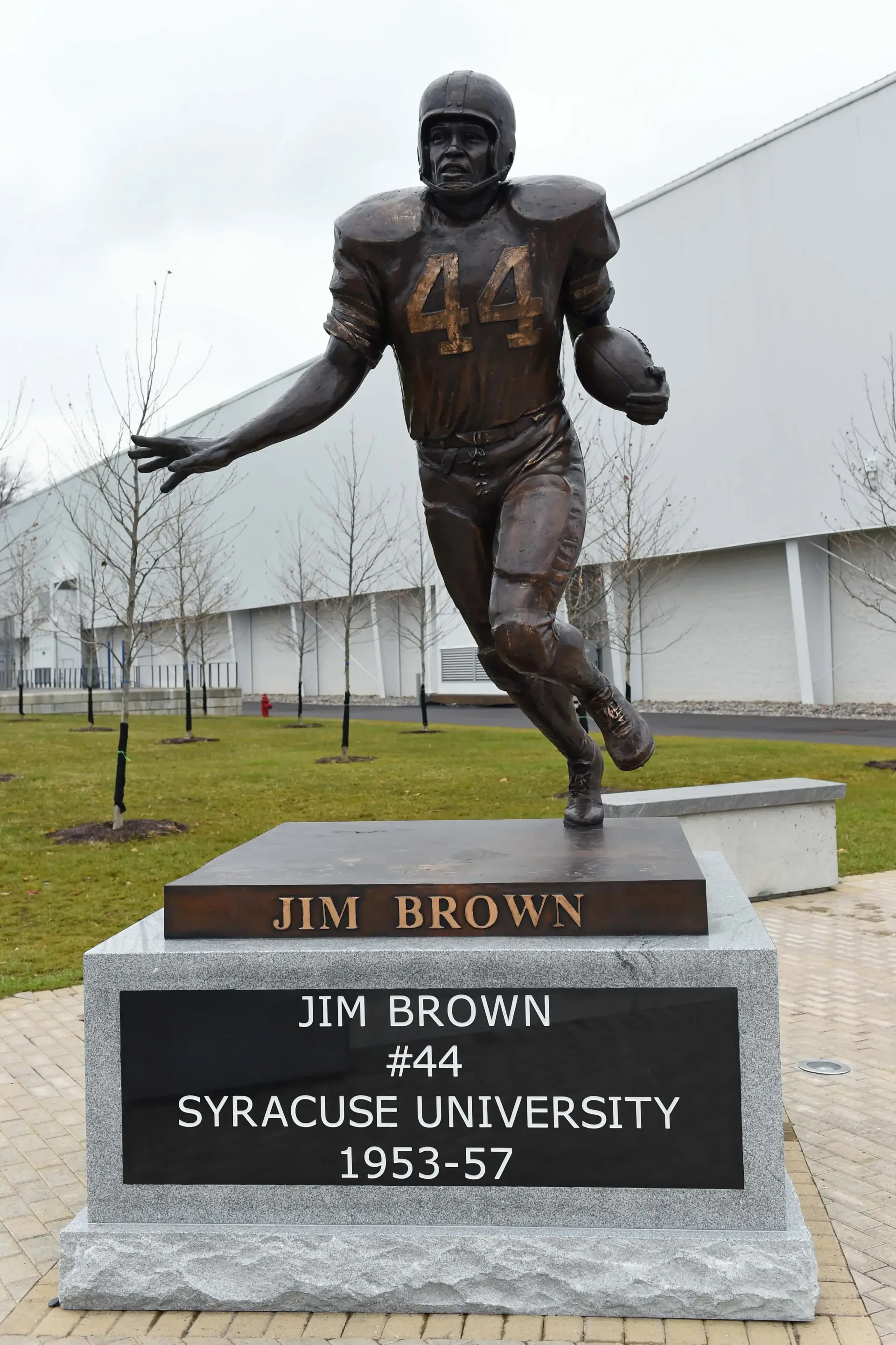
Collecting historical cards is also a way of engaging with sports history through physical objects. That same impulse appears across other card communities, including modern character and game collecting; Pokémon collecting news shows how the hunt for a specific character or rarity continues to connect fans with the things they enjoy. With Brown, the appeal is rooted in a player whose footprint includes football and lacrosse, plus a Syracuse bronze statue honoring him in his college No. 44.
How to read the sale figures
A top sale is a single documented result, rather than a fixed price guide. The grades cited here are especially important because they identify the condition tier of the individual card that sold. A PSA 10, for example, should not be treated as interchangeable with a PSA 8.5, even if both carry the same card number and image.
The reported population figures add another piece of context. Population, in this use, refers to the number of examples reported at that particular grade. It is not the complete surviving supply of a card, nor does it establish that every ungraded copy is absent or inferior. It simply helps put a high-grade result into perspective. The two cards in this ranking with supplied population figures are particularly notable: three PSA 10 copies are reported for the 1959 Topps, while seven PSA 8.5 copies are reported for the 1958 Topps rookie and three PSA 8.5 copies for the 1962 Topps.
That is why headline prices should be read carefully. They are valuable reference points, but not automatic valuations for every copy that may surface. Collectors considering a vintage Brown card need to identify the exact year, manufacturer, card number and condition before comparing it to a famous sale.
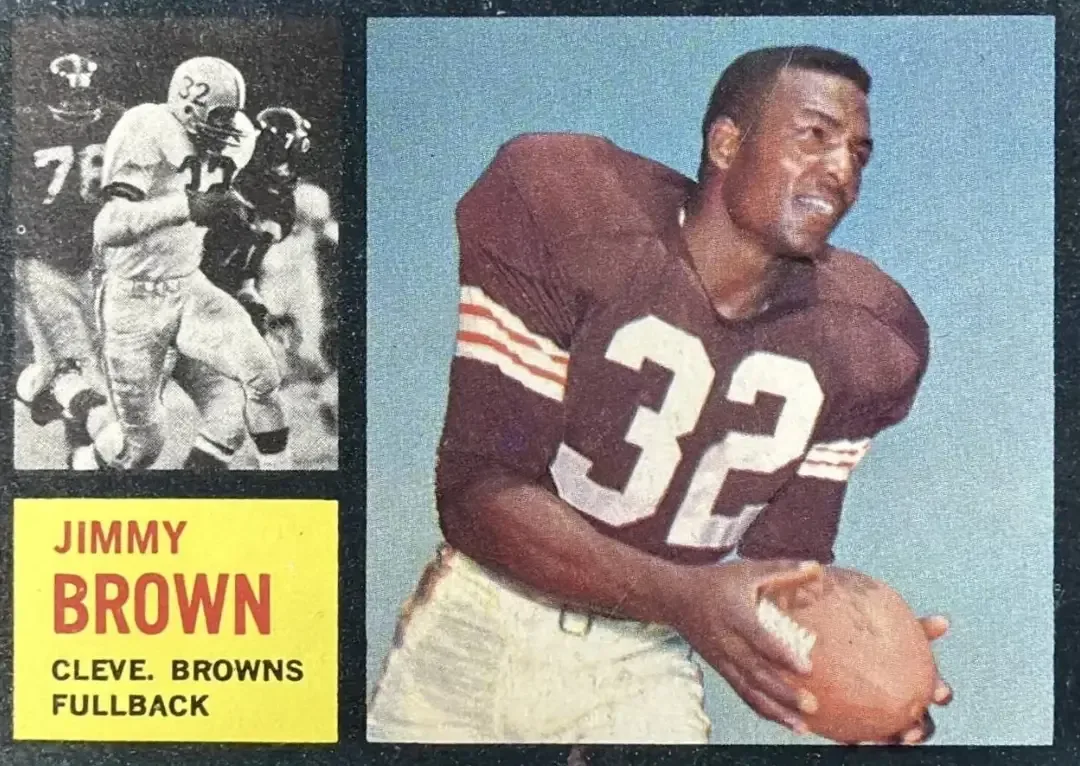
5. 1962 Topps Jimmy Brown #28
Reported top sale: PSA 8.5 for $33,193 on September 9, 2023, through Memory Lane.
Related coverage includes 5 Most Valuable Jim Brown Cards and Their Top Sales.
Reported PSA 8.5 population: 3.
The 1962 Topps #28 offers two views of Brown on one card. One is a color image from a photo session, while the other is a black-and-white running image. That split presentation gives the card an identity distinct from a simple portrait or a single action photograph: it combines a composed player image with an on-field moment.
It is also one of several cards that use “Jimmy Brown” rather than “Jim Brown” on the front. For collectors searching listings or organizing a want list, that naming variation is worth remembering. It does not describe a different player or a separate branch of the Brown collecting tree; it is simply how some of the period cards identified him.
The cited population of three at PSA 8.5 provides context for the $33,193 result. It signals that the particular condition level attached to the sale is uncommon within the supplied grading data. It should not be used to infer a price for lower-grade examples, but it explains why a strong-condition copy can become a major card rather than merely a later-career issue.
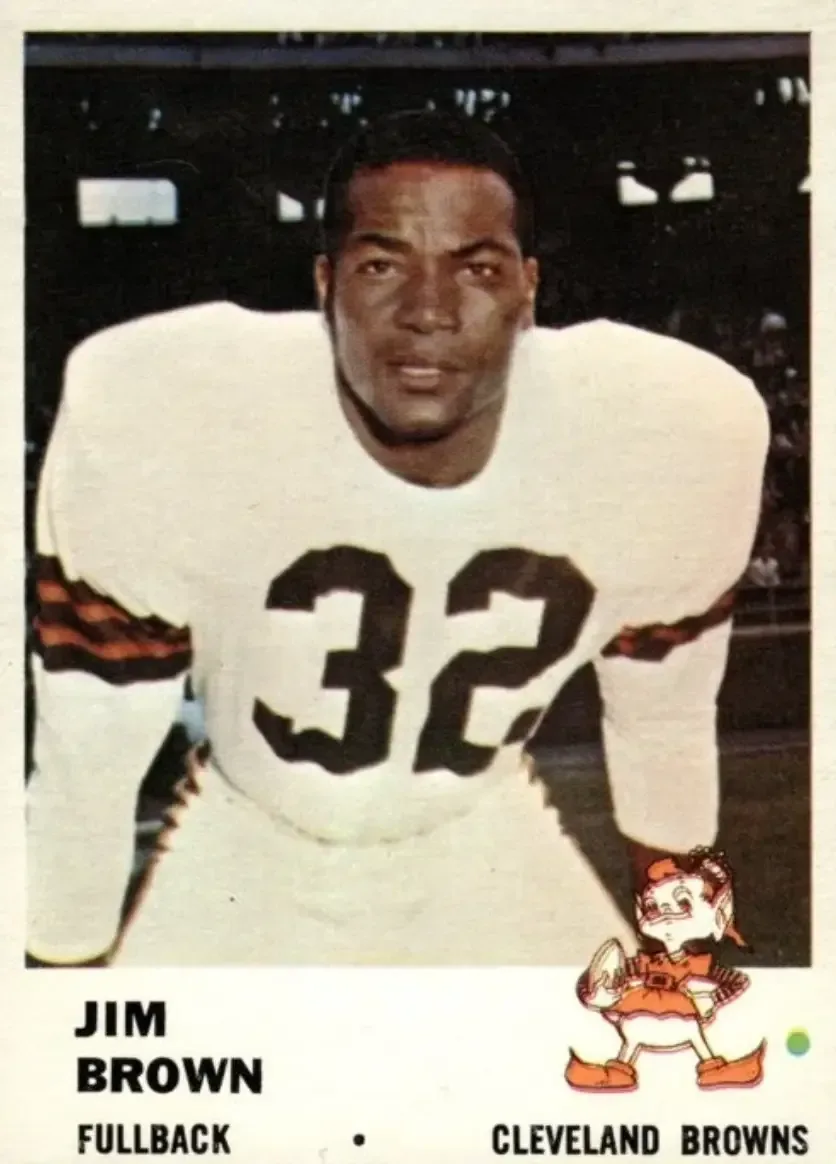
4. 1961 Fleer Jim Brown #11
Reported top sale: $54,259.20 on September 12, 2024, through Mile High.
The 1961 Fleer #11 presents Brown in a white jersey with three-quarter-length sleeves and his familiar No. 32. It comes from his fourth NFL season and has a notably uncluttered visual approach. In a ranking filled with cards that offer sharply different aesthetics, this one is the straightforward option: player, uniform number and a clean presentation.
Its reported high sale of $54,259.20 demonstrates why collectors should not reduce a player’s market to a rookie card alone. The 1961 Fleer arrives several years after Brown’s rookie season, yet it has still crossed the $50,000 mark in a reported sale. The result suggests that collectors can assign substantial importance to a memorable image and a significant vintage issue even when the card is not the first one issued for the player.
For someone building a focused Brown run, this is a useful example of a card whose appeal is easy to articulate. The design does not need a complicated gimmick: the defining details are Brown’s recognizable No. 32, the white uniform and the period image. That clarity can be as much a collecting draw as elaborate artwork or a densely designed card front.
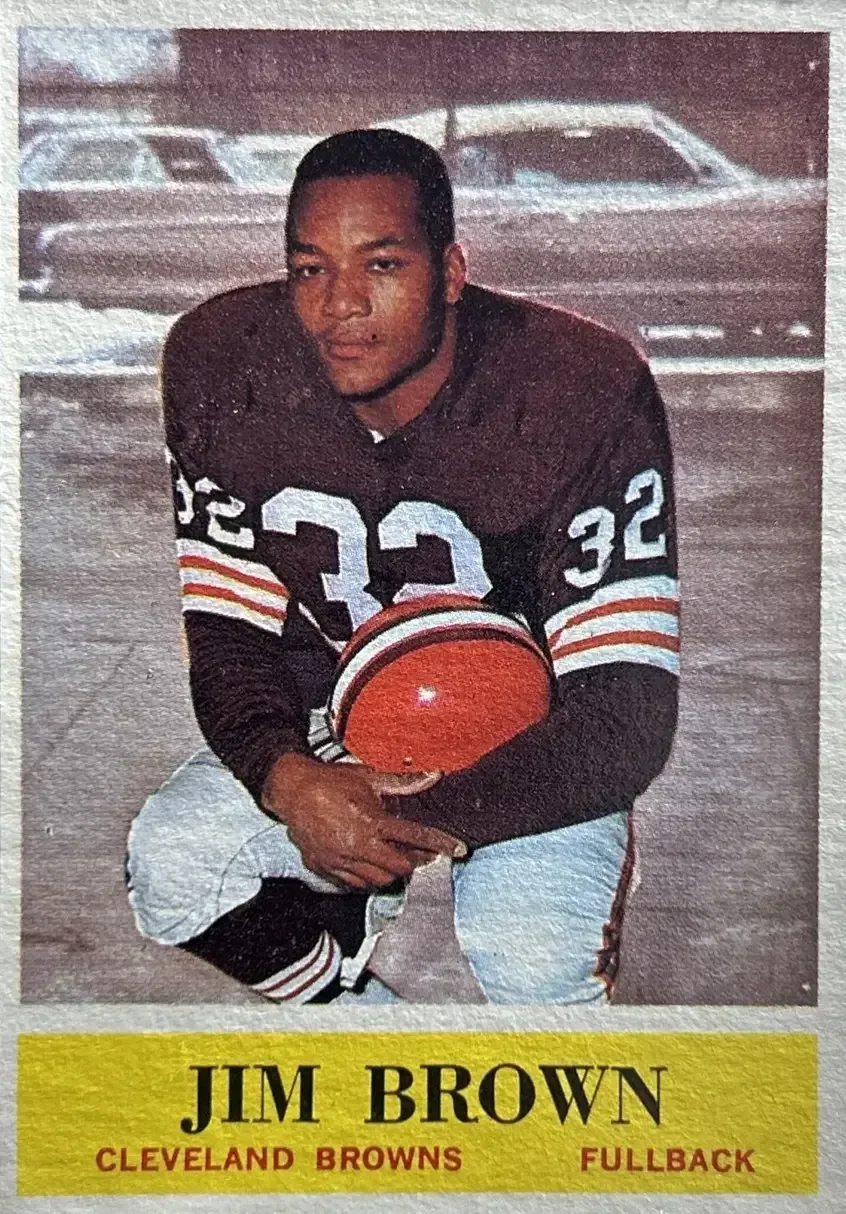
3. 1964 Philadelphia Jim Brown #30
Reported top sale: $117,585.60 on April 14, 2024, through Mile High.
The 1964 Philadelphia #30 has the third-largest reported sale in this group, at $117,585.60. It also makes the list’s manufacturer variety especially clear. The five cards span Topps, Fleer and Philadelphia, so the major Brown cards represented here are not confined to one company’s visual language.
Its setting is the key design detail. Rather than placing Brown against the kind of generic or tightly cropped backdrop collectors may expect from a football card, the image includes concrete, pavement, a chain-link fence and a large car. Those elements create a more environmental scene. The card does not merely show Brown; it places him in a specific-looking physical space.
That background may be unusual, but it is also a practical identification tool. When assessing an ungraded card from a listing or a collection, visual markers such as the fence and vehicle can help distinguish the 1964 Philadelphia #30 from other Brown issues quickly. Card number and set name should remain the final checks, but distinct scenery can make initial identification much easier.
The sale figure is also a good illustration of why visual character deserves attention when studying vintage sports cards. There is no supplied evidence that the background alone caused the price, and it would be wrong to claim that it did. But the unusual scene plainly gives the card a personality that separates it from more conventional football-card photography.
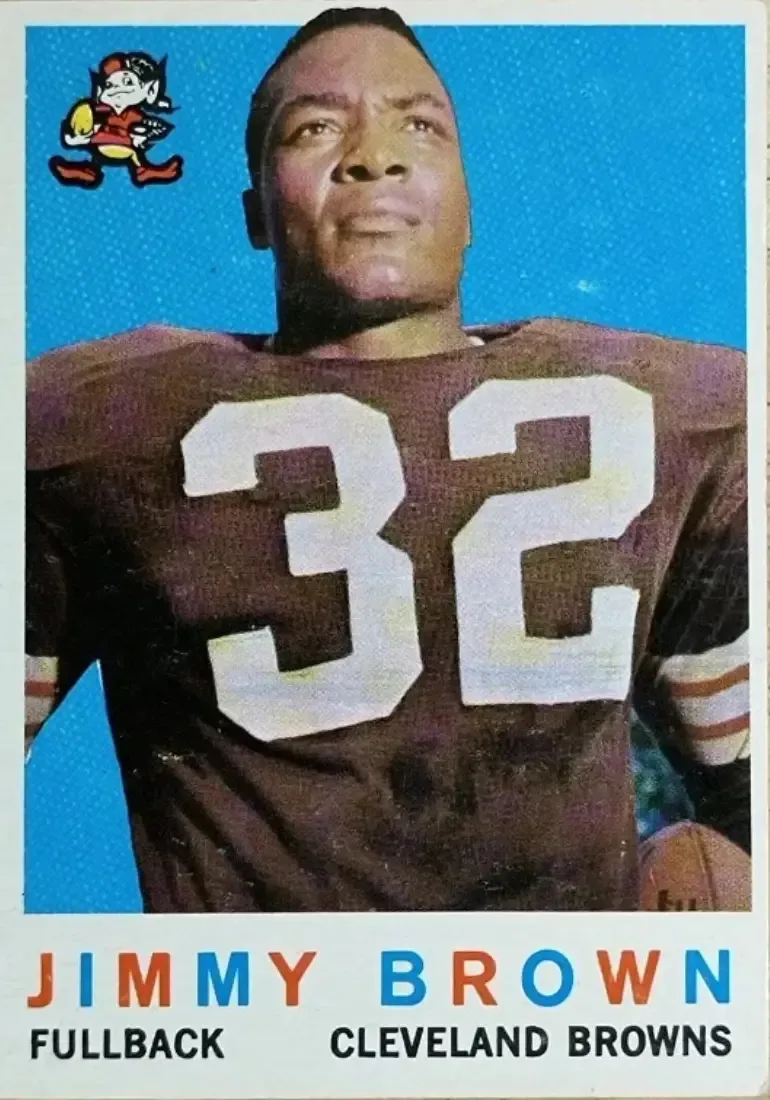
2. 1959 Topps Jimmy Brown #10
Reported top sale: PSA 10 for $205,200 on March 8, 2021, through Goldin Auctions.
Reported PSA 10 population: 3.
The 1959 Topps #10 is the only card in this group whose reported top sale is explicitly tied to a PSA 10: $205,200. The supplied population is three at that grade. Together, those details should keep the headline number in its proper lane. It is a price for an exceptionally graded copy, not a blanket estimate for every 1959 Topps Brown.
Design is central to the card’s attraction. Brownie the Elf appears over Brown’s right shoulder, creating an instantly recognizable visual relationship between the player and the Browns-associated character. The broader 1959 Topps approach includes solid backgrounds and alternating text colors, while a small open area beneath Brown’s left arm breaks the otherwise bold color field.
For collectors, this card brings together several layers that are easy to recognize at a glance: an early Brown issue, a distinct Topps style, Brown’s image and Brownie the Elf. The $205,200 reported result places it firmly behind the rookie in this ranking, but comfortably ahead of the other three cards listed here.
It is also a reminder to compare like with like. A PSA 10 sale should be compared cautiously with an 8.5 sale, because the grade stated alongside the transaction is part of the story. Rankings are useful as snapshots of record sales, but the grade is often the detail that turns a broad comparison into a meaningful one.
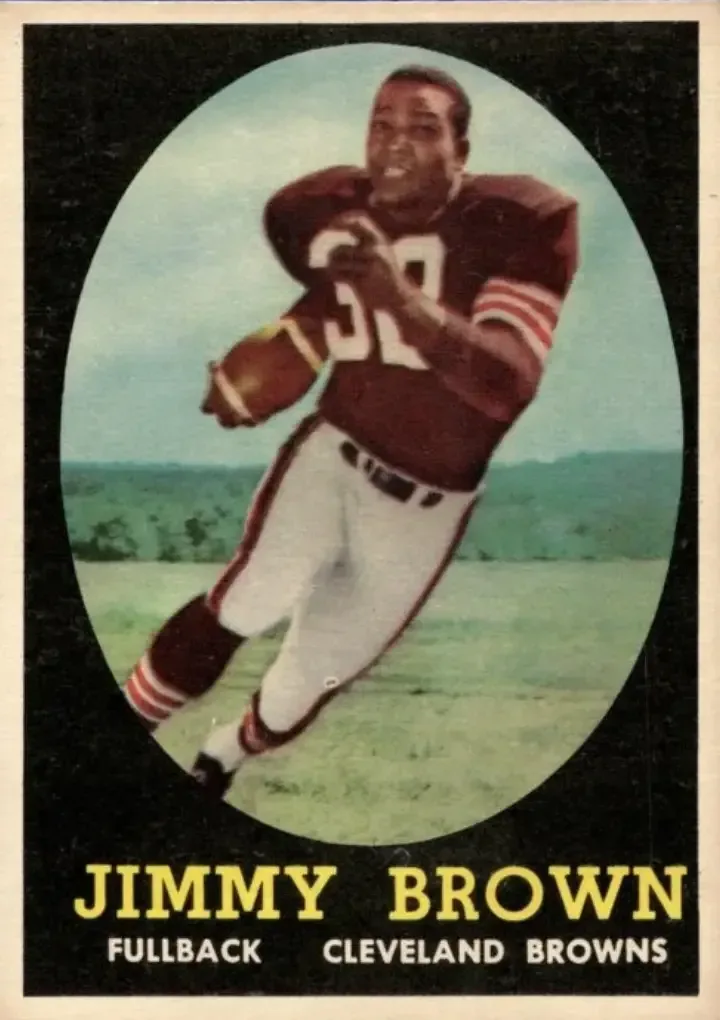
1. 1958 Topps Football Jimmy Brown #62
Reported top sale: PSA 8.5 for $360,000 on February 11, 2022, through eBay.
Reported PSA 8.5 population: 7.
The 1958 Topps Football #62 is Jim Brown’s rookie card, and it stands first in this group with a reported $360,000 sale for a PSA 8.5 copy. A reported population of seven at PSA 8.5 gives additional context to that specific result. The combination of rookie status, vintage age, condition and strong design places it at the center of Brown collecting.
The front has two different visual components. An oval-framed portrait gives the card its formal focal point, with a matted appearance around the image. Alongside it is an action shot of Brown running across an open field, with hills visible behind him. The result is a card that captures both the player’s face and the athletic motion for which he is remembered.
Rookie card is a technical collecting term for a player’s first widely recognized card issue. In this case, that designation gives the 1958 Topps #62 a special role within Brown’s card catalog. It is not merely an early card; it is the rookie that collectors use as a major reference point for his market.
The card’s $360,000 record is more than $150,000 higher than the reported peak for the 1959 Topps #10. That gap does not prove that every 1958 Topps copy will command more than every 1959 Topps copy, since condition remains decisive. It does show the force of the rookie premium when a high-grade example reaches the market.
What a focused Jim Brown checklist shows
These five cards create a concise collecting checklist across seven years: 1958, 1959, 1961, 1962 and 1964. The group traces Brown from the rookie issue through a later-career Philadelphia card, while offering three very different manufacturers and several different approaches to player photography. One card emphasizes an oval portrait and open-field action; another uses Brownie the Elf and bright set design; another places Brown in an unexpectedly detailed outdoor setting.
The practical lesson is not that every collector must pursue the $360,000 rookie. It is that a well-defined player collection benefits from precision. Identify the card by set, year and number. Note whether the name is printed as Jim or Jimmy. Understand the grade attached to any comparable sale. And treat population counts as context for a stated grade, rather than as a substitute for examining the exact card being considered.
Brown’s top cards endure because they preserve several dimensions of his story at once: an NFL career that ran from 1957 to 1965, Syracuse roots commemorated by a No. 44 statue, and an athletic résumé spanning football, lacrosse, track and basketball. The 1958 Topps #62 may be the centerpiece, but the wider group makes the case for collecting Brown as a player with more than one essential card.