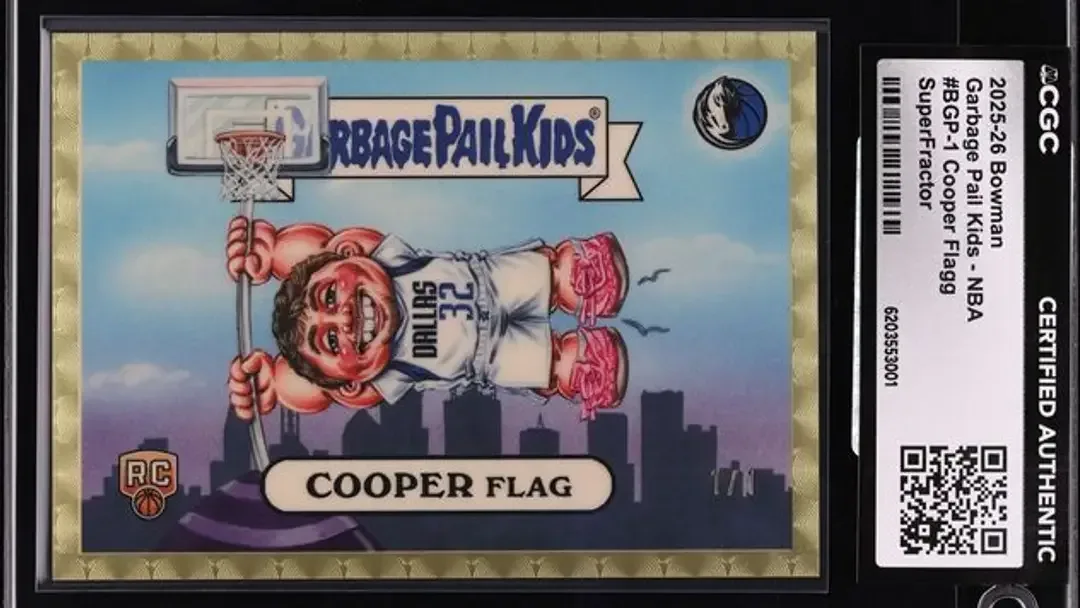
A one-of-one Cooper Flagg Garbage Pail Kids insert from 2025 Bowman has set an enormous benchmark for the modern crossover niche, selling for $288,000 on August 28, 2026. The CGC-authenticated card sits comfortably atop the five reported highest sales for Bowman Garbage Pail Kids inserts, ahead of a group that includes Shohei Ohtani, Paul Skenes, Munetaka Murakami and Aaron Judge.
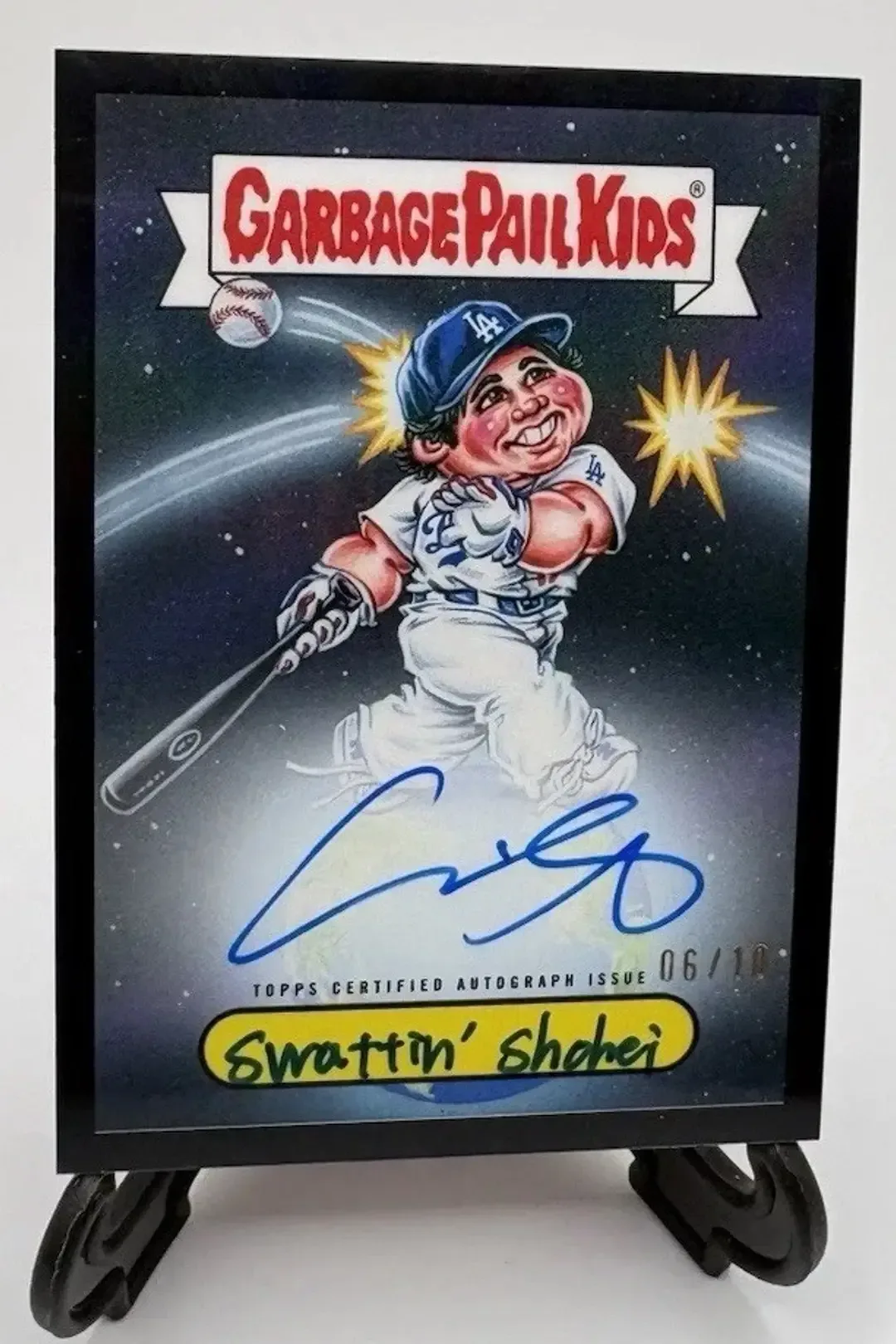
The gap is the striking part. Flagg’s sale is more than eight times the $35,000 paid for the next entry, a 2026 Bowman Chrome Shohei Ohtani Garbage Pail Kids Black autograph numbered to 10. The remaining three cards each sold in a much tighter band, from $26,975 to $28,200. That makes the Flagg result less a routine escalation of recent GPK prices than a standout transaction defined by extreme scarcity and a player whose first overall NBA draft selection carries immediate collecting weight.
The five reported Bowman Garbage Pail Kids sales
- 2025 Bowman Garbage Pail Kids NBA Cooper Flagg Superfractor, CGC Authentic — $288,000. Sold August 28, 2026.
- 2026 Bowman Chrome Shohei Ohtani Garbage Pail Kids Black Autograph /10 — $35,000. Sold September 24, 2026.
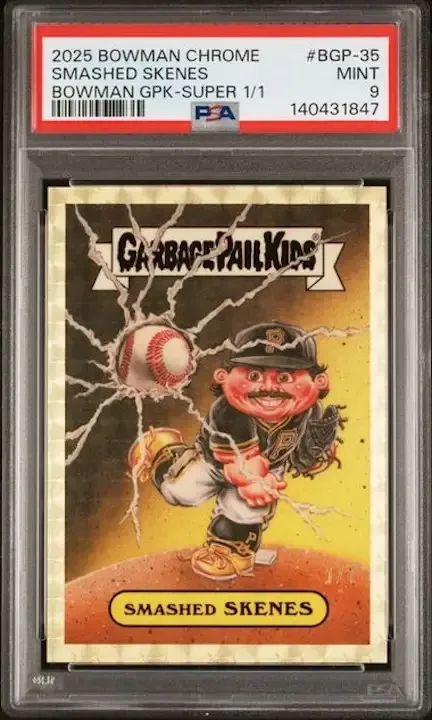
- 2025 Bowman Chrome Garbage Pail Kids Paul Skenes Superfractor, PSA 9 — $28,200. Sold July 24, 2026.
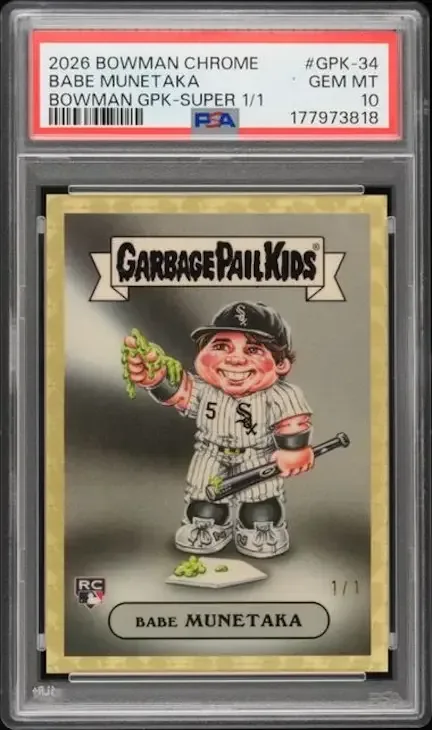
- 2026 Bowman Chrome Garbage Pail Kids Munetaka Murakami Superfractor, PSA 10 — $27,600. Sold October 23, 2026.
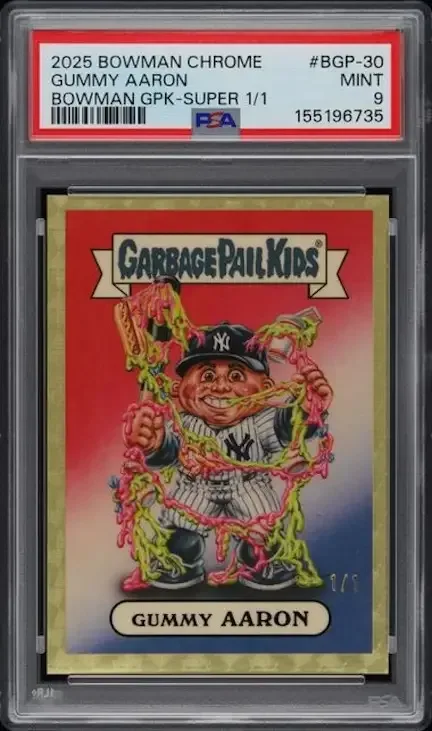
- 2025 Bowman Chrome Garbage Pail Kids Aaron Judge Superfractor, PSA 9 — $26,975. Sold May 9, 2026.
Why the Flagg Superfractor stands apart
Flagg was selected first overall by the Dallas Mavericks in the 2025 NBA Draft after one year at Duke. His Bowman GPK Superfractor is a one-of-one card, and its stated pack odds were one in 722,080 packs. The card was authenticated by CGC rather than assigned a numerical grade.
A Superfractor is the one-of-one version in a parallel card lineup: in practical collecting terms, there is no identical numbered copy for another buyer to pursue. That does not automatically make every Superfractor equally valuable; player demand, product appeal, card condition and the number of comparable items all still matter. But it means a collector wanting that exact Flagg-GPK combination cannot simply wait for another copy to surface.
The stated pull odds supply important context, too. One card in 722,080 packs is a measure of pack-insertion rarity, not a guarantee that a buyer will value it at any particular amount. Still, it helps explain why the result can break so sharply from sales of cards with larger print runs. When an uncommon parody-art insert intersects with a one-of-one parallel and a recent No. 1 draft pick, the buyer pool may be responding to several types of scarcity at once.
It is also worth separating authentication from grading. CGC’s “Authentic” designation establishes that the card itself is genuine, while PSA 9 and PSA 10 labels on other cards are numerical condition grades. Those descriptions should not be treated as interchangeable. A PSA 10 represents a different certification outcome from an authenticated card, and the market can weigh condition, eye appeal and the specific card independently.
Ohtani’s autograph is the only non-one-of-one in the group
The second-highest sale belongs to Ohtani’s 2026 Bowman Chrome Garbage Pail Kids Black autograph, numbered to 10, at $35,000. Unlike the four Superfractors on the list, this card has a print run of 10, but it adds an autograph. An autograph parallel combines the underlying insert with a player signature; the “/10” indicates that ten numbered copies were issued.
Ohtani’s accomplishments provide the performance case behind the card’s appeal. He was the starting pitcher for the 2021 All-Star team and also appeared as a hitter, has four MVP Awards and two World Series titles with the Dodgers, and produced the first 50-home-run, 50-stolen-base season in 2024. Those facts make him the most established major-league star among the baseball names in the top five.
Yet his /10 autograph still finished far below Flagg’s one-of-one. The comparison is a useful reminder that a sales list is not a universal ranking of athletes. It records individual transactions for highly specific cards. An autograph, a limited serial number, player stature, release year and the particular buyer competition at sale time can all pull pricing in different directions.
Skenes, Murakami and Judge form a remarkably close cluster
The final three results are separated by just $1,225. Paul Skenes’ 2025 Bowman Chrome Superfractor, graded PSA 9, sold for $28,200. Munetaka Murakami’s 2026 Bowman Chrome Superfractor, graded PSA 10, realized $27,600. Aaron Judge’s 2025 Bowman Chrome Superfractor, graded PSA 9, sold for $26,975.
Skenes entered professional baseball as the first overall pick in the 2023 draft and debuted in Major League Baseball the following year. He won National League Rookie of the Year honors in 2024 and was the unanimous National League Cy Young Award winner in 2025. The $28,200 result places his GPK Superfractor slightly above the Murakami and Judge examples, despite all three being one-of-one parallels.
Murakami’s card reached $27,600 after a 2026 rookie season in which he hit 35 home runs and drove in 77 runs. The White Sox reached the playoffs but lost to the Guardians in the American League Division Series. His PSA 10 label denotes the highest numerical grade cited within this five-card group, although the sale shows why a top grade cannot be viewed in isolation: it is one input in the price of a card with its own player, release and collecting audience.
Judge’s $26,975 sale came earlier, on May 9, 2026. His 2025 Bowman Chrome Superfractor was graded PSA 9. The Yankees star has won three MVP Awards and led the club to the 2024 World Series, where it lost to the Dodgers; it was the franchise’s first World Series appearance since 2009. His presence gives the list a veteran superstar alongside younger players whose values are closely connected to early-career momentum.
What these results say about the GPK crossover
Garbage Pail Kids began as a Topps sticker set in 1985, built as a parody of Cabbage Patch Dolls. Its characters were known for deliberately grotesque mishaps, deaths and deformities. Sports entered the GPK mix in 2015, creating a hybrid category where player collecting meets a visual language that is intentionally unlike conventional action photography or standard prospect-card design.
Bowman’s more recent GPK inserts offer a base version alongside numbered variations. The five sales here show the upper end of that structure, not the expected value of the regular insert. For collectors, that distinction is crucial. A base card and a one-of-one Superfractor share a character concept and player subject, but they do not share the same scarcity profile or market behavior.
Likewise, these transactions should not be read as a price guide for all Garbage Pail Kids cards, all Bowman inserts or all cards of the featured athletes. Each sale concerns an individual high-end parallel with its own certification details. A list of headline sales is useful for tracking what has attracted serious money, but it is not evidence that a similar-looking card—particularly an unnumbered base card—will command a comparable amount.
Practical checkpoints for collectors
- Read the parallel carefully. “Superfractor” identifies a one-of-one, while “/10” means a card is one of ten. Those are materially different scarcity levels.
- Keep certification language straight. Authentication confirms genuineness; numerical grading assesses condition. The labels reported here include CGC Authentic, PSA 9 and PSA 10.
- Compare like with like. A signed /10 should not be casually compared with an unsigned one-of-one, and a GPK insert is a distinct market from a player’s standard rookie or flagship cards.
- Watch the transaction date. The five sales occurred between May and October 2026, so they are a snapshot of a developing segment rather than a complete history of values.
- Distinguish player fame from card-specific demand. Ohtani and Judge bring established accolades, while Flagg, Skenes and Murakami illustrate how top picks and early-career achievements can shape interest in scarce modern cards.
The list also reinforces how much one-of-one cards can turn a niche insert into a marquee collectible. Four of the five sales are Superfractors, and the outlier at No. 1 is not merely a Superfractor but an NBA Flagg card with exceptionally long stated pack odds. The Ohtani autograph offers the counterexample: a card can remain the second-largest sale without being one-of-one when a signature and a limited run meet the demand for an elite player.
Cross-category cards continue to create unusual comparisons. This group places a deliberately irreverent GPK presentation next to names normally pursued for conventional sports-card reasons—rookie status, awards, championships, production and signature scarcity. Collectors following similarly singular Topps items can also see how the market treats a different one-of-one format in a reported purchase of a 1-of-1 Topps flagship rookie patch autograph.
For now, Flagg’s $288,000 Superfractor is the defining number in Bowman Garbage Pail Kids sales. Whether it becomes a durable high-water mark or an unusually singular result will depend on future transactions. What is already clear from the five reported sales is that modern GPK sports inserts have produced a premium tier where one-of-one status, player appeal and distinctively offbeat card art can converge at major-dollar levels.