There are many ways to collect basketball cards: complete a favorite set, chase new packs, follow a team, or focus on a single player with unusual precision. New Jersey collector Vinny Di Meglio has taken the player-first route, assembling more than 1,420 distinct Patrick Ewing cards. Within that larger collection, five graded cards show why a focused checklist can lead collectors into some of the hobby’s scarcest and most closely watched inserts.
The group spans 1997 through 2015 and includes cards limited to 45, 50 and 100 copies, plus a Kaboom! insert without a stated serial number in the available information. It also demonstrates an important distinction for collectors: stated print run, grading-population count and public sale history are related, but they are not interchangeable measurements of rarity or value.
All five examples are tied to Ewing, the New York Knicks center, but they come from notably different products and eras. Their appeal is therefore not simply about completing a player run. It is also about identifying inserts and parallels whose limited supply, difficult condition profile, or small number of known graded copies can make a particular version stand apart from its base-card counterpart.
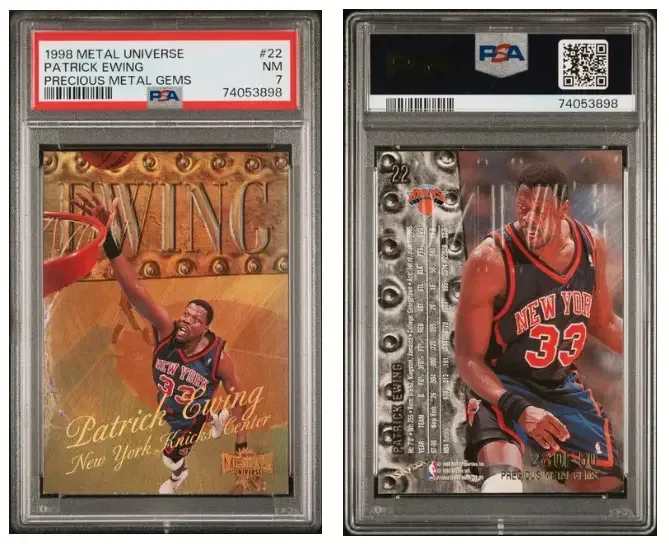
1. 1998 SkyBox Metal Universe Precious Metal Gems /50 — PSA 7
The centerpiece is a 1998 SkyBox Metal Universe Patrick Ewing Precious Metal Gems, numbered to 50 and graded PSA 7. A serial-numbered card uses an explicit production limit printed or otherwise designated by the manufacturer; in this case, “/50” communicates that 50 copies were intended for the parallel. That finite figure is a starting point, not a census of surviving copies or an assurance that every copy will be submitted for grading.
The available PSA population data is especially striking. No higher PSA grade is recorded for the card. PSA has seven copies at PSA 7, four at PSA 6 and one at PSA 5, for 12 graded examples in total. That does not prove only 12 remain, but it does show that comparatively few examples from the 50-copy run have appeared in this particular grading company’s registry.
One PSA 7 sold publicly for $13,000 on May 19, 2024, through Fanatics. It is a meaningful reference point, although one sale should not be treated as a universal price guide. Individual cards can differ in eye appeal even within the same numerical grade, and a public result reflects the buyers, timing and venue involved in that transaction. Still, the combination of a 50-copy limit, a highest-recorded PSA grade of 7, and a five-figure documented sale explains why this Ewing card anchors the five-card group.
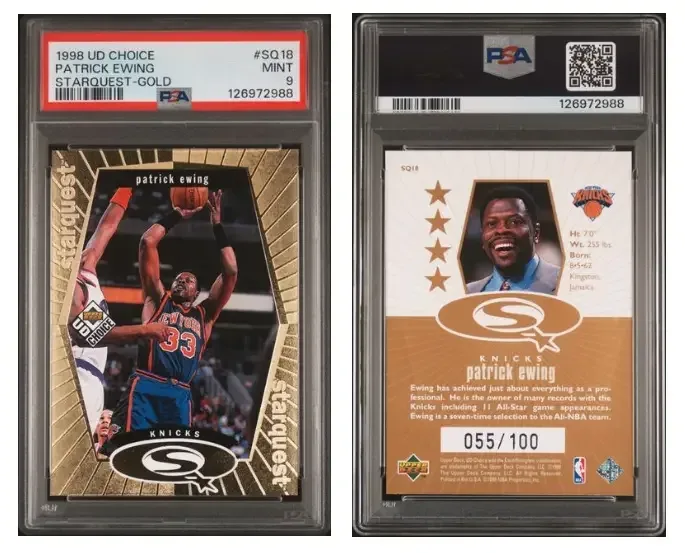
2. 1998 Upper Deck Collector’s Choice Starquest /100 — PSA 9
Di Meglio’s 1998 Upper Deck Collector’s Choice Starquest Gold Ewing is numbered to 100 and graded PSA 9. Compared with the Precious Metal Gems card, the stated print run is larger. Yet the reported grading population is much smaller than 100: one PSA 10, two PSA 9s and one PSA 8.
That population is useful because it frames the importance of the specific PSA 9 copy. PSA 9, commonly described as Mint, is one step below PSA 10, commonly called Gem Mint. A grade is an assessment of a card’s physical condition, rather than a direct appraisal of its desirability. Centering, corners, edges and surface can all matter to graders, while collectors may also care about visual presentation beyond the number on the label.
Related coverage includes Vinny Di Meglio’s Five Standout Patrick Ewing Cards.
Raw, or ungraded, copies have generally sold in the $60 to $100 range. The cited high public result for a PSA 9 is dramatically different: $7,200 on November 30, 2025, through Fanatics. There is no recorded public sale for the lone PSA 10. That absence matters. It should not be read as proof of a particular value for a PSA 10; it means there is no disclosed transaction in the supplied sales record to use as a direct comparable.
The Starquest is a useful illustration of why collectors should separate “raw-card price” from “graded-card price.” A card’s condition can be a major component of demand when the graded population is tiny, but the gap is not an automatic formula. Before placing a valuation on an ungraded copy, collectors should avoid assuming it can reach a top grade.
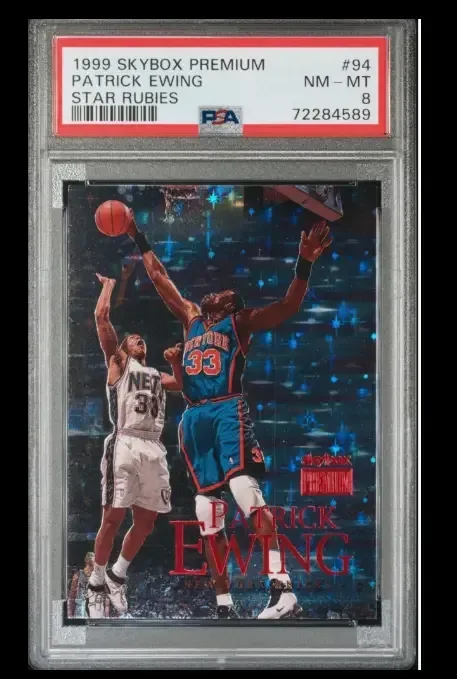
3. 1999 SkyBox Premium Star Rubies /45 — PSA 8
The 1999 SkyBox Premium Star Rubies Ewing is limited to 45 copies, making it the smallest stated print run among the serial-numbered selections here. Di Meglio’s example is graded PSA 8. The reported PSA population consists of one PSA 9, two PSA 8s, two PSA 7s and four PSA 6s.
A nine-card PSA population does not establish the full surviving population of a 45-copy issue. Some cards may be held raw, graded elsewhere, unsubmitted, or unavailable to the market. But it does add context for a collector comparing visible supply against a low stated production total. Di Meglio’s card is one of only two PSA 8s in the supplied count.
The strongest reported public sale for a graded copy came on September 17, 2026, when a BGS 8 realized $2,760 through Fanatics. BGS refers to Beckett Grading Services, a different grading company from PSA. The shared grade number can be informative, but it is not a perfect apples-to-apples comparison across companies. Collectors often weigh the company, label, subgrades when present, and the card’s individual appearance alongside the numeric result.
For anyone pursuing Star Rubies, the practical lesson is straightforward: record the exact issue, stated numbering, grader and grade when comparing sales. “Star Rubies Ewing” alone is not enough information to establish a precise market comparison.
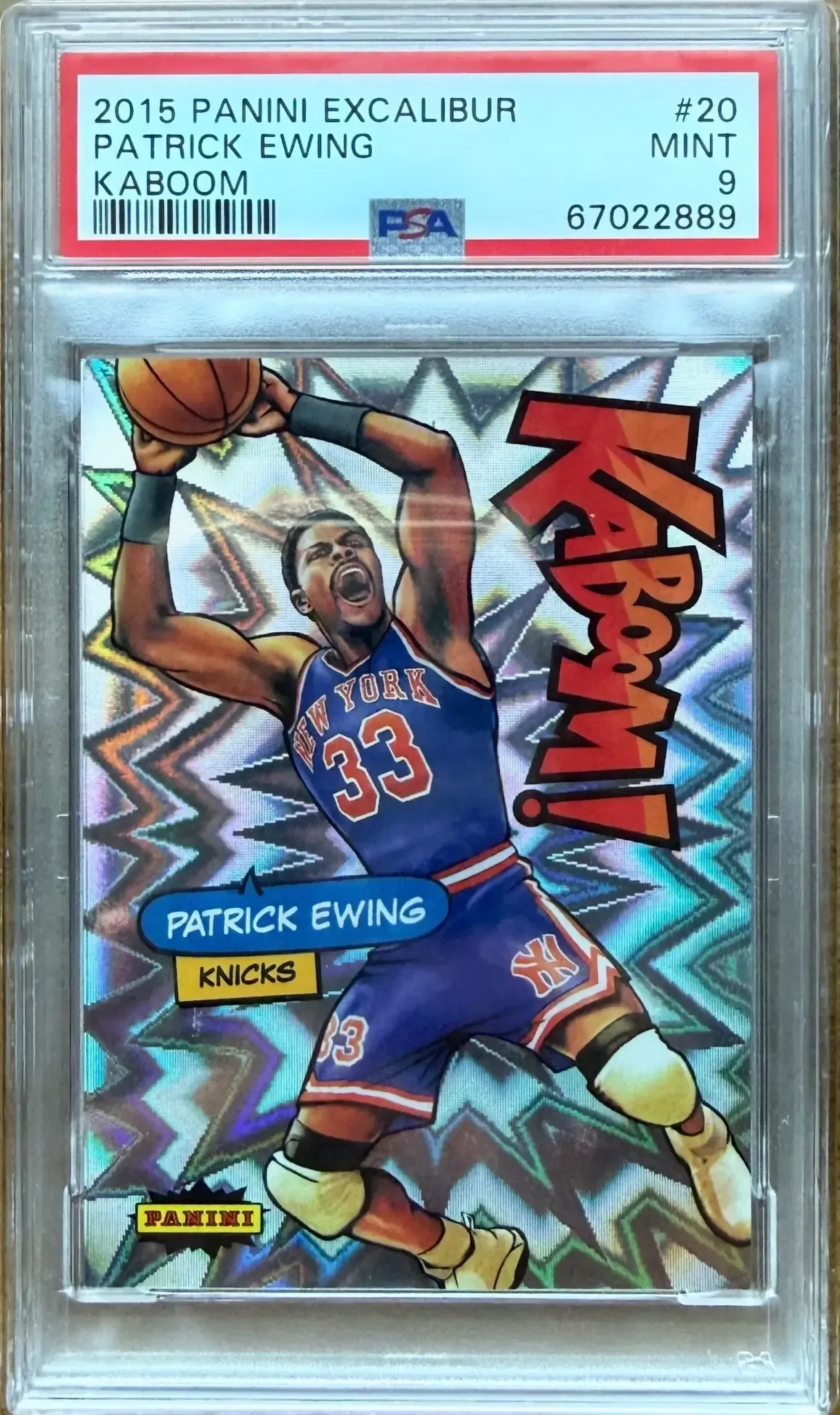
4. 2015 Panini Excalibur Kaboom! — PSA 9
The 2015 Panini Excalibur Kaboom! shifts the list to a later release and an insert format whose market evidence is more active across high grades. Di Meglio’s Ewing is a PSA 9. The supplied PSA population lists seven PSA 10s, 11 PSA 9s and one PSA 8.
Raw examples generally sell for $225 to $300, while the cited public sales show the premium that top graded examples can command. A PSA 9 sold for $3,000 through eBay on January 29, 2026. A PSA 10 then reached $6,300 on July 5, 2026. These numbers do not turn every raw Kaboom! into a four-figure card, but they make clear why careful condition evaluation matters for collectors considering a graded submission or purchase.
Unlike the numbered parallels elsewhere in the collection, the supplied information does not give Kaboom! a stated print run. That is a key limit on any rarity comparison. It would be inaccurate to declare it scarcer or more common than a card numbered to 45, 50 or 100 using only the facts available. What can be said is that the PSA count supplied here totals 19 examples across grades 8 through 10, and that both PSA 9 and PSA 10 public sales have been recorded.
The contrast makes Kaboom! an important part of the collection. It represents a desirable insert with documented high-grade demand, while the older numbered issues draw a different kind of interest through their explicit production limits and sparse grading populations.
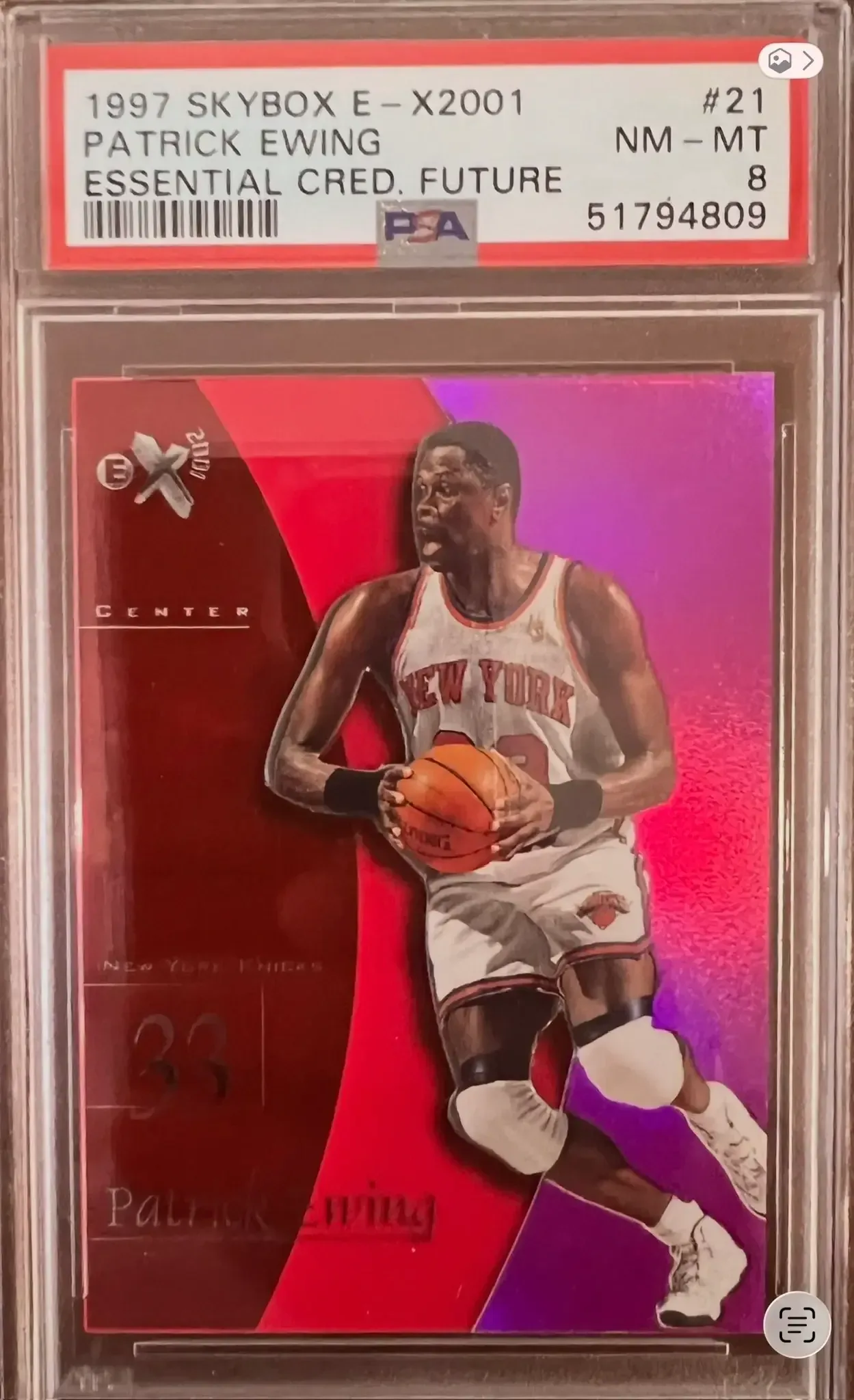
5. 1997 SkyBox E-X2001 Essential Credentials Future — PSA 8
The oldest card in the group is the 1997 SkyBox E-X2001 Essential Credentials Future Patrick Ewing, graded PSA 8. Its reported PSA population is one PSA 9, three PSA 8s and four PSA 7s. In other words, Di Meglio’s example belongs to a group of three PSA 8s, while no public sale has been recorded for the sole PSA 9 in the available data.
For the PSA 8 level, a public sale on August 17, 2023, reached $4,509 through Goldin. The reported raw range is $175 to $350. As with the Starquest and Kaboom!, that difference underscores that a raw price range is not a substitute for a graded sales record. It also highlights the value of identifying the full card name rather than reducing it to year and player. “Essential Credentials Future” is the relevant insert designation, and collectors need that detail to find suitable comparisons.
This card also shows the limits of headline numbers. The PSA 8 sale is a concrete, reported event, while the unrecorded PSA 9 result is an unknown, not a blank check for speculation. Market research is strongest when it identifies what was actually sold, in what grade, on what date, and through which marketplace.
How to read the five-card checklist
These five cards make a strong case for player-focused collecting as a research discipline. A super collector does more than accumulate duplicates or chase the biggest auction result. The work involves learning issue names, recognizing parallels, tracking stated print runs, checking population reports and separating evidence from assumption.
- Print run: A number such as /45, /50 or /100 indicates the stated production limit for that parallel. It does not reveal how many copies survive, are graded, or are for sale.
- Population report: This is the number of cards recorded at a grading company in particular grades. It is valuable context, but does not count raw cards or cards graded by competitors.
- Raw: A card that has not been encapsulated and assigned a grade by a third-party grader.
- Public sale: A reported transaction with a disclosed outcome. It is evidence of a sale at a moment in time, not necessarily a guaranteed current value.
- Comparable: A prior sale used to inform a potential value. The best comparables match card, parallel, grade and grading company as closely as possible.
The practical implication is that the “best” Ewing card depends on a collector’s goal. A person who values low stated production may prioritize Star Rubies or Precious Metal Gems. Someone interested in high-grade population scarcity may look at the Starquest Gold. A collector drawn to a later insert with documented sales in PSA 9 and PSA 10 may favor Kaboom! Essential Credentials Future, meanwhile, offers a particularly limited PSA count and a recorded PSA 8 benchmark.
For broader market context around modern sports-card releases and their themed inserts, see our coverage of Topps and Panini’s 2026 holiday sports-card releases.
Di Meglio’s collection demonstrates the advantage of depth. More than 1,420 distinct Ewing cards gives a single-player collector the opportunity to notice overlooked variations and distinguish a familiar base card from an important parallel or insert. These five selections, ranging from Essential Credentials Future to Precious Metal Gems, show that Patrick Ewing’s cardboard legacy contains far more than a single obvious chase card—and that careful labeling, grading context and documented sales are essential to understanding why each one stands out.