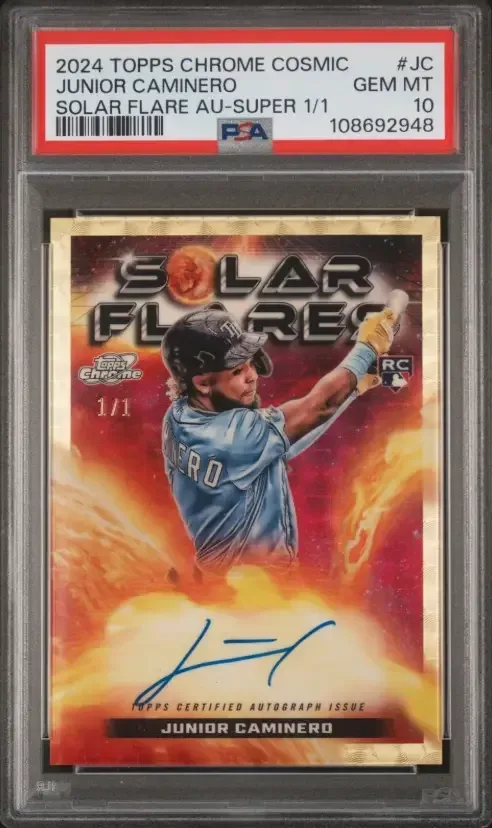
Pete Crow-Armstrong’s one-of-one 2024 Topps Chrome Update MLB Debut Patch Autograph has sold for $1.098 million, turning a card tied to his first Major League game into one of the biggest baseball-card transactions in the modern patch-card market.
The auction’s winning bid reached $900,000 after 30 total bids and 30 minutes of extended bidding. A 22% buyer’s premium raised the final amount to $1.098 million. That total landed agonizingly close to the current high for an MLB Debut Patch Autograph: Paul Skenes’ one-of-one, which sold for $1.1 million in March 2025. The gap is only $12,000.
It is a massive outcome, but the timing is just as important as the headline number. Crow-Armstrong had just finished a season in which he hit .280 with 45 home runs, 41 stolen bases, 119 runs and 107 RBI. He became the seventh player in MLB history to reach 40 home runs and 40 steals in one season, as well as the first Chicago Cub to do it. A card that documents his arrival in the majors is now being valued in light of what he has done since that moment.
What is actually in the card?
The card is not simply a rare parallel with an autograph attached. It combines several collecting elements that high-end buyers tend to value independently:
- One-of-one scarcity: Only one version of this specific card exists.
- A debut-worn patch: The patch originated from the jersey Crow-Armstrong wore during his MLB debut.
- An on-card autograph: The signature was placed directly on the card rather than on a separate sticker.
- Third-party grading: The card received a PSA Gem Mint 10, and its autograph received a PSA/DNA Gem Mint 10.
- Authentication: It is MLB Authenticated and MBA Silver Diamond Certified.
The patch is tied to Sept. 11, 2023, when Crow-Armstrong made his Major League debut at Coors Field against the Colorado Rockies. That specific connection matters. In collecting terms, provenance describes an item’s documented history and origin. The value proposition here is not merely that a piece of jersey material is inside a card; it is that the material is associated with an identifiable, foundational event in the player’s professional career.
That distinction separates an MLB Debut Patch from a manufactured patch. A manufactured patch is made for insertion into a card product and has no game-use history. A game-worn debut patch, by contrast, links the card to a jersey used in a real Major League game. Once that item is authenticated and paired with a unique autographed card, it becomes a compact piece of memorabilia, trading card and player history all at once.
The season changed the context around the patch
When Crow-Armstrong debuted in 2023, the patch marked the beginning of a career whose ultimate ceiling was unknown. Following his 45-homer, 41-steal regular season, that same artifact carries a much clearer narrative: it records the start of a player who has already delivered a historically uncommon power-and-speed campaign.
The 40/40 benchmark is particularly easy for collectors and fans to understand. It requires a player to combine two production categories that do not always travel together: home runs, which are a measure of power, and stolen bases, which reflect speed, timing and baserunning opportunity. Crow-Armstrong’s 45 home runs and 41 steals put him beyond the threshold rather than merely at it.
Related coverage includes Pete Crow-Armstrong MLB Debut Patch Autograph Sells for $1.098 Million.
Topps also commemorated the feat with 2026 Topps NOW Card #712. Topps NOW cards are timely releases built around a particular on-field accomplishment, while the debut-patch card is a premium, one-of-one artifact from a different product format. The two items serve very different portions of the market. One preserves the milestone in a broadly obtainable form; the other is an ultra-scarce centerpiece tied to the player’s debut.
That does not mean every Crow-Armstrong card should be read as a seven-figure asset. The sale instead highlights how sharply the market differentiates between a singular, authenticated patch autograph and standard issues, lower-numbered parallels, or cards without game-used material. Collectors should be careful not to treat a sale for a one-of-one as a simple pricing guide for every other card carrying the same player’s name.
Why the Skenes comparison is meaningful
Paul Skenes’ $1.1 million result remains the top sale for Topps’ MLB Debut Patch program, but Crow-Armstrong’s $1.098 million finish makes the comparison unavoidable. Both cards are one-of-one debut-patch autographs, and both derive much of their appeal from the collision of scarcity, authenticated game use and a young player whose career has attracted intense attention.
The $12,000 difference is small in percentage terms, though it should not be oversimplified. Auctions are not laboratory tests. The final result reflects the bidders present, their individual budgets, how urgently they wanted that precise item, and the amount of competition that survived into extended bidding. The 30 bids and half hour of extended action show there was substantial interest, but a one-of-one has no direct substitute. A buyer who misses it cannot simply locate another copy next week.
Nick Kurtz offers another useful reference point. His one-of-one MLB Debut Patch Autograph sold for $516,000 after more than four hours of extended bidding. The contrast between that figure and the Skenes and Crow-Armstrong prices illustrates both the upside of the format and its volatility. These are not commodity cards with a deep sales history. They are singular objects whose values are heavily influenced by the athlete, the moment represented, visual appeal, condition, certification and the bidders participating on the day.
A patch-card boom that now crosses sports
Baseball is not alone in turning debut-patch cards into marquee auction lots. The same basic concept has recently generated even larger basketball sales. Kon Knueppel’s one-of-one 2025-26 Topps Chrome NBA Debut Patch Autograph sold for $2.34 million, while Dylan Harper’s reached $2.88 million.
Cooper Flagg’s one-of-one NBA Debut Patch Autograph went still further, selling for $8.04 million. That result became the fifth-highest sports-card sale ever. The card drew substantial attention soon after it was pulled, with interest reported from auction houses, private buyers and public bounty offers before it was consigned.
These sales do not prove that every patch card is destined for seven figures. They do show that the debut-patch format has become a major high-end category in a short period of time. It gives card makers and collectors an unusually direct story to tell: this fabric was worn on the athlete’s first appearance at the sport’s highest level, and it is now housed in a unique signed card.
The market is also rewarding other combinations of elite player and one-of-one game-used material. Shohei Ohtani’s one-of-one 2025 Topps Chrome MVP Award Gold MLB Logoman Autograph sold for $3 million. Its ingredients differ from Crow-Armstrong’s card, but the underlying appeal overlaps: exceptional athlete, singular construction, autograph, and a meaningful piece of authenticated game-used memorabilia.
How collectors should read a headline sale
The practical lesson is not “buy any card with a patch.” It is to identify the specific qualities that made this card exceptional. Crow-Armstrong’s sale is built on the convergence of a one-of-one serial designation, a debut-game connection, direct autograph placement, top grades, authentication and a breakout season with a historic 40/40 achievement.
Collectors considering modern cards with memorabilia should read descriptions closely and distinguish among game-worn, player-worn and manufactured material. Those labels describe materially different relationships between the card and the athlete. They should also separate an issuer’s serial numbering from actual market liquidity. A card numbered 1/1 is uniquely scarce by definition, but that does not automatically establish demand or make valuation simple.
Grades are another component, not a universal answer. PSA Gem Mint 10 indicates that this particular card met the grader’s top condition standard, while the PSA/DNA Gem Mint 10 autograph grade speaks to the signature’s quality. The grades add reassurance and desirability, especially for a card with an embedded patch and a direct autograph, but the player and memorabilia story remain central to why bidders pushed the sale above $1 million.
For buyers operating far below this market tier, disciplined budgeting still matters more than the excitement of a record-adjacent result. The same approach used for fast-moving modern releases—setting a ceiling before chasing a card and comparing the exact version, condition and scarcity—remains sensible. Our guide to retailer watchlists and sensible price caps explores that broader collector habit in a different card category.
A beginning preserved at the highest end of the hobby
Crow-Armstrong’s card is now the clearest possible example of why debut patches resonate. It preserves a piece of the uniform from Sept. 11, 2023, but its auction result was shaped by everything that followed. A 24-year-old player’s 45-home-run, 41-steal season transformed the significance collectors attach to his first Major League appearance.
At $1.098 million, the card did not quite eclipse Skenes’ MLB Debut Patch benchmark. It did, however, make the margin almost microscopic and reinforce the modern market’s appetite for authenticated, game-worn, one-of-one cards attached to baseball’s emerging stars.