Randy Johnson’s baseball-card story is a useful reminder that greatness on the field and status in the hobby do not always move in lockstep. Johnson finished his career second on baseball’s all-time strikeout list with 4,875, behind only Nolan Ryan’s 5,714. He won five Cy Young Awards, posted 101.1 career WAR, and did so while pitching roughly 1,250 fewer innings than Ryan. Yet collectors have historically assigned Johnson a markedly smaller premium than the longtime hobby titan.
That gap is not merely an argument about which pitcher was better. It is about when their cards arrived, how many were printed, which designs became cultural touchstones, and whether an individual card offered a compelling scarcity story. Ryan’s career began in 1966 and spanned 27 seasons, letting multiple generations encounter him as an active player. Johnson entered mainstream card sets during the overproduced late-1980s and early-1990s period often called the junk-wax era, when billions of cards were printed.
Johnson’s market, however, has recently shown momentum. His market index rose 131% over two years. That does not make every Randy Johnson card rare, nor does it make a past sale a guarantee of a future one. It does make the differences among his cards especially important. A collector can find inexpensive base issues from his era, while a relatively short list of rookie cards, corrected-error variants, premium parallels, and early serial-numbered cards carries a very different profile.
The five cards below are not simply the most expensive Johnson cards. They map out the major routes by which a player from an era of enormous print runs can acquire hobby significance: a limited minor-league first card, a premium version of an overprinted rookie, an error variation, a landmark parallel, and a celebrated limited card from the 1990s.
Why Johnson’s cards occupy an unusual value tier
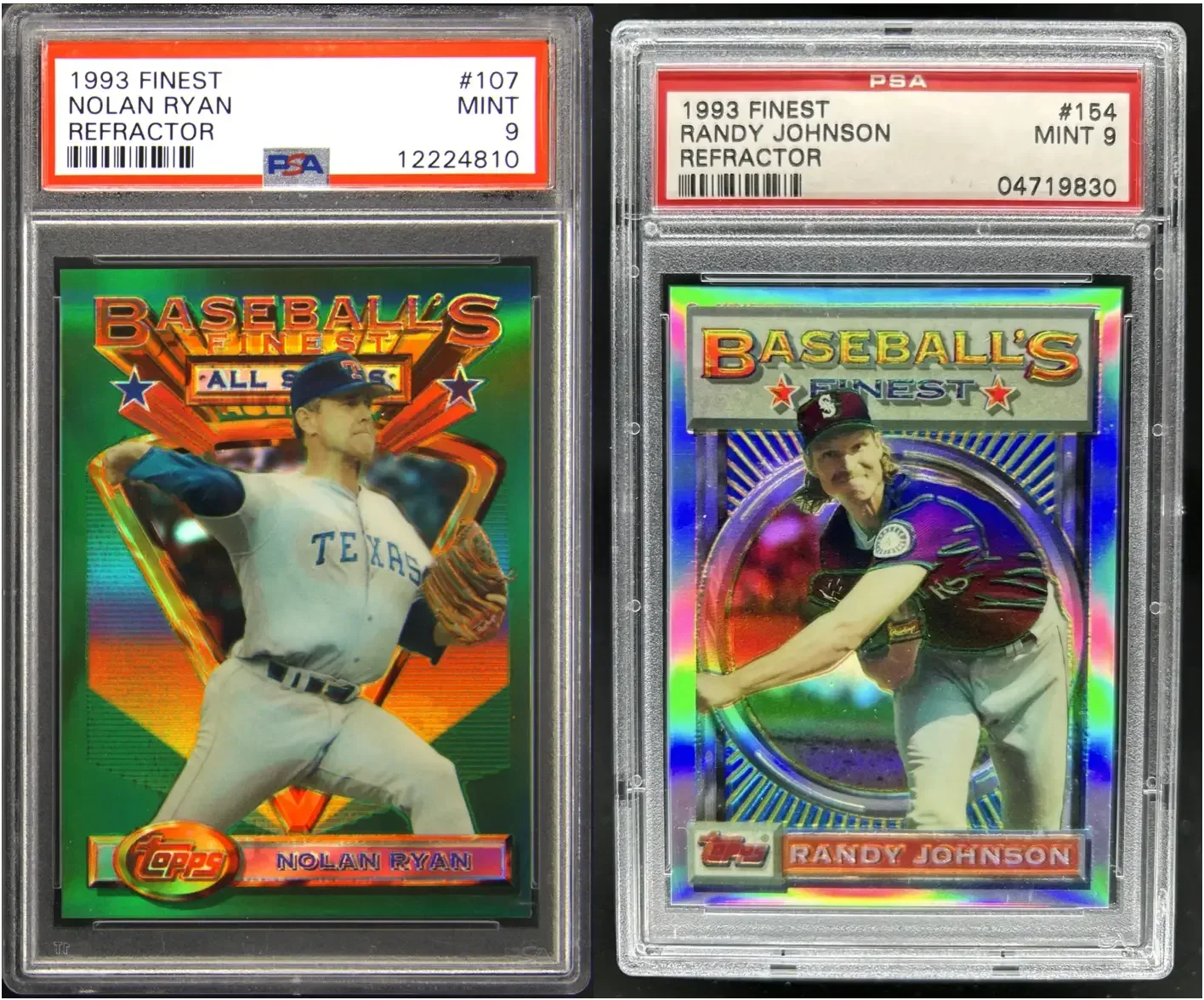
Comparisons with Ryan make the divide plain. A PSA 10 1991 Topps Tiffany Nolan Ryan #1 recently sold for $3,000, while a PSA 10 1991 Topps Tiffany Randy Johnson #225 last sold for $196. In 1993 Topps Finest Refractors, a PSA 9 Ryan #107 recently sold for $13,500; a Johnson #154 in the same grade sold for $1,550.
Those pairings matter because they reduce a few variables. The cards come from the same products and are assessed in the same grading tier, so the comparison illustrates player demand as well as scarcity and set appeal. It does not prove that Johnson cards are overlooked or that they must rise to Ryan’s level. It does show that extraordinary career credentials alone have never been the whole pricing equation.
For newer collectors, a few terms are worth separating. A parallel is a version of a base card produced with a different finish, color, or stated limitation. A refractor is a shiny, reflective parallel treatment associated with 1990s premium cards. PSA population means the number of examples PSA has graded, not necessarily the total number in existence. And a number such as “/30” indicates an announced production cap of 30 copies. These measures all inform scarcity, but none by itself determines demand.
The wider card world also rewards the visual language of particular sets. Johnson’s defining cards include the bright paper-stock distinction of Topps Tiffany, Fleer’s awkward attempt to remove a background tobacco advertisement, mirror-finish Select Certified parallels, and the gleaming Precious Metal Gem design. Collectors are often buying that shared set history along with the player.
1. 1986 ProCards West Palm Beach Expos
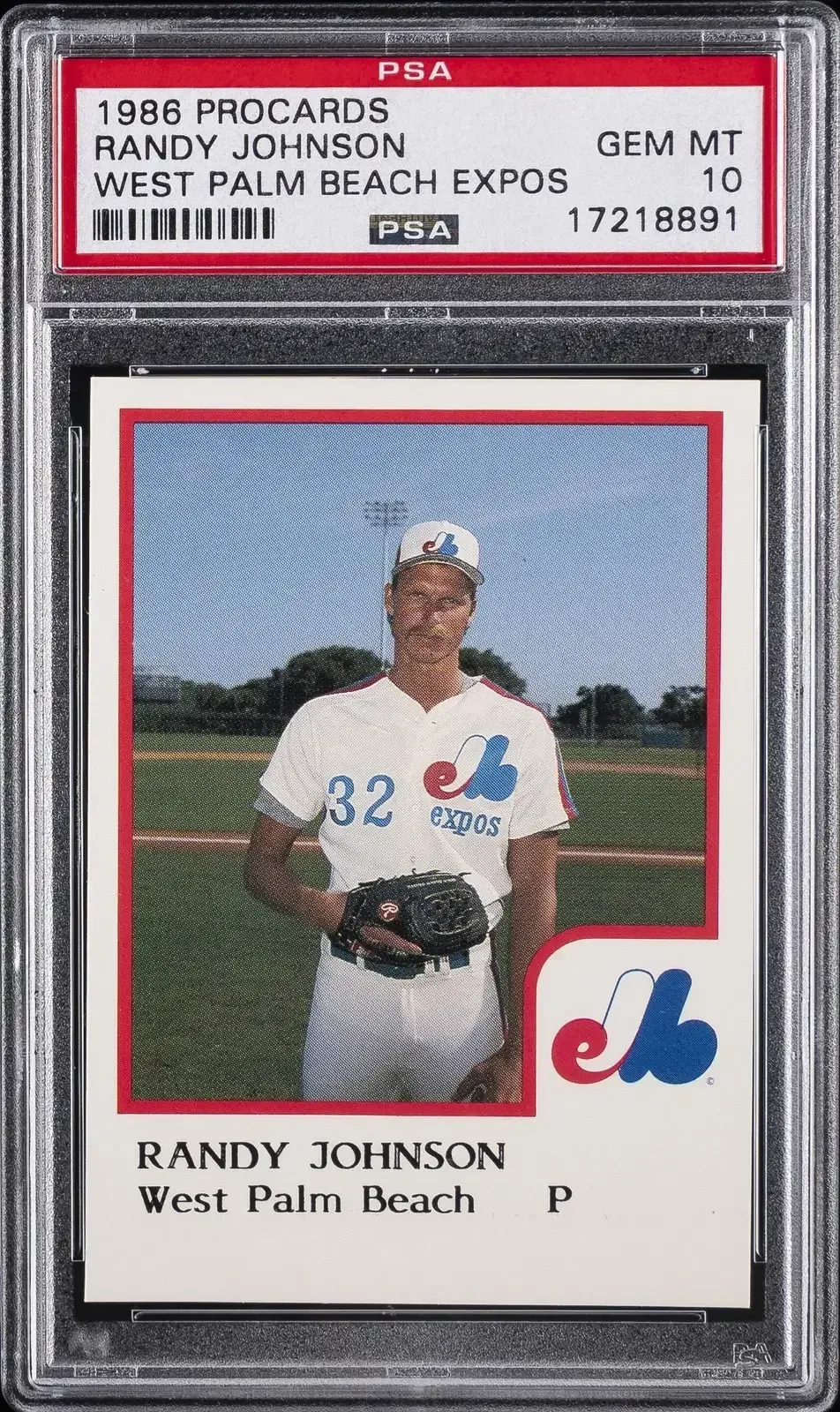
Johnson’s first baseball card is a 1986 ProCards West Palm Beach Expos issue, depicting the future Big Unit shortly after the Montreal Expos selected him in the second round, 36th overall, of the 1985 MLB Draft. The Braves had drafted him in the fourth round out of high school in 1982, but Johnson instead attended the University of Southern California.
This card’s appeal begins with chronology: it is the first stop in a Johnson collection. It also comes from an 1980s minor-league team set rather than a standard national release, which means its production was limited compared with a major Topps issue. That makes it a fundamentally different proposition from familiar late-1980s mass-market rookies.
Recent reported sales underline how sharply grade can matter on early cards. A PSA 10 sold for $2,500, while a PSA 9 sold for $325. PSA has graded 349 copies in total, with 46 at PSA 10. The large divide should not be read as a universal price rule, but it illustrates why collectors should identify both the exact issue and its grade before using any sale as a comparison.
For a collector building around Johnson rather than simply chasing a famous design, the ProCards serves as the cleanest origin point. It predates his major-league rookie cards and preserves the prospect-stage context that the later Seattle imagery and 1990s inserts cannot offer.
2. 1989 Topps Tiffany #647
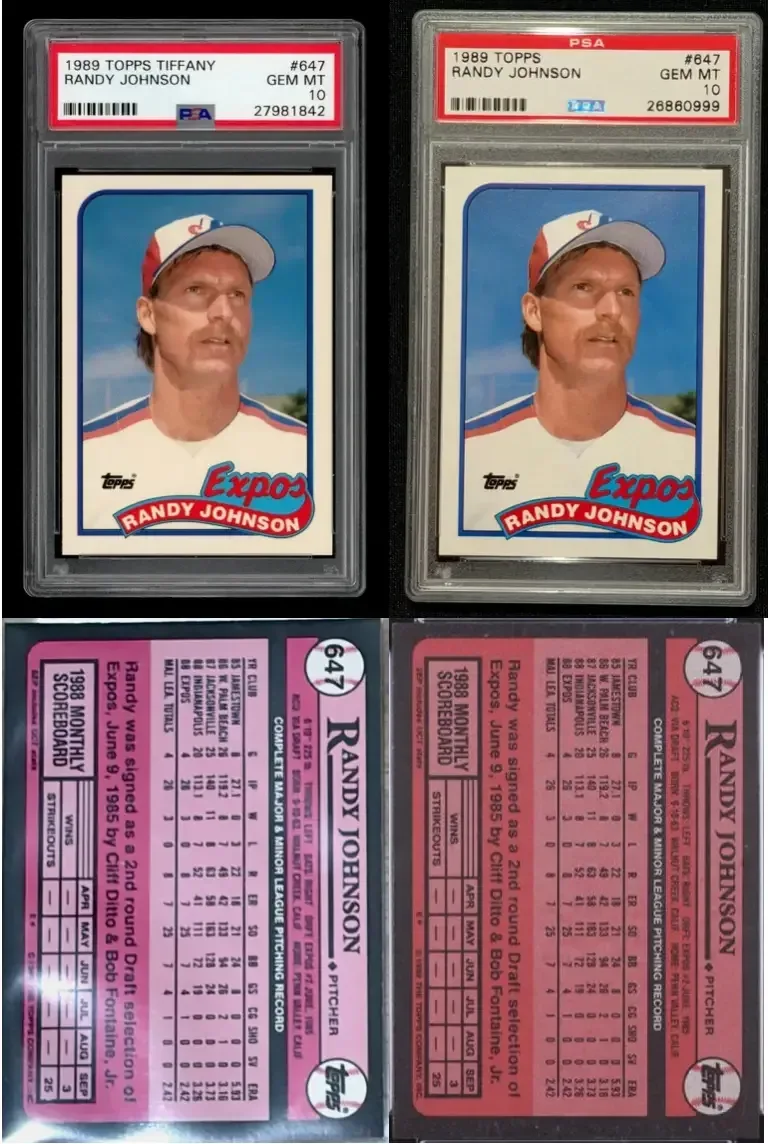
The 1989 Topps card is Johnson’s familiar mainstream rookie image. The Tiffany edition uses that same image, but was made in far smaller quantities than regular Topps. Its key appeal is therefore straightforward: it combines the recognizability of a traditional rookie card with a significantly tighter surviving graded population.
Topps Tiffany cards were among the early premium and scarce alternatives within the junk-wax period. The front can look nearly identical to the ordinary version, so identification matters. The brighter cardstock on the back is the easiest stated visual distinction. Collectors should not assume that a familiar 1989 Topps front is automatically Tiffany.
The grading figures make the scarcity contrast concrete. PSA has graded 14,385 copies of Johnson’s regular 1989 Topps card, nearly 10 times the 1,349 total graded Tiffany copies. More strikingly, there are 1,838 PSA 10 examples of the standard card—more than the entire graded population of the Tiffany issue.
A recent PSA 10 Tiffany sale reached $6,000, compared with $400 for a PSA 9. The PSA 10 population is 112. These are reported sales rather than fixed values, but the numbers explain why this is Johnson’s premier conventional rookie-card target for collectors who want a scarce version without leaving the classic 1989 rookie image behind.
3. 1989 Fleer #381 with the Marlboro advertisement visible
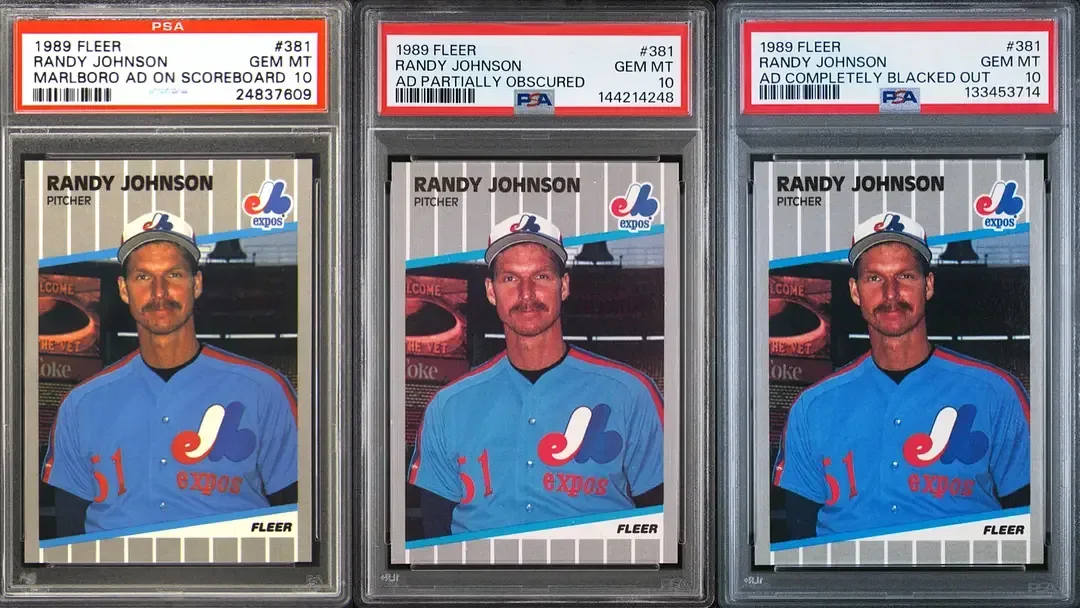
Johnson’s 1989 Fleer rookie is an error-card landmark. In its original form, a Marlboro advertisement appears on the scoreboard in the background. Fleer then altered later print runs to obscure the ad, an especially consequential problem for a product aimed at children. The result was not one tidy corrected version but a sequence of changes that spawned 13 identified variations.
PSA recognizes three broad forms: the advertisement visible, partially obscured, and completely blacked out. The fully visible version is the rarest and most sought-after of those major categories. That makes this card interesting for a reason that has little to do with Johnson’s pitching record: it captures a production correction unfolding in real time.
A recent PSA 10 sale for the visible-ad version was $1,475, while a PSA 9 sold for $385. PSA’s total population for the card is 967, with 110 PSA 10s. The important practical point is precision. “1989 Fleer Randy Johnson rookie” is not enough information for a reliable comparison. Collectors need to establish which variation they have, because the visible-ad version, partial obscuring, and blacked-out forms are not interchangeable.
This is also the most approachable kind of iconic card conceptually. Even collectors who do not pursue printing variations can understand the narrative at a glance: a background advertisement appeared, the manufacturer tried to remove it, and the successive fixes became part of the card’s identity.
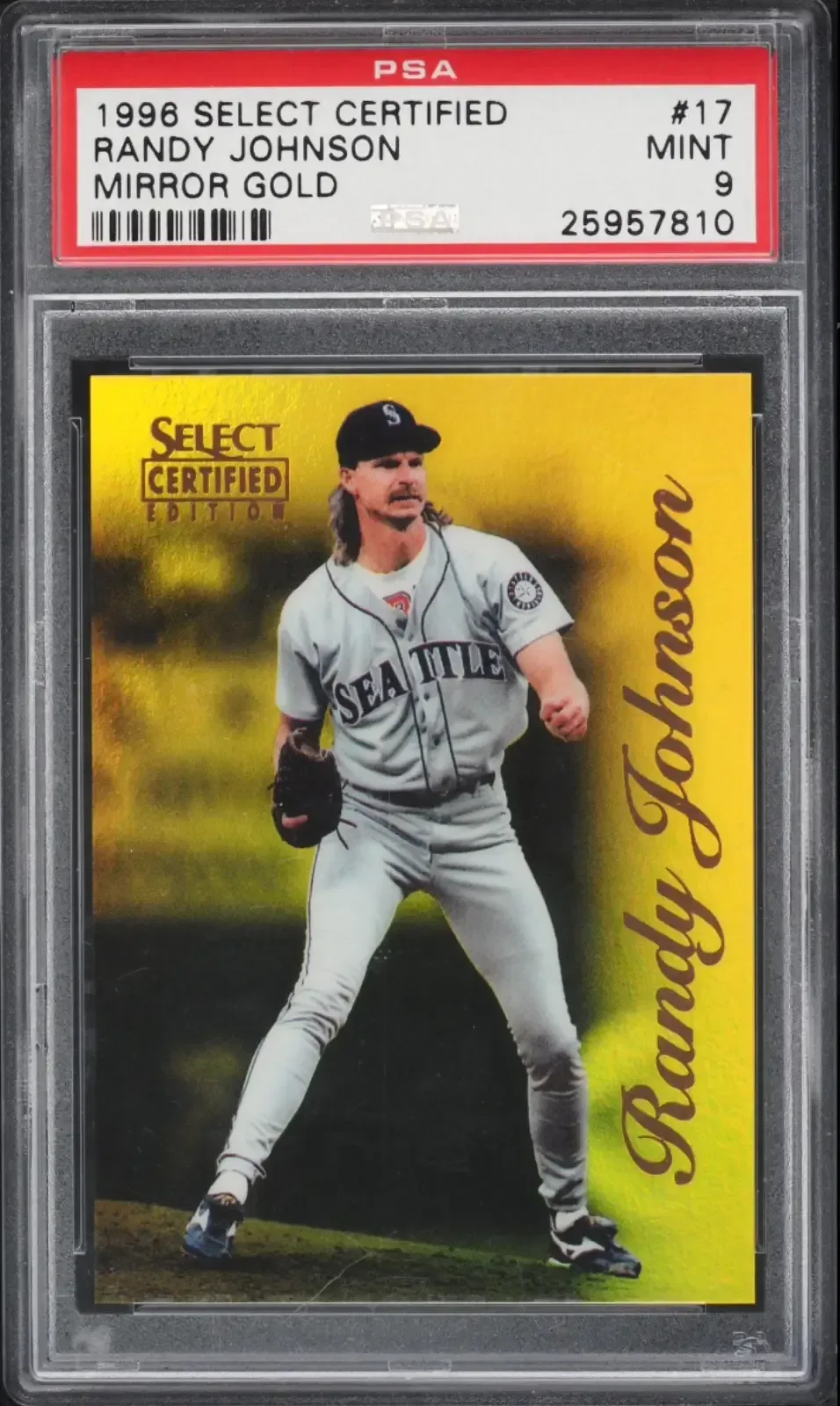
4. 1996 Select Certified #17 Mirror Gold /30
The 1996 Select Certified Mirror Gold marks a different phase of the hobby. It is one of the notable 1990s parallel cards and was limited to 30 copies. Rather than relying on a rookie designation or a production error, its stature comes from deliberate scarcity and the Mirror parallel format.
The base Select Certified card had a stated run exceeding 50,000, and the set also included Certified Red /1800, Artist’s Proof /500, Certified Blue /180, Mirror Red /90, Mirror Blue /45, and Mirror Gold /30. Together, those versions form what collectors call a rainbow: a player’s multiple parallel versions from the same card design. The descending print limits give the Mirror Gold a clear place at the top of that ladder.
Only 12 copies have been graded by PSA, including one PSA 10. Recent reported sales include $5,400 for a PSA 9 and $3,500 for a PSA 8. With a card limited to 30, individual sales can be infrequent, and a small number of transactions should be treated carefully. Still, the limitation explains why this Johnson is dramatically scarcer than most early-career issues.
The Mirror Gold is crucial in explaining Johnson’s collecting appeal because it links him to a set-driven 1990s category. A collector may want it not just as a Johnson card but as a key example of a landmark parallel era. That overlap between player collecting and set collecting can broaden attention for cards whose players were not hobby superstars on Ryan’s level.
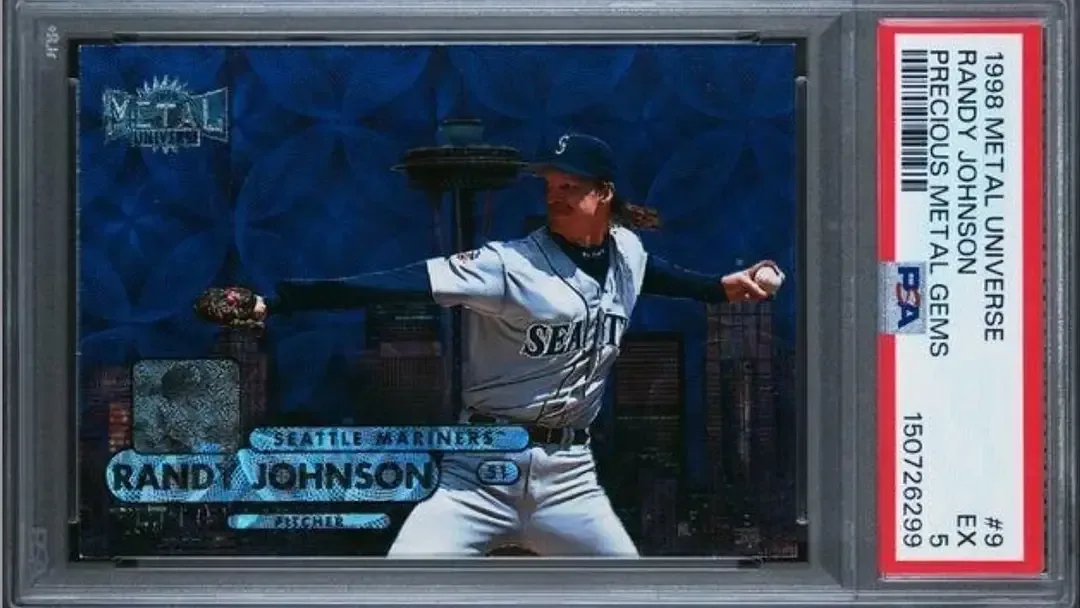
5. 1998 Metal Universe #9 Precious Metal Gem
The 1998 Metal Universe Precious Metal Gem, often shortened to PMG, is the most conspicuously scarce card in this group. Just 50 copies were produced. Its design uses the Seattle Space Needle in the background, tying it directly to Johnson’s Seattle identity, while its vivid metallic look belongs to the flashy 1990s visual style that has become central to PMG appeal.
A PSA 5 copy sold for $6,178 on July 27, 2026. PSA’s population is nine. The grade is essential context: collectors should not treat that sale as the value of every copy, much less compare it casually with a higher-grade card from a different set. With a 50-card print run and only nine PSA-graded examples reported, the market has limited public reference points.
The PMG’s importance also reveals a useful distinction between rarity and accessibility. The standard 1998 Metal Universe #9 has the same Space Needle-centered design and can be found raw for a dollar or two. The base and PMG versions share an aesthetic identity but sit at entirely different scarcity levels. That gives collectors a way to appreciate one of Johnson’s most memorable designs without confusing a low-cost base card with the 50-copy parallel.
For those whose interest is specifically the history of 1990s inserts and parallels, the PMG is the signature Johnson card. It combines an extremely limited production run, a widely celebrated card format, and a player/set connection visible in the design itself.
Other Johnson cards that deepen the checklist
Several honorable mentions provide alternative routes through Johnson’s catalog. The 1991 Topps Desert Shield #225 is another scarcity-focused issue; a PSA 10 sold for $1,600 in 2025. The 1993 Finest #154 Refractor is a major early refractor entry and provides the set context for the $1,550 PSA 9 sale noted above.
Collectors seeking later 1990s limitations can look to the 1997 E-X2000 #41 Essential Credentials /99, the 1997 Flair Showcase Legacy Collection Row 1 #20 Masterpiece 1/1, and the 1998 E-X2001 #73 Essential Credentials Now /73. At the contemporary end of the supplied list is the 2025 Topps Dynasty Dynastic Deed Perfect Game Patch Auto 1/1. These cards vary radically in format, but all illustrate the same collecting lesson: a player with abundant base cards can still have a narrow tier of cards defined by an explicit cap, a special treatment, or a singular production status.
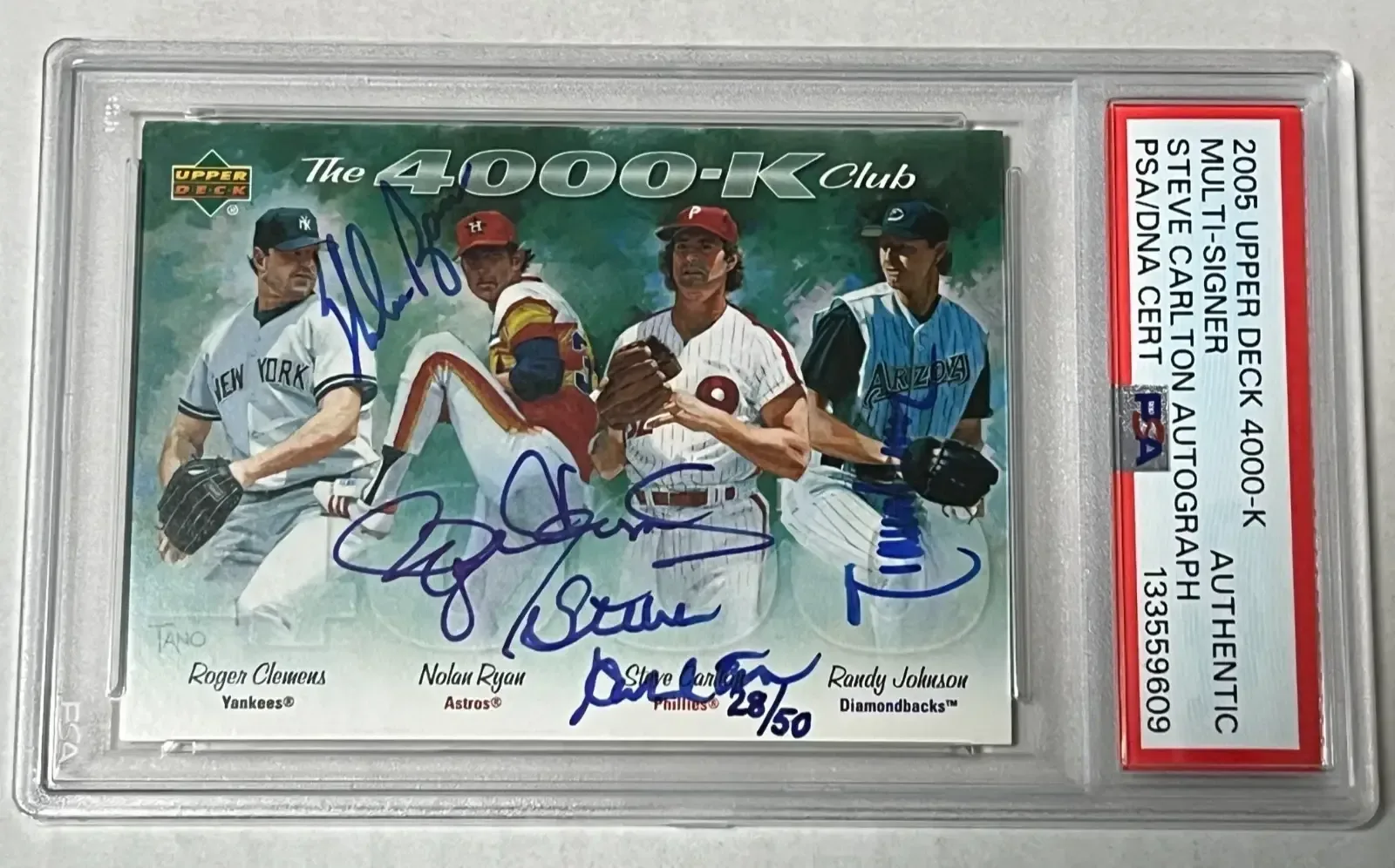
Johnson also appears on the 2005 Upper Deck 4000 Strikeout Autographs quad autograph alongside Ryan, Steve Carlton, and Roger Clemens, the four members of the 4,000-strikeout club. One recently sold for $5,500. That card is a different kind of collectible again: its draw is not a rookie status or a parallel rainbow, but the intersection of four historic strikeout careers and four signatures.
For collectors deciding where to start, the sensible first question is not which card is “best.” It is which story matters most. The ProCards is the first-card chase; Topps Tiffany is the premium traditional rookie; Fleer is the variation story; Mirror Gold is the serial-numbered parallel milestone; and the PMG is the high-end 1990s design icon. Those distinctions offer a more useful way to navigate Johnson’s market than treating all cards bearing one of baseball’s greatest power pitchers as equivalent.
Collectors tracking both sport and memorabilia may also enjoy the broader intersection of football culture and collectibles in this look at a sneaker gift during a Sunday Night Football broadcast.