Pokémon TCG: 30th Celebration launches worldwide on September 16 with plenty of obvious collector bait: 30 Pikachu illustrations, Classic Collection reprints, anniversary branding, and the general gravitational pull of a major milestone. Yet one of the set’s most interesting additions is not simply another popular Pokémon in a fancier frame. It is an entirely new card designation: Futuristic Rare, abbreviated FUR.
New rarities always invite the same immediate questions. Is this the next permanent tier in the Pokémon TCG’s chase-card hierarchy? Is it a short-lived visual experiment? Does a limited number of cards make the rarity inherently valuable? The responsible answer to all three is: not yet. Futuristic Rare has only two debut cards, and its long-term role has not been formally established.
That uncertainty does not make the cards uninteresting. Quite the opposite. Mew and Mewtwo are two of the franchise’s most durable collector favorites, and their designs are closely tied to the identity of 30th Celebration. But collectors considering the cards should distinguish between the appeal of these specific releases and the idea that a rarity label, by itself, guarantees a durable premium.
The two Futuristic Rare cards in 30th Celebration
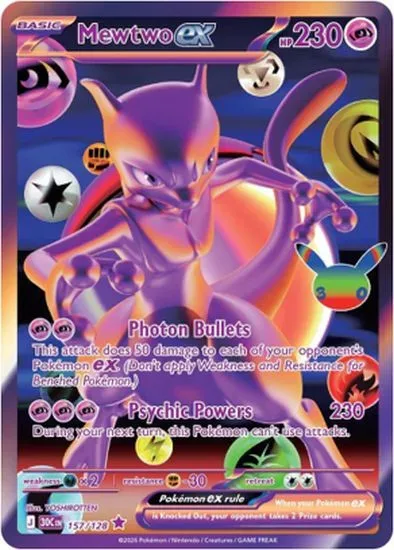
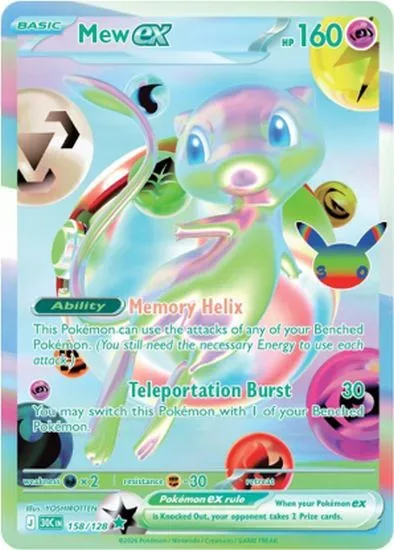
Futuristic Rare begins with just two cards in the main set:
- Mewtwo ex (157/128)
- Mew ex (158/128)
Both were illustrated by YOSHIROTTEN, whose work also appears in the set’s key art and on its anniversary Basic Energy cards. That gives the two FUR cards a coherent place within the larger visual presentation rather than making them feel like unrelated high-number variants.
The defining look is intentionally elaborate. Each Pokémon appears in a metallic, holographic treatment over a futuristic setting. All nine Energy symbols ring the composition, a Poké Ball is incorporated into the artwork, and the 30th-anniversary logo carries holographic color. The rarity indicator is a star whose tint corresponds with the leading color of the individual card. The overall concept is intended to evoke optimism about an unknown future.
In a hobby where a card’s visual identity can matter as much as its checklist position, those details count. These are not merely standard Mew and Mewtwo ex cards given a reflective surface. Their treatment is a complete design package built around the anniversary and a single artist’s aesthetic.
Checklist order does not define a rarity tier
The two Futuristic Rares occupy the very end of the numbered 30th Celebration set. The Special Illustration Rare Pikachu ex cards are numbered 149/128 and 150/128, while Mewtwo ex and Mew ex follow at 157/128 and 158/128.
Related coverage includes Pokémon TCG Futuristic Rare Debuts in 30th Celebration With Mew and Mewtwo Leading the Chase.
It would be easy to read that placement as a definitive declaration that FUR is the top rarity. It is not that simple. No formal rarity hierarchy has established Futuristic Rare’s position. Set databases currently list it between Ultra Rare and Special Illustration Rare, but a cataloging convention is not the same thing as a confirmed statement about pull rates, future usage, or collecting status.
Numbering is useful for building a binder and identifying a card. It is much less reliable as a prediction tool. Pokémon has repeatedly shown that rarity names can be temporary, era-specific, or foundational. The crucial question is not whether Futuristic Rares sit late in one checklist; it is whether the game continues to make them.
Pokémon’s previous rarity experiments point in different directions
There is no single historical outcome for a new Pokémon TCG rarity. Some treatments arrive, make an impression, and disappear. Others become part of the hobby’s basic vocabulary. Futuristic Rare could resemble either path, though its debut circumstances provide some clues.
Amazing Rare was memorable, but brief
Amazing Rare first appeared in Vivid Voltage in November 2020, then returned in Shining Fates in February 2021. Across those releases, there were nine Amazing Rare cards. The treatment had a distinctive multicolored look and remains recognizable to collectors, but it did not become a recurring structural rarity after that small window.
That history matters because it demonstrates the difference between recognition and perpetual market escalation. A rarity can be visually memorable and permanently limited without becoming a universal high-end collecting pillar.
Radiant Pokémon had a longer run, then stopped
Radiant Pokémon arrived in Astral Radiance in May 2022. The mechanic continued through the latter portion of the Sword & Shield period, but did not move into the Scarlet & Violet base set. Its multi-set run made it more than a one-release curiosity, yet it was still tied to an era rather than installed as a permanent tier.
That is another useful reminder for anyone treating a new label as an automatic long-term investment thesis. A rarity can last for a while and still be retired when a new block begins.
Illustration Rare became part of the modern framework
Illustration Rare and Special Illustration Rare provide the counterexample. Both began with the Scarlet & Violet base set on March 31, 2023, and have remained regular fixtures since. They are now central to how modern Pokémon sets are collected, providing art-focused targets across a wide range of Pokémon and serving as key high-end chases.
The context of that debut was different. Illustration Rare launched at the opening of an era, where it could be established as continuing set architecture. Futuristic Rare is entering through a self-contained 30th-anniversary release, visually centered on one guest artist and a specific celebration. That does not prove it will vanish after this set. It does, however, make the comparison to a contained novelty such as Amazing Rare more natural than the comparison to Illustration Rare.
Scarcity is only one part of card value
Collectors and speculators often treat discontinuation as a built-in price floor: if a rarity is never printed again, the logic goes, every example should steadily become more desirable. History is much messier. A short production life creates a finite supply, but supply only becomes powerful when enough people want what is scarce.
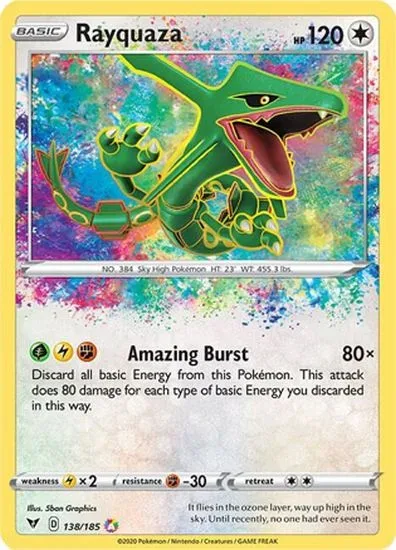
Rayquaza (138/185) from Vivid Voltage is a practical example. It is among the best-known Amazing Rares from a rarity that appeared for only a few months and never returned. Despite that permanent scarcity, ungraded copies are around $26 on the secondary market six years later. The figure can move with condition, venue, timing, and broader market activity, but the larger lesson holds: rarity discontinuation alone did not turn every Amazing Rare into a major-value card.
Scarcity describes how many cards may exist. Demand decides how many collectors feel they need one.
Character choice is therefore hugely important. Mewtwo has a long record as a centerpiece Pokémon: iconic, visually imposing, and strongly associated with the franchise’s early mythology. Mew carries an equally potent but different appeal, blending first-generation nostalgia with a playful, elusive design. Putting both on an anniversary-exclusive-looking art treatment gives Futuristic Rare far better raw collector ingredients than a new rarity attached to less broadly desired Pokémon might have.
The art is another independent reason to care. YOSHIROTTEN’s holographic metallic style, the Energy-symbol ring, and the anniversary mark make these cards immediately legible as 30th Celebration pieces. A collector who wants a distinct Mew or Mewtwo display card has a clear case for pursuing one, regardless of whether FUR survives into the next release cycle.
A sensible way to evaluate Mew ex and Mewtwo ex
For collectors, the strongest case for these cards is specific rather than abstract. Consider them through the attributes that would still matter if the Futuristic Rare name never appeared again:
- Pokémon popularity: Mew and Mewtwo have deep, cross-generational demand.
- Artistic identity: The cards have a highly specialized look tied to YOSHIROTTEN and the anniversary package.
- Event significance: They are part of a 30th Celebration set, not a routine release.
- Checklist scarcity: Only two FUR cards debut in the main set, though a low card count does not reveal a complete supply picture.
- Condition and presentation: Surface quality, centering, print behavior, and how well the holo treatment holds up will matter to collectors over time.
What should not carry the entire decision is the assumption that “Futuristic Rare” will necessarily become a permanent, top-end Pokémon TCG category. There is simply no published confirmation of that. The rarity may recur, may evolve, or may remain a 30th Celebration-only flourish.
That uncertainty is not a reason to dismiss the cards. It is a reason to buy with the right motivation. Mew ex (158/128) and Mewtwo ex (157/128) have a compelling collector story because of their characters, their art, and their anniversary connection. The rarity symbol is a fascinating new detail, but it is not the whole thesis.
Collectors tracking markets across categories may recognize the same distinction in our sports card heat check: attention, player or character appeal, and a collectible’s visual and cultural story can matter at least as much as a limited label. Futuristic Rare has the ingredients for memorable cards. Whether it becomes enduring Pokémon TCG infrastructure remains an open question.