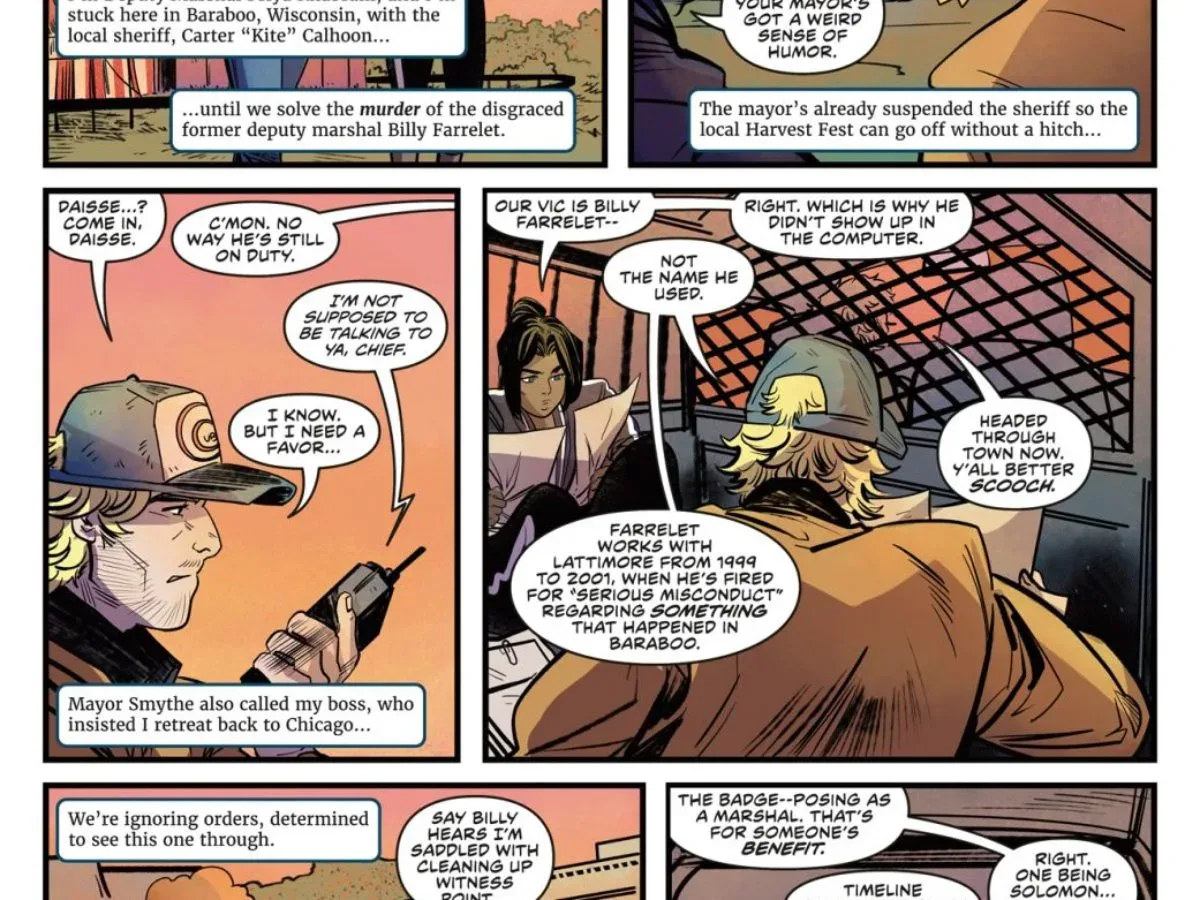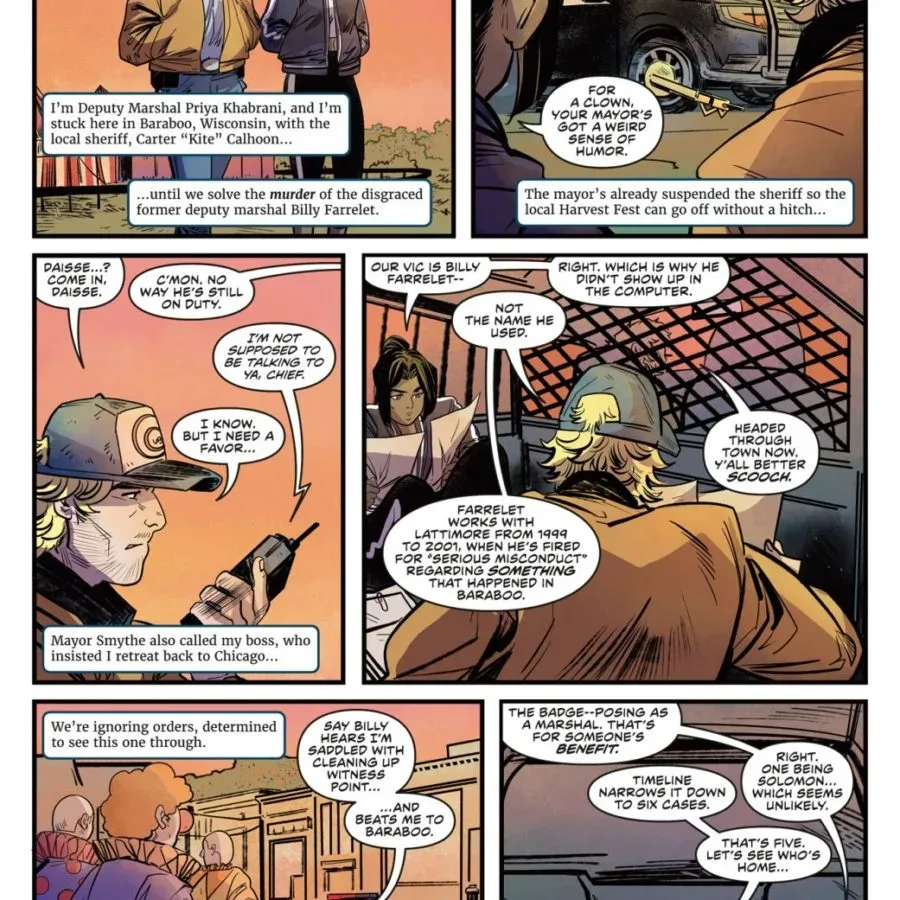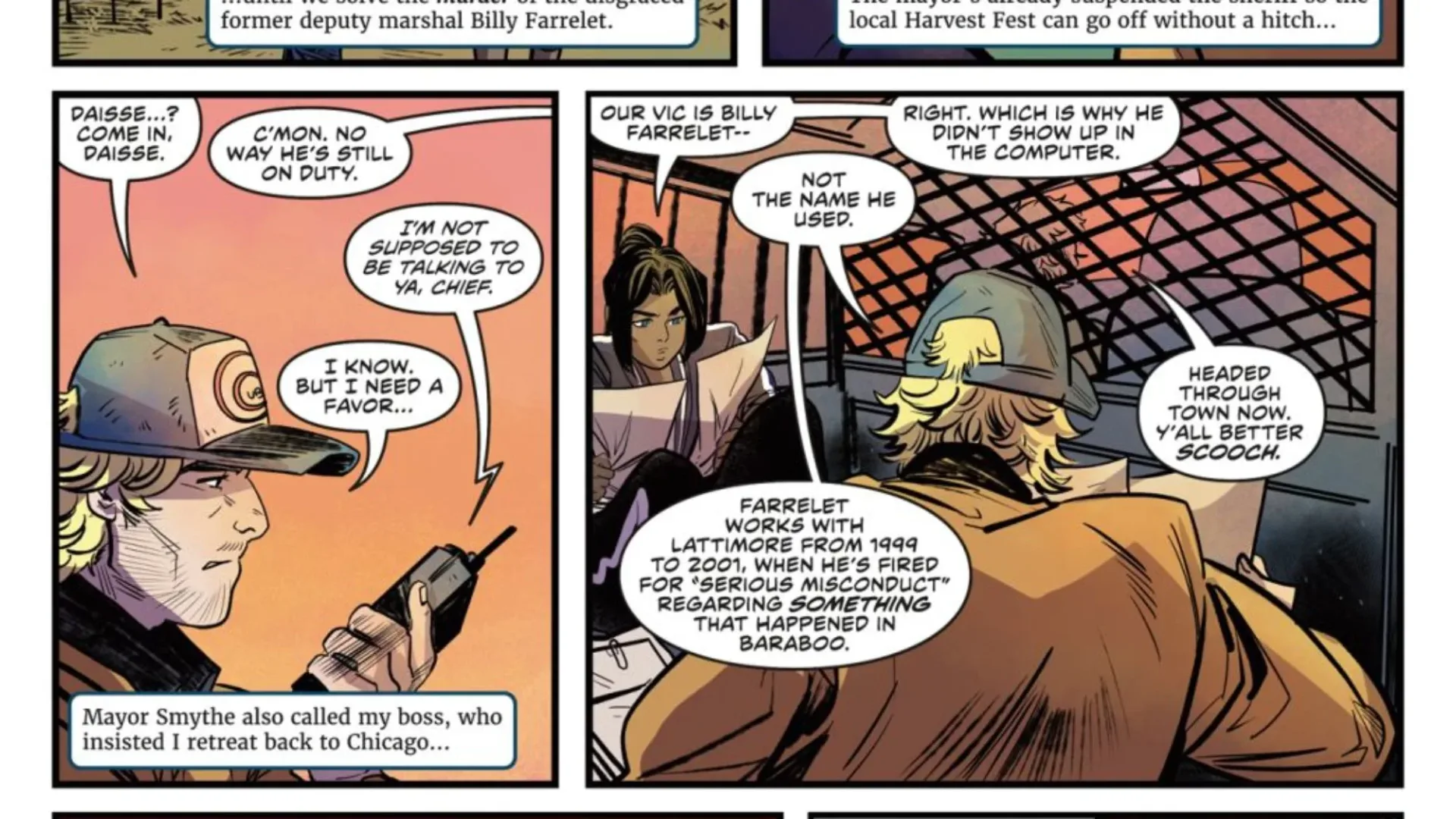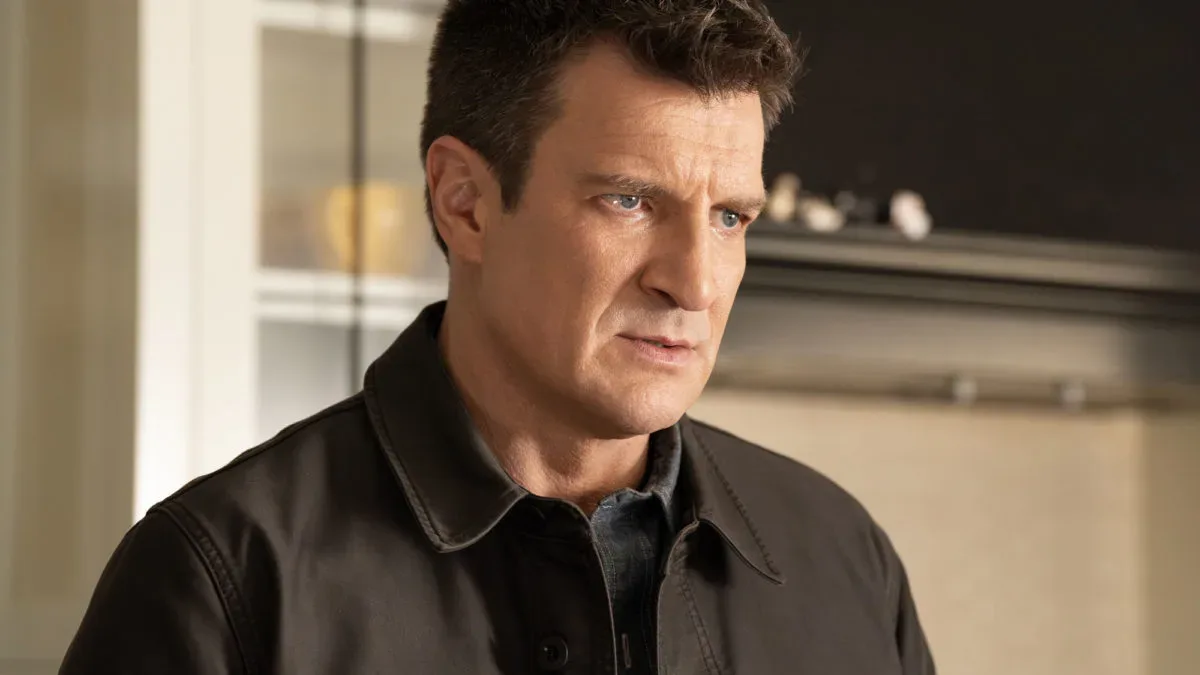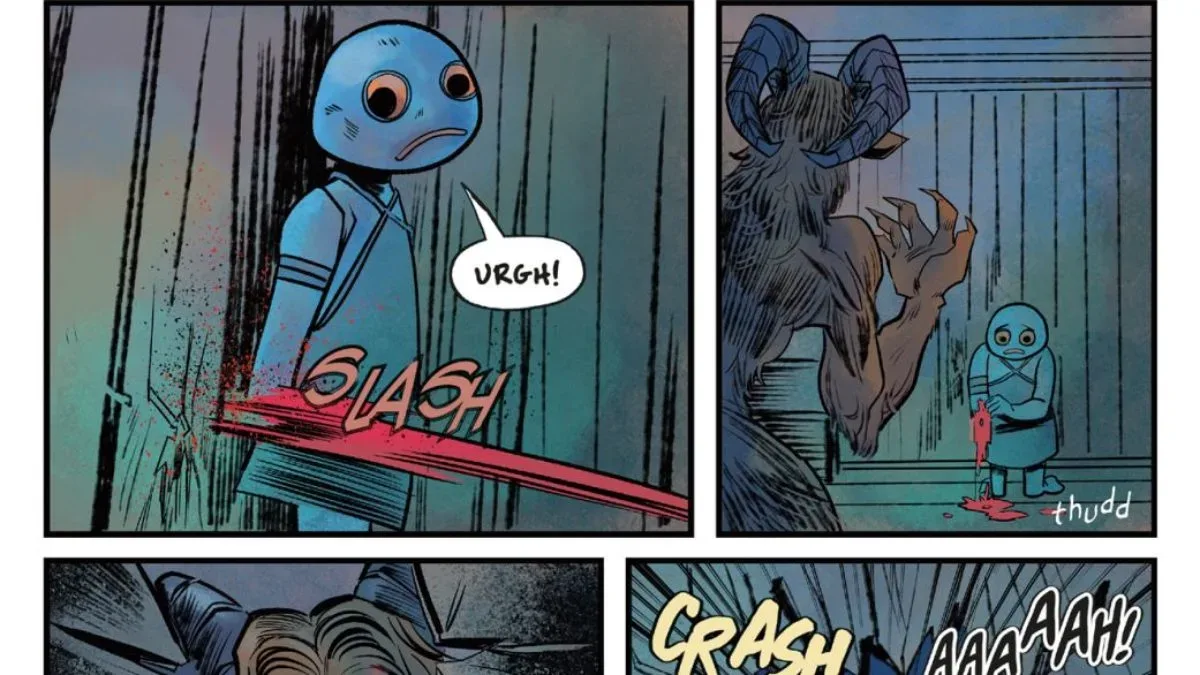
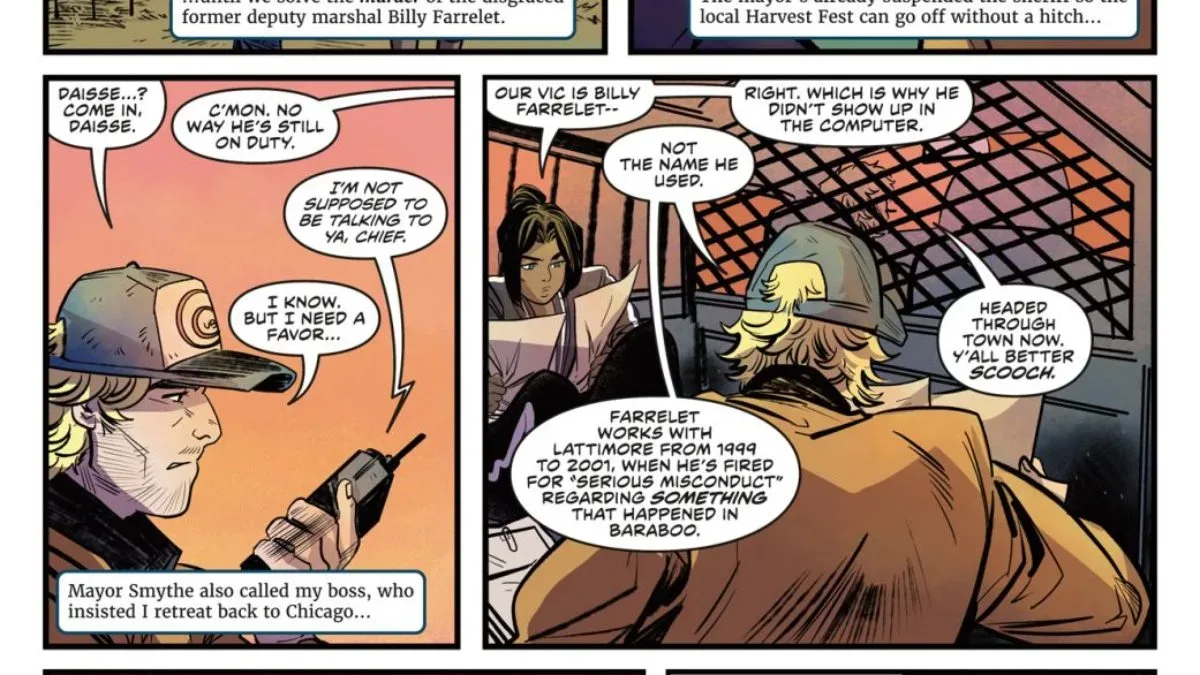
Witness Point #4 brings the four-issue murder mystery to its advertised finish on November 25, 2026. Published by Dark Horse Comics, the 32-page, $4.99 issue reunites the credited creative team of Nathan Fillion, writer Heath Corson and artist Soo Lee, who also provides the cover. It is rated T+.
The finale places its central investigation under a distinctly inconvenient deadline: the Baraboo Harvest Festival and its circus parade are about to bring crowds of tourists into town. Sheriff Calhoon and Deputy U.S. Marshal Khabrani are racing to identify a killer while contending with the mayor’s agenda, the town’s buried information and an emerging threat from the True Crime Club.
That club’s podcast is not simply background color. The stated danger is that it could reveal the truth about Witness Point itself, putting everyone in the program at risk. The series has framed its setting as a witness-protection community, making exposure a practical threat to many people rather than merely an embarrassing revelation for one suspect.
A finale built around competing clocks
A mystery finale generally has to answer two questions at once: who committed the crime, and whether the people investigating it can act before the situation gets worse. Witness Point #4 has several pressures working at the same time. Calhoon and Khabrani need to continue an investigation despite orders that would pull them away from it. The mayor wants a public event to proceed without disruption. And the podcast’s potential disclosure could permanently change the safety of the community.
The festival provides a useful setting for that collision. A crowded celebration may be good for a town’s image, but it can also complicate a police investigation. In the issue’s setup, crowds are not presented as allies in finding the truth. They are oblivious tourists arriving as the investigators try to separate real leads from local maneuvering. The approaching parade consequently raises the stakes without requiring the story to leave its small-town setting.
The description also deliberately leaves the identity of the culprit uncertain, even teasing the possibility of more than one murderer. That wording should not be read as confirmation of multiple killers; it is a question posed by the solicitation. Still, it signals that the final issue is meant to preserve uncertainty around the case rather than treating the culprit as already obvious.
What “Midwestern noir” means for this premise
The book is described as a Midwestern noir. Noir is a crime-fiction mode commonly associated with moral pressure, secrecy, compromised institutions and protagonists trying to find clarity in situations designed to obscure it. Here, the noir ingredients are plainly visible in the material provided: murder, a politically motivated desire to keep a festival orderly, a town with secrets, and investigators operating under constraints.
Adding “Midwestern” establishes a contrast with the genre’s more familiar city-at-night imagery. Witness Point instead centers on a community preparing for a public festival. That does not make the danger less severe. It makes the tension more public: a town may be presenting normality to visitors at the exact moment its internal arrangements are most vulnerable.
The witness-protection angle is particularly suited to a noir structure. “Witness protection” refers to measures intended to keep at-risk witnesses safe, often by shielding their identities and locations. The supplied premise calls Witness Point a community tied to that program. If a podcast identifies its secret, the fallout extends beyond spoiling a mystery. Exposure can create a direct danger for people whose safety depends on anonymity.
The podcast is part of the story’s danger, not a side gag
The True Crime Club’s podcast introduces a modern mechanism for escalating an old-fashioned whodunit. A podcast is an episodic audio program distributed for listeners, and true-crime programming often focuses on real or fictional criminal cases. In this story, the club’s planned episode threatens to turn private information into a public broadcast. The problem is therefore not only whether Calhoon and Khabrani can solve the murder, but whether they can prevent the investigation’s underlying secret from becoming content.
That setup gives the finale two potentially conflicting kinds of truth. Solving a homicide demands disclosure: investigators need facts, motives and identities. Protecting a witness-protection community demands restraint: some facts may be dangerous if widely circulated. The issue’s premise does not reveal how it will resolve that conflict, but it clearly identifies it as a major obstacle facing the leads.
The mayor’s machinations add another layer. The official description does not specify the mayor’s exact actions or motives, so readers should not assume the character is connected to the killing. What is established is that the mayor represents an institutional complication at the moment Calhoon and Khabrani need room to work. Keeping the festival on track and fully pursuing a disturbing local mystery are presented as incompatible priorities.
The creative credits and issue details
Fillion is credited alongside Corson and Lee on the concluding issue, with Corson identified as writer and Lee as artist and cover artist. The project is described as Fillion’s first original comic. The central law-enforcement pairing consists of Sheriff Calhoon and Deputy U.S. Marshal Khabrani, giving the series a local investigator and a federal officer confronting the case together.
- Title: Witness Point #4
- Publisher: Dark Horse Comics
- On sale: November 25, 2026
- Format: 32 pages
- Price: $4.99
- Rating: T+
- Credits: Nathan Fillion, Heath Corson and Soo Lee
- Cover: Soo Lee
As a fourth issue advertised as the conclusion, this release is positioned as the payoff for the series’ mystery rather than the start of a new arc. Readers following the case will be looking for answers about the killer, the mayor’s role in the town’s tensions and the exact information that could be exposed by the True Crime Club. Newcomers should note that a final chapter will likely carry more weight with the preceding installments in hand, since its central appeal is resolution.
Why the festival setting matters
Harvest festivals and parades are designed around shared civic identity: public spaces, local organizers, visitors and a carefully managed sense of welcome. Witness Point #4 uses that setting as friction for a story about identities that must remain hidden. The circus parade, tourists and municipal pressure all make it harder to treat the town as a closed environment.
There is also a simple procedural problem. A major event creates noise, movement and distractions. Whether the finale uses those details as evidence, cover for a suspect, or merely an obstacle is not established in the available premise. But the event’s proximity guarantees that the investigation will be taking place amid a community focused on something else.
For comic readers tracking current shop material more broadly, Joking Joystick also has a look at comic-shop sales led by Absolute Batman. That is separate from Witness Point, but it offers additional context on the wider comic-shop conversation.
What the solicitation confirms—and what it leaves open
The confirmed framework is straightforward: a murderer has not yet been unmasked, Calhoon and Khabrani are pursuing the case, a festival is imminent, and the True Crime Club’s podcast could expose the witness-protection community. The issue is marketed as a fast-moving conclusion built from those ingredients.
Much remains intentionally unrevealed. There is no confirmed identity for the killer, no stated outcome for the podcast, and no detailed explanation of the mayor’s plan. The supplied material also does not establish whether the podcast has already published sensitive information or whether its threat can be stopped. Those are the suspense points the finale is designed to address.
Witness Point #4 therefore arrives with its mystery narrowed to an urgent final confrontation: two investigators have to reach the truth while a public celebration, political pressure and the prospect of a damaging broadcast all threaten to make that truth harder to handle. It goes on sale November 25, 2026.