Sumerian’s January 2027 comic releases pair two very different kinds of horror: an intimate, surreal story about a man confronting an altered sense of self, and an episodic supernatural-police series in which an entire city’s nightmares require active containment.
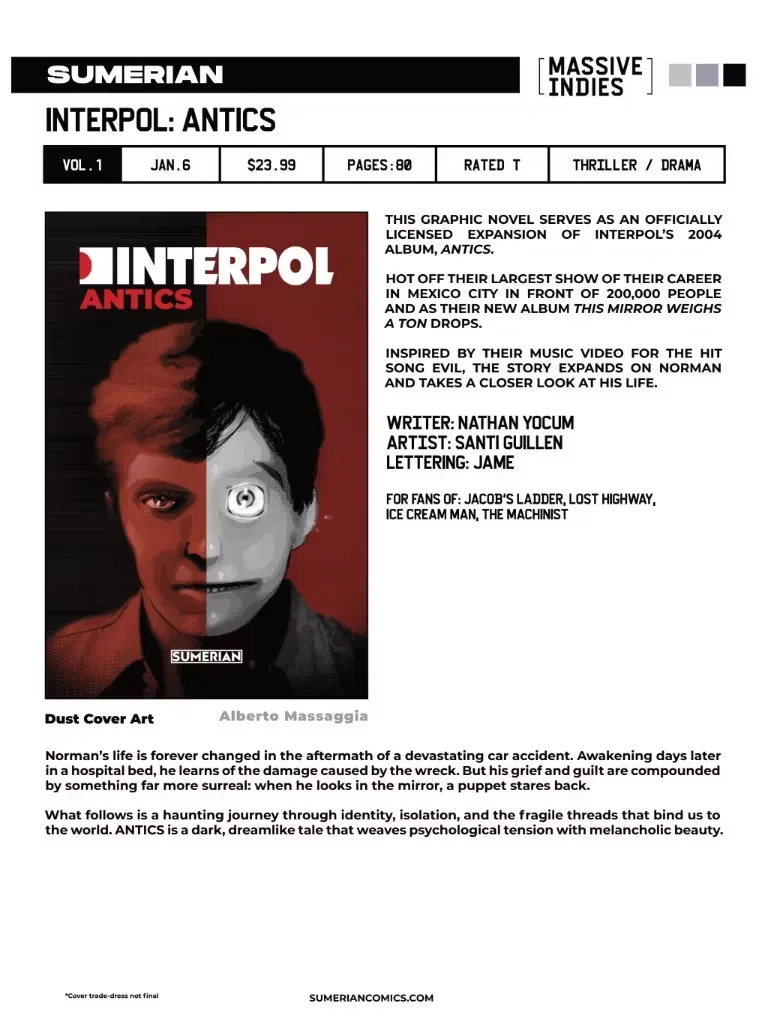
Interpol Antics TP Vol. 01, by writer Nathan Yocum and artist Santi Guillen, is listed as an officially licensed expansion of Interpol’s 2004 album Antics. Meanwhile, Osaka S.P.D. #1, written by Andy Leavy with art and cover work by Hugo Araujo, continues the setting established in the original graphic novel Osaka Mime. Both are scheduled for January 6, 2027, but their descriptions point toward sharply distinct approaches to the genre.
Interpol Antics turns a familiar music-video figure into a psychological horror lead
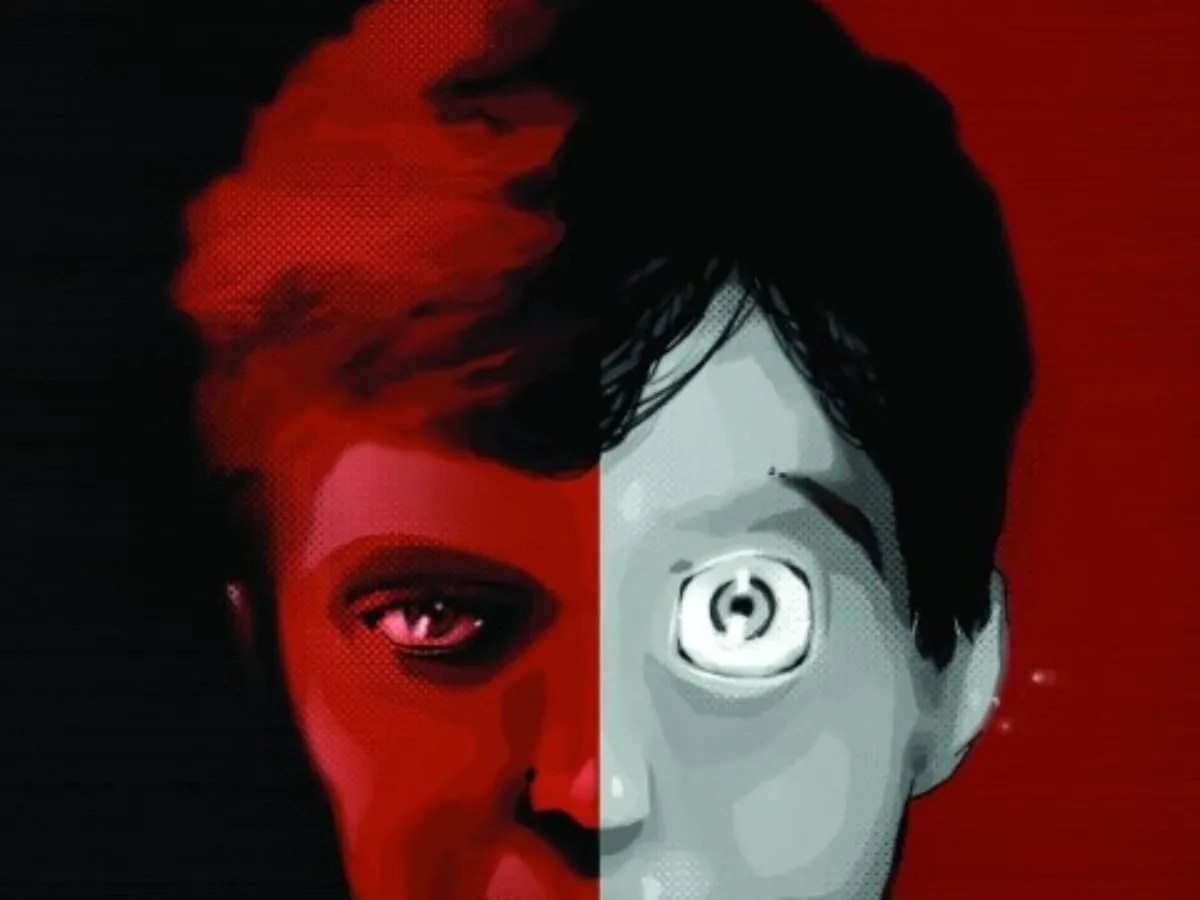
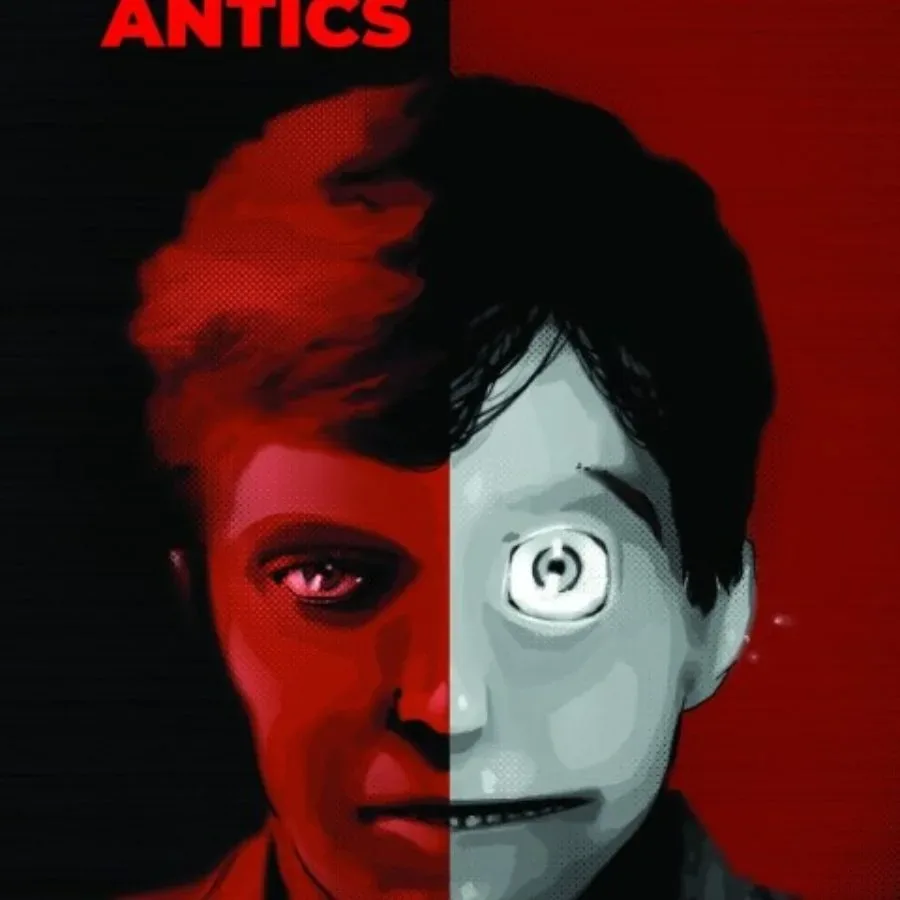
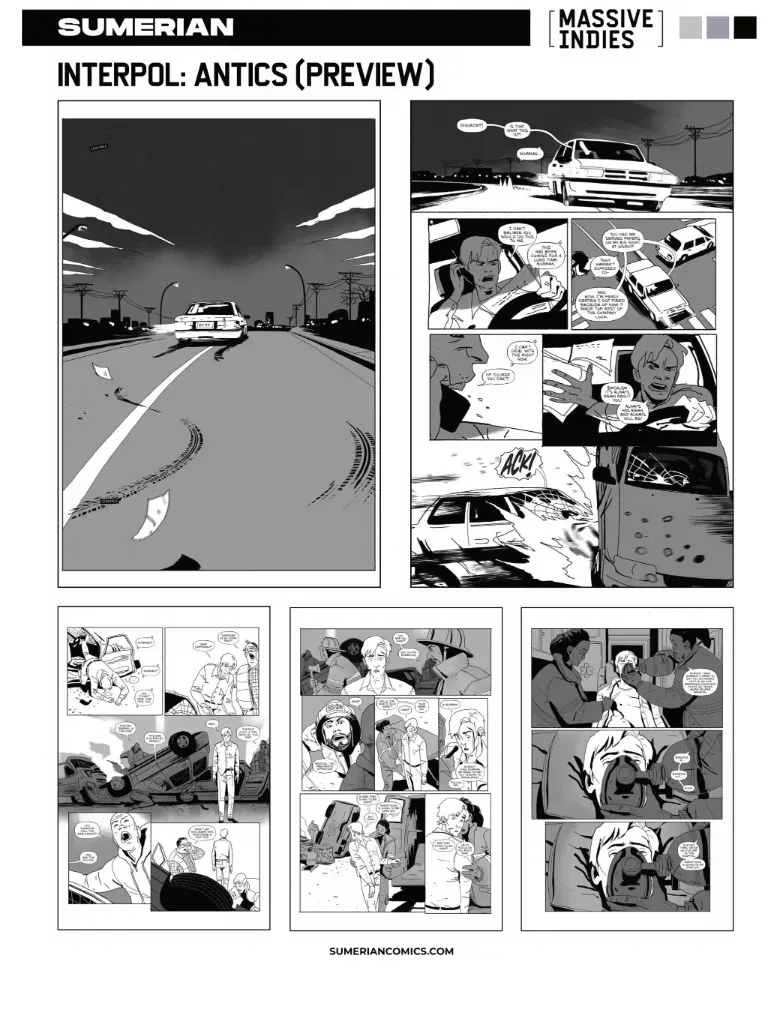
Interpol Antics TP Vol. 01 takes inspiration from the music video for “Evil” and follows Norman, placing him at the center of a new narrative. The central event is a devastating car crash. Norman wakes several days later in a hospital and learns the extent of the wreck’s damage, bringing grief and guilt into the story from the outset.
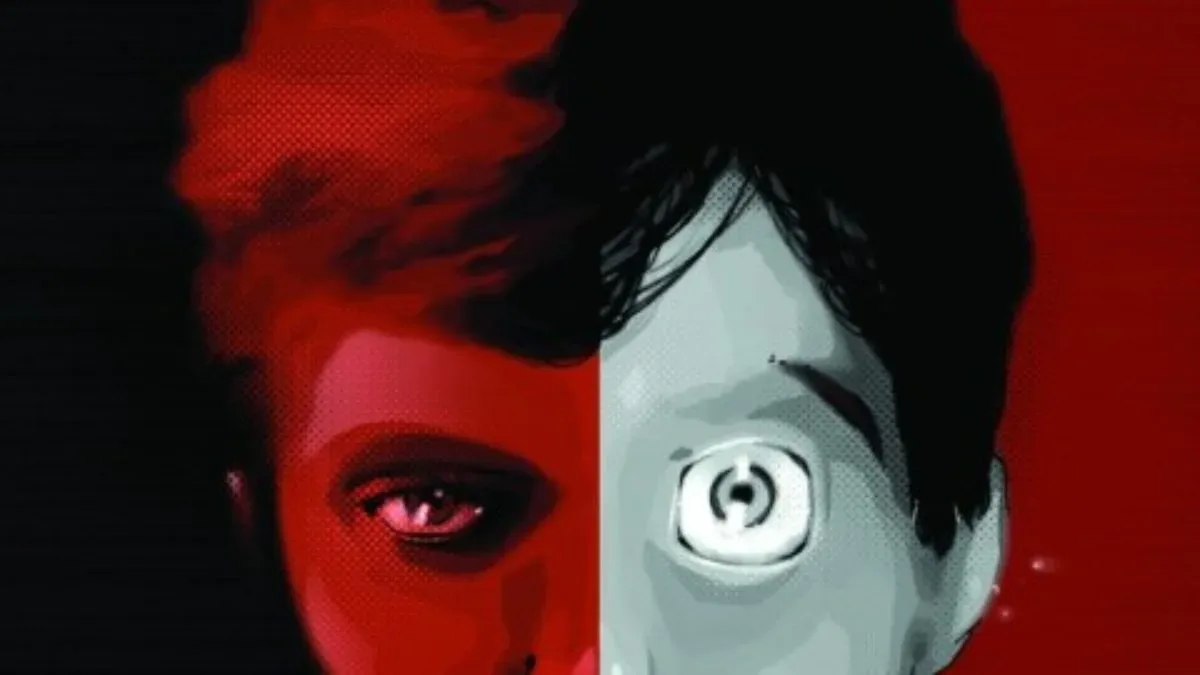
That trauma is accompanied by a more overtly unreal problem: Norman looks into a mirror and sees a puppet looking back. The premise makes the mirror image more than a visual shock. It is the story’s key question: if a person’s reflection no longer appears to be them, what does that mean for identity, memory, responsibility, or even the reliability of their own perspective?
The solicited material frames the book as a dark, dreamlike tale concerned with identity, isolation and the delicate connections that keep people anchored to the world. Those terms matter because they clarify that this is not simply a monster story with a puppet as its threat. Psychological horror generally places fear in a character’s perception, emotional condition, or uncertainty about reality. In Norman’s case, the puppet image appears after a crash and hospital stay, so the apparent transformation is inseparable from a moment of physical and emotional upheaval.
That setup leaves room for ambiguity, which is often essential to this type of story. The supplied description does not establish whether Norman has physically changed, whether the puppet is a manifestation seen only by him, or whether the story will operate by another set of rules. Keeping those possibilities unresolved lets the character’s emotional state carry as much weight as the eerie image itself.
The book is also positioned as an officially licensed expansion of the album. In practical terms, that means the graphic novel is not merely using an album title as a loose label; it is presented as a sanctioned work that builds on the music and the imagery connected to “Evil.” It does not mean the comic is an adaptation of lyrics or a retelling of an existing video scene by scene. Instead, the solicitation identifies Norman as the bridge between the earlier visual material and this longer-form story.
For readers, that distinction is useful. A licensed expansion can serve both as a point of entry for people who know the album and as a standalone psychological-horror premise for people who do not. The available details support Norman’s crash, hospital recovery, guilt and disturbing mirror encounter as the narrative foundation; they do not reveal how closely the wider plot will map to any particular song or video imagery.
The trade paperback is listed at $23.99.
Osaka S.P.D. widens the world beyond one shapeshifting mime
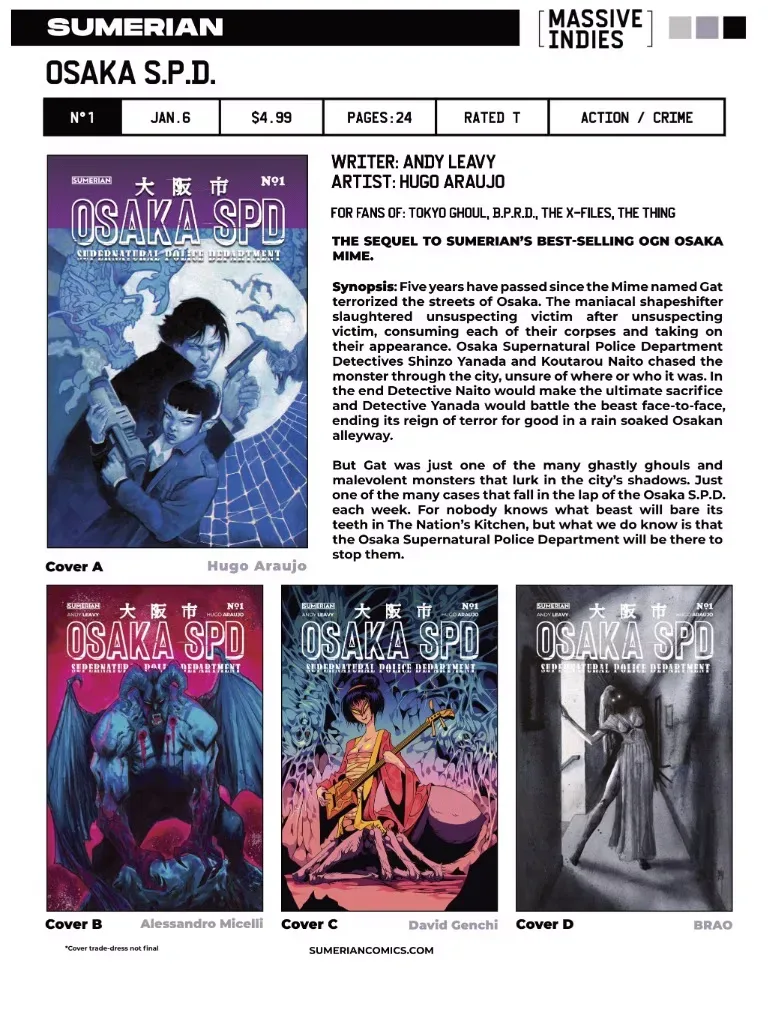
Osaka S.P.D. #1 takes a more procedural direction. It is described as a sequel to Sumerian’s bestselling original graphic novel Osaka Mime, whose prior case involved a shapeshifting mime stalking Osaka. The creature did not simply attack its victims: it took their identities, allowing it to move through the city while hidden inside the lives it had stolen.
That earlier pursuit ended in a rain-soaked alley, where the Osaka Supernatural Police Department confronted the mime. One detective made a fatal sacrifice, while another faced the creature directly and ended its reign. The first issue’s setup makes clear that this incident was not the full story of the city. It was one case in an ongoing, far broader supernatural crisis.
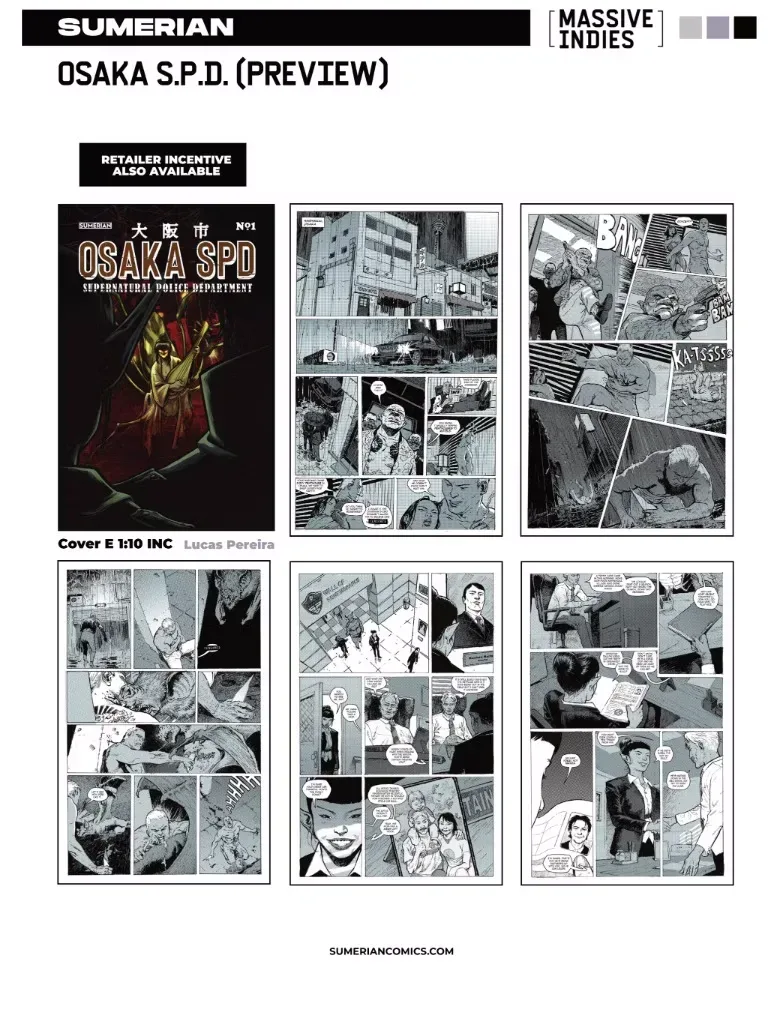
The new series follows the Osaka Supernatural Police Department as it deals with impossible threats on a weekly basis. This shifts the premise from a self-contained hunt toward a supernatural procedural. A procedural is a story format organized around cases, investigations, or missions. Here, the familiar investigative structure is given a horror twist: the department is not pursuing ordinary criminals, but nightmares that conventional authorities cannot handle.
That structure has an immediate advantage for a new series. It makes room for an expanding set of threats without requiring every reader to begin with the same monster. The description establishes the mime’s identity-stealing danger as part of the setting’s history, then promises that another horror can strike at any time. Osaka S.P.D. is positioned as the unit that responds when it does.
There is also a strong tension built into the department’s role. Police stories are often concerned with evidence, patterns and procedures. Supernatural horror, by contrast, often gains power from forces that break ordinary logic. The ongoing appeal of Osaka S.P.D. may lie in the collision of those ideas: investigators attempting to impose order on threats that may be able to disguise themselves, alter identities, or otherwise evade normal explanation.
The solicitation identifies Osaka as Japan’s “Nation’s Kitchen,” grounding the series in a specifically named city while retaining an ominous sense that danger can emerge anywhere within it. Beyond that, details of the department’s personnel, its methods and the new issue’s specific adversary have not been outlined. The confirmed promise is the series format itself: impossible cases, recurring supernatural danger and a specialized department willing to confront it.
Osaka S.P.D. #1 is listed at $4.99.
Two horror formats, one January release date
Released on the same day, the books offer a useful contrast for readers looking at Sumerian’s January lineup. Interpol Antics is a graphic novel built around one character’s inward, unsettling journey after catastrophe. Its horror is tied to reflection, selfhood and the possibility that Norman’s own face has become alien to him.
Osaka S.P.D., by comparison, puts horror into an institutional frame. Its characters work for a department designed to take on the threats no one else can face. The earlier mime case supplies the world’s proof of concept, while the new #1 opens the door to a continuing stream of supernatural investigations.
Neither description offers a complete answer to its biggest mysteries—and that is the point. What exactly has happened to Norman? What horror will be next for Osaka? The solicits establish their respective moods and formats while holding back the details that will define each story’s first major turn.
Horror franchises can also take very different paths when they extend beyond a single work, a subject echoed in discussion around the long-term future of Resident Evil’s main story. In this case, Sumerian is offering two clear expansion models: use a recognizable visual icon to explore a personal, dreamlike narrative, or turn a prior horror encounter into the foundation for an ongoing case-file universe.
Release details
- Osaka S.P.D. #1 — Written by Andy Leavy; art and cover by Hugo Araujo; $4.99; scheduled January 6, 2027.
- Interpol Antics TP Vol. 01 — Written by Nathan Yocum; art and cover by Santi Guillen; $23.99; scheduled January 6, 2027.