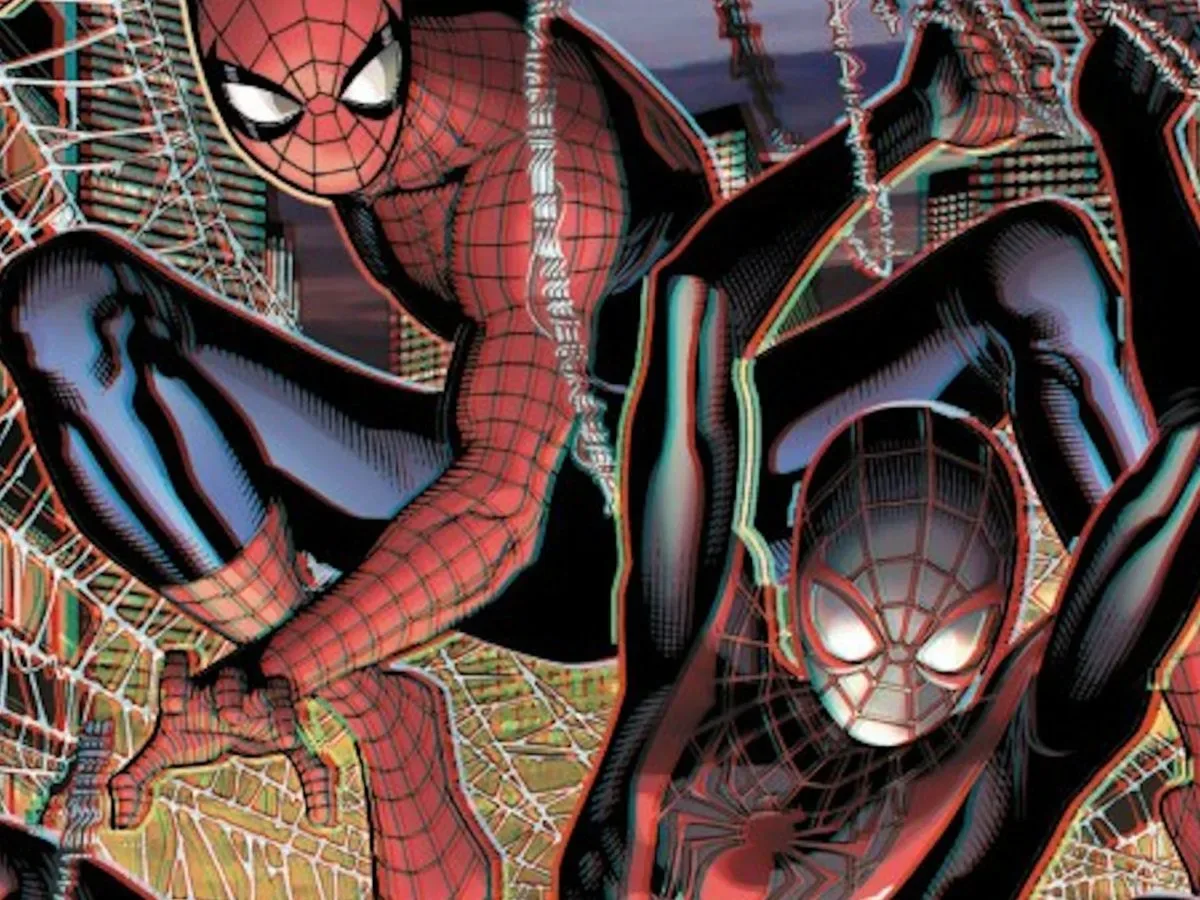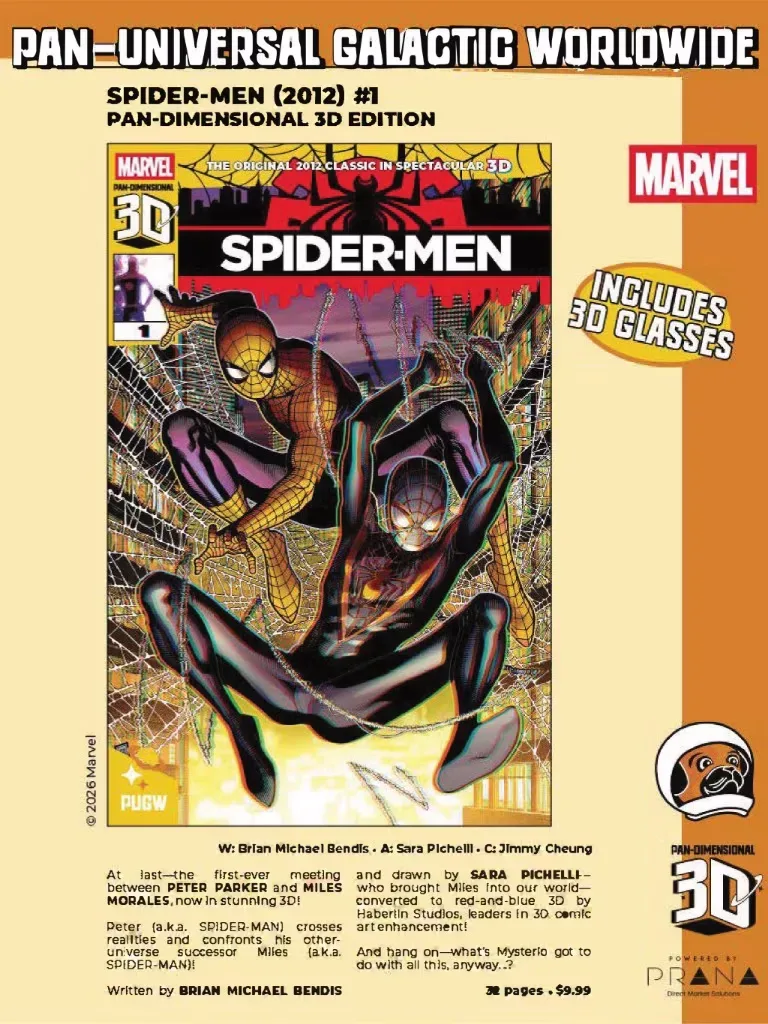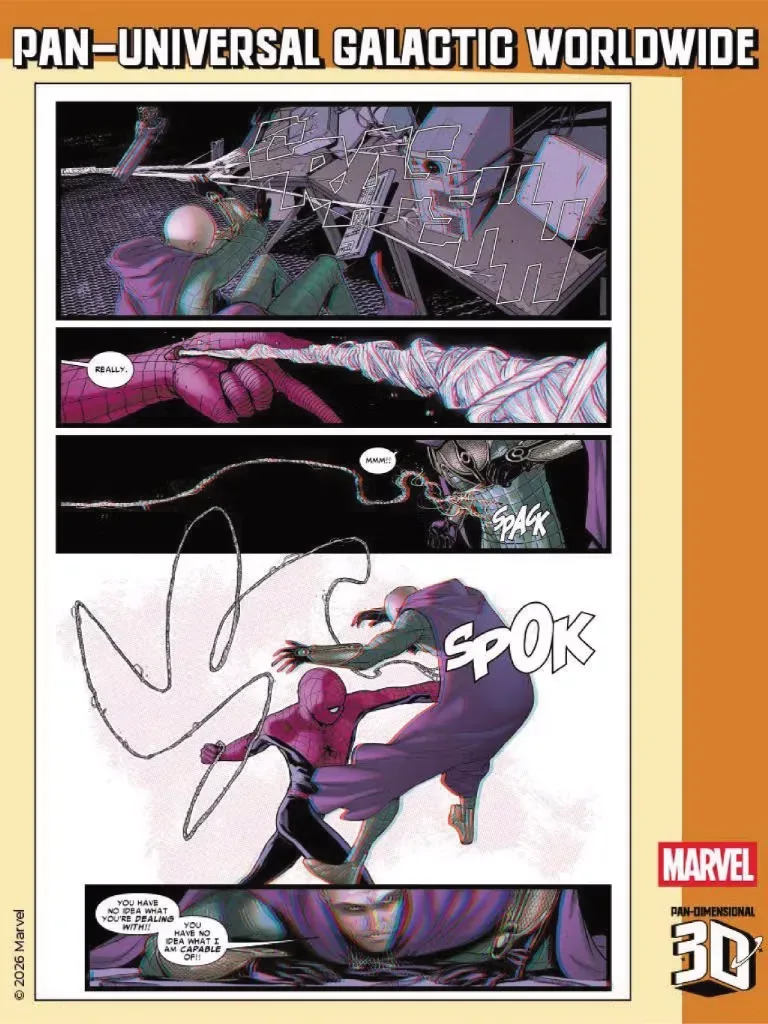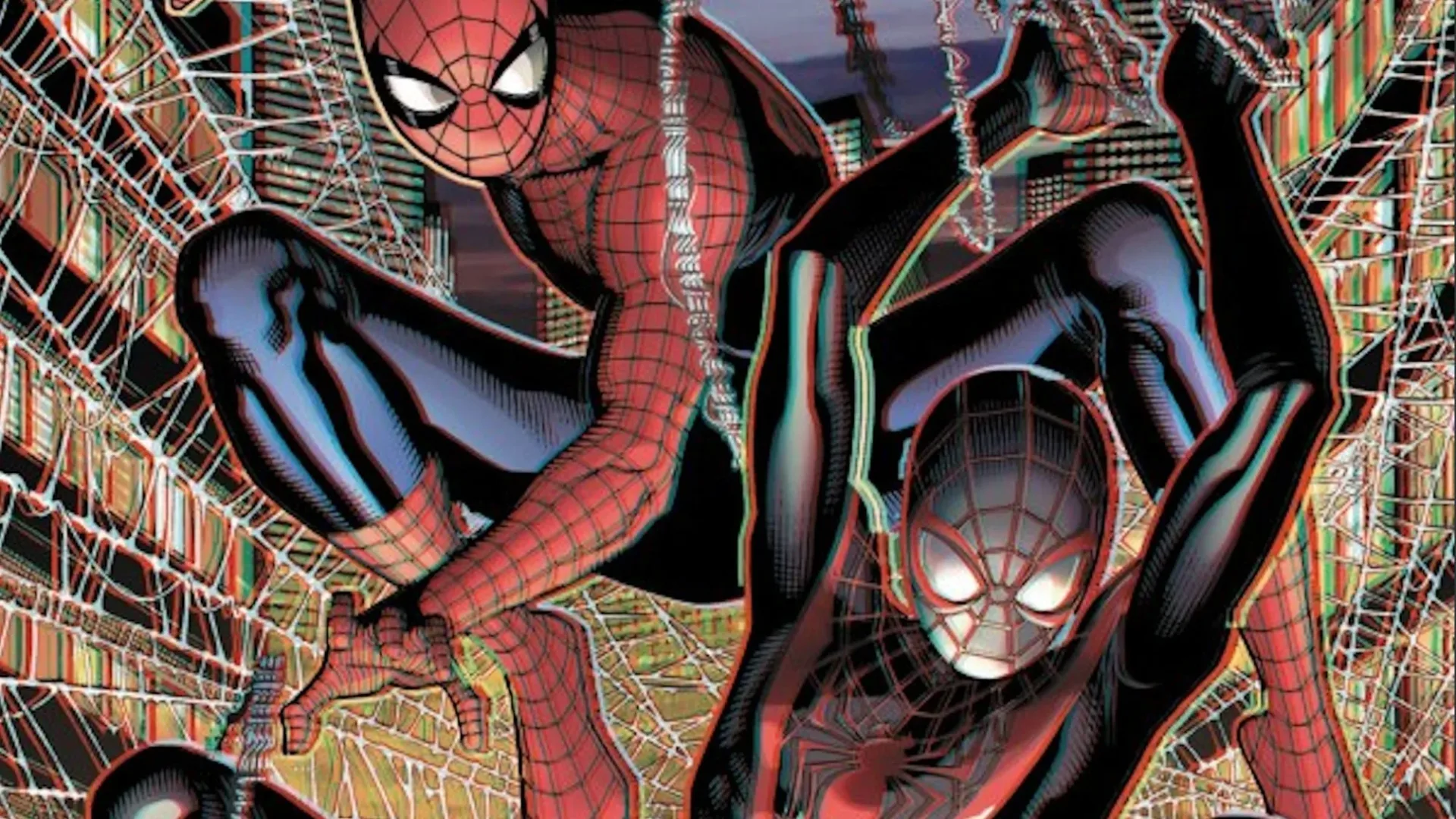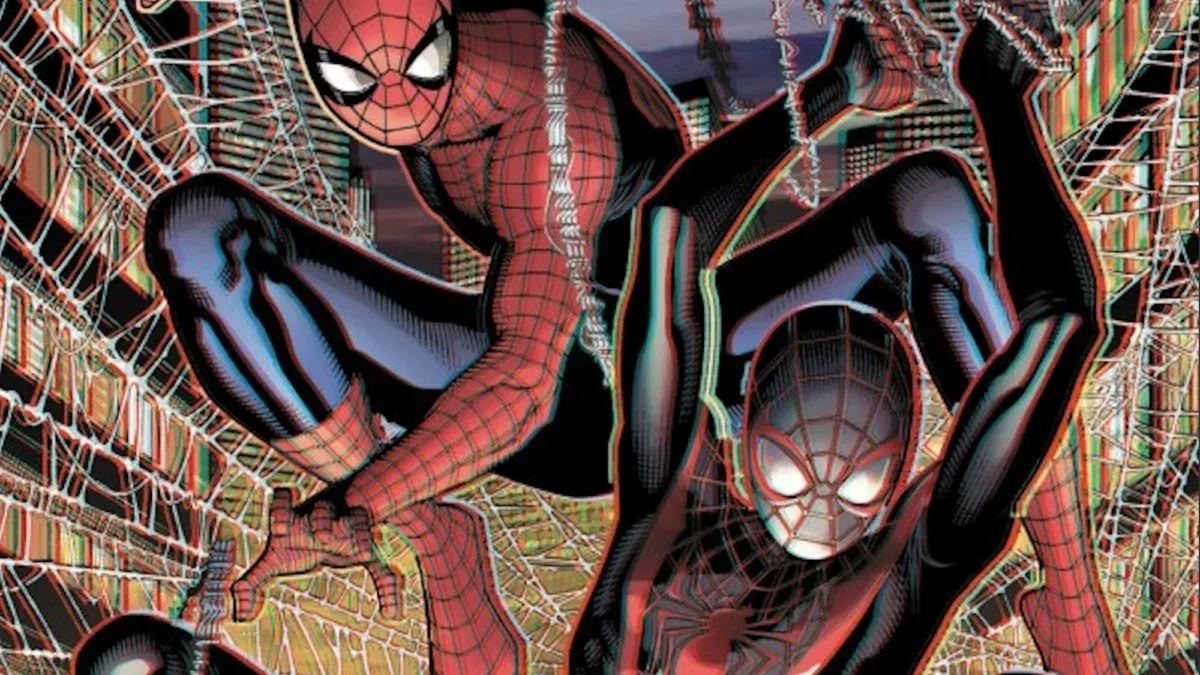
One of Marvel’s most consequential modern Spider-Man encounters is being repackaged for a deliberately old-school visual experience. Pan-Universal Galactic Worldwide, also known as PUG-W, has listed Spider-Men (2012) #1: Pan Dimensional 3D Edition with 3D Glasses for January 2027. The 32-page reprint carries a $9.99 price and includes the red-and-blue glasses needed to view its stereoscopic artwork.
The issue is notable both for its content and its place in PUG-W’s distribution plans. It is identified as the Southern California publisher’s first offering for Direct Market comic shops as the company joins Prana Publishers for subdistribution through Lunar Distribution in 2027. PUG-W has previously licensed Marvel material for 3D republication, and this release brings a major Spider-Man crossover into that program.
For readers, the basic pitch is clear: this is not presented as a new Spider-Men story or a continuation of the series. It is a new-format edition of the original first issue, written by Brian Michael Bendis and illustrated by Sara Pichelli, with 3D conversion credited to Anomaly Productions. Its appeal rests on a landmark story chapter being translated into a physical viewing format that asks readers to put on the supplied glasses.
A historic meeting, revisited in a different format
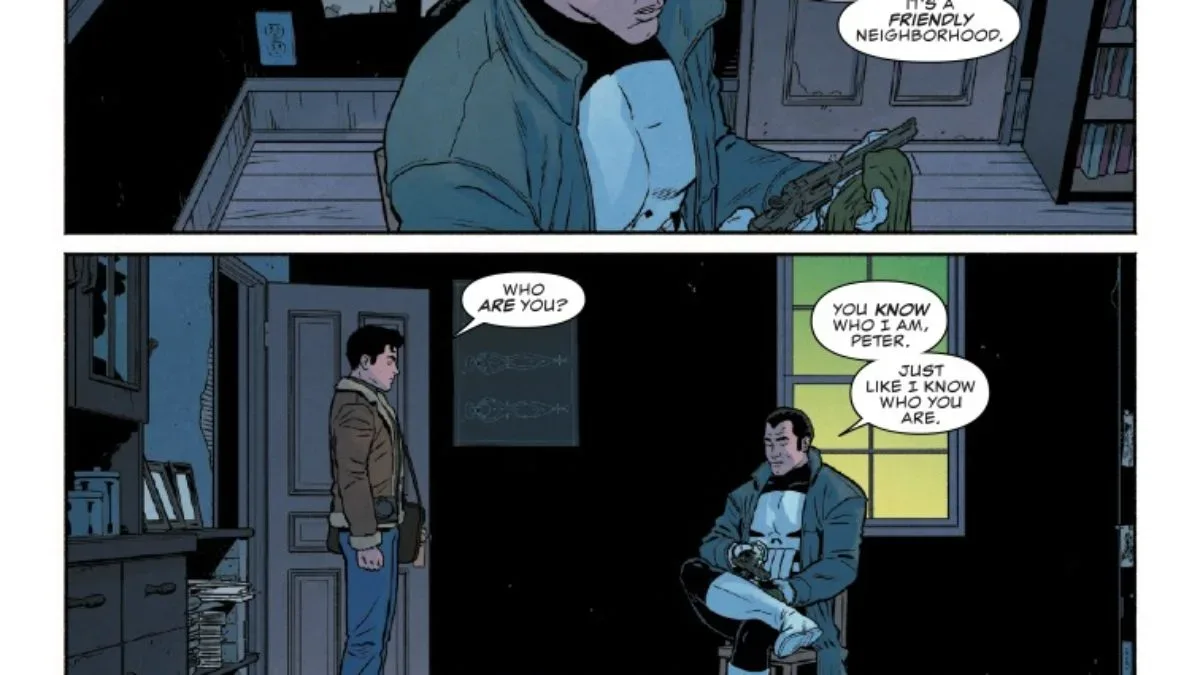
Originally published in 2012, Spider-Men was a five-issue miniseries built around the first meeting of Peter Parker and Miles Morales. At that point, the two heroes came from separate Marvel continuities: Peter was the original Spider-Man from the primary Marvel universe, while Miles was the Ultimate Marvel incarnation of Spider-Man.
The premise starts with Peter crossing realities and encountering Miles, an alternate-universe successor who also carries the Spider-Man name. That setup makes the debut issue more than a routine team-up. It is structured around the friction and fascination of two characters sharing an identity while coming from different worlds and different points in their respective journeys.
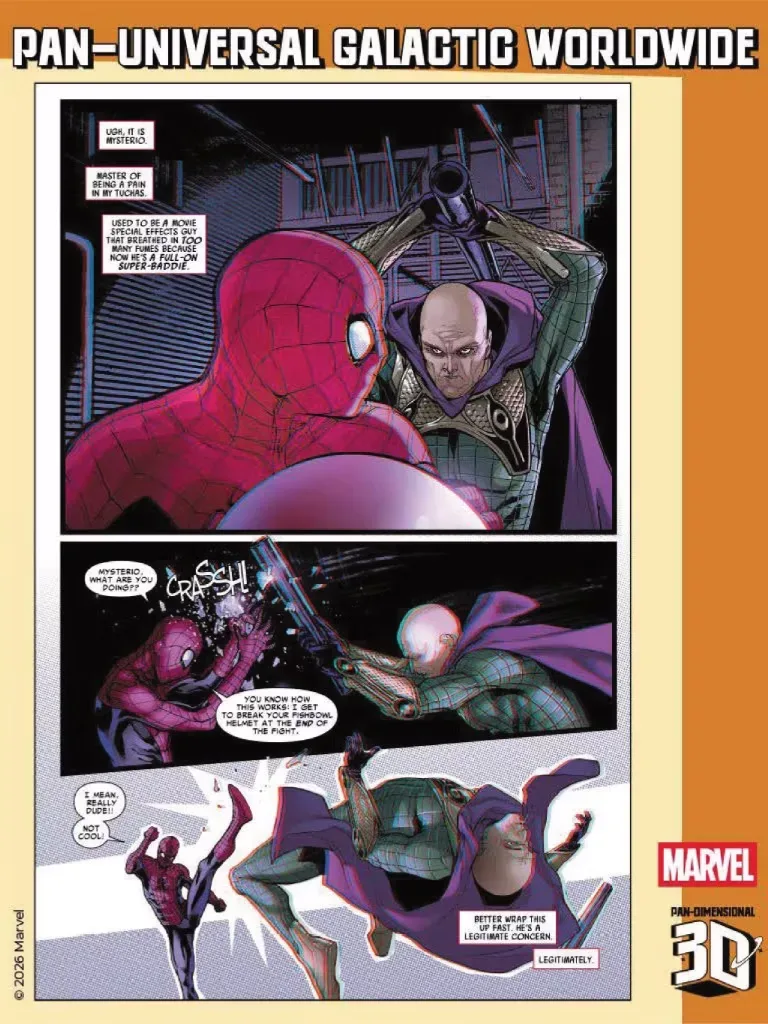
The crossover also mattered within the larger publishing framework. The Ultimate Universe had debuted in 2000, and Spider-Men marked the first crossover between characters from the original Marvel Universe and the Ultimate Universe. Mysterio is tied to the story’s central mystery, giving the series a villainous thread alongside the headline collision of Spider-Men.
That context helps explain why this particular issue works as a reprint candidate. A first encounter is accessible to someone who knows the characters only in broad terms, while its cross-universe premise gives longtime readers a specific piece of continuity history to revisit. The new edition does not change the importance of the original story; it changes the way pages are meant to be viewed.
What “Pan Dimensional 3D” means here
The Pan Dimensional edition uses red-and-blue 3D glasses, the familiar anaglyph approach to stereoscopic imagery. In simple terms, the art is prepared so each colored lens filters part of the printed image. The aim is to create the perception of depth when both eyes receive those slightly separated visual signals.
This is distinct from a new comic being drawn with 3D from the outset. The listed credits describe the issue as converted to red-and-blue 3D by Anomaly Productions. The underlying comic remains Bendis and Pichelli’s Spider-Men #1; the conversion is an added production treatment applied to the existing material.
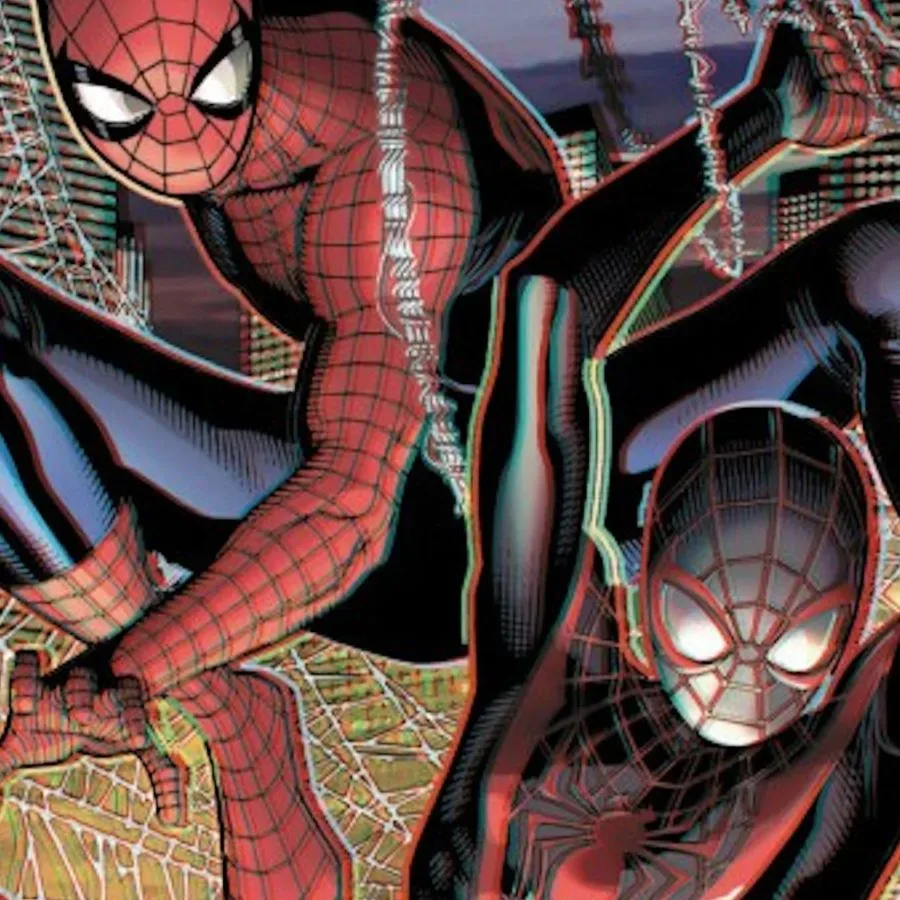
Practically, readers should expect the glasses to be integral rather than an incidental bonus. Without them, anaglyph art can show color separation or ghosted-looking outlines because the image has been built for filtering through red and blue lenses. With the glasses, the intended depth effect should become legible. The choice also creates a more hands-on reading ritual than an ordinary single-issue reprint: the comic comes with its own viewing accessory, and that accessory is part of the presentation.
There is a thematic fit between the technique and the material. Spider-Men concerns characters crossing between realities, while a stereoscopic conversion attempts to push figures and settings into separate perceived layers on the page. That does not mean the edition adds story material or alters continuity. It means the visual packaging plays into the issue’s dimension-hopping hook.
Why the Peter-and-Miles pairing still has weight
The lasting significance of the original miniseries is tied to what it allowed on the page: Peter Parker and Miles Morales could finally meet rather than merely exist as counterparts in isolated universes. Miles is described in the solicitation as Peter’s other-universe successor, which captures the unusual dynamic at the heart of the series. He is not simply another hero recruited for a crossover; he is another Spider-Man whose existence raises immediate questions for Peter and for the reader.
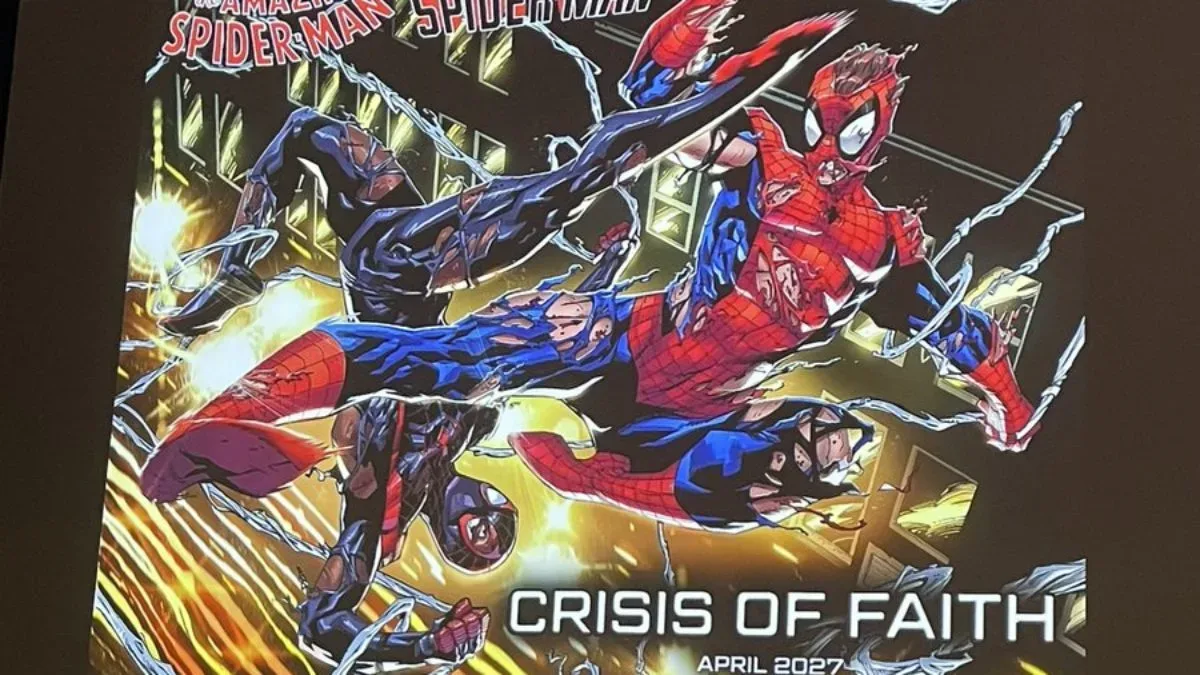
The series later received a follow-up, Spider-Men II, in 2017. By then, Peter and Miles were both living in the Marvel 616 universe. That miniseries also included the native Marvel 616 version of Miles Morales, depicted as an adult and a close friend of the Kingpin. The 2027 3D reprint, however, returns to the earlier moment when the central attraction was the first collision of Peter’s and Miles’ worlds.
For comic readers who follow superhero media beyond print, it is another reminder that character legacies often move across formats and eras while certain foundational comic issues remain reference points. The wider superhero conversation is always shifting, including on the DC side, where Batman casting discussions continue around the DCU. In this case, though, the focus is firmly on an earlier Marvel crossover and a physical reprint designed around a specific visual gimmick.
What collectors and readers should take from the listing
The available details support a straightforward distinction between this item and the 2012 original: this is a licensed 3D republication of Spider-Men #1, not a newly created first issue. Its stated format is 32 pages, it includes glasses, and it is priced at $9.99. Those details are the clearest reasons a buyer might choose it over a conventional copy: interest in the stereoscopic presentation, the included accessory, or PUG-W’s first Direct Market release.
It is also worth keeping expectations precise. A conversion can offer a different way to experience the layouts, but readers looking for the complete 2012 story should remember that Spider-Men was a five-issue series and this listing is specifically for #1. Likewise, the listing identifies Bendis and Pichelli as the original writer and artist and Anomaly Productions as the 3D conversion team; those roles describe a reworked edition of existing comic material, not a replacement creative run.
PUG-W’s January 2027 entry therefore lands at the intersection of comic-book nostalgia, licensed reprint publishing and a format that is unusually tactile for a standard floppy issue. Peter Parker and Miles Morales’ first meeting already carries historical weight within Marvel’s multiverse publishing. Giving that meeting red-and-blue depth makes the reprint’s purpose easy to understand: spotlight a familiar milestone by asking readers to see it differently.