Red Roots #6 is set to open a new story arc for Kate and Dan, turning an already brutal predicament into a pointed decision: the War is apparently the only route that can take them home. Image Comics lists the issue for release on Wednesday, November 25, 2026, at $3.99.
The new installment is written and illustrated by Lorenzo De Felici, who also supplies the main cover. Rafael Albuquerque and the team of Bilquis Evely and Matheus Lopes are credited with variant covers. That creative setup makes issue #6 a clean entry point in one important sense: it explicitly marks the beginning of a fresh arc. But the premise is hardly a soft reset. Kate and Dan are carrying unresolved matters, confronting a conflict called the War, and facing threats that appear to be as internal as they are monstrous.
A homecoming route with a very high cost
The core setup for Red Roots #6 is direct. Kate and Dan have reached the conclusion that they can only get back home by going through the War. In adventure fiction, “getting home” can sound like a simple objective, but it is more usefully understood as a pressure point: it gives every compromise, alliance and act of violence a personal consequence.
That does not mean the issue’s solicitation explains precisely what the War is, where it takes place, or how Kate and Dan entered this situation. Those details are not established here, and readers should not mistake a preview premise for a complete map of the series’ world. What is clear is that the War is not described as an obstacle they can simply avoid. It is framed as the required passage back.
This makes the new arc sound less like a detour and more like a commitment. “Only way home” language puts an especially sharp limit on the characters’ options. It suggests that their choices will not revolve around whether to engage, but around how much of themselves they can retain while doing so.
Kate’s conflict: duty versus survival
Kate is described as having unresolved issues and fighting her survival instinct, yet choosing to do her part. That contrast is meaningful. A survival instinct normally pushes a person away from danger; choosing responsibility in spite of it means the character is not being portrayed as fearless. Rather, she is acting while fear and self-preservation remain present.
That distinction matters in a war-centered story. “Courage” is often treated as the absence of hesitation, but the premise offered for Kate points in another direction. Her decision appears to be one made against the urge to protect herself. The drama, then, is not merely whether she can survive the coming conflict. It is whether she can reconcile her need to survive with whatever role she believes she must play.
The solicitation’s reference to unresolved matters also leaves room for the arc to treat the War as more than a physical gauntlet. An external conflict can force characters to confront problems they have postponed, concealed or tried to outrun. That is an interpretation of the setup, not a confirmed plot beat, but it is the tension the issue’s description foregrounds.
Dan and the danger within
Dan’s side of the story is framed around a different form of risk. He does what he does best, while attempting to avoid being consumed by his own darkness. The phrase is intentionally broad, and the available information does not define whether that darkness is emotional, moral, supernatural or something else entirely. What can safely be said is that the arc positions Dan’s own impulses or condition as a threat alongside the dangers of the War.
That ambiguity gives the setup a potentially uncomfortable edge. A character can be highly capable and still be dangerous to himself or others. Indeed, the wording implies those facts may be connected: the traits that make Dan effective could also be the things he must control most carefully.
For readers, this is a useful distinction between an external antagonist and an internal conflict. An external antagonist is a person, creature, army or force that opposes the protagonists from outside. Internal conflict is the struggle inside a character: fear, guilt, anger, temptation, trauma or a destructive capability. Red Roots #6 signals both categories at once. Kate is fighting against a survival impulse; Dan is resisting his darkness; and both must deal with the War as the unavoidable route ahead.
What the preview imagery suggests—and what it does not
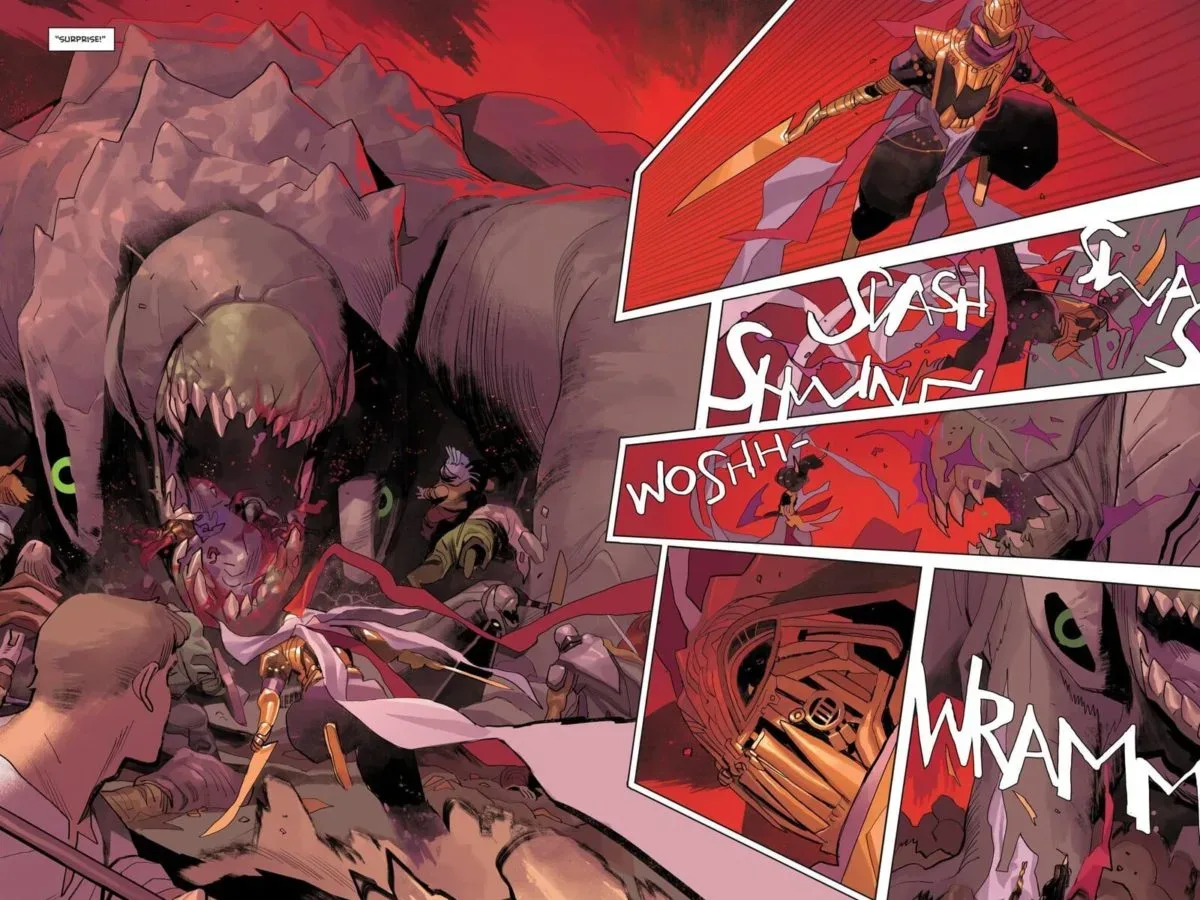
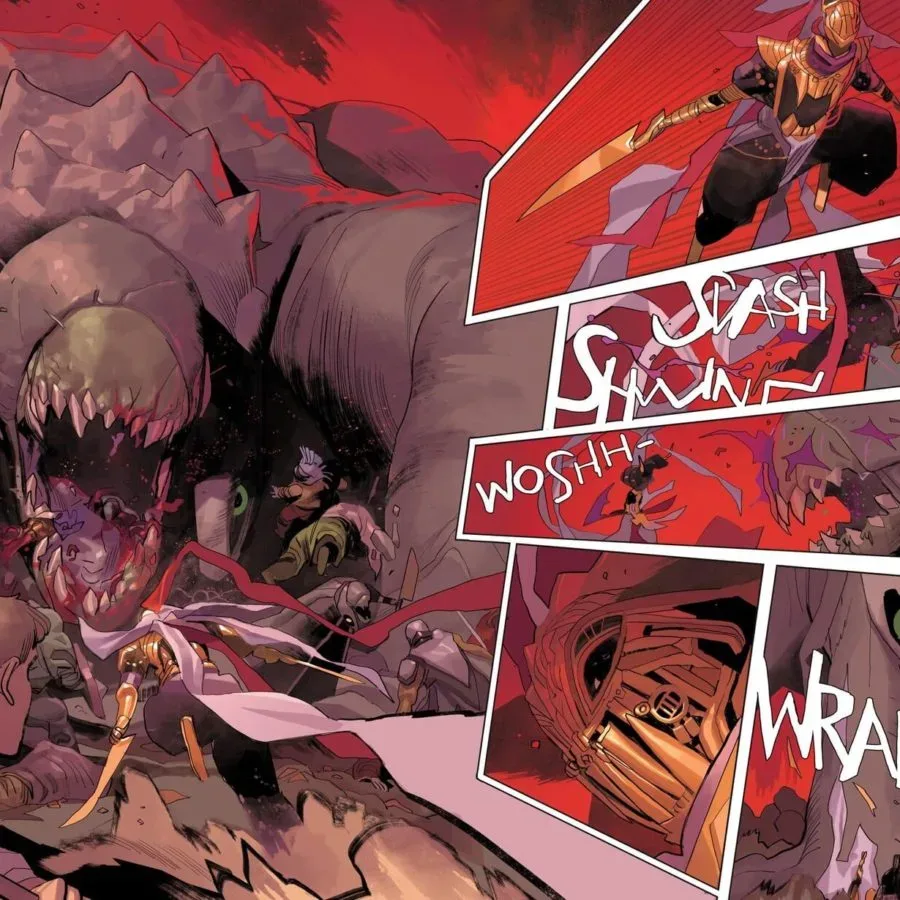
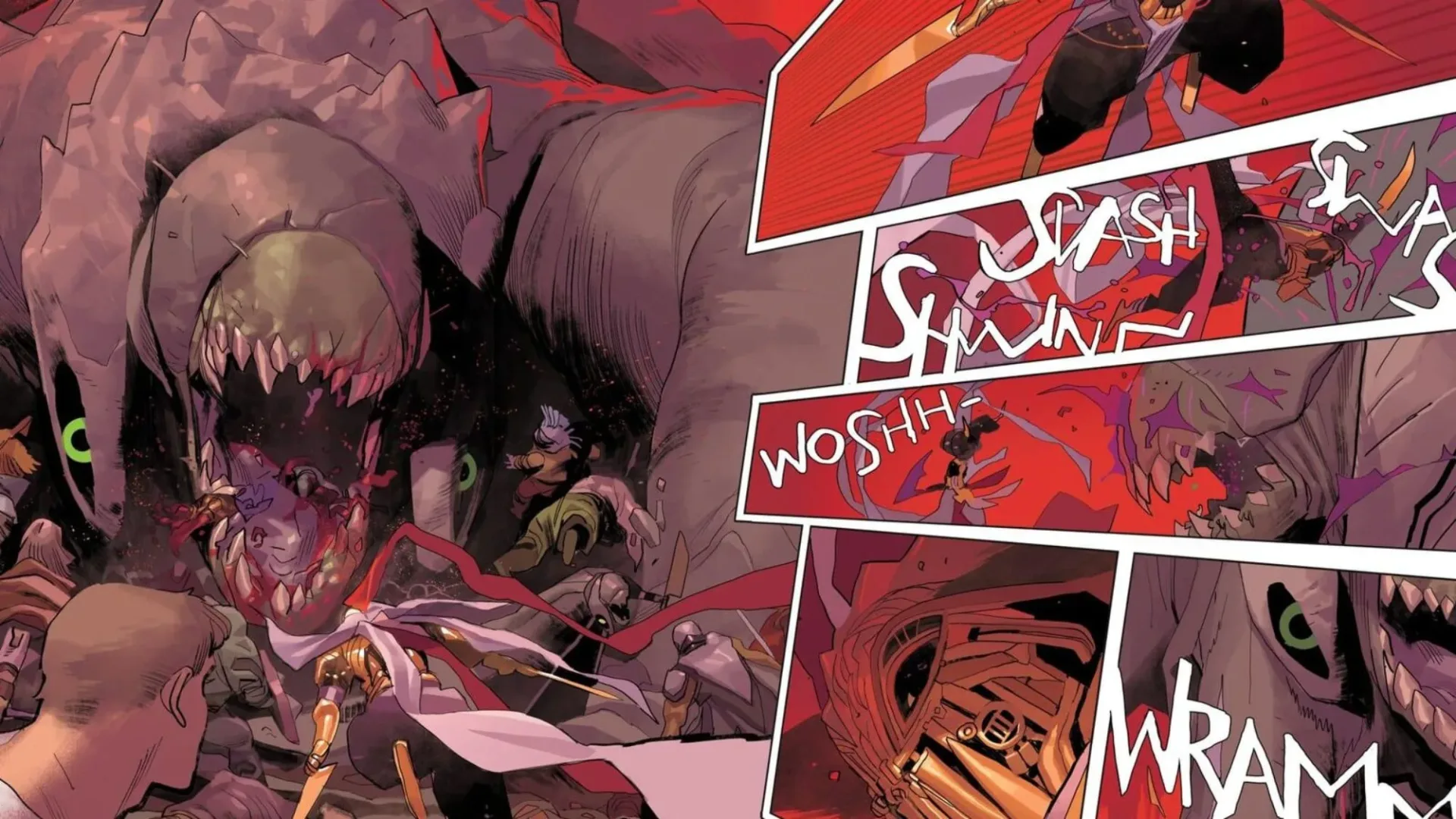
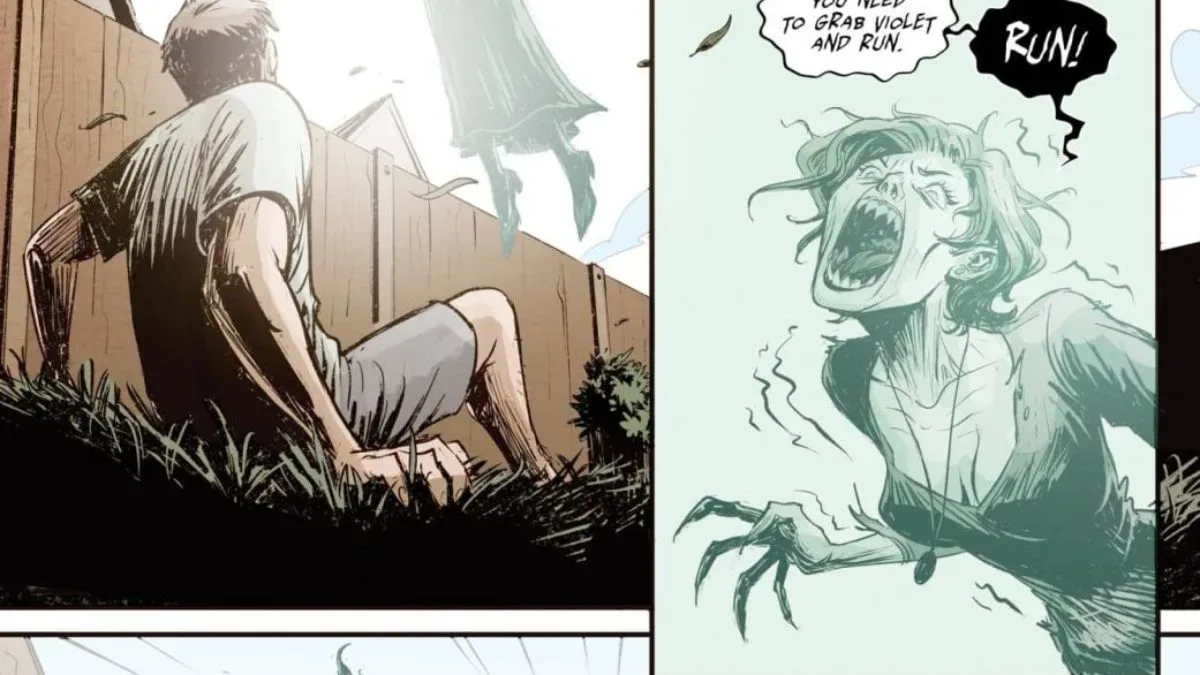
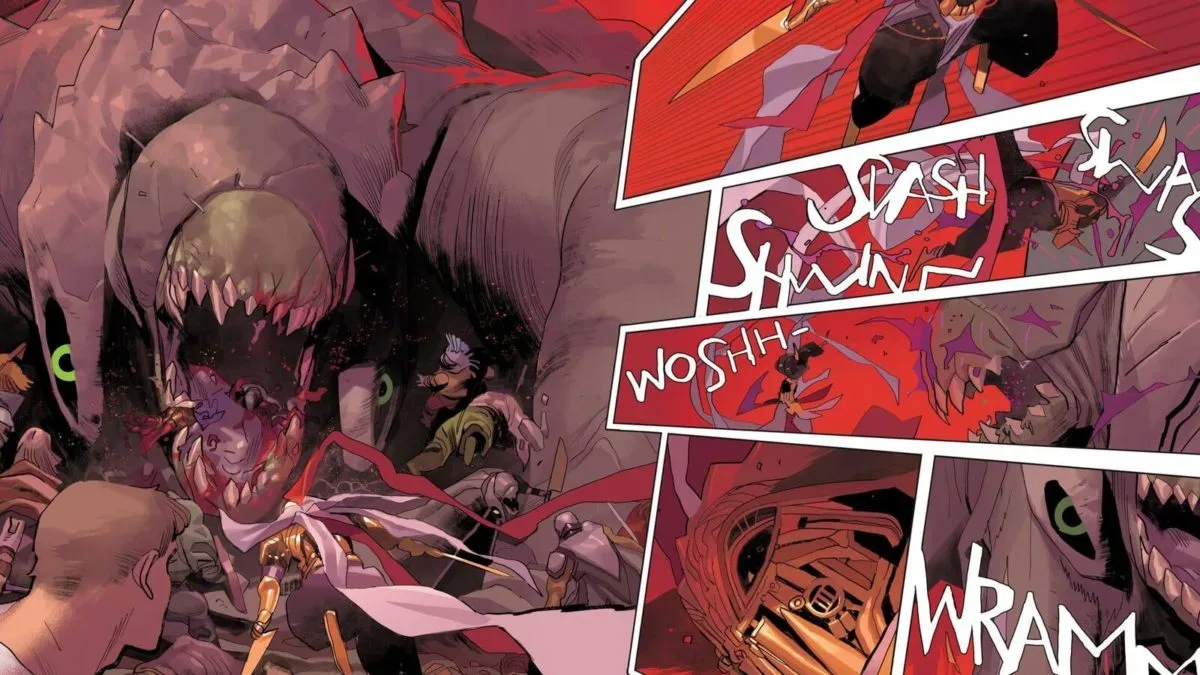
The material accompanying the issue description includes an armored fighter facing an enormous, tooth-filled creature. Another figure appears to throw a knife toward what may be an eye, only to question whether it truly is one. These glimpses support the idea of a hostile, uncanny conflict zone where conventional combat instincts may not be enough.
Still, isolated preview images are not a substitute for plot confirmation. They can establish a tone of danger, scale and body-horror-adjacent creature design, but they do not prove the monster’s identity, allegiance or importance to the full arc. Nor do they establish who is winning, what the fighters want, or how the moment relates to Kate and Dan’s route home.
That limitation is worth keeping in mind with comic previews generally. A preview is a selected slice designed to introduce an issue’s premise and visual atmosphere. It may show a major scene, a representative encounter, or something deliberately chosen to preserve the larger reveal. In this case, the most concrete takeaway is simply that the War-facing arc seems prepared to put its characters in direct conflict with formidable creatures as well as their personal burdens.
Why the “new story arc” label is useful
In serialized comics, a story arc is a connected run of issues built around a particular conflict, objective or change in a character’s status quo. Starting a new arc does not guarantee that all prior knowledge becomes unnecessary. It does, however, often mean the story is setting a newly defined immediate direction.
Here, that direction is unusually concise: home lies beyond the War. Kate and Dan’s decisions provide the emotional stakes inside that premise. For readers who have followed the series, issue #6 looks positioned to establish its next phase. For those considering the title now, the clear mission statement may make this a more approachable point than an issue billed solely as the middle of an ongoing storyline.
Approachable does not necessarily mean consequence-free. The solicitation specifically refers to unresolved matters, meaning the series’ existing character history remains relevant. A new arc can establish a fresh objective without erasing the experiences that made the objective hurt. Readers looking to start here may want to recognize that distinction: the issue advertises a new chapter, not a standalone tale.
The art role of a writer-artist
De Felici is credited as both writer and artist on Red Roots #6, in addition to the main cover. A writer-artist is a creator handling both the script and the interior visual storytelling. That combined role can be especially significant in a comic built around atmosphere and creatures, because the person determining the pace of the story is also designing the page’s visual emphasis.
It does not automatically tell readers how the issue will read or look; no assumptions should be made about panel counts, coloring approach or narrative style without the finished comic. But the credit does clarify that the central storytelling responsibilities are united under one creator for this installment. Albuquerque’s cover and the Evely/Lopes cover offer additional cover choices, while De Felici’s credit remains the main creative through-line named for the issue.
Release details and cover options
- Title: Red Roots #6
- Publisher: Image Comics
- Release date: Wednesday, November 25, 2026
- Writer/artist/main cover: Lorenzo De Felici
- Variant cover: Rafael Albuquerque
- Variant cover: Bilquis Evely and Matheus Lopes
- Suggested retail price: $3.99
The main listing is identified as 0926IM0413. The Rafael Albuquerque cover is listed as 0926IM0414, while the Bilquis Evely and Matheus Lopes cover is listed as 0926IM0415. Those identifiers can help readers and retailers distinguish among the three listed editions when ordering or checking stock.
Variant covers are alternate cover artworks for the same comic issue. They are not, on the information available here, separate story editions. Collectors who prefer a particular artist’s cover should verify the specific edition with their chosen shop, while readers focused on the next chapter of Kate and Dan’s story can look for the issue number and De Felici’s creative credit.
A grim mission statement for the next chapter
Red Roots #6 presents its new arc with a harshly simple premise: Kate and Dan cannot get home without confronting the War. The tension is sharpened by the fact that neither lead is presented as untroubled. Kate must overcome the instinct to preserve herself, while Dan must keep his own darkness from overtaking him.
It is an effective framework because the route forward is not framed as safe, clean or morally uncomplicated. The characters may be moving toward home, but the issue’s setup makes clear that the journey itself is the point of conflict. And while fictional AI chauffeurs are not the subject of this comic, anyone tired of seeing AI pitched as an answer to every problem may appreciate the wider discussion around AI development and its real-world release challenges rather than a promised automated shortcut.