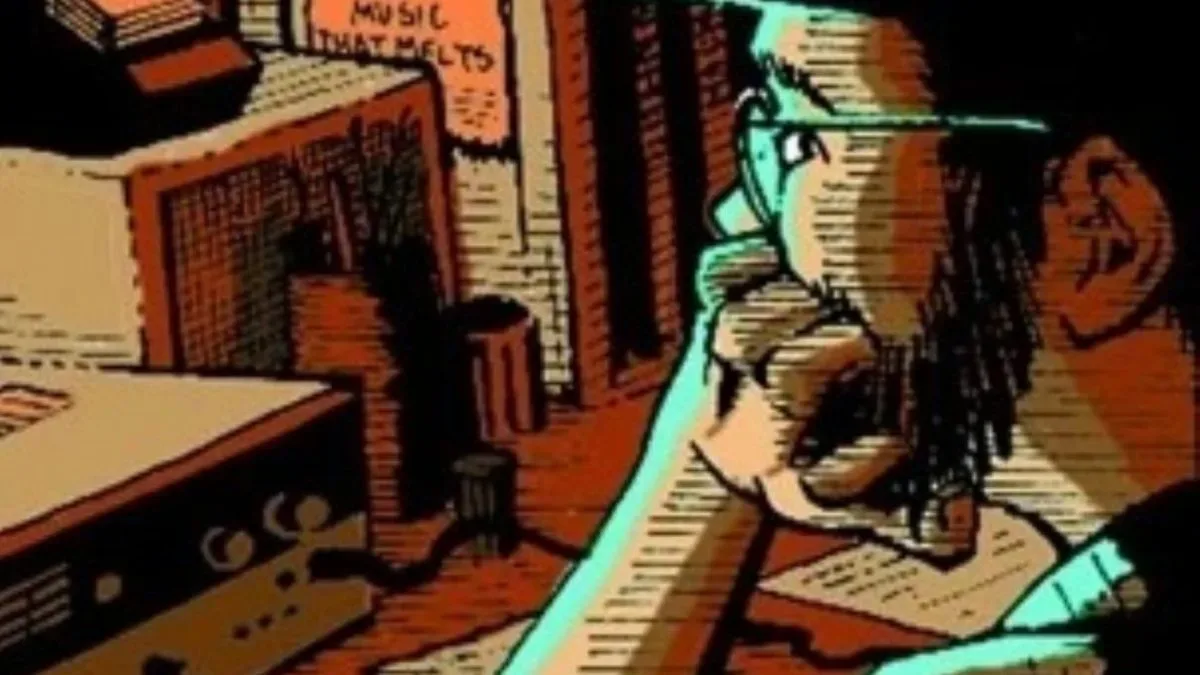
Matt Howarth, the independent comic creator and publisher whose work built dense, strange, music-charged worlds across more than five decades, has died at the age of 72. The news was shared by Eli Schwab of Cosmic Lion Productions, a publisher that worked closely with Howarth in his later years.
Howarth’s name is most closely associated with Those Annoying Post Bros. and Savage Henry, two series that point to the particular creative territory he made his own. His stories could be surreal, science-fictional and packed with intersecting realities, but they were not merely exercises in weirdness. They were sustained personal worlds, developed through self-publishing, serial comics, graphic novels, digital releases and collaborations that connected comics to experimental and alternative music.
His death is a significant loss for readers who value independent comics as a medium where an artist can return to an idea for years, follow it through formats and publishers, and make a fictional universe feel bigger than any one issue.
A career built outside the usual lanes
Howarth co-founded Howski Studios in 1969, then began self-publishing in the mid-1970s. His early graphic novel Afternoon in the Sun arrived in 1976. That timeline matters: he was making and independently circulating comics well before many readers came to think of the graphic novel or creator-owned serial as a familiar part of the comics landscape.
In 1980, his experimental serial Changes appeared in Heavy Metal. The magazine placed his work in proximity to artists including Moebius, Philippe Druillet and Enki Bilal, all creators Howarth admired. It was a fitting venue for work that did not observe tidy genre borders. His comics embraced science fiction and fantasy, but also carried the visual density, shifting logic and exploratory structure often associated with underground and alternative comics.
For readers encountering Howarth’s work for the first time, “independent comics” here should not be read simply as a business label meaning a book released outside a major superhero publisher. It also describes a creative method. Howarth’s long career gave him room to build recurring settings, revisit characters, experiment with formats and put work directly into the world through self-publishing. That continuity of authorship is central to the identity of his catalog.
He did contribute to larger publishers, including DC, Dark Horse, Fantagraphics and Antarctic Press. But the defining thread was an unusually durable creator-led practice. In later years, he continued to make comics, prose and digital work through Bugtown Mall, producing more than a hundred publications in print and digital forms.
Bugtown and the Post Bros.
Those Annoying Post Bros., Howarth’s best-known continuing series, launched in 1985 through Vortex Comics and later appeared through Rip Off Press and MU Press. The premise alone signals the elastic rules of a Howarth story: the Post Brothers are regenerating, dimension-hopping siblings from the chaotic setting of Bugtown.
“Regenerating” means the brothers can return from destruction; “dimension-hopping” means the story can cross between alternate realities rather than remain fixed to one conventional setting. Those concepts offer more than a grab bag of outlandish plot devices. They give a series freedom to keep moving, mutating and colliding with new situations while retaining a recognizable center.
Bugtown, meanwhile, was not a disposable backdrop. It became a key piece of Howarth’s creative vocabulary, recurring in titles such as Bugtown itself and in the wider network of work published through Bugtown Mall. The result was less like a single closed story than an expanding fictional environment: one where characters, styles and realities could overlap.
That approach is especially notable in the practical world of independent comics. A creator working over decades may face changing publishers, changing formats and an audience that discovers books out of sequence. A shared fictional environment provides both flexibility and continuity. It lets readers enter through one title while rewarding those who trace connections across the larger body of work.
Savage Henry put music inside the comics world
Howarth launched Savage Henry in 1987. Its lead character was an alternate-reality guitarist, a premise that made explicit the bond between Howarth’s comics and music. The series included authorized appearances by musicians and groups including The Residents, Hawkwind, Moby, Ash Ra Tempel, Klaus Schulze, Foetus, Wire and Conrad Schnitzler.
The word “authorized” is important. These were not casual references placed in the background; the material involved approved appearances by the artists. That kind of collaboration gave Howarth a distinctive way to bring musical culture into sequential art. Instead of treating a soundtrack as something separate from the comic, he made music, performance and artist identities active ingredients in the fiction.
His later collaborations took that idea further. Howarth described a long-held ambition to pair one of his comic strips, supplied as a PDF on a CD, with a band’s music as a loose soundtrack to the story. He worked this way with a broad range of electronic and alternative musicians, including Klaus Schulze, Bill Nelson, Arthur Brown, Radio Massacre International, Quarkspace, Conrad Schnitzler, Hugh Hopper and Legendary Pink Dots.
A “loose soundtrack” is not the same as a score synchronized scene by scene to a film. It leaves the reader and listener space to form connections: the music can set a mood, create a tonal counterpoint or simply accompany the act of reading. For comics, a medium traditionally experienced silently on the page, that is an unusually direct attempt to change the texture of the reading experience without abandoning the comic’s own pacing.
It also reflects the experimental spirit of Howarth’s career. He did not treat a comic as an isolated object. It could be a print issue, a graphic novel, a digital file, prose, or part of a package with music. That willingness to work across formats remains relevant as comics continue to find new digital distribution routes. Readers following the broader shift in digital comics can see one current example in the move toward Webtoon-powered Marvel Comics, though Howarth’s work came from a markedly personal, independent approach rather than a platform-led one.
A prolific catalog with room for new discoveries
Beyond Those Annoying Post Bros. and Savage Henry, Howarth’s notable works included Keif Llama: Xeno-Tech, Star Crossed and Particle Dreams. He also contributed to Teenage Mutant Ninja Turtles-related material, including The Haunted Pizza, produced early pin-up work for TMNT comics, and wrote the first review of Teenage Mutant Ninja Turtles for Heavy Metal.
Those TMNT connections are a useful reminder that independent-comics history is not neatly split into isolated camps. Creators, small publishers, magazines and emerging properties continually crossed paths. Howarth was present in that ecosystem both as a maker and as an engaged reader and critic.
His influence came from multiple directions. The creators and writers associated with his work include Philip K. Dick, H.P. Lovecraft, Steve Ditko, Bernie Wrightson, Moebius and Philippe Druillet. The list helps explain the unusual range in his pages: reality can be unstable; horror can sit beside science fiction; detailed linework can carry an intricate plot; and a story can be deliberately strange without surrendering its internal personality.
Still, an influence list should not flatten an artist into his references. What made Howarth singular was the way he joined these elements to a personal, ongoing set of worlds and to his musical interests. His stories were not simply retroactive imitations of admired figures. Their defining qualities were their interlocking realities, recurring places, restless genre blending and the sense that there was always more of the map beyond the immediate narrative.
Later work and an enduring creative record
In his later years, Howarth continued creating new material with Cosmic Lion Productions. Titles included The Termite Mound and A Slice of Spy. Additional unpublished work is planned for release, meaning his catalog will continue to grow after his death.
That planned material matters for both longtime readers and newcomers. A creator with a career as extensive as Howarth’s can be daunting to approach, particularly when books span multiple publishers and formats. But it also means there is no need to treat his work as a single prescribed reading assignment. Readers can begin with the dimension-spanning chaos of the Post Bros., the music-oriented fiction of Savage Henry, or a later Cosmic Lion title, then follow the threads that appeal to them.
Howarth once summarized his outlook with the line, “It may stop, but it never ends.” In light of his death, it reads as a concise description of a career built around recurrence, transformation and ongoing creation. The artist is gone, but the characters, alternate realities, comics-and-music experiments and substantial body of published work remain available for readers to explore.