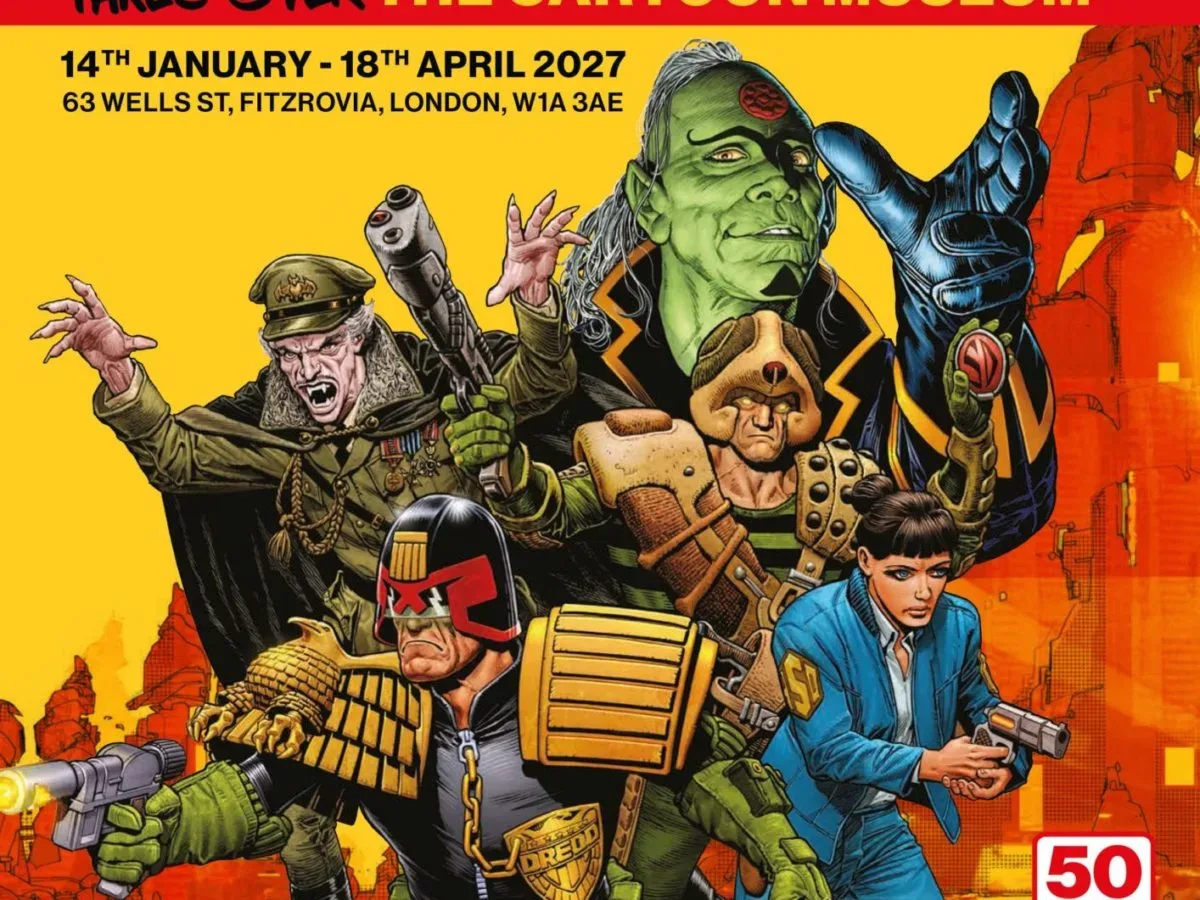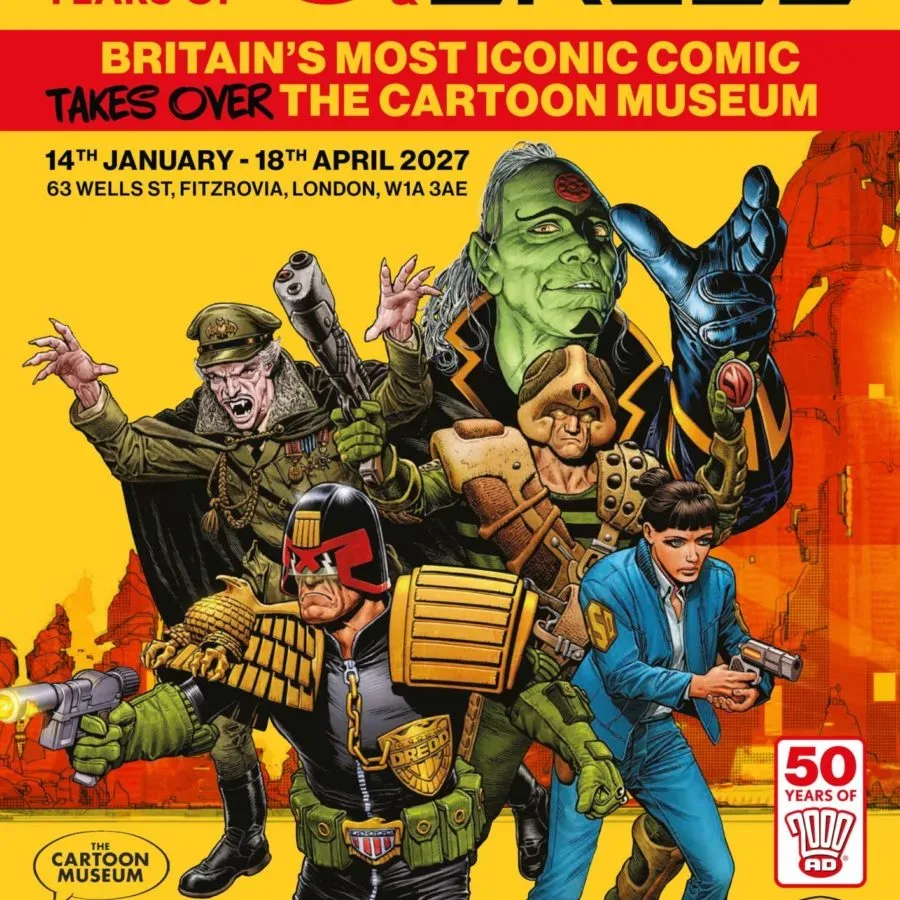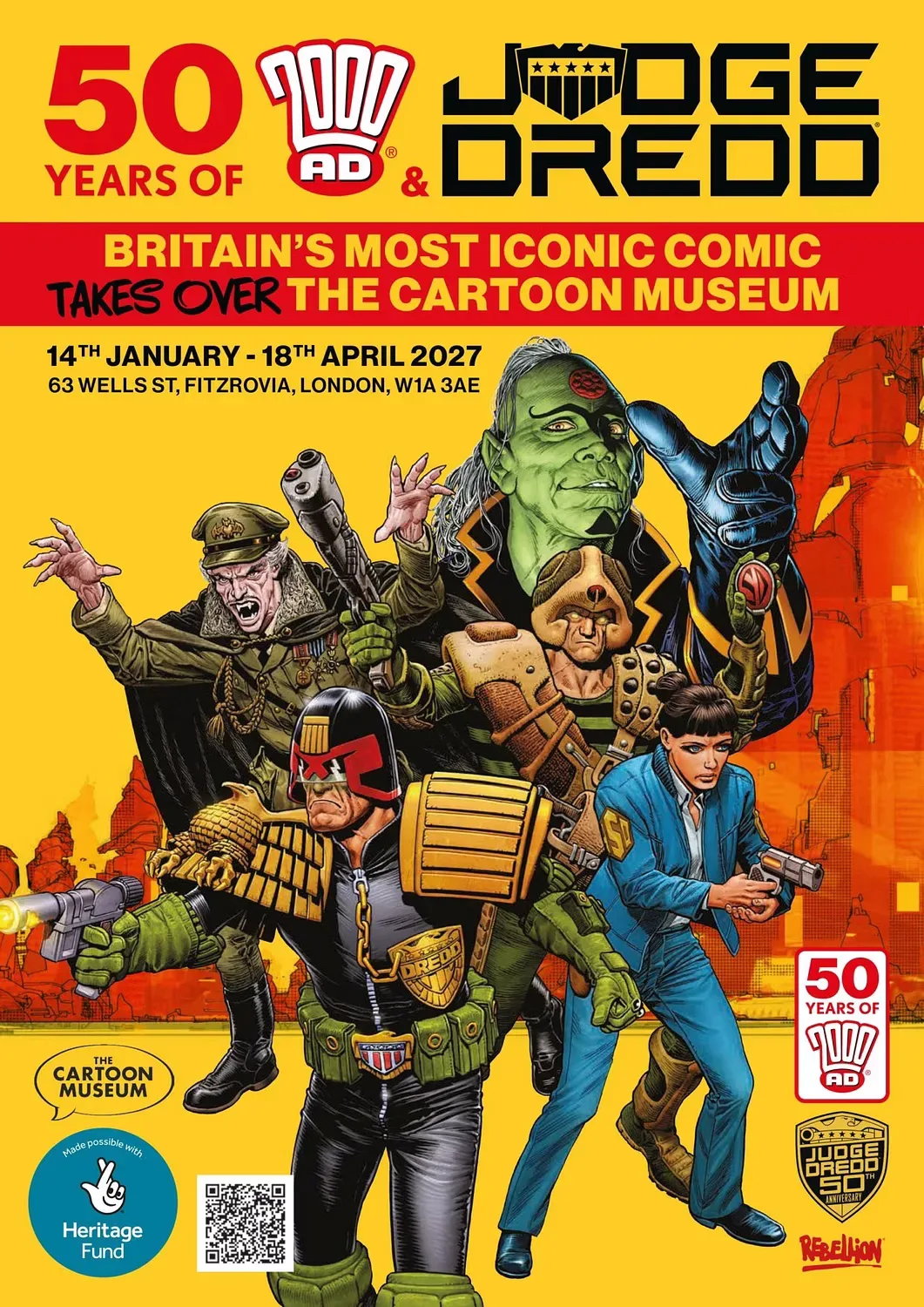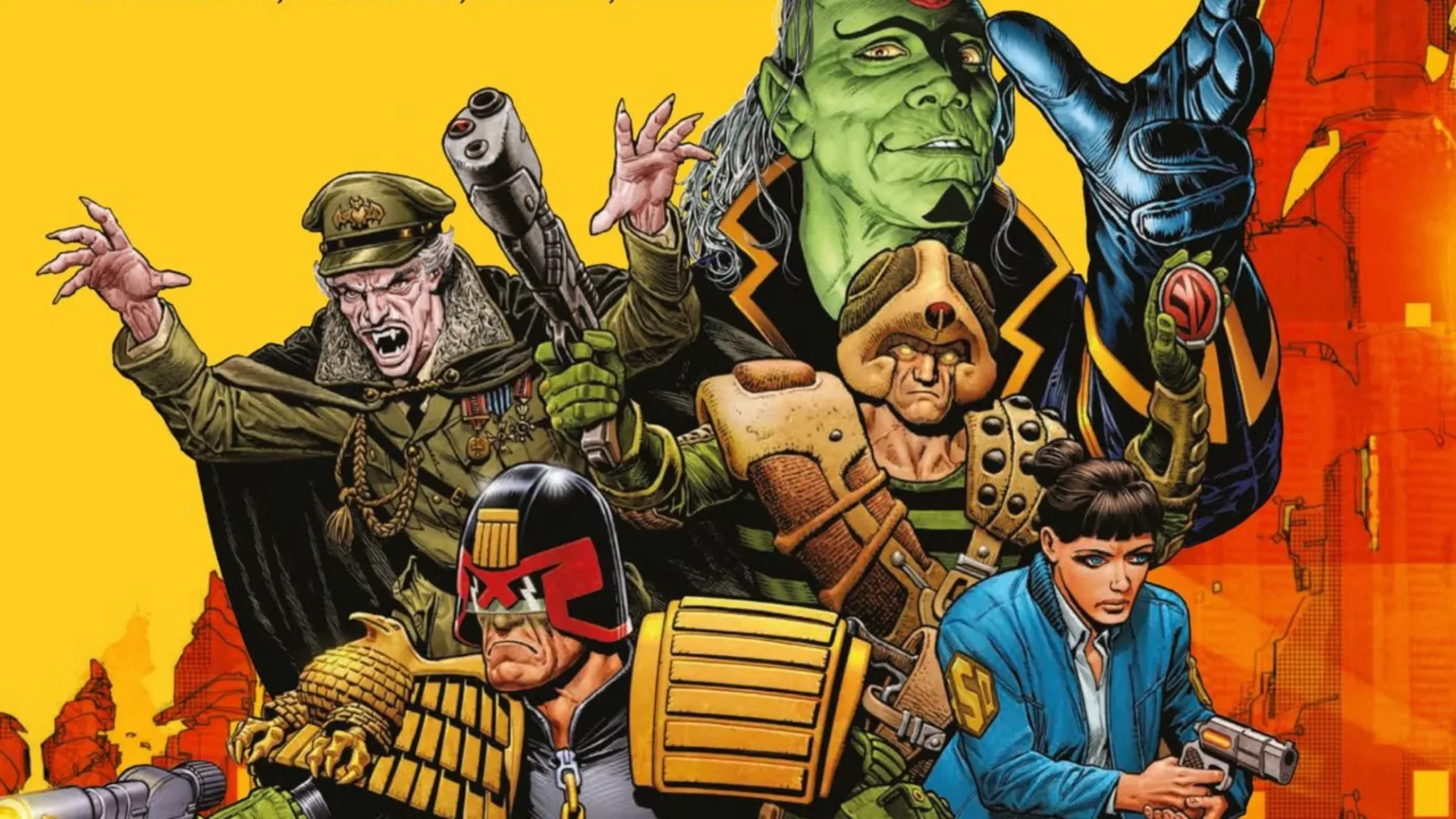
Judge Dredd is heading to a venue with considerably fewer exploding apartment blocks than Mega-City One. 50 Years of 2000 AD & Judge Dredd, a major anniversary exhibition, is scheduled to take over every gallery at London’s Cartoon Museum from January 14 through April 18, 2027.
The show marks a half-century for 2000 AD and its most recognisable lawgiver, Judge Dredd. It is being curated by Rebellion and will draw on artwork held in artists’ collections, private loans and the publisher’s archive. Rather than focusing on a single run, character, or era, the exhibition is positioned as a broad survey of work from across the histories of 2000 AD and the Judge Dredd Megazine.
That scope matters. A retrospective built around original comic art is not simply a display of familiar covers enlarged for gallery walls. Original pages can preserve the physical decisions behind printed comics: pencilled structure, inked finishes, corrections, lettering space, panel rhythm and the visual compromises needed to tell a story a page at a time. The exhibition also promises material explaining how comics are made, giving visitors a route into the craft as well as the characters.
A full-gallery 2000 AD retrospective
This will be the third significant 2000 AD-related exhibition at the Cartoon Museum. A 40th-anniversary show was held in 2017 at the museum’s former Little Russell Street location and attracted tens of thousands of visitors. It was followed by the more compact Dredd @ 45 exhibition in 2022. The 2027 event raises the scale again, using every gallery in the museum’s current Wells Street building.
For more context, explore The Joust Reports 100-Plus Updates as Engine and Graphics Overhaul Lands.
The announced contributor list spans artists associated with defining looks, periods and strips in the wider 2000 AD world. Names include:
- Carlos Ezquerra
- Simon Bisley
- Brian Bolland
- Steve Dillon
- Kevin O’Neill
- Glenn Fabry
- Mick McMahon
- Steve Yeowell
- Chris Weston
- Simon Davis
- Ron Smith
- Bryan Talbot
- Henry Flint
- Cam Kennedy
- Jock
- Ian Gibson
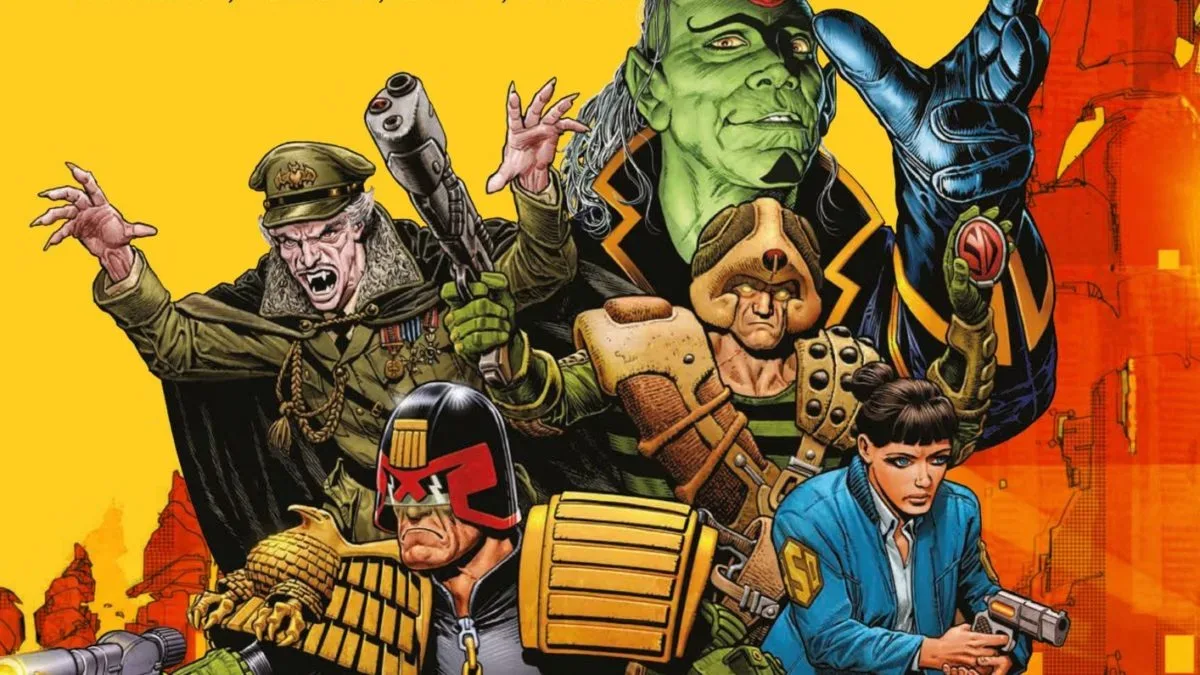
That is a useful indication of the show’s intended range, even before the wider list of participating artists is considered. Different artists can make the same fictional city feel radically different: oppressive and monumental, filthy and crowded, grotesquely comic, streamlined, expressionistic or brutally functional. A museum-wide presentation has the potential to put those changes side by side, making the visual evolution of a long-running British comic easier to see than it is when pages are separated by years of collected editions and back-issue hunting.
The importance of original art
“Original artwork” has a specific meaning in a comics exhibition. It generally refers to the physical art made for publication rather than a reproduction of the finished printed page. It is valuable for historical reasons, but it is also revealing in practical terms. Printed comics are designed to be read at a particular size and pace. Gallery viewing lets visitors scrutinise line work, texture and composition without turning immediately to the next page.
For an exhibition centred on a character as visually identified with Judge Dredd, that difference can be significant. Dredd’s helmet, eagle shoulder pad, armour, oversized city architecture and stern silhouette are all graphic shorthand. In printed form, they must communicate instantly. In original art, the construction of that shorthand can become more apparent: how much black ink anchors a figure, where a crowd scene directs the eye, and how an artist gives a helmeted character presence when much of his face is deliberately obscured.
The exhibition’s planned coverage of production should also help distinguish the comic from the finished object readers know. Comic-making is a sequence of decisions shared across writing, art, lettering, editing and production. A gallery display cannot recreate every deadline or editorial conversation, but preparatory and original material can show that a comic page is made rather than simply appearing in a weekly publication fully formed.
A new Dredd statue based on Carlos Ezquerra’s art
One of the exhibition’s central new pieces will be a life-sized Judge Dredd statue. It is based on co-creator Carlos Ezquerra’s full-length painting of the character.
That choice roots the statue in an artist-specific interpretation rather than treating Dredd as a fixed costume sheet. It also underlines the point of an art-focused anniversary: Judge Dredd may be a hugely recognisable character, but the way he is drawn is inseparable from the artists who defined, revised and challenged his visual language over decades.
Ezquerra’s role gives the installation added weight. The show is celebrating both the longevity of the character and the work of the people who made that longevity possible. A life-sized figure is likely to be a natural focal point for visitors, but its stated basis in a particular painting ties it back to the original-art focus rather than turning the exhibition into a generic character display.
Satire, influence and a future that keeps feeling uncomfortably close
The museum presentation will examine the comic’s influence beyond its pages, including its relationship with film, video games, comics and music. Rebellion’s Ben Smith has argued that the comic’s influence can be felt across popular culture and has noted that the future depicted in Judge Dredd seems increasingly prescient.
That second point is central to why Dredd remains such an effective anniversary subject. Mega-City One is not presented here merely as a futuristic setting full of gadgets and grim architecture. Its value as a satirical backdrop comes from exaggeration: authoritarian enforcement, sprawling urban life and systems so vast that they can become absurd. When readers see echoes of the present in that exaggeration, the satire gains bite. The exhibition’s inclusion of influence and production material suggests an interest in that continuing relevance, rather than treating the comic solely as a nostalgia object.
“Influence” can be a loose word, so it is worth keeping the claim grounded. The planned show does not need to prove that every later dystopian story descends from Dredd. It can instead demonstrate the lasting reach of a comic whose imagery, tone and approach to future-city satire have remained culturally legible across five decades. The promised material on comics craft is especially suited to that task: it can show how ideas become layouts, pages and visual symbols that endure.
Part of a larger 2027 anniversary programme
The Cartoon Museum exhibition will sit within a broader 50th-anniversary programme in London. A two-day 2000 AD & Judge Dredd 50th Anniversary Weekend is planned for Protein Studios in Shoreditch on March 6 and 7, 2027.
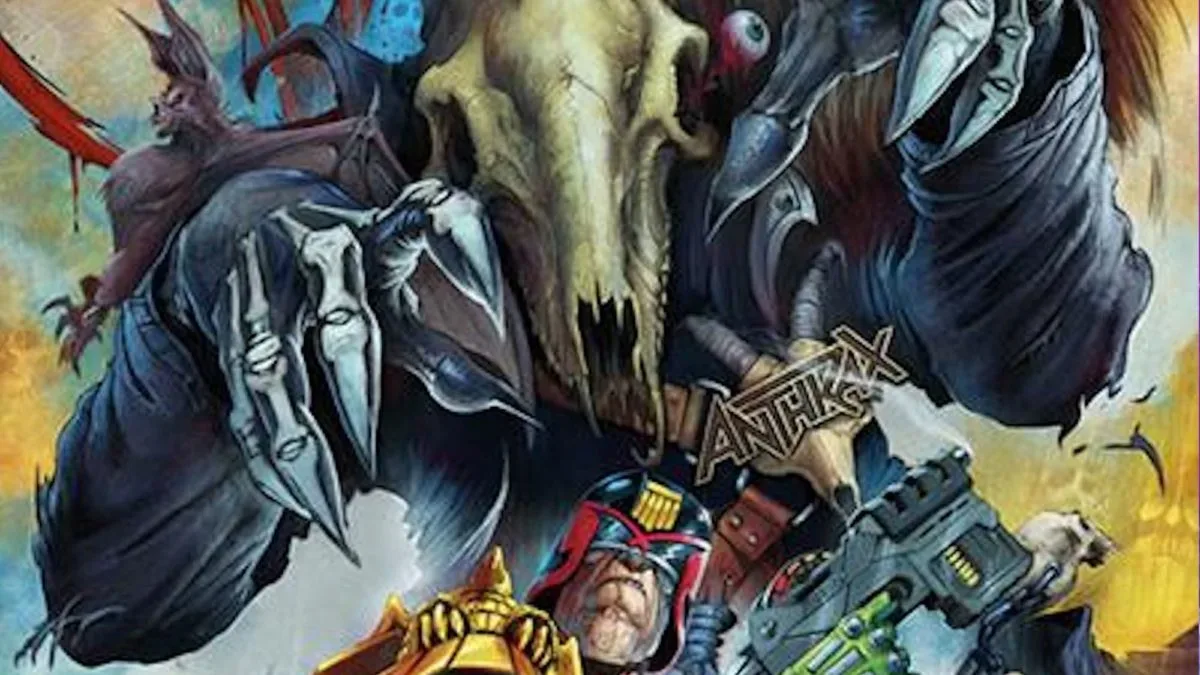
January 2027 publishing plans also include a 2000 AD Anniversary Special, a Visual History hardcover, and Judge Dredd Magazine #500. That magazine issue is set to involve members of Anthrax writing, editing and introducing their own Dark Judge into the canon: Judge Anthrax.
Together, those projects show an anniversary being treated as more than one commemorative issue or one-off gathering. The museum show provides the historical and visual centrepiece; the Shoreditch weekend gives the celebrations a live event; and the planned publications extend the milestone into new reading material. For fans able to attend more than one, the calendar offers distinct experiences rather than simple repetitions of the same retrospective.
What visitors should expect
The Cartoon Museum will retain a selection from its permanent collection in the Clore Learning Studio while the rest of the building is given over to the anniversary exhibition. That is a practical detail with a pleasant implication: the show is substantial enough to occupy the museum’s main gallery space, but the venue’s wider comics-and-cartoon remit is not being erased for the duration.
Visitors should not assume that every key work or every creator from 50 years can be represented. Any exhibition of this scale depends on what can be borrowed from artists, private owners and archives, and the announced material is better understood as a curated cross-section than a definitive inventory. Still, the breadth of named artists, the commitment to every gallery and the emphasis on original work suggest a substantial opportunity to trace how 2000 AD and Judge Dredd have been drawn, constructed and reinterpreted over time.
For readers who know Dredd mainly through a favourite story, a film adaptation, a game appearance or a striking cover seen from across a comic shop, a display of original pages may offer a more direct encounter with the medium. For longtime readers, it should provide a chance to compare the hands and styles behind a comic that has never relied on a single aesthetic voice.
50 Years of 2000 AD & Judge Dredd runs at the Cartoon Museum, London, from January 14 to April 18, 2027. Exhibition and ticket information is available through the Cartoon Museum.