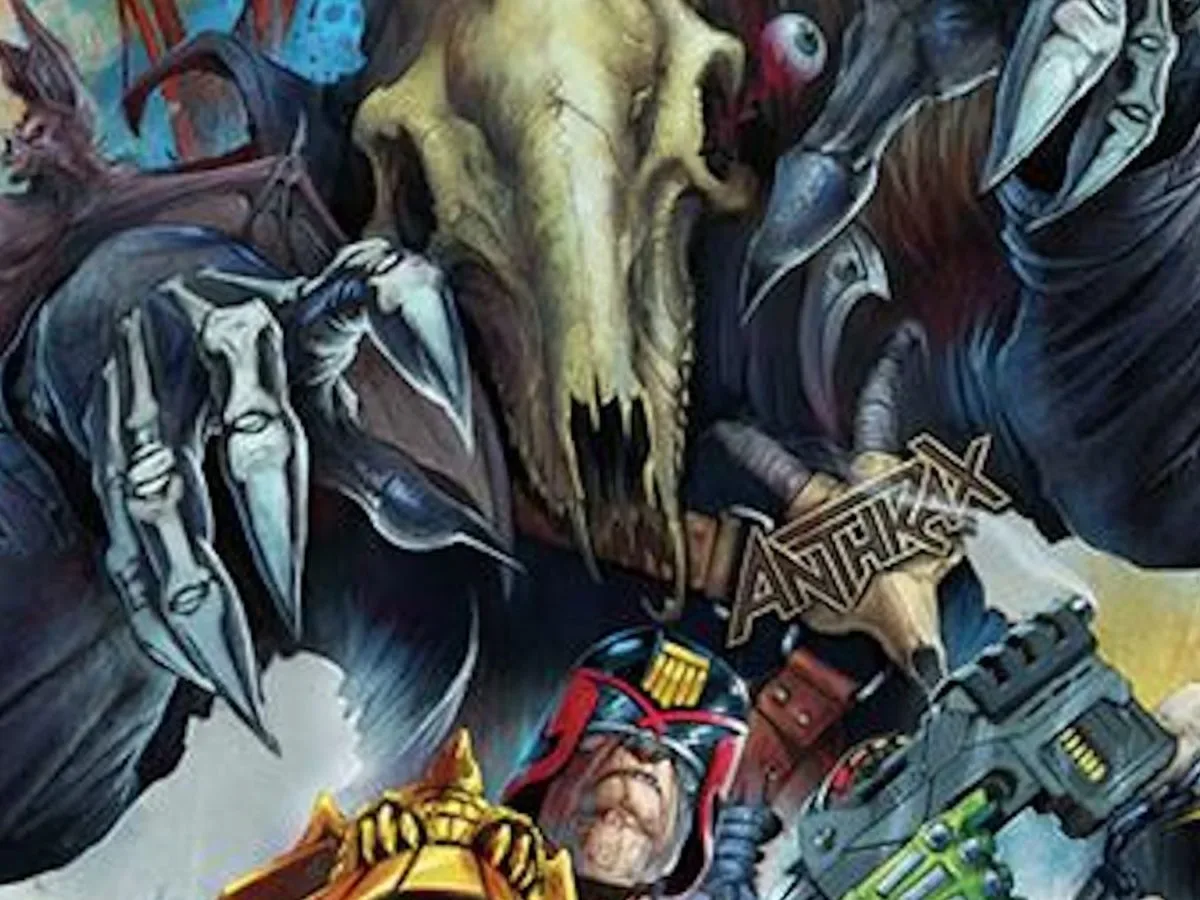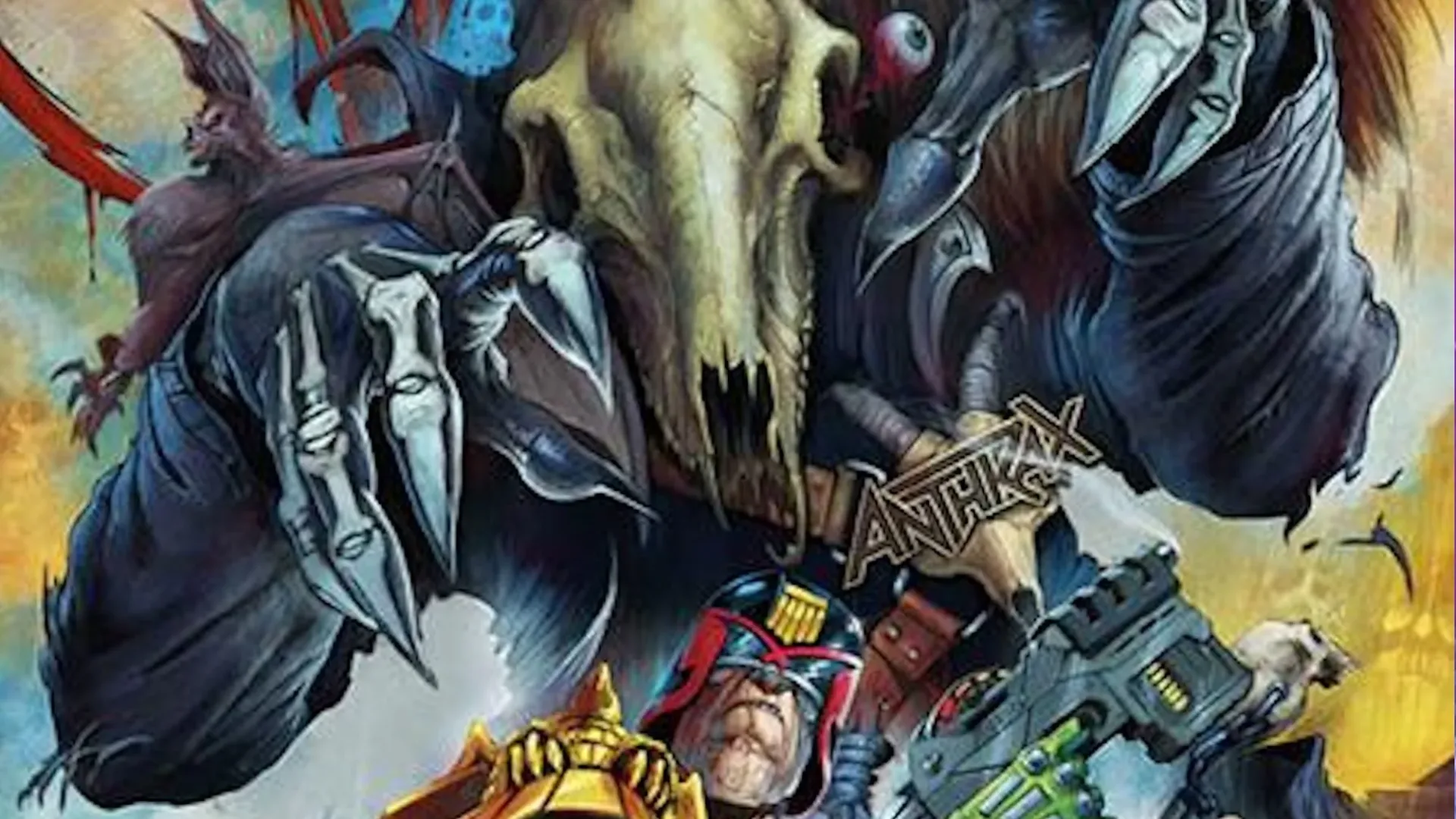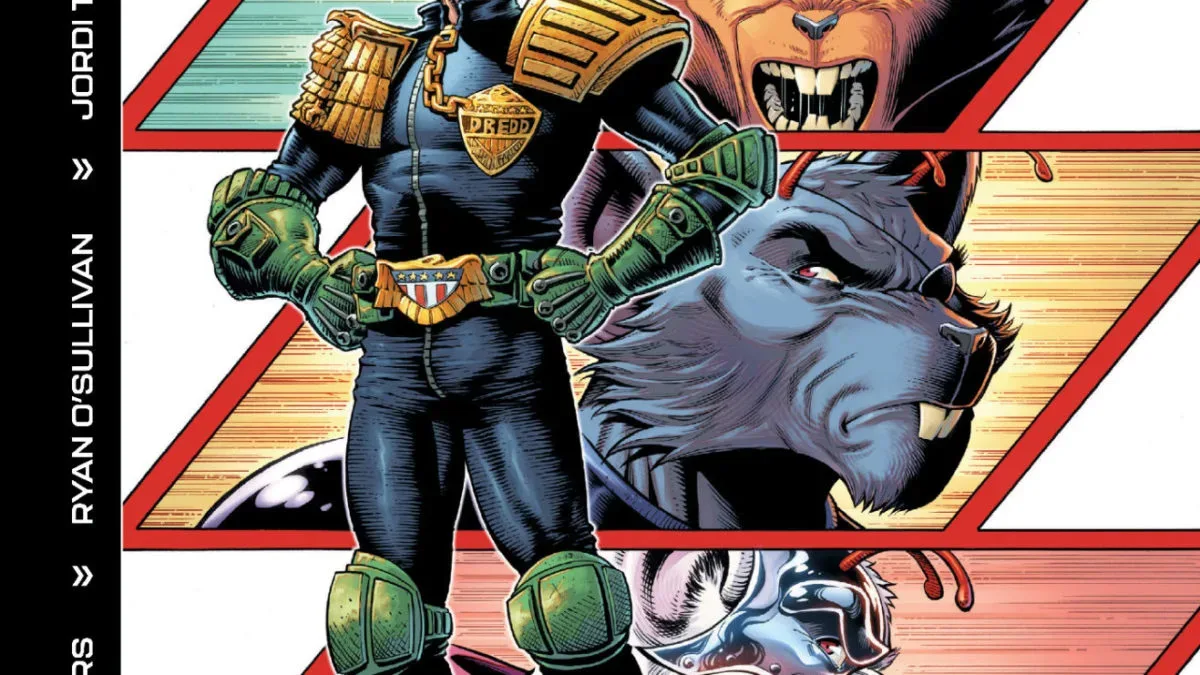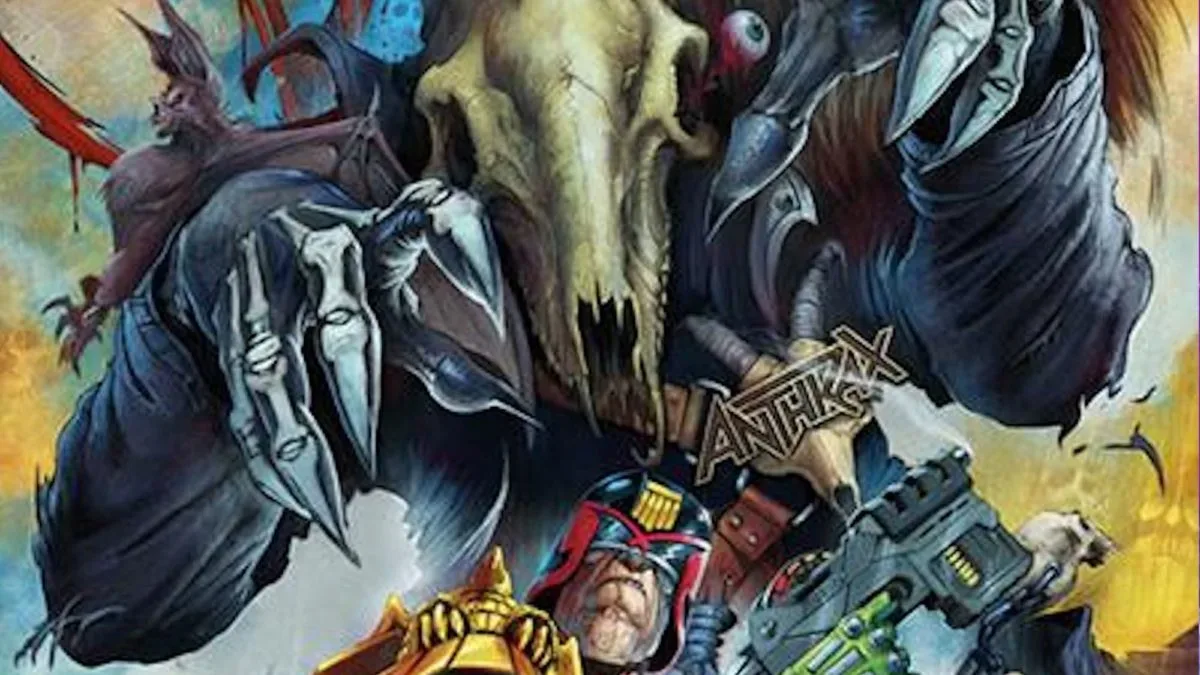
Anthrax guitarist Scott Ian and drummer Charlie Benante are extending the band’s long-running connection to Judge Dredd with a new character: Judge Anthrax. The character is set to debut in Judge Dredd Megazine #500, a 100-page milestone issue planned for early 2027 as part of the wider 50th-anniversary celebration for 2000 AD.
Ian and Benante are credited as co-creators alongside writer John Reppion and artist Kieran McKeown. Their contribution is described as a double-length story featuring Judge Dredd, the Dark Judge, and the newly introduced Judge Anthrax. The setup puts the new antagonist’s motives at the center of the plot, with Mega-City One and Dredd directly in their sights.
A metal-band name enters Mega-City One
The name Judge Anthrax is an unusually direct bridge between a band and a comic-book universe, but it is not a random celebrity cameo. The supplied details position the character as a new Dark Judge, placing them within one of the most recognizable supernatural threats in Dredd’s world rather than simply using the band’s name as a visual gag.
For readers unfamiliar with the terminology, a Dark Judge is distinct from a regular Judge of Mega-City One. Dredd is part of a system in which Judges combine policing, prosecution, judgment, and sentencing. Dark Judges take that authoritarian premise into horror territory: they are supernatural figures whose warped idea of justice turns life itself into the offense. Calling Judge Anthrax a Dark Judge therefore signals that the character is designed as a major threat, not merely another street-level criminal in Dredd’s city.
For more context, explore 29 Newly Listed Games Span VR Sandboxes, Manor Mysteries and One Very Ambitious Jelly.
The story’s billing also notes the presence of “The Dark Judge,” which leaves the exact relationship between that figure and Judge Anthrax to be revealed in the comic. What is clear is that the new character will arrive as part of a narrative built around an established strand of Dredd mythology. That is a sensible setting for a band name associated with aggressive thrash metal: the Dark Judges have long given the franchise room for heightened horror, extreme imagery, and apocalyptic stakes.
Why this crossover has more history behind it than it first appears
Anthrax’s Dredd connection substantially predates Judge Anthrax. Scott Ian’s fandom reportedly reaches back to 1986, and the band’s song “I Am the Law” became a particularly overt tribute to the character and the wider 2000 AD world. The connection was visible beyond lyrics. Artwork for a 12-inch single incorporated Dredd’s badge with the Anthrax logo, presented against an American flag.
That earlier use of Dredd imagery mattered because it established a working relationship with the character’s rights holders at a point when Dredd was less familiar to a U.S. audience. The licensing arrangement was described as notably accommodating, and that relationship continued as the band used Dredd-related images on merchandise over subsequent decades.
In practical terms, Judge Anthrax is the latest stage of a long-running exchange rather than a one-off branding exercise. The band has repeatedly brought Dredd into its visual identity, while the comic’s custodians have allowed that association to grow into approved storytelling. For comic readers, that context is important: Ian and Benante are arriving with existing familiarity and a demonstrated investment in the material.
The 2021 precedent: an official Dredd story
There is also a closer creative precedent. The 2021 Among the Living graphic novel was published to mark Anthrax’s 40th anniversary. Structured as an anthology inspired by the album’s tracks and narrated by a redesigned version of the band’s Not Man mascot, it included an “I Am the Law” chapter that crossed fully into Dredd territory.
Ian wrote that 13-page Judge Dredd story in partnership with 2000 AD and Rebellion, while longtime Dredd artist Chris Weston drew it. The story was approved as official 2000 AD continuity. “Continuity” in this context means a story is treated as belonging to the shared ongoing fictional history, rather than being an unofficial homage or a disconnected alternate take. That distinction gives the earlier chapter more weight than a licensed novelty project.
Benante also contributed related cover artwork featuring Dredd and Judge Death. Taken together, those credits show that both musicians have already worked in different capacities around the property: Ian through a Dredd narrative, Benante through art, and both through the new character’s creation. The new project has a different creative team for the actual Megazine strip, with Reppion writing and McKeown handling the art, but it builds on work that was already accepted into the setting.
There is an added note of intrigue in the description of the 2021 story. It has been characterized as potentially offering a view of a final fate for Dredd. That does not establish a definitive outcome for the character, and readers should not mistake it for a confirmed endpoint. It does, however, illustrate how seriously the previous collaboration was framed within the world of the comics.
What makes Megazine #500 a fitting place for the debut
Issue #500 is designed as a landmark edition rather than a standard-sized release. At 100 pages, it is set to launch the anniversary activity in early 2027. A double-length Dredd feature centered on a new Dark Judge gives the issue a clear event hook while letting it include work beyond Dredd’s corner of the setting.
Other named contributors and characters attached to the issue include Liam Johnson, Ales Kot, Michael Carroll, Rob Richardson, Paul Marshall, and Antonio Fuso, with stories involving Devlin Waugh and Judge Anderson. Devlin Waugh is identified as a vampiric exorcist, which underlines that the Megazine’s lineup is not limited to the procedural or dystopian side of Dredd’s world. Judge Anderson, meanwhile, is one of the setting’s best-known Judges and expands the issue’s focus beyond Dredd himself.
The anniversary program is broader still. Judge Dredd: The New Future is listed as a new series from Rob Williams and Laurence Campbell. A separate 2000 AD 50th Anniversary Special is set to feature new stories involving Judge Dredd, Robo-Hunter, Nikolai Dante, and Brink, alongside the return of an unnamed classic series. Its announced creative names include John Wagner, Robbie Morrison, Ian Edginton, Pat Mills, Dan Cornwell, Simon Fraser, Mike Perkins, Ian Culbard, and Brian Bolland.
There are retrospective releases in the plan as well. Visual History To 2000AD is slated as a hardcover covering five decades, with contributors including Scott Montgomery, Bolland, Simon Bisley, Dave Gibbons, Kevin O’Neill, and Carlos Ezquerra. The publisher also plans Judge Dredd Compact Comics, beginning with collections of the earliest black-and-white strips from 1977.
What readers can reasonably expect—and what remains unknown
The announced facts give a firm outline, but not a full character dossier. Judge Anthrax is a powerful new Dark Judge; Dredd is a target; Mega-City One is at risk; and the story will be longer than a regular installment. There is no supplied information on Judge Anthrax’s appearance, abilities, origin, identity, or lasting role after the debut. Those absences are worth preserving because a Dark Judge’s design and twisted logic are often fundamental to the impact of their first appearance.
Likewise, there is no basis yet to call Judge Anthrax a permanent addition to the cast, to suggest the character will appear in other anniversary material, or to assume a particular connection to Judge Death beyond Benante’s earlier cover art. The key confirmed point is narrower and still significant: Ian and Benante are helping bring an original character into an official Dredd story, with established comics creators responsible for translating the concept to the page.
For longtime Anthrax listeners, the project offers a rare escalation of a fandom that has been visible since “I Am the Law.” For Dredd readers, it introduces a new antagonist in an issue constructed to mark a major publishing milestone. And for readers arriving from either side, the debut has an advantage many music-comics crossovers lack: it is rooted in a relationship with the property that has endured across music artwork, merchandise, a continuity-approved comic story, and now a full new character.