Jeff is about to meet the one opponent designed specifically to be more Jeff than Jeff.
Jeff the Land Shark: Superstar #4 arrives October 21, 2026, with a premise that puts the cheerfully chaotic land shark in the kind of absurdly high-stakes predicament that suits him: Mojo wants a replacement. Not merely a substitute, either. The plan is for M.O.D.O.K. to build an all-new, supposedly all-improved Jeff who will follow every command.
That leaves the original Jeff with two immediate problems. First, a clone engineered for obedience threatens to turn Jeff’s own image into a weapon for Mojo. Second, Ken is trapped in Mojoworld. Jeff and the Jeff Coast Avengers respond with a heist intended to get Ken back, while the issue also poses the far more fundamental question of how anybody escapes Mojoworld in the first place.
It is a delightfully compact comics setup: a rescue operation, a villain-made duplicate, a team mission, and an extradimensional media tyrant whose entire world is built to make normal solutions feel inadequate. Jeff is a land shark, after all. “Normal solution” was never likely to be on the menu.
Mojo’s idea of an upgrade comes with strings attached
The key word in the issue’s setup is obedient. Mojo is not seeking an improved Jeff for the sake of better land-shark performance reviews. He wants a Jeff who will heed his every command. The supposed upgrade is therefore an act of control, making the clone story less about whether a new model can do more and more about who gets to decide what Jeff is for.
M.O.D.O.K. is the architect of that attempt. The enormous-headed villain’s role is to create the new Jeff, placing the story’s science-fiction mechanics squarely inside Mojo’s entertainment-driven power structure. In a comic-book context, a clone is not simply a biological duplicate. It is a narrative pressure point: someone who can look like the hero, potentially act like the hero, but has been made to serve an entirely different agenda.
That distinction matters here. A duplicate designed to obey Mojo is an imitation stripped of the unpredictable independence that makes the real Jeff useful to his friends and intolerable to his enemies. The villain’s “better” version is better only by the standards of somebody who regards free will as bad television.
There is plenty of room for the premise to be funny, especially because an evil replacement story is being applied to a small shark who operates on a wavelength where cute, brave and catastrophic can occupy the same panel. But the concept also gives the issue a clean emotional spine. A hero does not have to make speeches to establish that they are more than a product. Being the one who refuses to become somebody else’s mascot can do the job.
The rescue mission puts the Jeff Coast Avengers on the clock
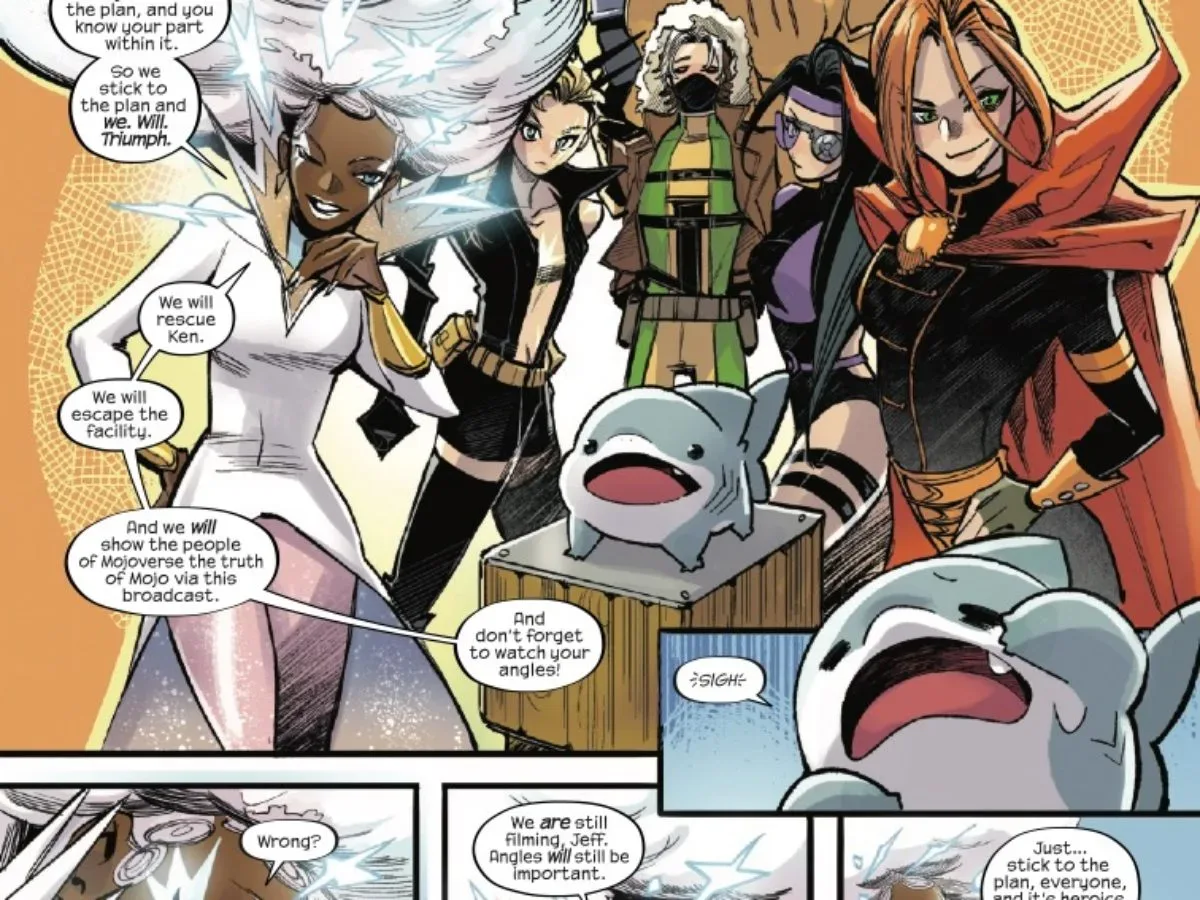
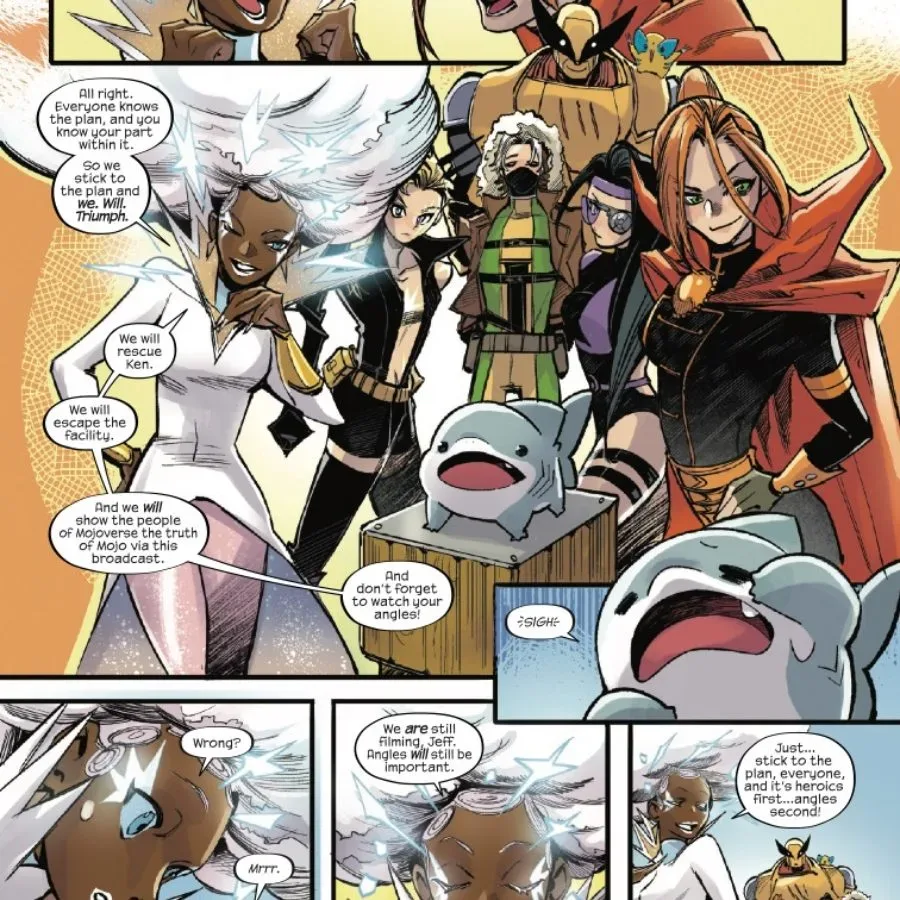
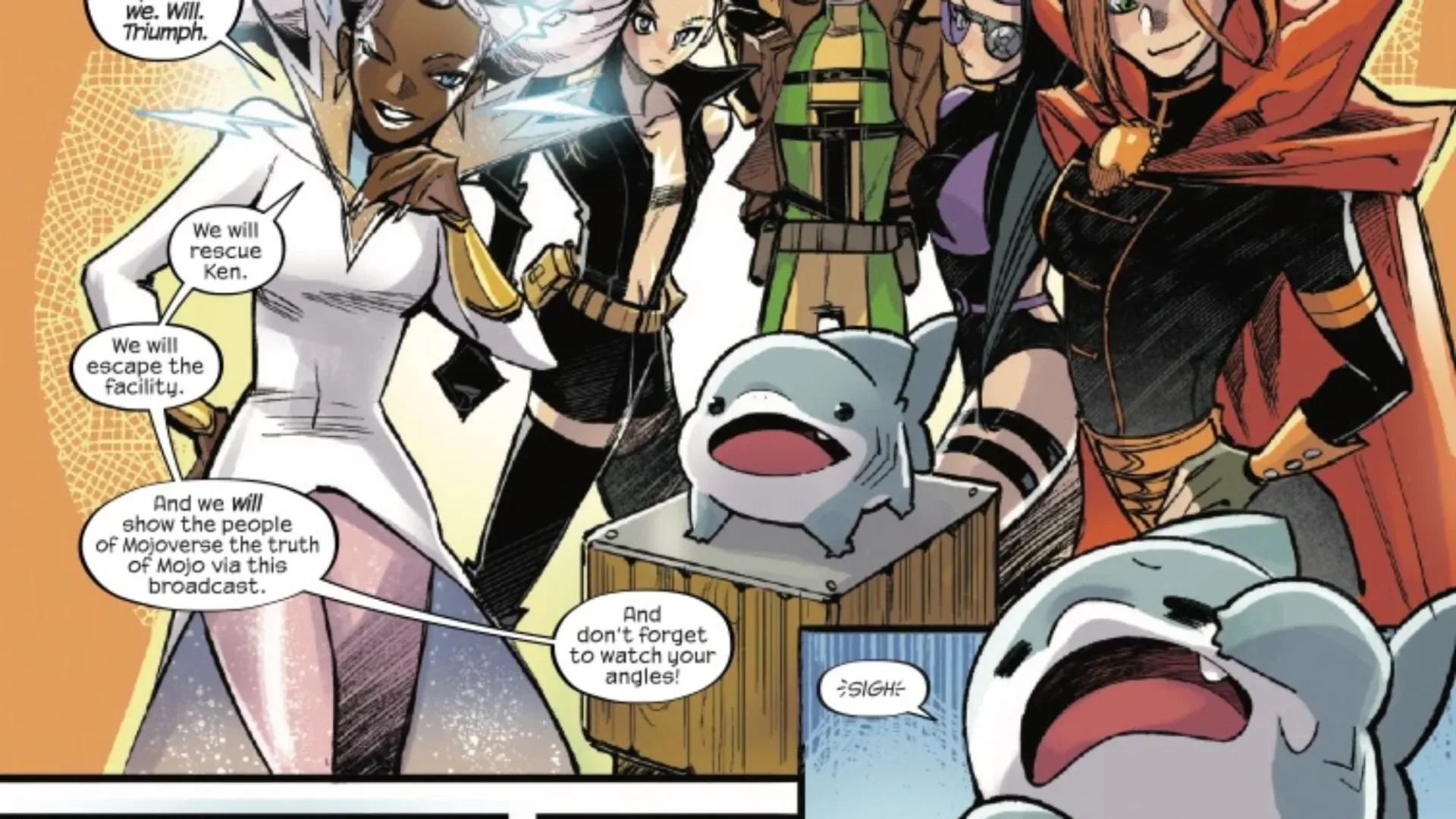
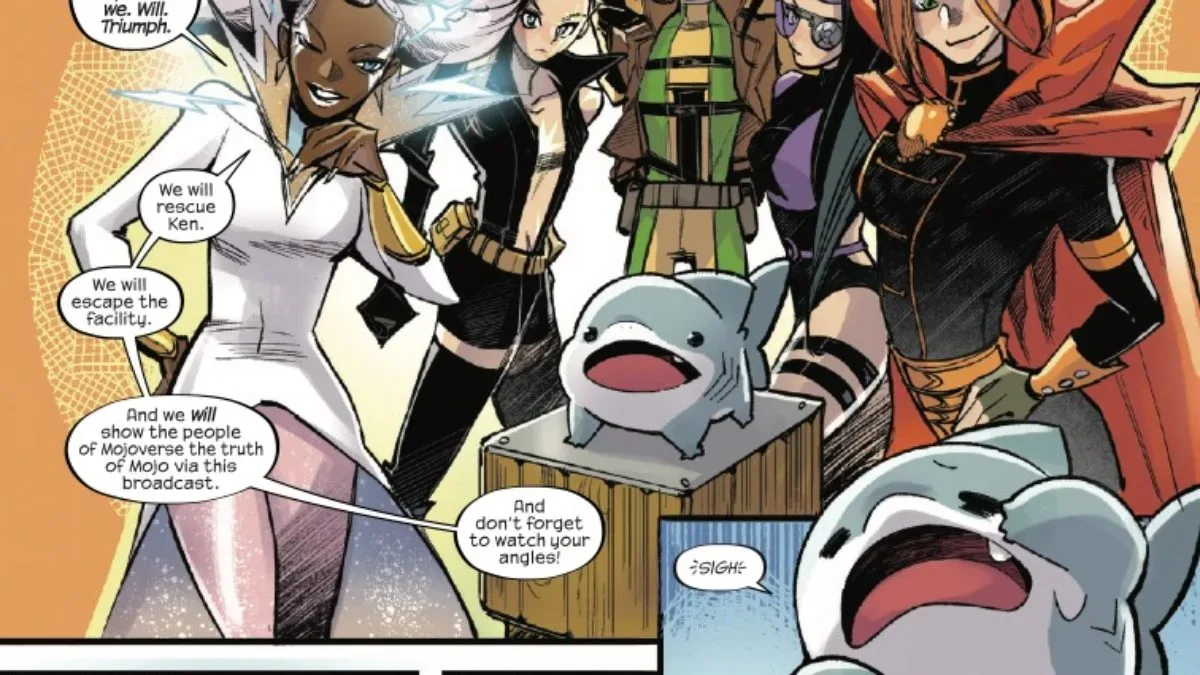
While Mojo and M.O.D.O.K. work on their controlled replacement, Jeff and the Jeff Coast Avengers stage a heist to rescue Ken. A heist, in this context, means a mission shaped around infiltration, timing, evasion and a getaway rather than an open, straightforward confrontation. The word promises that the team’s obstacle is not just a powerful villain; it is the challenge of getting a person out of a hostile place that may be constructed to keep everyone exactly where Mojo wants them.
That is particularly pointed when the location is Mojoworld. The issue’s solicitation explicitly asks how one escapes it, framing the setting itself as part of the conflict. A prison does not need bars if the whole dimension serves the jailer’s purposes. For Jeff’s crew, saving Ken is only half the assignment. The other half is surviving the exit.
The Jeff Coast Avengers’ involvement should make the mission feel bigger than a solo detour. Team stories give a character like Jeff a useful change of rhythm: the star can be the heart of the operation, but the plan can depend on several personalities carrying different pieces of the chaos. Whether the rescue goes smoothly is another matter. The solicitation itself warns that it could all go sideways, a fair possibility whenever Mojo, M.O.D.O.K. and a newly created land-shark duplicate are all active variables.
The underlying appeal is simple. Jeff is not just reacting to a threat against himself. He is acting to bring Ken home. The clone plot adds identity trouble; the heist adds forward motion; the rescue provides a reason to care about the outcome beyond winning a fight.
A clone plot is a perfect fit for a character defined by personality
Clone stories are a familiar superhero device because they make identity visible. Put the protagonist next to a manufactured counterpart and the story can ask questions that are harder to articulate in an ordinary fight: What makes the original special? Is it appearance, capability, memory, instinct, choices, relationships, or the mistakes no laboratory would deliberately program?
For this issue, the question is sharpened by Mojo’s command that the clone be improved. “Improved” is a loaded term. It sounds neutral, even helpful, until the reader sees who defines it. In Mojo’s hands, an improvement is likely to mean a version of Jeff without resistance. That is less an upgrade than a hostile rewrite.
The story’s comedic potential and its conflict are not at odds. In fact, they reinforce each other. The more ridiculous the assertion that a villain can manufacture a superior Jeff on demand, the more satisfying it may be for the original to prove that the real quality being measured cannot be fabricated to order. A perfect replica of the shape is not necessarily a perfect replica of the person.
That framing also makes the “new Jeff” more than a one-note monster-of-the-week idea. The clone may be an obstacle, but its existence reflects the villain’s misconception: that loyalty is an engineering problem and that personality can be reduced to a controllable specification.
What readers can expect from issue #4
The available details establish the broad direction without revealing the solution. Jeff and the Jeff Coast Avengers are mounting their rescue. Ken is the objective. Mojo has pressed M.O.D.O.K. into creating a compliant replacement Jeff. Mojoworld remains the dangerous setting and the escape problem. Whether the team succeeds, how the clone behaves, and what “all goes sideways” actually looks like are the unanswered parts.
That is a strong place for a middle-series issue to operate. It has an immediate mission with a concrete target, but the adversaries add complications that can shift the story from a simple break-in to a battle over Jeff’s identity. Readers looking for an offbeat Marvel adventure get a compact hook without needing the premise to over-explain its own weirdness. There is a land shark. There is an evil media ruler. There is a giant-headed scientist making an obedient copy. The only sensible response is to assemble the Avengers-adjacent crew and attempt a dimensional heist.
Kelly Thompson writes the issue, Tokitokoro provides the interior art, and Gurihiru supplies the cover. The standard issue is listed at 32 pages and $4.99. A JHONY CABALLERO variant is also listed at $4.99 in the United States and $6.25 in Canada.
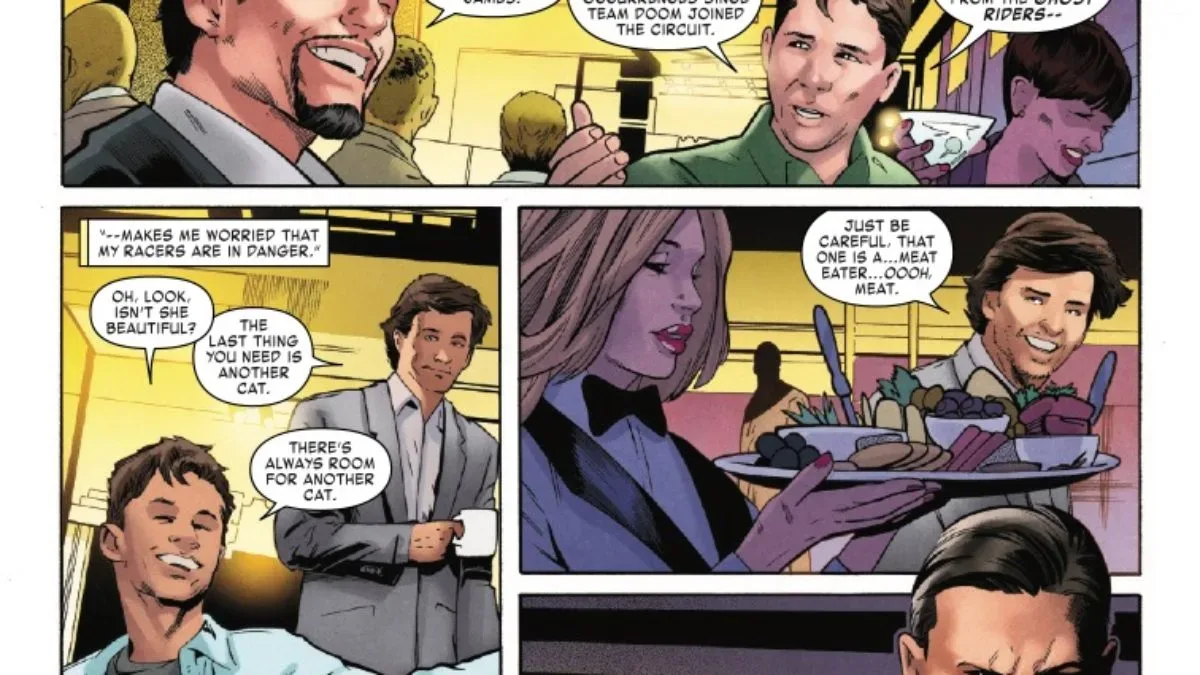
Marvel’s comic slate has room for giant-scale conflicts, but it also needs stories willing to make the stakes personal, strange and a little bit silly. Jeff the Land Shark: Superstar #4 appears ready to do that by turning a rescue mission into a contest between the real Jeff and a version built to make villainy look efficient. Anyone hoping for another Marvel matchup involving a major name and an absurd premise can also see how Iron Man: Racing Towards Doom #1 puts Tony Stark and Doctor Doom on an F1 collision course.
For Jeff, though, the job is more urgent: get Ken out, get out of Mojoworld, and make sure the “improved” model does not become Mojo’s new favorite piece of programming.