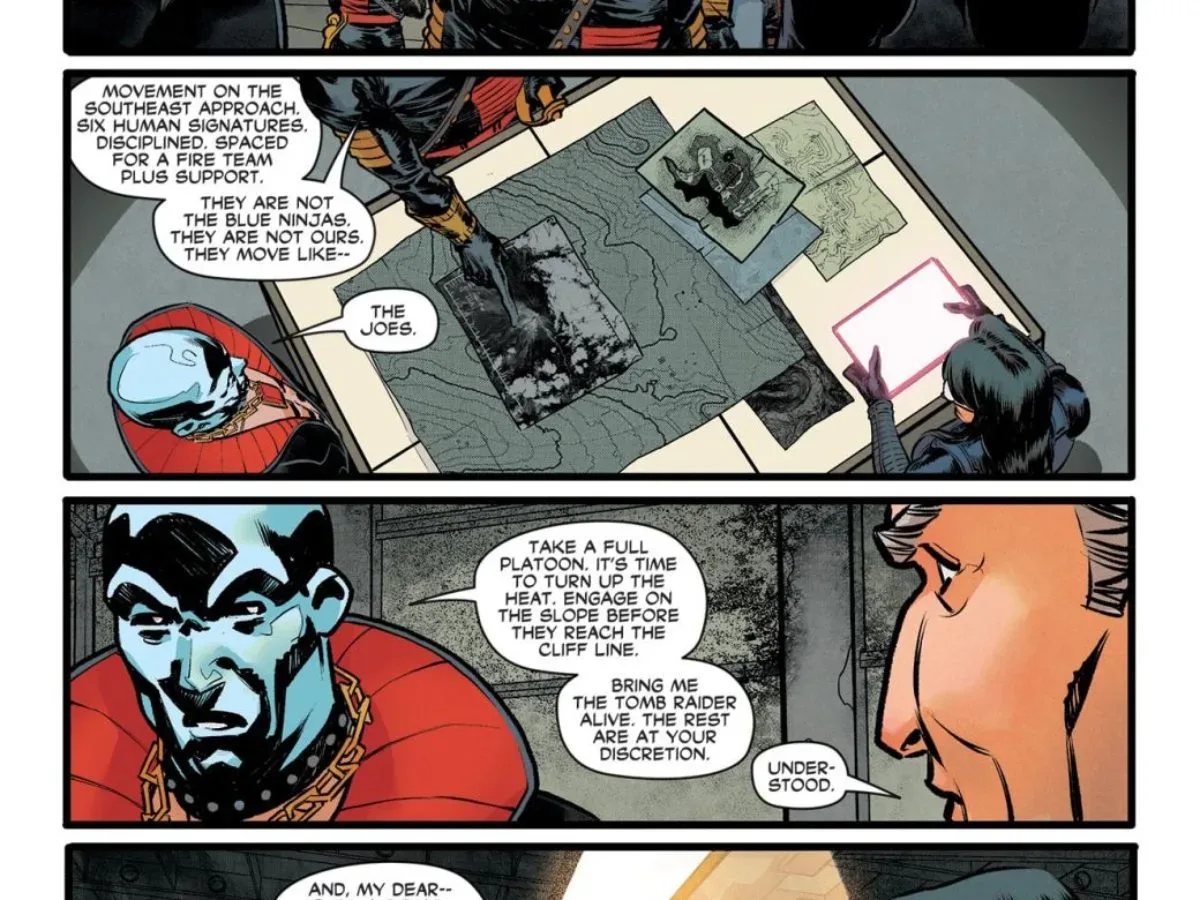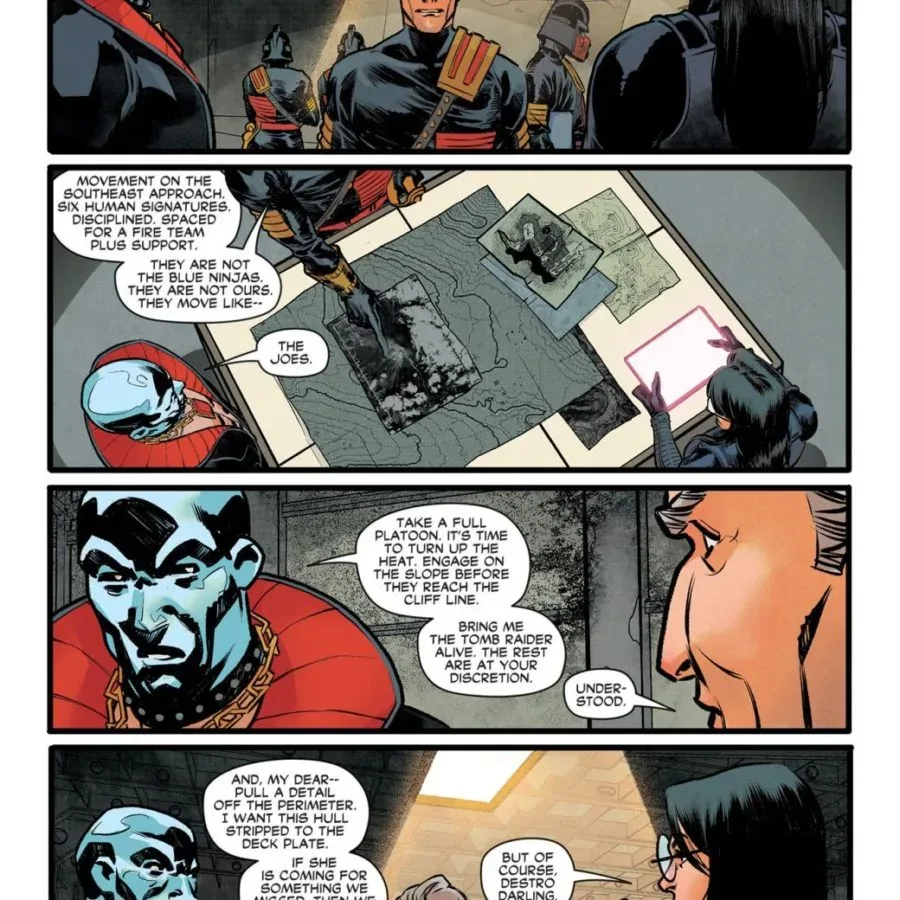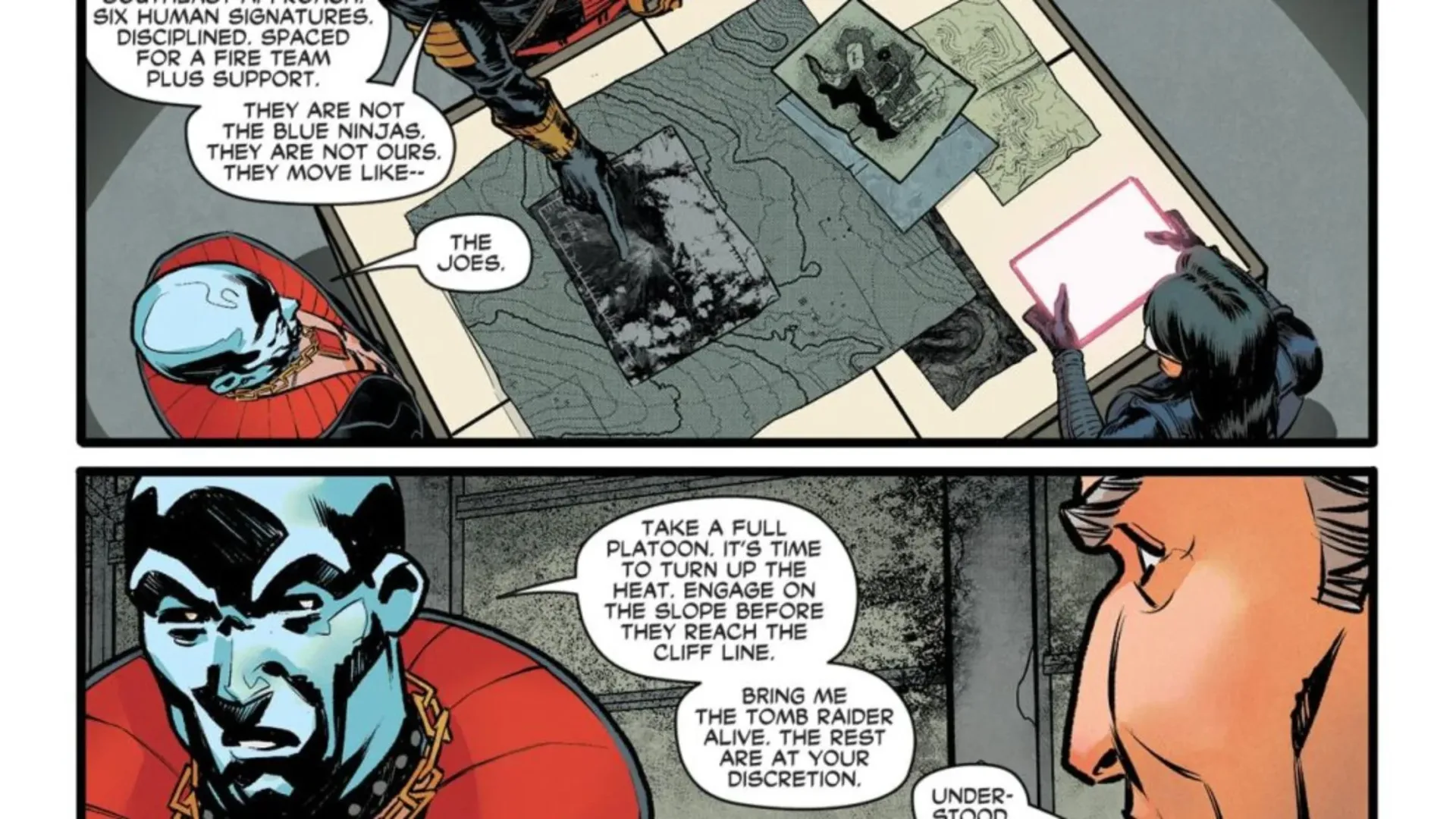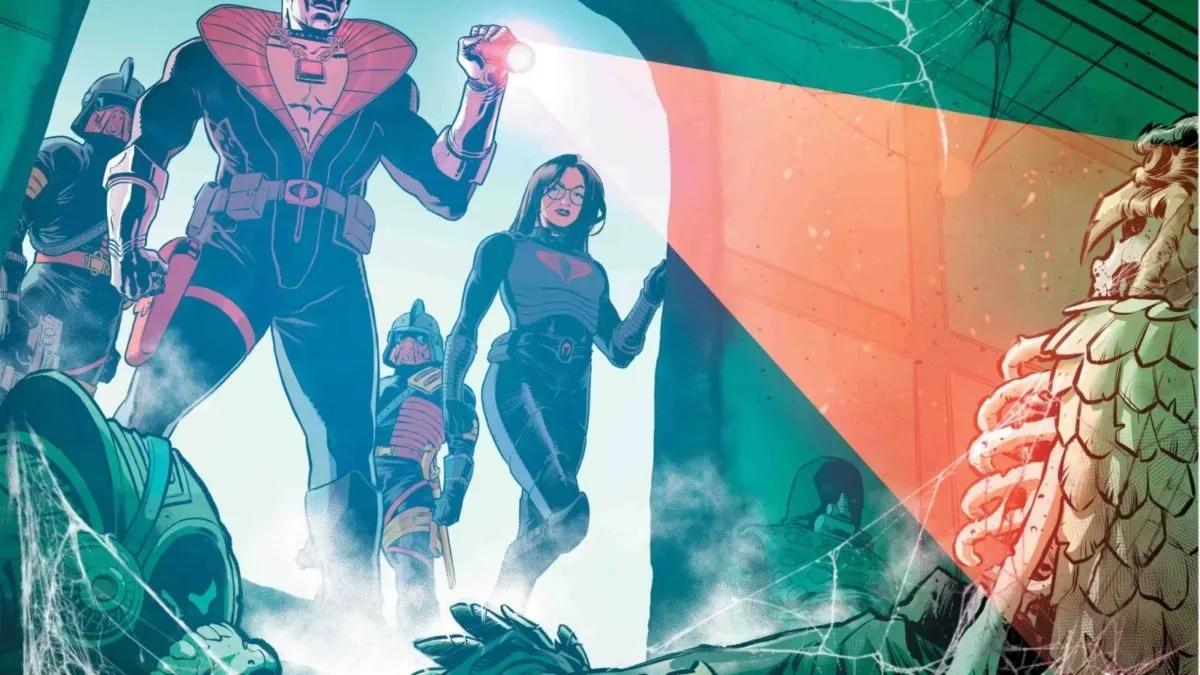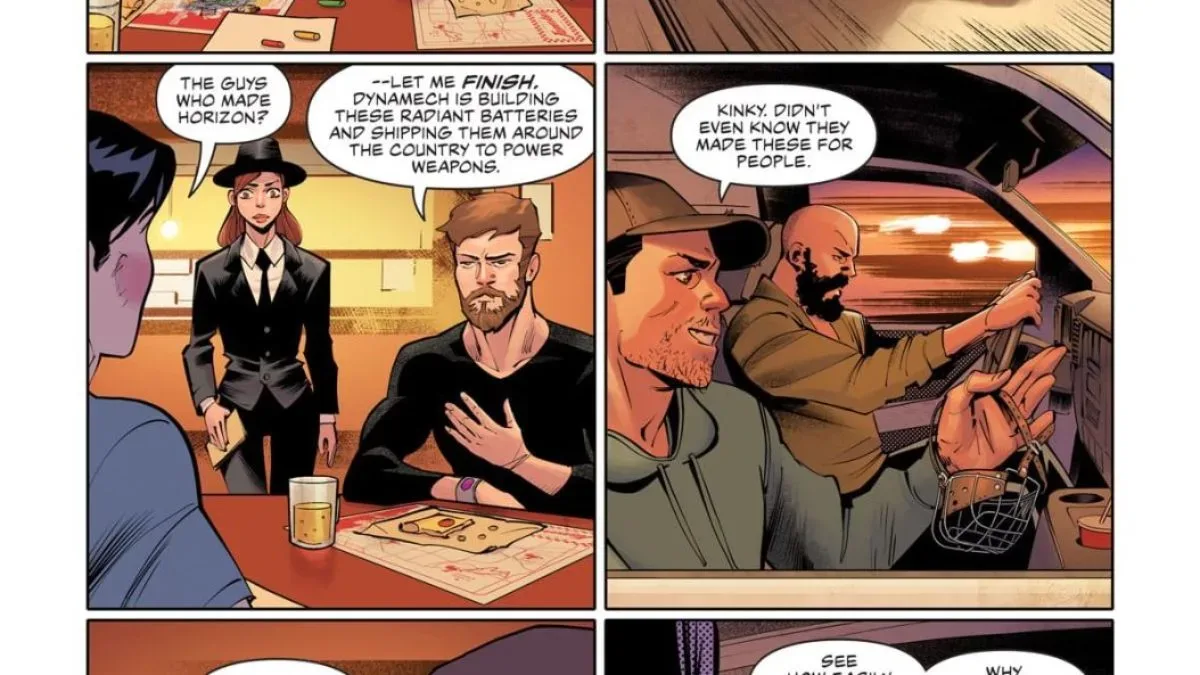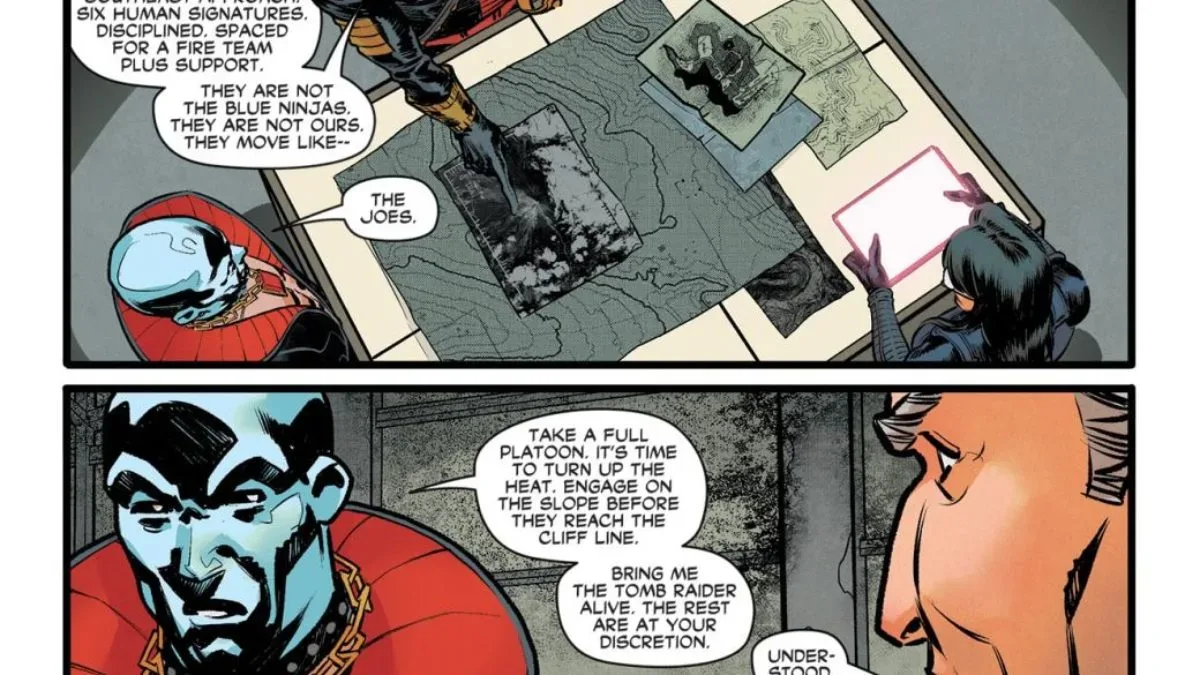
G.I. Joe: A Real American Hero/Tomb Raider #2 is set to bring Lara Croft deeper into Cobra Island territory, pairing the adventurer with Shipwreck and an elite G.I. Joe battalion for a land, sea and air operation. Their goal is not simply to reach the island first: the team is racing Destro and his Iron Grenadiers to solve a deadly puzzle and uncover whatever secret lies at its end.
The issue is listed for comic shops on November 4, 2026, from Image Comics. Kyle Higgins is credited as writer, with Elena Casagrande and Alex Guimaraes credited for art and cover art.
A crossover built around two kinds of action
The setup makes the division of labor fairly easy to see. Lara Croft is the character most immediately associated with ruins, traps, ancient mechanisms and puzzle-solving. G.I. Joe, meanwhile, supplies the military scale: a battalion, a hostile island and an approach conducted across multiple fronts. Putting those ingredients together gives this chapter a clear race-against-time structure, rather than presenting the crossover as a simple team-up skirmish.
That distinction matters because a puzzle race creates a different kind of tension from a straight firefight. The characters do not just need force, mobility or superior numbers. They must interpret clues and survive an environment designed to punish mistakes, all while knowing a rival force may reach the answer first. The solicitation does not identify the puzzle’s origin, its final prize or its hazards beyond calling it deadly. Those unanswered details are therefore central to the issue’s hook.
“By land, sea, and air” is also more than a dramatic slogan in this case. It suggests the story is framing the Cobra Island mission as a coordinated insertion, with the Joes’ operational breadth standing alongside Lara’s more specialist archaeological skills. Shipwreck’s inclusion puts a recognizable naval presence at the center of the lineup, while Destro’s Iron Grenadiers give the opposing side a specific force rather than an unnamed Cobra contingent.
Why Cobra Island is the natural pressure cooker
Cobra Island is an especially fitting destination for the premise because it immediately establishes hostile ground for the Joes and a location where an expedition can turn into a siege. The announced mission places the heroes in terrain controlled by their adversaries, with Destro’s group pursuing the same objective. That makes every stage of exploration potentially contested: reaching a location, securing an entrance, deciphering a mechanism and keeping the opposition from exploiting the answer.
The advertised land-sea-air descent also points to a story with multiple simultaneous pressures. A team arriving from one direction could be cut off, while information or personnel may need to move between the fronts. That is analysis of the premise rather than confirmation of specific scenes; the available details do not establish which characters take each route or how the assault develops. Still, the format is a good fit for a G.I. Joe operation, and it gives the Tomb Raider side of the crossover a larger tactical frame.
For readers, the important practical expectation is that this appears to be a plot-forward second chapter. Issue #2 is positioned as an escalation: the crossover “continues,” the competing parties are now descending on Cobra Island, and the unknown at the heart of the puzzle remains in play. Anyone considering the single issue should expect an installment that advances a continuing conflict rather than a self-contained Lara Croft adventure.
Destro and the Iron Grenadiers set the rival objective
Destro’s presence clarifies the stakes on the villain side. He and the Iron Grenadiers are not merely trying to stop the heroes from completing a mission; they are attempting to unlock the same secret. That shared goal is what makes the contest a race. If one group solves the puzzle, the other may be forced to deal with the consequences rather than prevent them.
The solicitation deliberately leaves the secret undefined. That restraint means readers should not assume it is a weapon, artifact, treasure or piece of intelligence. All that has been established is that it is important enough to draw Lara Croft, an elite G.I. Joe battalion, Destro and the Iron Grenadiers into the same dangerous operation. Keeping the object of the search unnamed lets the issue’s mystery remain part of the appeal.
It also preserves an interesting crossover balance. Lara’s expertise is relevant to the problem at hand, while the G.I. Joe cast’s experience with hostile operations is relevant to getting her through the island and holding ground against Destro’s people. The premise does not require either side of the crossover to be reduced to a cameo role. Instead, its basic conflict depends on both the expedition element and the military confrontation.
What “deadly puzzle” means for the story’s tone
In adventure fiction, a puzzle is usually a challenge built around clues, mechanisms, symbols or spatial logic. Calling it deadly changes the function of that challenge. It implies that solving it incorrectly—or simply attempting it—may carry physical danger. The listing stops short of naming traps or particular threats, so readers should treat that as an indication of tone rather than a confirmed checklist of hazards.
That language is significant for a Tomb Raider crossover. It promises that Lara’s contribution is likely to be more substantial than carrying weapons beside the Joes. A lethal, time-sensitive enigma is precisely the sort of obstacle that lets an adventurer’s interpretive skills affect the outcome. At the same time, the wider operation means the puzzle cannot be separated from the conflict with the Iron Grenadiers. The team must contend with an environment that is dangerous on its own terms as well as enemies who may capitalize on every delay.
Readers who enjoy game characters moving into other media may also be interested in how recognizable gaming imagery travels across formats. For a separate example of a game-character reference influencing music-video styling, see this look at Jisoo’s confirmed Ada Wong inspiration. Lara’s role here is different: she is not a reference or a costume influence, but an active lead within a shared comic-book plot.
Creative credits and listed editions
The issue credits identify Kyle Higgins as writer and Elena Casagrande and Alex Guimaraes for art and cover art. A Sweeney Boo cover is also listed in the available product information. Collectors and readers who choose between editions should check the specific cover and price with their preferred comic shop, since the listings include multiple product codes and price points.
- G.I. Joe: A Real American Hero/Tomb Raider #2 — listed at $4.99.
- Sweeney Boo cover listing — product information includes listings at $4.99 and $5.99.
- Publisher: Image Comics.
- Scheduled shop date: November 4, 2026.
The base solicitation price is $4.99. Since the provided listing shows more than one entry associated with the Sweeney Boo cover and does not explain their respective formats, it is safest not to assume the reason for the difference. A local comic retailer can confirm which edition corresponds to each price and whether it can be ordered.
The key question heading into issue #2
The central question is straightforward: can Lara Croft, Shipwreck and the Joes solve the Cobra Island puzzle before Destro’s Iron Grenadiers do? But the story’s appeal is in what that question combines. It is an expedition, an infiltration and a contest over an unrevealed secret, all set within a crossover designed to give both franchises a role in the outcome.
For Lara Croft readers, the issue’s puzzle language and hazardous setting are the immediate draw. For G.I. Joe readers, the coordinated deployment and the clash with Destro’s forces bring a larger tactical dimension. And for readers following the series as a crossover event, #2 is the chapter where those strands converge on the same island objective.