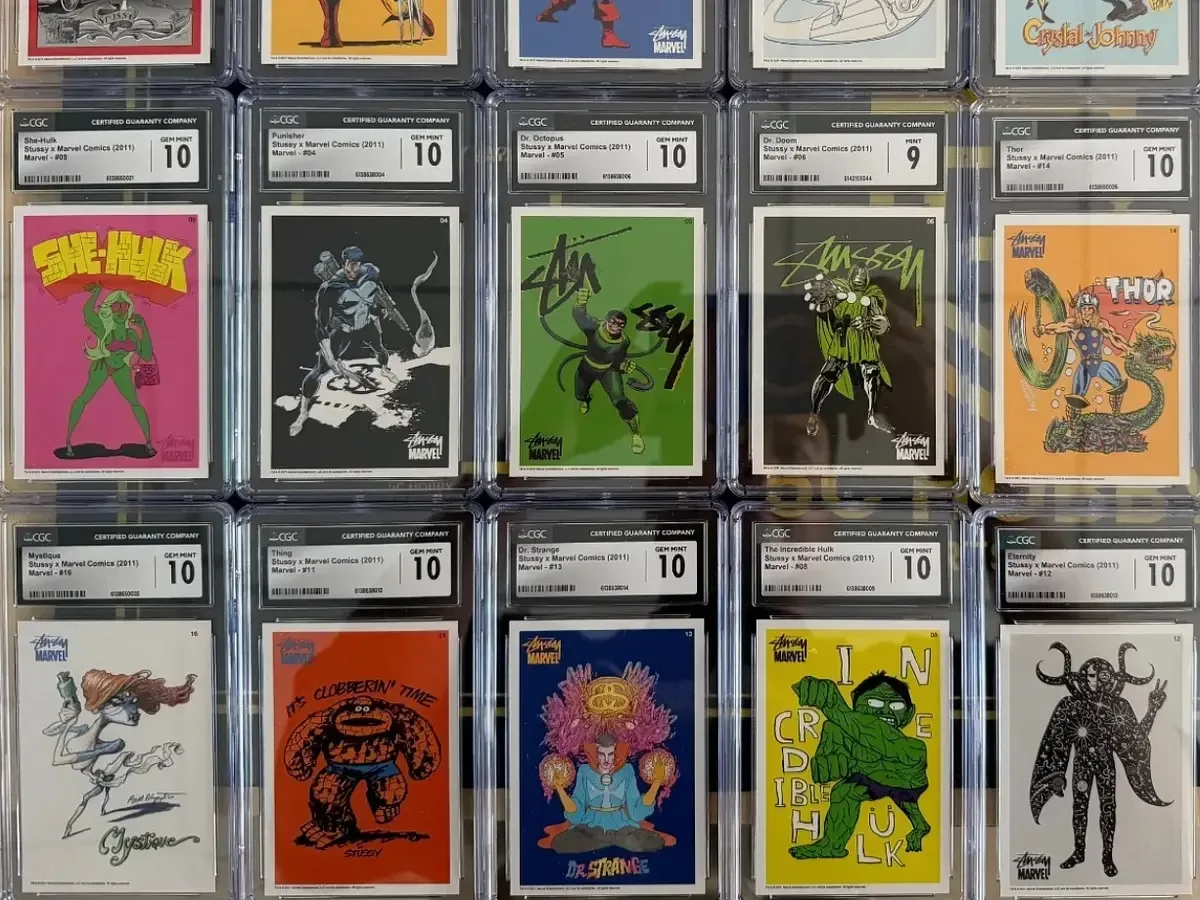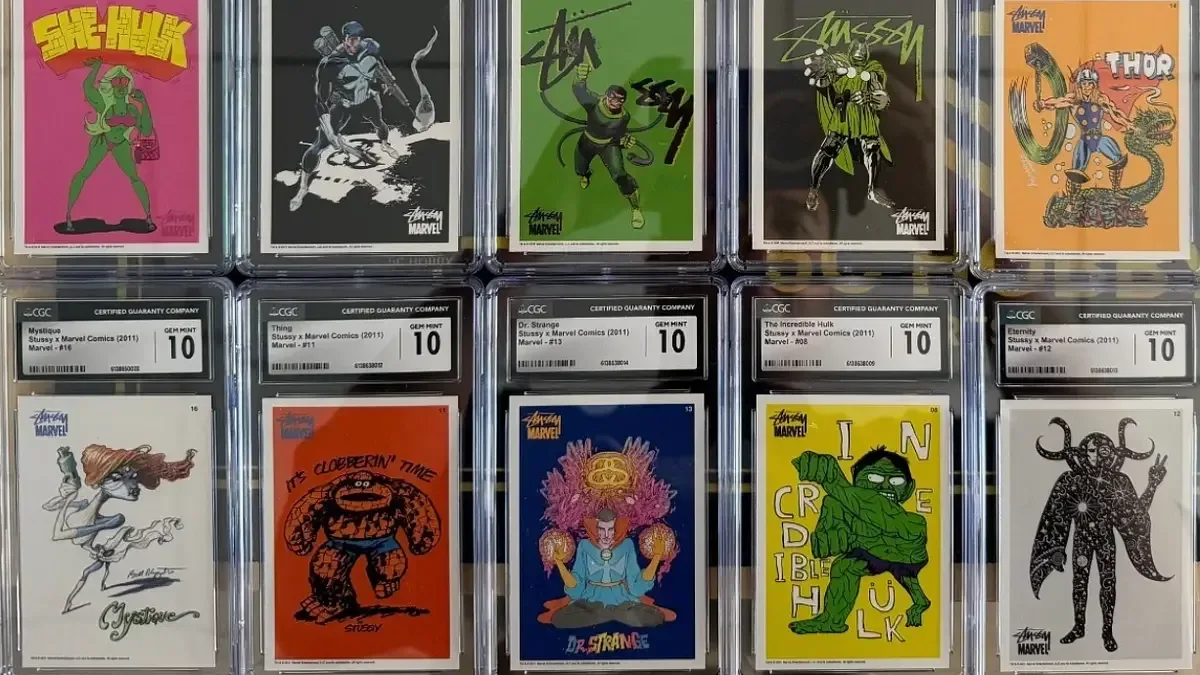
Today’s trading-card landscape is crowded with entertainment licenses, artist collaborations, limited apparel tie-ins and increasingly serious collectors. That makes the 2011 Stüssy x Marvel project feel startlingly modern. Yet it arrived at a time when many buyers likely saw its cards as a cool extra tucked in with a T-shirt, rather than a collectible to sleeve, grade and lock away.
Fifteen years later, that assumption has changed dramatically. The Stüssy x Marvel cards are a compact 17-card snapshot of comic-book history, streetwear culture and artist-driven reinterpretation. They also demonstrate why non-sports cards have become such an interesting part of the wider hobby: a card’s appeal can come from the character, the art, the collaborator, the original product context and its condition all at once.
With recent sales attached to key high-grade cards and sealed packs, the collection has become a notable example of an item that was not necessarily marketed as a traditional premium card release but has acquired that status over time.
A collaboration built in two distinct waves
Stüssy and Marvel released the collaboration in two parts during 2011. Series 1 arrived in April and drew upon vintage Marvel imagery. Characters represented included Wolverine, Captain America, Silver Surfer, Punisher, Doctor Octopus, Doctor Doom and Ghost Rider.
The sourcing behind the apparel and associated imagery was unusually deep for a crossover of this kind. Stüssy reportedly looked through comic conventions, local comic shops and eBay, locating material from original comic books and scarce collector posters. The artwork selected stretched from the 1960s through the 1990s. That breadth matters because it gave the project a sense of Marvel’s visual history rather than anchoring it to one movie cycle, one modern comic era or one particular artist.
Series 2 followed in May, shifting the concept from archival appreciation toward contemporary interpretation. Nine artists were paired with Marvel characters, creating work in their individual visual languages. The known pairings include James Jarvis with The Thing, David Shrigley with Hulk, Todd James with She-Hulk, Gary Panter with Thor and Los Angeles tattoo artist Mister Cartoon with Spider-Man.
The finished card lineup consists of seven Stüssy Marvel character cards, nine Artist Series cards and one Marvel cover card. That structure is simple, but it neatly captures the project’s two identities: Marvel nostalgia on one side and a gallery-like set of fresh character treatments on the other.
Why the cards feel so current
Artist-led cards are now an established collectible format, but the Stüssy x Marvel cards appeared before that model became familiar to a large portion of the market. Topps Project 2020 and Project70 later made the idea of artists recasting iconic baseball-card imagery central to their releases. In another form of crossover collecting, Kith later included exclusive Lionel Messi cards with purchases made through its apparel partnership with the football star.
Those later examples do not make the 2011 release identical to today’s projects. They do, however, show why it is easy to see Stüssy and Marvel as early participants in a direction the hobby would eventually embrace. The release connected several collecting communities that frequently overlap now but were not always treated as one audience: comic fans, streetwear buyers, contemporary-art followers and card collectors.
That cross-pollination is a major reason pop-culture cards can be difficult to value with a single rulebook. A sports card is often discussed through statistics, rookie-card status, championships or a player’s historical standing. A release like Stüssy x Marvel adds other questions. Which character has the broadest fan base? Which artist has the strongest following? Was the shirt itself widely worn? Did buyers preserve the cards? Were packs opened as a novelty? And how many examples remained clean enough to grade at the highest levels?
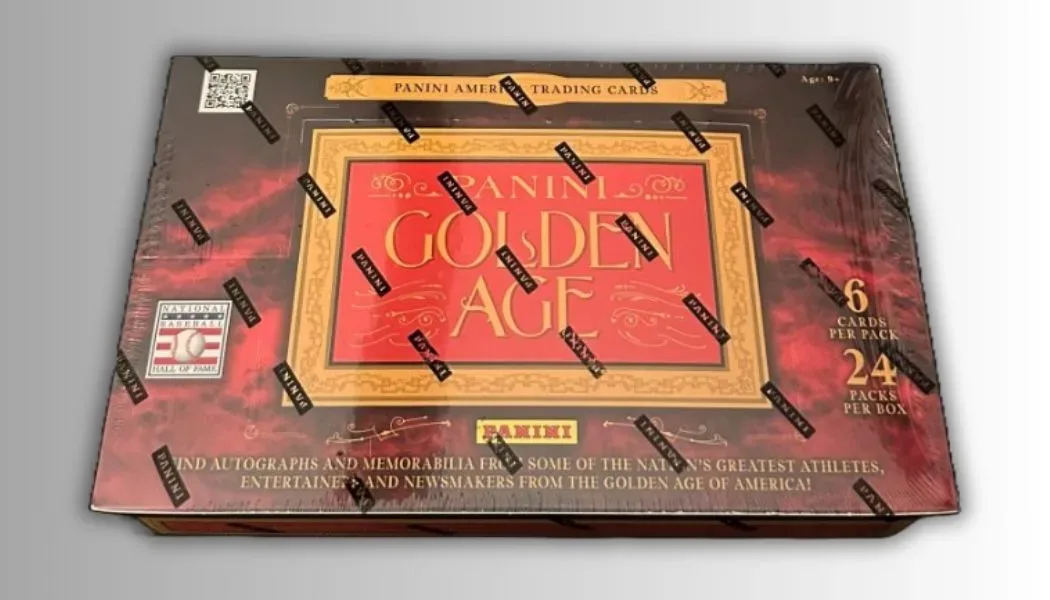
It is the same wide-angle appeal that makes hybrid releases compelling beyond sports. A product can function as memorabilia, graphic design, fashion ephemera and card-set collecting simultaneously. For another example of how cards can pull together subjects outside their nominal category, 2012 Panini Golden Age Baseball’s mix of sports, history and pop culture illustrates the collector interest in cards that travel well beyond one conventional lane.
The $36 shirt changed the preservation story
One detail gives the Stüssy x Marvel cards much of their present-day intrigue: the shirts originally sold for $36. The cards were connected to an apparel purchase, which means their original purpose may have been promotional or supplementary in the eyes of many buyers. The clothing, not a chase card or sealed box, was likely the immediate draw.
That context has consequences for condition. In 2011, modern-card grading did not carry the same cultural presence it has today. A person who opened these cards from a shirt purchase had little reason to assume that a pristine copy of an artist-themed Spider-Man could become a four-figure collectible. Cards may have been handled, traded, stored casually or simply misplaced. Some may still be with their original shirts; others may have been separated long ago.
As a result, the high-grade population can be more meaningful to collectors than it would be for a release designed from day one around protected packs and modern break culture. There is no publicly documented production figure for the cards, so rarity cannot be pinned to a confirmed print run. That uncertainty makes surviving condition, public sales history and demand for individual characters especially important reference points.
Mister Cartoon Spider-Man leads the market discussion
Spider-Man #10, featuring Mister Cartoon’s interpretation of the wall-crawler, has emerged as a standout card from the set. A PSA 10 copy recently sold on eBay for $1,000, following another PSA 10 sale at $950 in July. For perspective on the shift in market interest, a PSA 10 sold for $644 in July 2022.
Those figures should be read carefully. Individual sales are evidence of what specific buyers paid for specific copies at specific times; they are not a guarantee of a continuing price level. An asking price is also not a completed sale. Still, the progression is useful in showing how the card’s mix of Spider-Man popularity, Mister Cartoon’s contribution, crossover appeal and top-grade scarcity has attracted attention.
Wolverine #1 is another card with notable high-grade results. CGC 10 copies sold for $600 on both Aug. 18 and Aug. 20. Wolverine’s enduring place in Marvel collecting gives that card an obvious character advantage, while the Stüssy context distinguishes it from the many other Wolverine cards available across decades of licensed releases.
Collectors considering these cards should separate the elements of the listing rather than treating every number as equivalent. A raw card, a CGC 9, a CGC 10 and a PSA 10 are not direct stand-ins for one another. The grader, numeric condition, centering, surface quality, card identity and timing of the transaction can each affect the result. A listing seeking $720 for a Mister Cartoon Spider-Man, for example, signals seller expectations rather than establishing a finished market value.
Sealed packs have their own appeal
The interest is not confined to graded singles. A sealed Stüssy x Marvel pack sold on eBay for $465 on Sept. 7. That is more than triple the $149.95 paid for another sealed pack in March 2022.
Sealed material creates a different kind of collectible proposition. It preserves the mystery of which cards are inside while also acting as a piece of collaboration-era packaging. Opening a pack may reveal a desirable card, but it also destroys the sealed object that some buyers value most. With no public production total to settle how many packs were made or how many endured unopened, that decision becomes even more personal for a collector.
PSA’s Set Registry recognizes all 17 cards, providing another sign that the release has entered the more organized side of card collecting. Registry recognition does not settle every question about scarcity or value, but it helps collectors document progress toward complete sets and compare graded examples in a familiar framework.
A collectible category that caught up to the idea
The Stüssy x Marvel cards did not need to predict every detail of the current market to look prescient in hindsight. Their significance lies in the combination: licensed superhero characters, streetwear distribution, vintage source imagery, contemporary artists, promotional cards and a collecting audience that eventually became more attentive to condition and sealed product.
Non-sports card collecting now extends far beyond a small niche, encompassing properties such as Disney, SpongeBob, VeeFriends, G.I. Joe and Transformers alongside the hobby’s longstanding comic-card traditions. Within that broader expansion, the 2011 Stüssy x Marvel release stands out because its original format gave it an unusual survival story. It was clothing-adjacent ephemera first, then a serious card target later.
For collectors, that makes the set more than a group of 17 checklist entries. It is evidence of a period when separate fandoms were already meeting at the same table, even if the market had not quite recognized how valuable that table could become.