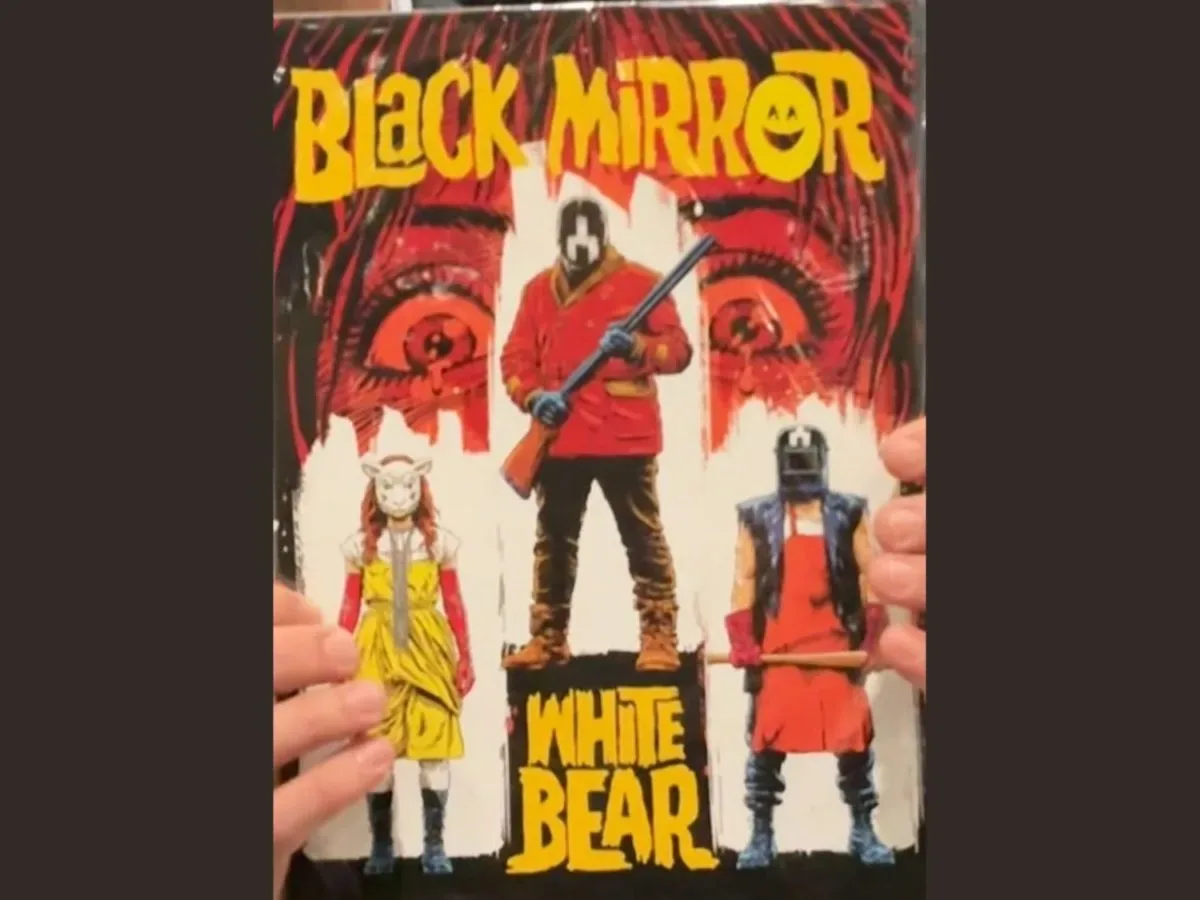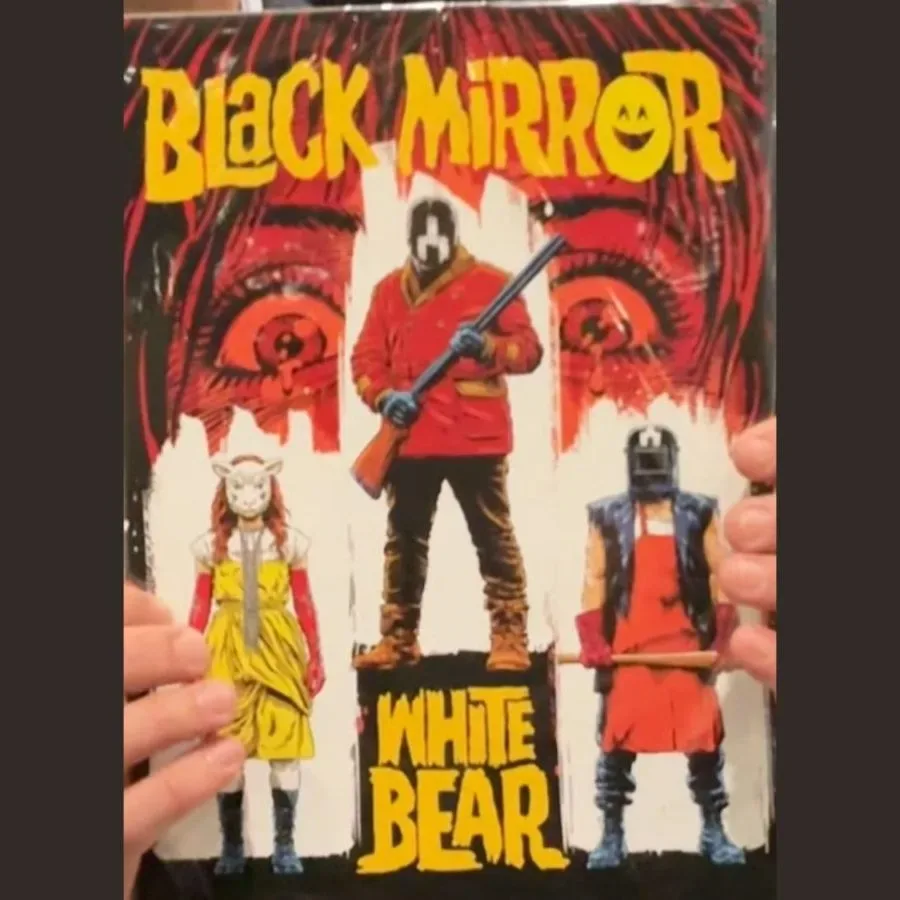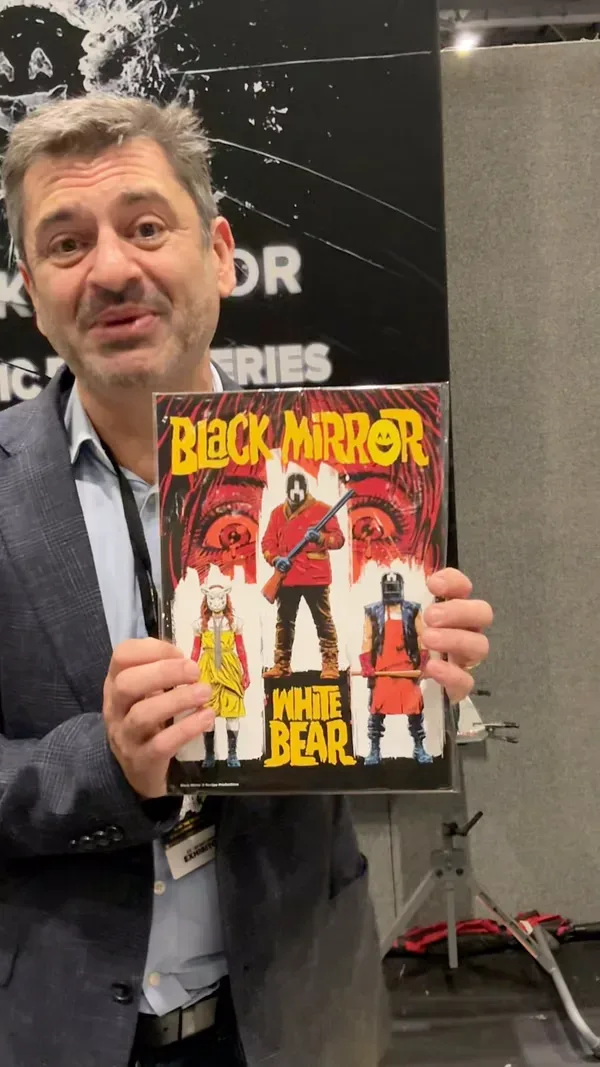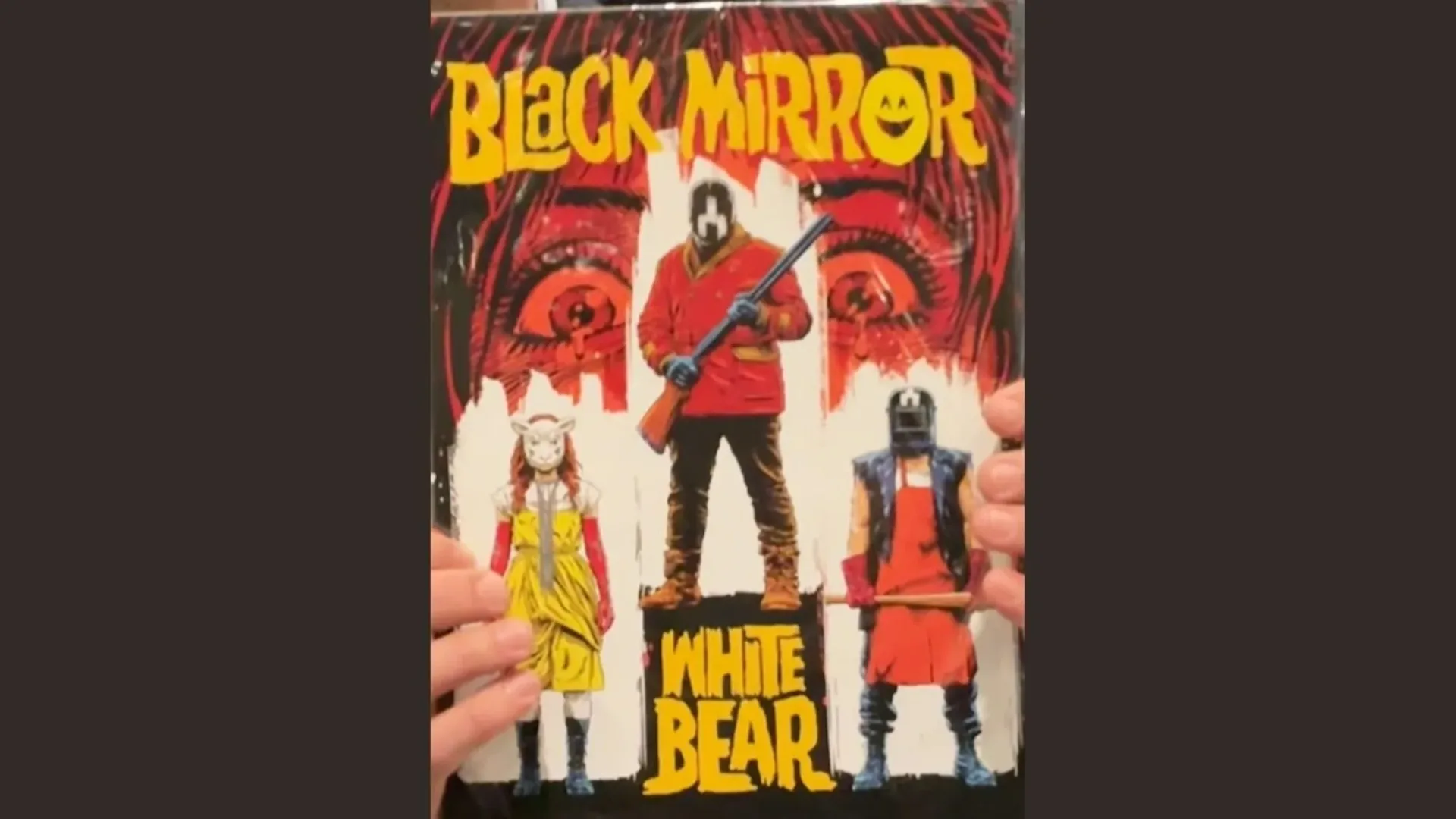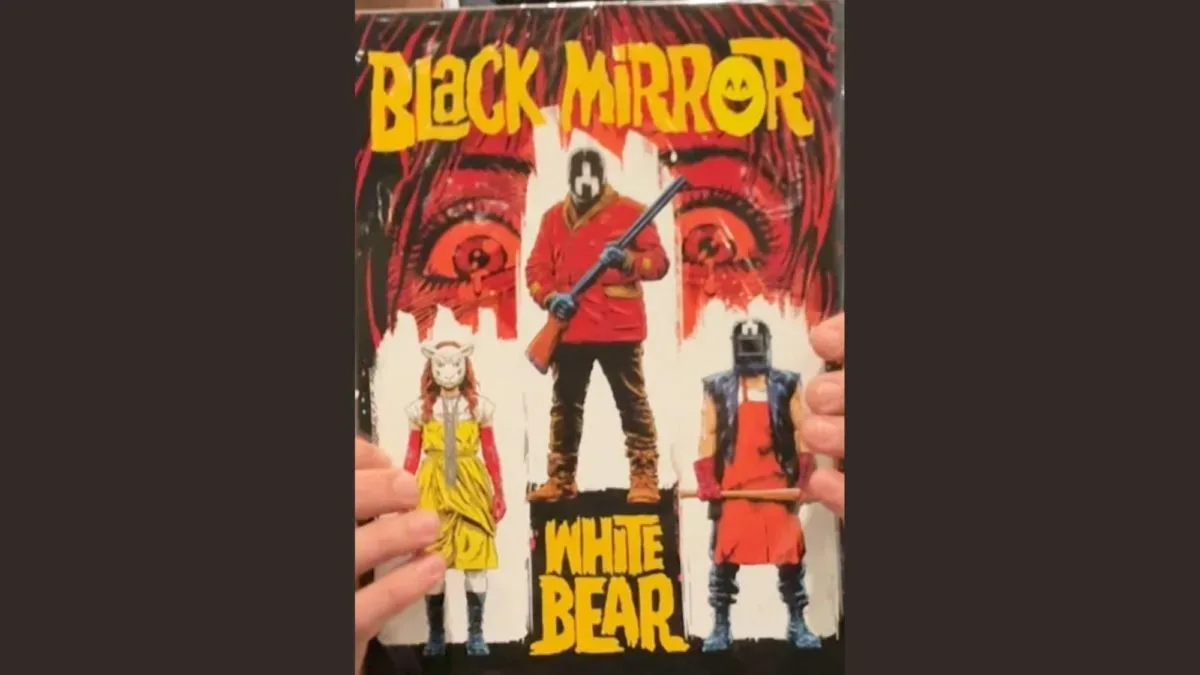
Black Mirror’s “White Bear” is set to become the next graphic novel in Twisted Comics’ adaptation line. The project was revealed at MCM London Comic Con, and it follows previous comic-book treatments of USS Callister and San Junipero. Charlie Brooker and Neil Gibson are credited as writers, while Piotr Kowalski will draw the book. Twisted Comics is slated to publish it next year.
The selection is a striking one. “White Bear,” the second episode of Black Mirror season two, first aired in 2013. It is remembered as one of the show’s harshest examinations of spectatorship, punishment and public appetite for cruelty. Its premise puts viewers in an unstable, frightening perspective: Victoria Skillane, played in the episode by Lenora Crichlow, awakens with little memory of her identity, then finds herself pursued through a world where onlookers record events rather than help.
That central image—people holding up phones while someone else suffers—has only become more immediately legible in the years since the episode debuted. A comic adaptation cannot reproduce the exact pacing of television, performance or sound design, but it can lean into a different kind of unease: the still image. Kowalski’s pages will have the opportunity to make the watcher and the watched occupy the same frame, asking readers to linger over the very behavior the story criticizes.
What has been confirmed
The announced creative team combines a writer associated with the television episode’s original conception with creators working in comics. Brooker and Gibson are writing the graphic novel, and Kowalski is handling the art. The publisher is Twisted Comics.
There is no stated release date beyond next year, and no format details, page count, price, edition information or plot additions have been specified. That leaves a meaningful distinction for prospective readers and collectors: this is confirmation of a forthcoming adaptation, not yet a complete publication plan. Until the publisher supplies further details, it is too early to assume whether the book will closely retell the episode, expand it, or take a more interpretive approach to its setting and themes.
The Black Mirror comics line has already drawn on episodes with very different identities. USS Callister is closely associated with genre play and digital power dynamics, while San Junipero is a more romantic, melancholy story about technology, memory and connection. “White Bear” is a sterner proposition. Its horror comes not only from its masked pursuers or its uncertainty, but from its attention to an audience that regards another person’s terror as something to capture.
Why “White Bear” fits comics particularly well
Comics are built from panels, gutters and page turns. A panel is a bounded image; a gutter is the space between panels, where readers infer movement, time and action that have not been shown. Those tools can be useful for a story rooted in disorientation. Fragmented panel layouts can limit what readers know, isolate a character within an environment, or force attention onto unsettling visual details. A page turn can withhold a reveal until the physical act of moving forward.
“White Bear” begins from Victoria’s lack of information. She wakes up unable to make sense of herself or her surroundings. As she tries to escape, the people she encounters largely watch and film. A group of survivors tells her that a mysterious signal has rendered most people passive observers, while those unaffected remain able to act—and masked hunters stalk the active people.
That setup gives an artist several visual tensions to work with. Victoria’s point of view requires immediacy and confusion, while the crowds create emotional distance: they are physically present but refuse the basic human response of intervention. The story’s phones are not merely props. They represent a boundary between observing an event and participating in it. On the page, the repeated rectangle of a screen can echo the rectangle of a comic panel itself.
That does not mean the medium automatically makes the adaptation more effective. Television controls duration: an episode decides how long an image stays on screen and when a cut occurs. Comic readers control their own pace, may reread clues, or pause on an expression. The creative challenge will be retaining the episode’s pressure while taking advantage of that reader control. The announced involvement of Brooker alongside Gibson suggests that the adaptation has a direct connection to the episode’s original creative voice, but no further story or structural details have been disclosed.
A story about watching rather than helping
The episode is often described as science fiction, yet the technology in “White Bear” is less important than the conduct around it. The signal provides the premise for a society divided between people who act and people who merely observe. But the larger question is moral rather than mechanical: what happens when witnessing suffering becomes a form of entertainment?
That concern is why the episode’s crowds matter so much. They do not simply fail to help; their filming turns the moment into a spectacle. The viewers are invited to notice their own position, too. Like the people on screen, an audience is watching an ordeal unfold. “White Bear” uses that resemblance to make passive consumption feel uncomfortable rather than harmless.
A graphic novel provides another layer to that idea. Reading is necessarily an act of looking at arranged images. Readers choose how long to study a scene, whether to go back, and how much attention to give a face in the background or a phone held at the edge of a frame. The form may therefore sharpen the uncomfortable overlap between the fictional bystanders, the literal reader and the characters being observed.
This is analysis of the episode’s premise rather than a claim about the unpublished book. The graphic novel’s specific approach remains unknown. Still, the source material offers clear thematic material for an adaptation: crowd behavior, guilt, retribution, empathy and the ease with which distance can make cruelty look like a public event.
Justice as performance
“White Bear” also probes the boundary between justice and punishment staged for an audience. Those are related ideas, but they are not identical. Justice, in the broad sense used by stories about crime and consequences, concerns accountability and proportional response. Retribution centers on imposing suffering in response to wrongdoing. When retribution is performed before spectators, the process can shift again: the punishment becomes an experience for the crowd, not solely a response to the person being punished.
The episode’s scenario uses this tension to ask whether public satisfaction can erode empathy. Its observers are not introduced as a conventional mob charging into action. Their passivity is precisely the point. They document. They look. They let the drama continue. The result is a social critique in which the frightening behavior is not confined to the obvious attackers.
For comics readers, that makes “White Bear” a notably different kind of licensed adaptation. The appeal is not likely to rest on world-building trivia or an action-heavy expansion alone. The story’s strength is its construction and the questions that construction poses. A successful graphic version will need to preserve the tension between immediate survival horror and the larger argument about what audiences believe they are entitled to watch.
It also joins a wider tradition of television stories moving into printed form without becoming simple transcripts. A graphic novel needs to translate rather than merely duplicate: a camera close-up becomes composition; a sound cue can become lettering, silence or an abruptly empty panel; performance can be redirected through posture, color, framing and facial detail. For a series as visually and conceptually deliberate as Black Mirror, those choices will be central to the book’s identity.
Readers interested in another screen-rooted story moving through questions of media, culture and political change may also want to read this look at Chris Carter’s restored X-Files film and “Queens for a Day”.
What readers should watch for next
For now, the essential details are the choice of “White Bear,” the Brooker/Gibson writing credit, Kowalski’s art and Twisted Comics’ plan to publish next year. Further announcements will need to establish the graphic novel’s release timing and whether it has any edition or format distinctions.
The project arrives with an unusually clear creative mandate. “White Bear” remains a story about a person trapped in a nightmare while everyone around her turns that nightmare into content. Its move to comics puts that subject inside a medium that asks readers to look closely, panel by panel. That is an apt and potentially unnerving match—provided the adaptation retains the episode’s focus on who gets to watch, who is made into a spectacle, and what it costs when empathy gives way to entertainment.