Spoilers for Avengers #1 follow.
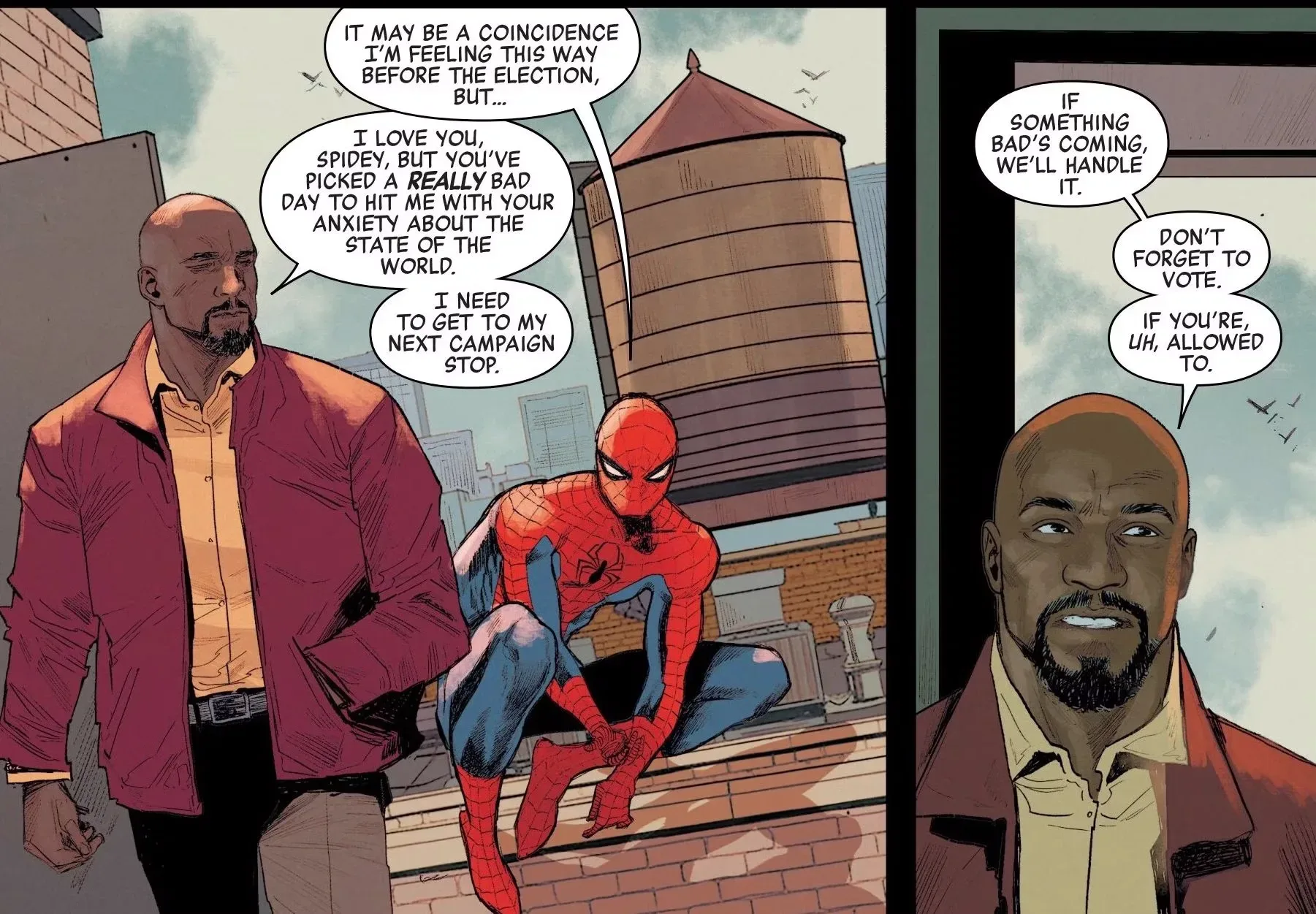
Marvel’s new Avengers run opens with a problem that cannot be solved by simply punching a bigger monster: New York has lost faith in its superheroes, and Mayor Luke Cage is trying to win re-election in the middle of that collapse. Avengers #1, written by Chip Zdarsky with art by Marco Checchetto, uses an election campaign as part of the book’s immediate conflict while laying the groundwork for a supernatural emergency involving Mephisto.
The issue arrives after Avengers: Armageddon and Captain America, with a world order described as fundamentally changed. In the story’s status quo, the Avengers have disbanded, Captain America, Thor and Iron Man are away, and public anger has hardened after a confrontation involving a nuclear Hulk in Russia. That event gives an anti-superhero political movement a powerful argument: whatever the intentions of costumed heroes, the damage from their battles is no longer something ordinary people are willing to accept as the price of being protected.
Luke Cage therefore starts this series in an unusually complicated position. He is both a mayor seeking another term and, based on the announced team roster, one of the heroes set to answer the Avengers call. The premise puts civic responsibility and superhero responsibility in direct tension. A mayor has to respond to constituents, donors, staff and public safety concerns; an Avenger may be called away by a threat no city administration could handle. The book’s opening treats that overlap as a source of pressure rather than an easy power fantasy.
A campaign built on anti-superhero anger
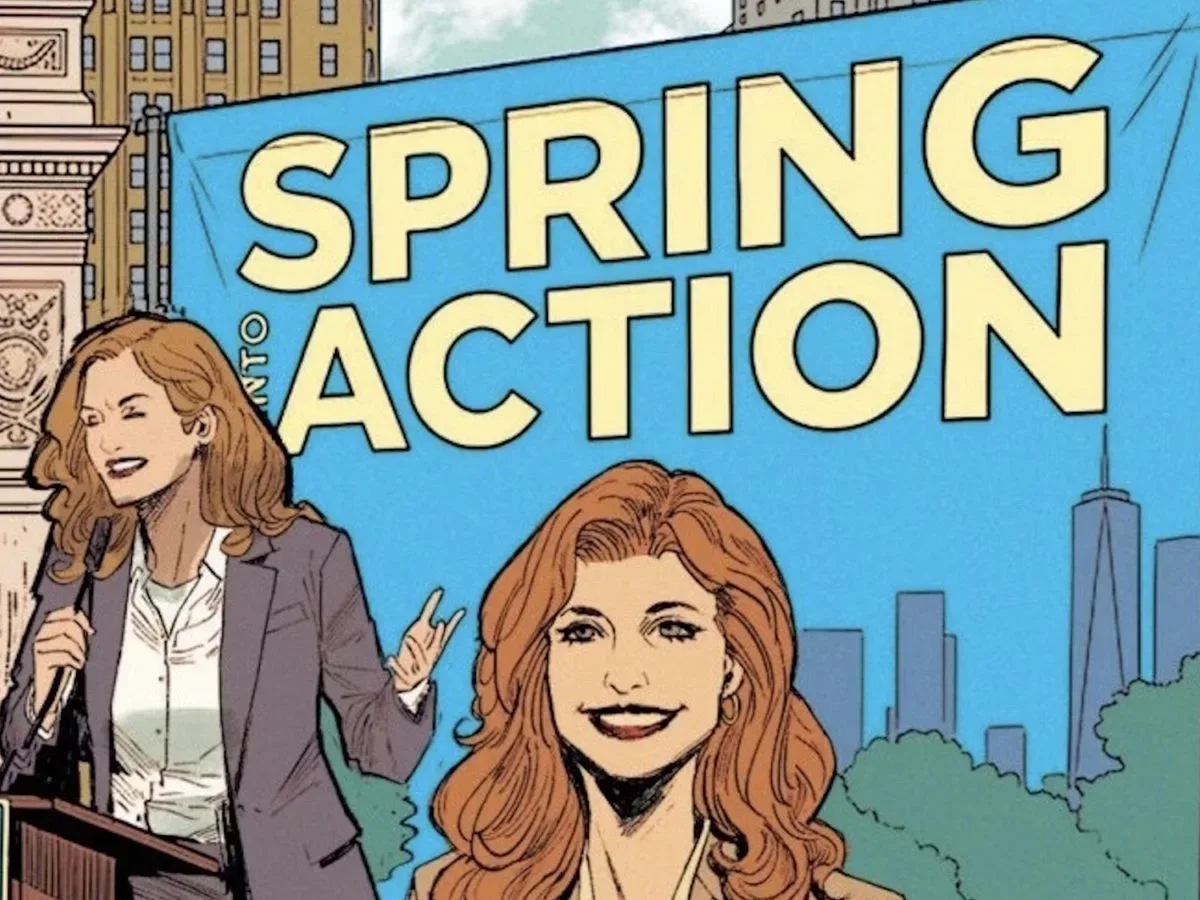
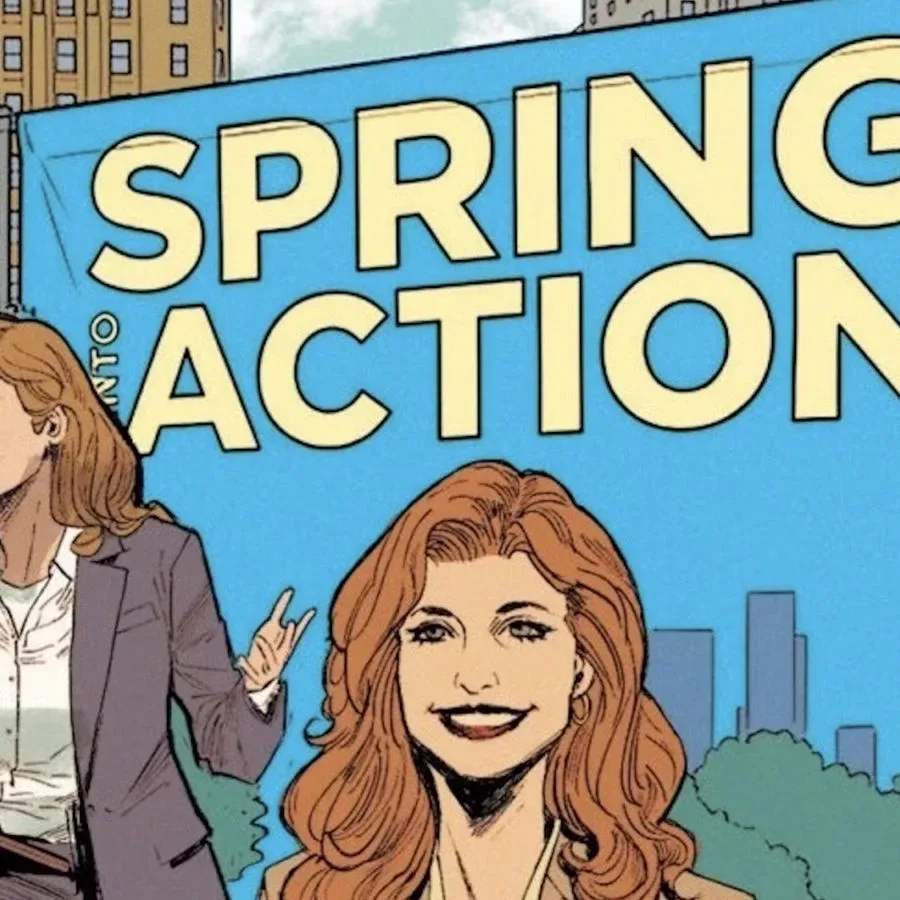
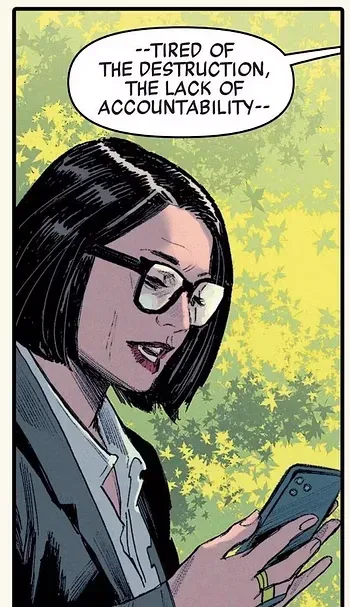
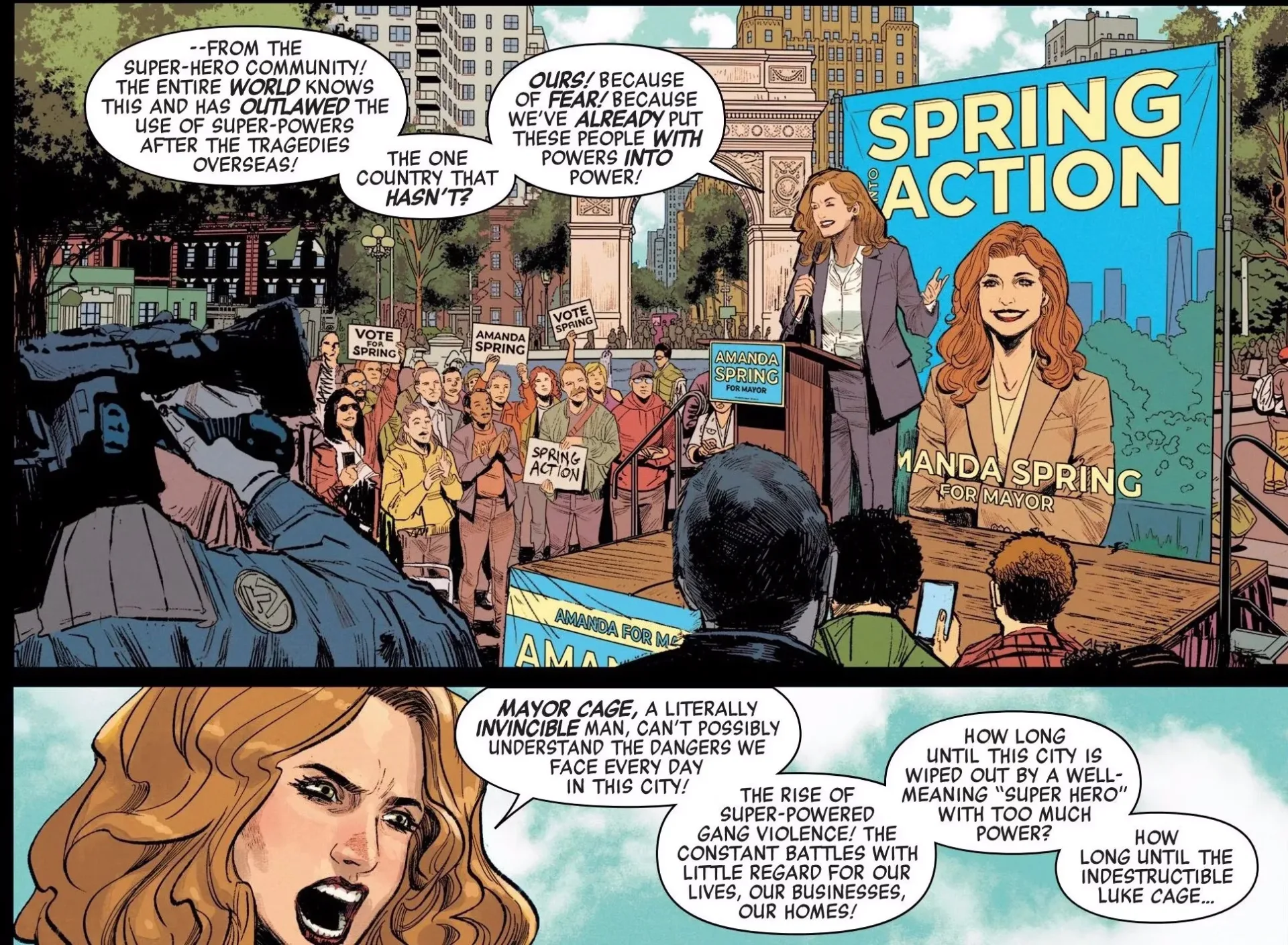
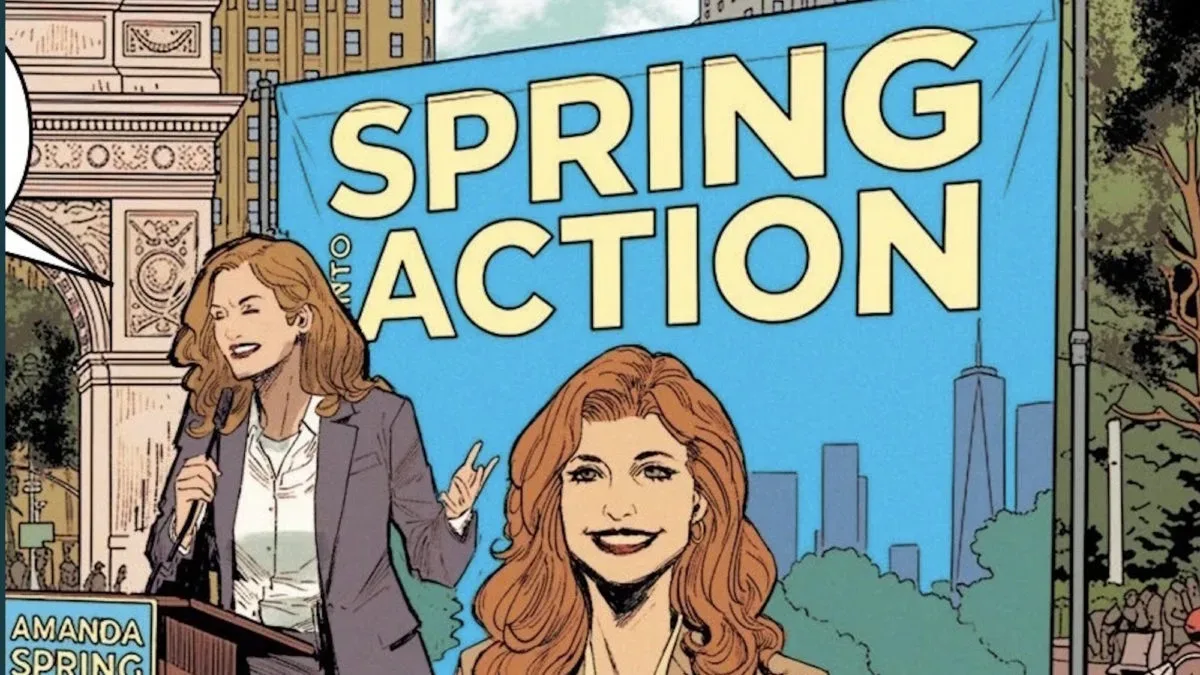
Cage’s challenger is Amanda Spring, whose campaign is called Spring Action. Her central political posture is clear: skepticism of superheroes is not background noise in this New York; it is an organized electoral message. The issue frames Spring’s effort as a direct attempt to turn anger over superhero destruction and impunity into votes.
That choice matters because it shifts the question from whether heroes can save the day to whether they retain the public’s permission to operate. Superhero stories frequently feature citywide destruction, but an election gives that destruction a more personal, institutional consequence. Voters do not need to be villains or secretly controlled by one to object to the danger, cost and uncertainty surrounding superhuman conflicts. In this setup, the Avengers’ damaged reputation is a problem with real political leverage.
The election material also avoids making the conflict solely about Cage’s past as a hero. The fallout has become broad enough to shape a citywide race. That is an important distinction: the series is not merely asking whether Luke Cage can be trusted. It is asking what New York expects from heroes after the Avengers’ failure, and whether a mayor who remains connected to that world can credibly lead during a backlash.
What “anti-superhero” means in this story
Here, anti-superhero sentiment is not presented as a rejection of one masked figure or a single unpopular decision. It is a reaction to a landscape in which public trust has failed at the same time that the former Avengers are absent or fractured. Spring Action gives that frustration a name and a campaign vehicle. It is a useful narrative device because it lets the series address consequences without pretending that a spectacular disaster vanishes once the next villain appears.
For readers, it also creates a different kind of deadline. Elections run on schedules, and scandals can change their direction rapidly. An alien invasion or demonic attack may seize immediate attention, but a campaign continues to absorb every revelation and every perceived mistake. Cage cannot simply defeat a threat and assume that the city will forget what it has seen.
Mephisto turns private bargains into public danger
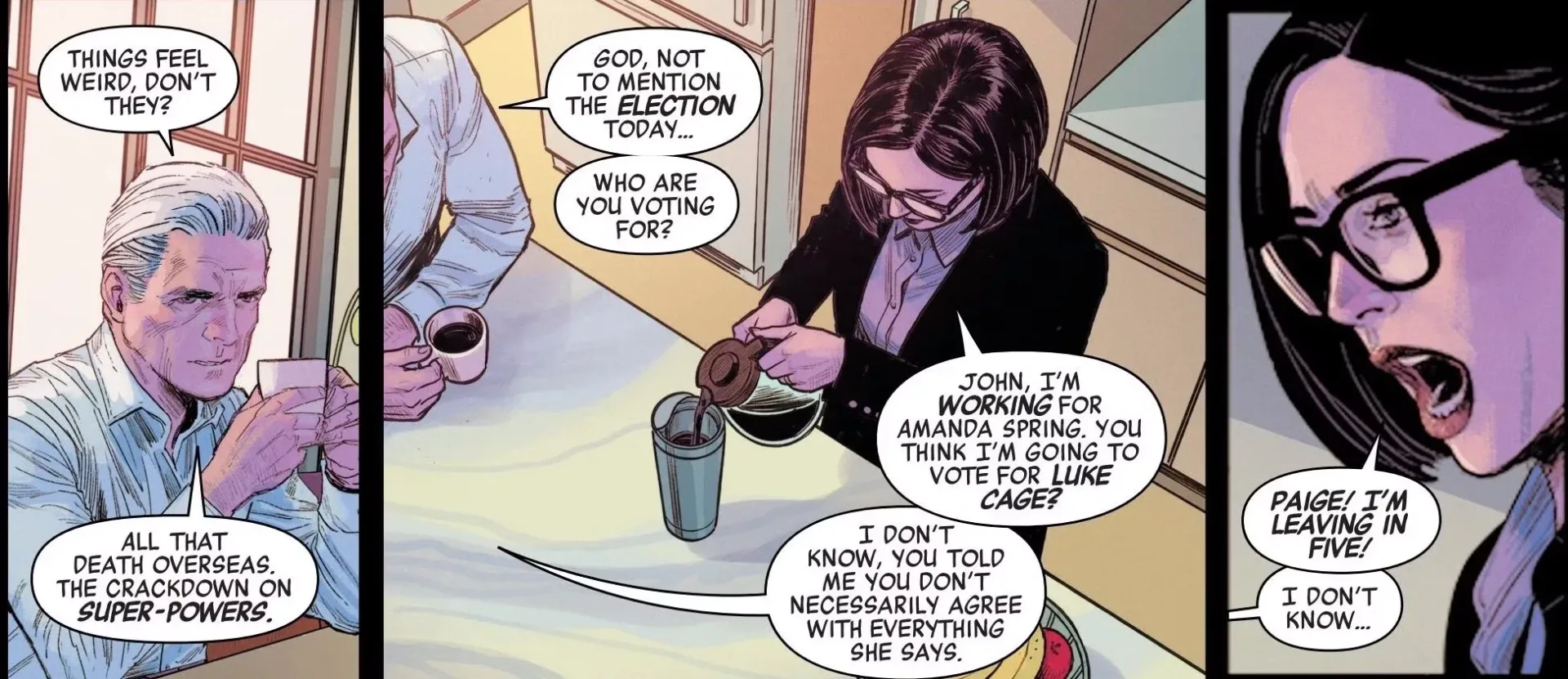
The political plot is entangled with Mephisto, the Marvel villain associated here with devilish agreements. The issue indicates that Mephisto’s deals have been nullified, a development that places the people connected to those bargains in jeopardy. The result is not limited to one faction in the mayoral contest. Julie Howley, who works for Amanda Spring, and members of her family, John and Paige, appear to have a looming scandal tied to the fallout. Donors connected to Luke Cage are also being targeted.
That spread is key. The story does not position Mephisto’s interference as a simple weapon handed to one candidate against the other. It threatens people near both campaigns, which makes the election more volatile while keeping the larger danger above ordinary partisan lines. Political alliances, family history and campaign finances can all become vulnerable when supernatural obligations stop behaving as their holders expected.
In practical story terms, a “nullified deal” means the consequences of an old bargain may no longer remain buried, managed or contained. That premise creates a strong bridge between intimate character stakes and a citywide event. Mephisto does not need to attack City Hall directly to destabilize the election: exposing or endangering people around the candidates may be enough to cause panic, scandal and mistrust.
The effect is especially sharp for Cage. He is trying to persuade New Yorkers that he can govern at a moment when suspicious events touch his supporters, while his rival’s team faces trouble of its own. A campaign normally depends on controlling its message. Demonic contracts make message control nearly impossible.
The new Avengers roster and the missing old guard
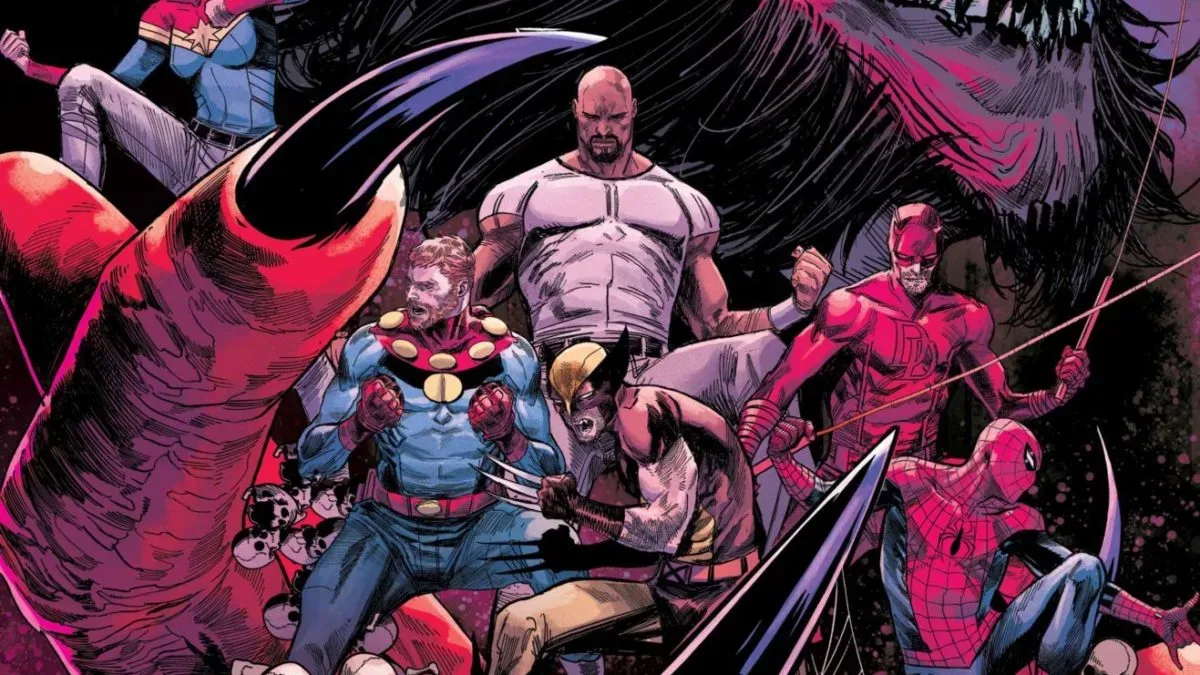
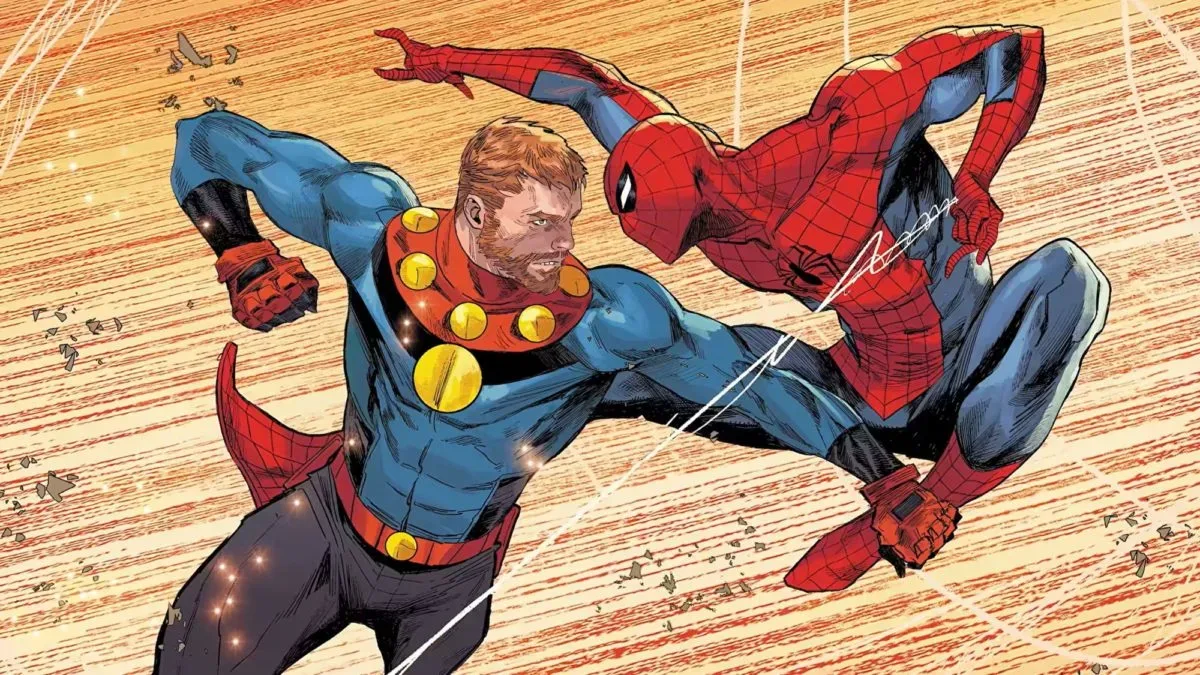
The announced roster for this new era is Spider-Man, Wolverine, Captain Marvel, Daredevil, Luke Cage and Miracleman. It is an intentionally varied group: street-level protectors, globally consequential heroes and a character whose very inclusion signals that the book intends to operate on a large scale. Its formation comes after the prior Avengers have quit and with Captain America, Thor and Iron Man elsewhere.
That absence gives the new team a meaningful task beyond simply assembling. They are not replacing a stable institution; they are trying to act in the vacuum left by one. The series description calls this a new group united to avenge the Marvel Universe, but the first issue’s New York election framing suggests that winning back trust may prove as important as defeating the next threat.
Spider-Man’s place in the lineup is particularly relevant to a story about distrust. The issue includes anti-immigrant rhetoric aimed at him, underlining how quickly fear around superheroes can overlap with broader attempts to define who belongs in the city. The detail is not a throwaway piece of campaign color. It reinforces the book’s larger concern: when anxiety is high, public anger can be turned toward individuals as readily as institutions.
Daredevil and Luke Cage add another layer to the New York focus. The announced team is not presented merely as distant defenders responding from orbit or another realm. Several members are closely identified with the city at the heart of the political and demonic crisis. That gives the book a potentially useful contrast between huge Marvel-universe stakes and the immediate civic consequences playing out in neighborhoods, campaigns and families.
Where the first issue points next
The solicited direction for Avengers #2 says demons will flood New York City, while Spider-Man faces a danger involving Aunt May. It also introduces a mysterious young woman carrying a prophetic book and points to a figure known as the Adjudicator. Those elements indicate that Mephisto’s influence will move well beyond the campaign-linked scandals in the opening issue.
Avengers #3, titled “Chase the Devil” Part One, escalates the premise further: Mephisto has unleashed Hell on Earth, and the newly formed Avengers intend to confront him, even as he gains unexpected allies. Together, the issue descriptions establish a clear progression. The first chapter places social and political instability around the team’s formation; the following chapters turn that instability into a full supernatural crisis for New York and beyond.
That structure may be the run’s most promising feature. The election is not simply a topical backdrop, and Mephisto is not simply a monster-of-the-month threat. The two story engines are designed to aggravate each other. Public faith is already damaged before demons arrive. Once the city faces overt supernatural disaster, every response from Cage, his opponents and the Avengers can carry political consequences.
Avengers #1 is listed at $5.99 with a November 4, 2026 date. Avengers #2 is listed at $4.99 for December 16, 2026, followed by Avengers #3 at $4.99 for January 27, 2027. Readers following Marvel’s wider street-level corner of the universe can also see how another Gotham-set comic is approaching criminal pressure in coverage of Gangs of Gotham #1.
For Zdarsky and Checchetto, the launch gives the Avengers a difficult mandate: assemble when the public is least inclined to welcome another team of heroes, protect a city whose politics are being poisoned by supernatural consequences, and confront Mephisto before the crisis becomes impossible to contain. The immediate threat may be demonic, but the question driving the first issue is grounded: after catastrophe, who does New York believe should have power?
Shop the products
Check current price, model and availability at the retailer.