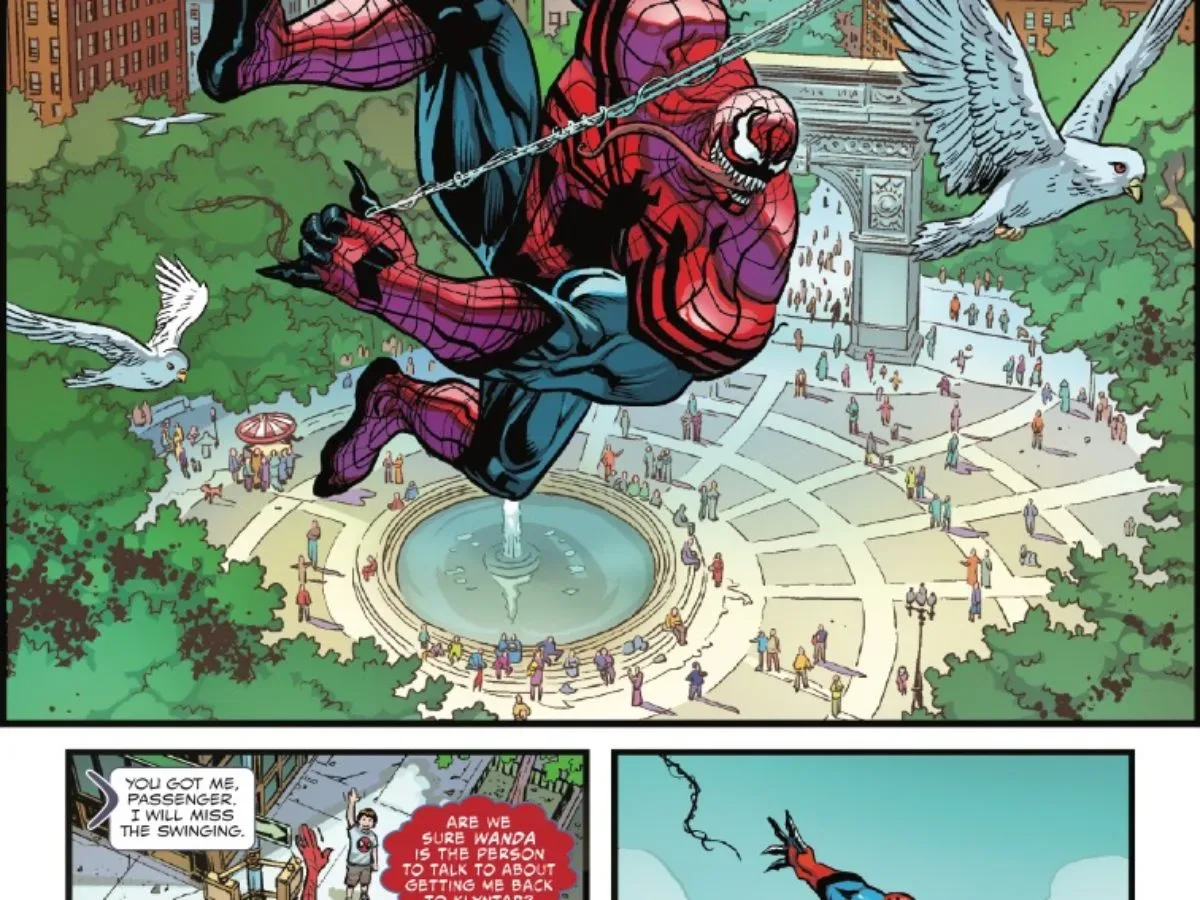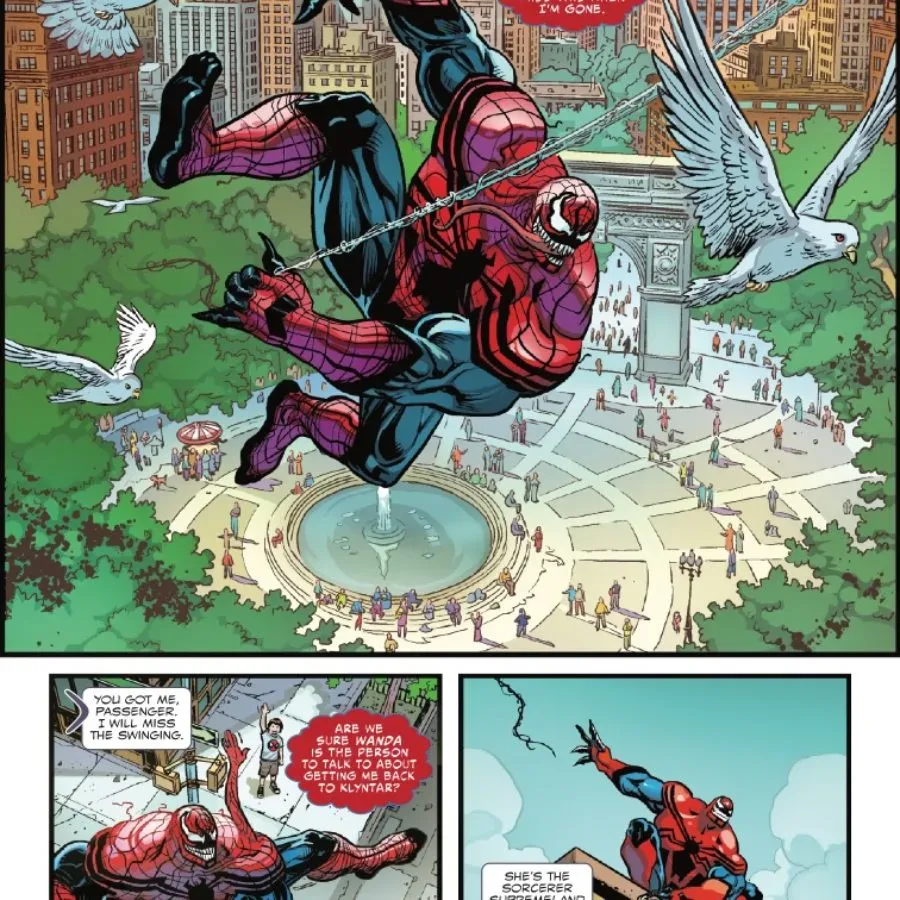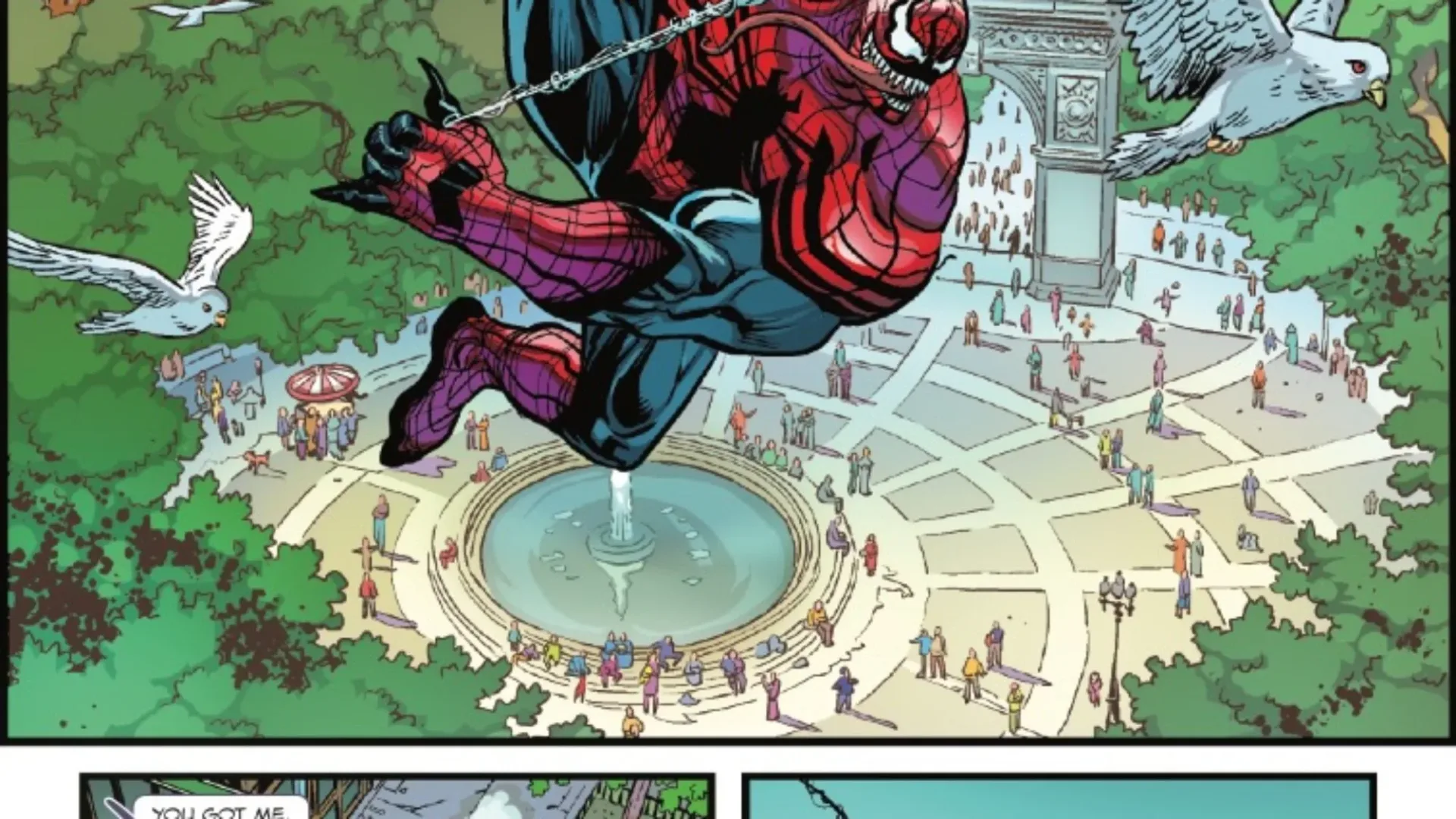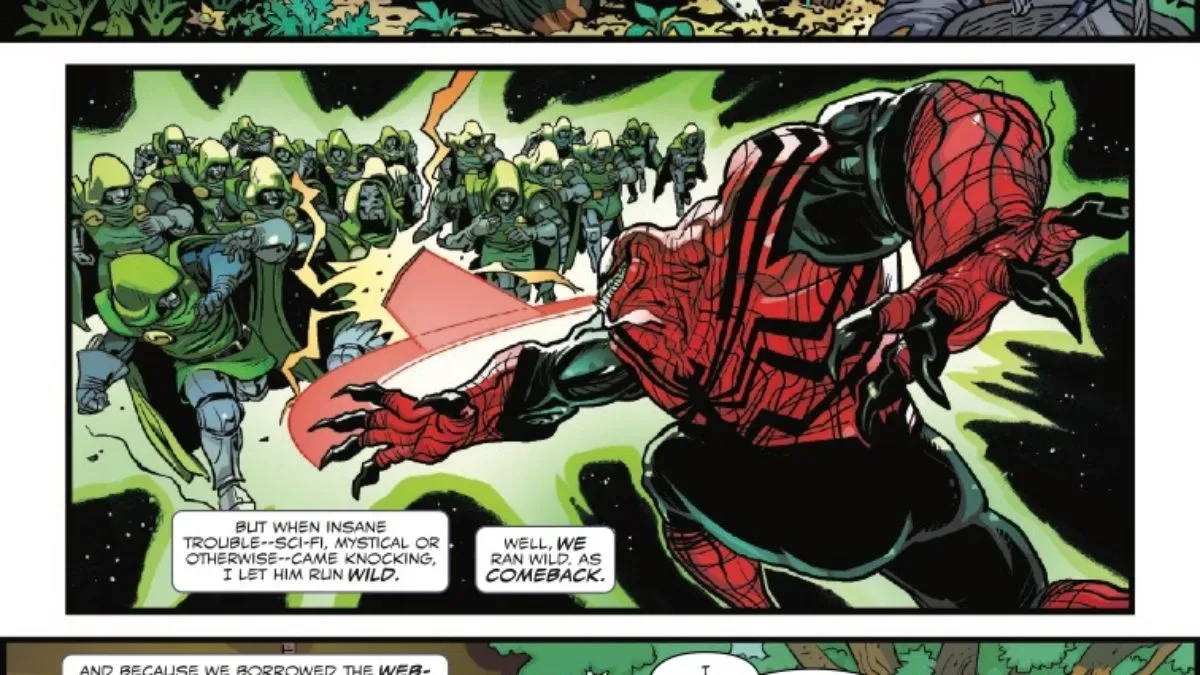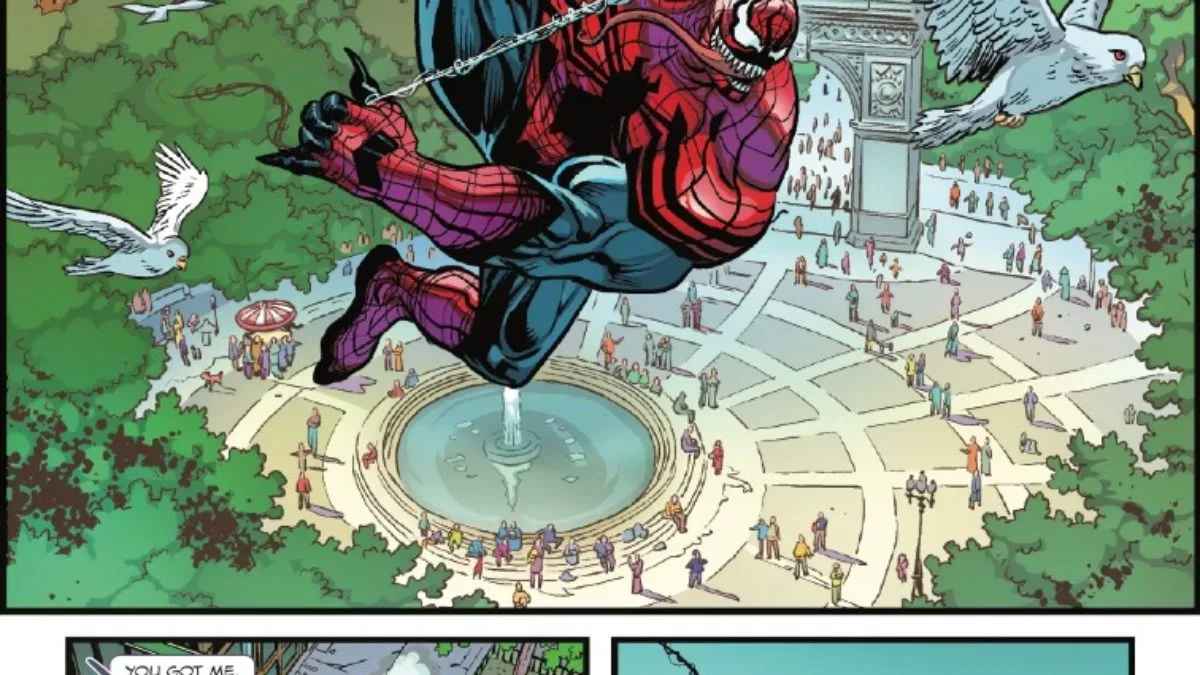
Amazing Venom #2 is scheduled to go on sale October 28, 2026, and its central problem is wonderfully direct: Comeback wants to reach Klyntar, while Boomerang is the kind of Earthbound operator for whom arranging an interstellar journey is far beyond the usual job description.
The issue is written by Jordan Morris, drawn by Luke Ross, and features a cover by Stefano Caselli. Marvel’s setup places Boomerang and Comeback on a tour of heroes and villains in search of a way off the planet. Scarlet Witch and the Fantastic Four are specifically named among the characters they will encounter.
There is one major complication before the trip even starts: the pair had apparently agreed that they were not doing “space stuff.” That abandoned rule gives the premise its comic engine. Rather than treating the journey to Klyntar as a clean escalation into cosmic superheroics, the issue frames it as an obligation that its would-be travelers seem ill-equipped—and perhaps reluctant—to fulfill.
A bagman confronts a cosmic logistics problem
Fred Myers, better known as Boomerang, is described in the issue’s premise as a simple bagman. In crime-fiction terms, a bagman is someone trusted to carry money, goods, or other sensitive material between parties. It is a role defined by practical errands and risk management, not by operating spacecraft or negotiating with Earth’s foremost scientific and mystical powers.
That contrast appears to be the core of the issue. Reaching Klyntar is not presented as something Boomerang can solve with a handy contact, a vehicle, or a quick scam. He and Comeback must seek an answer from figures with wildly different abilities and priorities. A request that begins as transportation quickly has the potential to become a social obstacle course: who can get them there, who would be willing to help, and what might those characters demand or warn them about in return?
The premise does not confirm the exact route the pair will take, whether they will receive help immediately, or which villains appear beyond the broader promise of a heroes-and-villains tour. What it does establish is that getting to Klyntar is the driving goal, and that the search will bring Boomerang into contact with people far outside his normal orbit.
Why Scarlet Witch and the Fantastic Four matter to the premise
Scarlet Witch and the Fantastic Four represent two very different kinds of possible assistance, at least at the level of the premise. Scarlet Witch is associated with magic, while the Fantastic Four are Marvel’s best-known family of science-minded explorers. For a story about a seemingly impossible trip from Earth to a distant destination, that creates room for competing solutions: mystical intervention on one side, extraordinary technology and expertise on the other.
The supplied material notes an attempted magical transport involving Wanda and Passenger, but does not establish how that effort ends. Readers should therefore treat the attempt—not a successful arrival—as the confirmed detail. That distinction matters in a preview-driven story: an obstacle can be more revealing than a solution, especially when the characters are trying to honor neither their confidence nor their earlier decision to stay away from space adventures.
The Fantastic Four’s inclusion similarly signals a scale beyond Boomerang’s usual operations without revealing their exact role. They may be consulted for access, knowledge, transport, or another kind of intervention; the premise only confirms that Boomerang and Comeback’s search takes them to the team. That restraint leaves the issue’s actual chain of favors, refusals, and detours intact for the comic itself.
The value of an intentionally mismatched lead
Superhero stories often make space travel look routine. When powerful characters have access to advanced vehicles, portals, cosmic allies, or abilities that ignore conventional distance, “getting there” can become a brief transition between larger scenes. Amazing Venom #2 instead makes travel the story problem. The point is not merely that Klyntar is somewhere else; it is that Boomerang has no natural place in the network required to reach it.
That mismatch can make every meeting more consequential. A character such as Boomerang cannot simply walk into a room full of major heroes and assume his request carries authority. The comedy and tension inherent in the setup come from watching a professional grifter navigate a situation where confidence alone may not be enough. Even before the story reveals its outcome, the premise establishes a clear practical question: how many favors, explanations, or compromises will it take for these characters to leave Earth?
Comeback’s determination supplies the counterweight. The issue description identifies Comeback as the person fixed on reaching Klyntar, which makes the pair’s dynamic central to the mission. One character has the destination in mind; the other has to deal with the inconvenient reality of arranging it. Their conflicting relationship to the trip may matter as much as the outside help they pursue.
What is confirmed for Amazing Venom #2
- On-sale date: October 28, 2026.
- Publisher: Marvel.
- Format: 32 pages, Rated T+.
- Creative team: Jordan Morris and Luke Ross, with a Stefano Caselli cover.
- Premise: Boomerang and Comeback pursue a way to reach Klyntar after previously swearing off space-focused adventures.
- Named encounters: Scarlet Witch and the Fantastic Four are among the heroes and villains involved in the search.
- U.S. cover price: $4.99.
Marvel also lists three $4.99 U.S. variant editions: a Will Robson variant, a Superlog variant, and an Andrei Bressan variant. For readers choosing between editions, the supplied information differentiates them by cover artist but does not identify any difference in story content, page count, or format. The standard issue and variants are all listed at 32 pages.
A small-scale objective with a very large destination
The appeal of this setup is its perspective. “Reach Klyntar” is an enormous objective, but the story approaches it through someone described as a bagman. That gives the mission a ground-level angle even as it pulls in magic, super-science, and an off-world target. Rather than promising that Boomerang has suddenly become a seamless cosmic adventurer, the issue foregrounds how unprepared he is for the assignment.
It also gives the guest appearances a functional purpose. Scarlet Witch and the Fantastic Four are not merely names attached to the issue’s promotional copy; they are tied to the concrete question of whether the protagonists can get off Earth. The comic’s broader heroes-and-villains tour should therefore be read as the mechanism of the plot, with each potential ally or obstacle bringing the characters closer to—or further from—their destination.
Marvel readers looking for a wider current-universe connection can also follow the site’s coverage of the growing Avengers: Doomsday cast. Amazing Venom #2, however, has a more intimate immediate hook: a pair of characters who promised not to go to space now need help from some of Marvel’s biggest names to do exactly that.
Whether the promised help turns into a direct ride, a magical solution, a scientific workaround, or an even messier detour remains unconfirmed. The solicited details make one point clear: for Boomerang and Comeback, leaving Earth is not the easy part of a cosmic story. It is the entire problem.