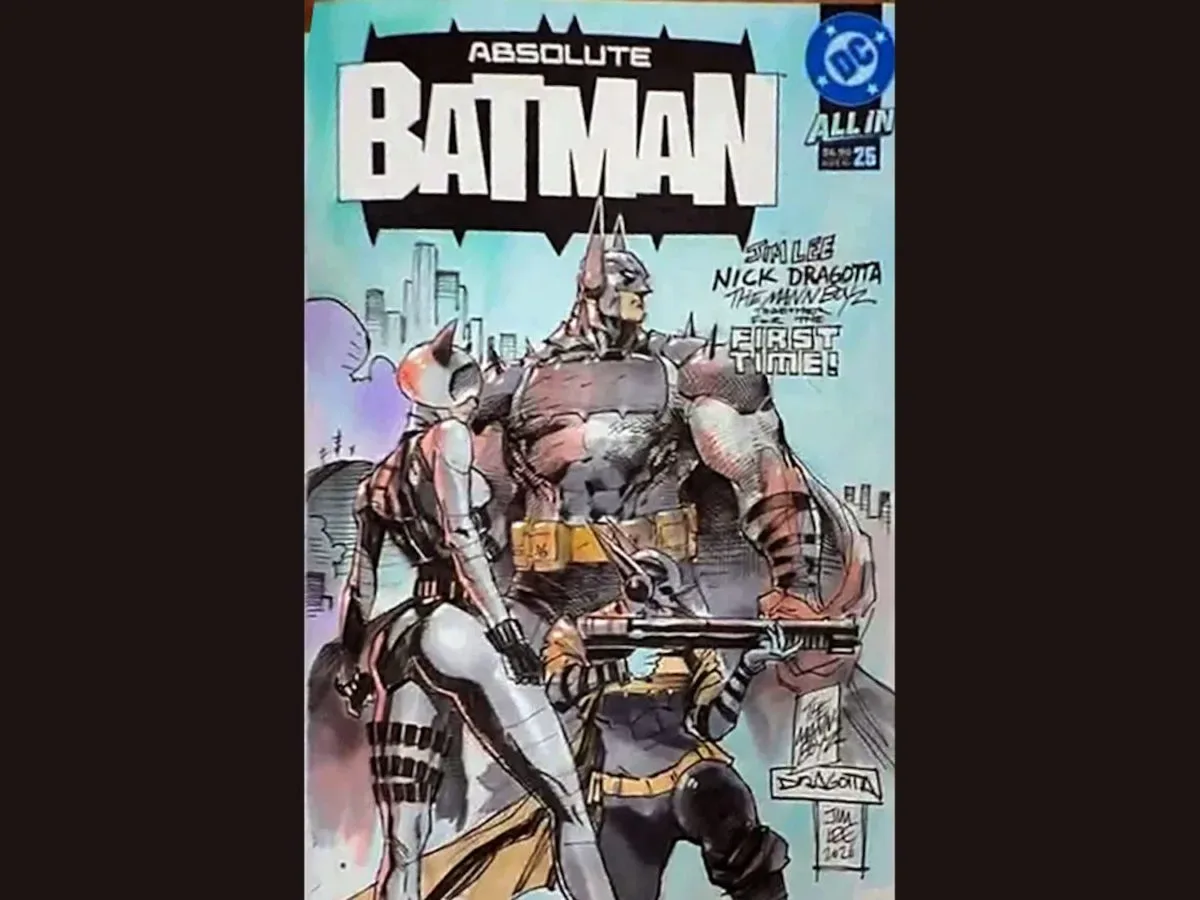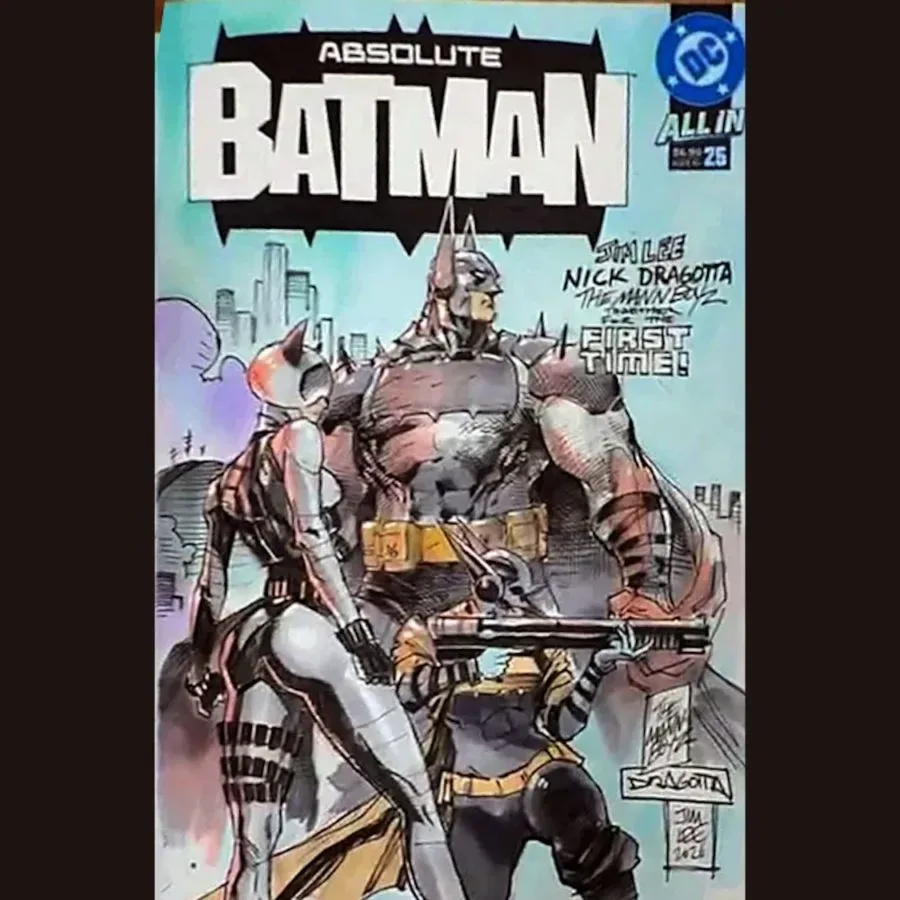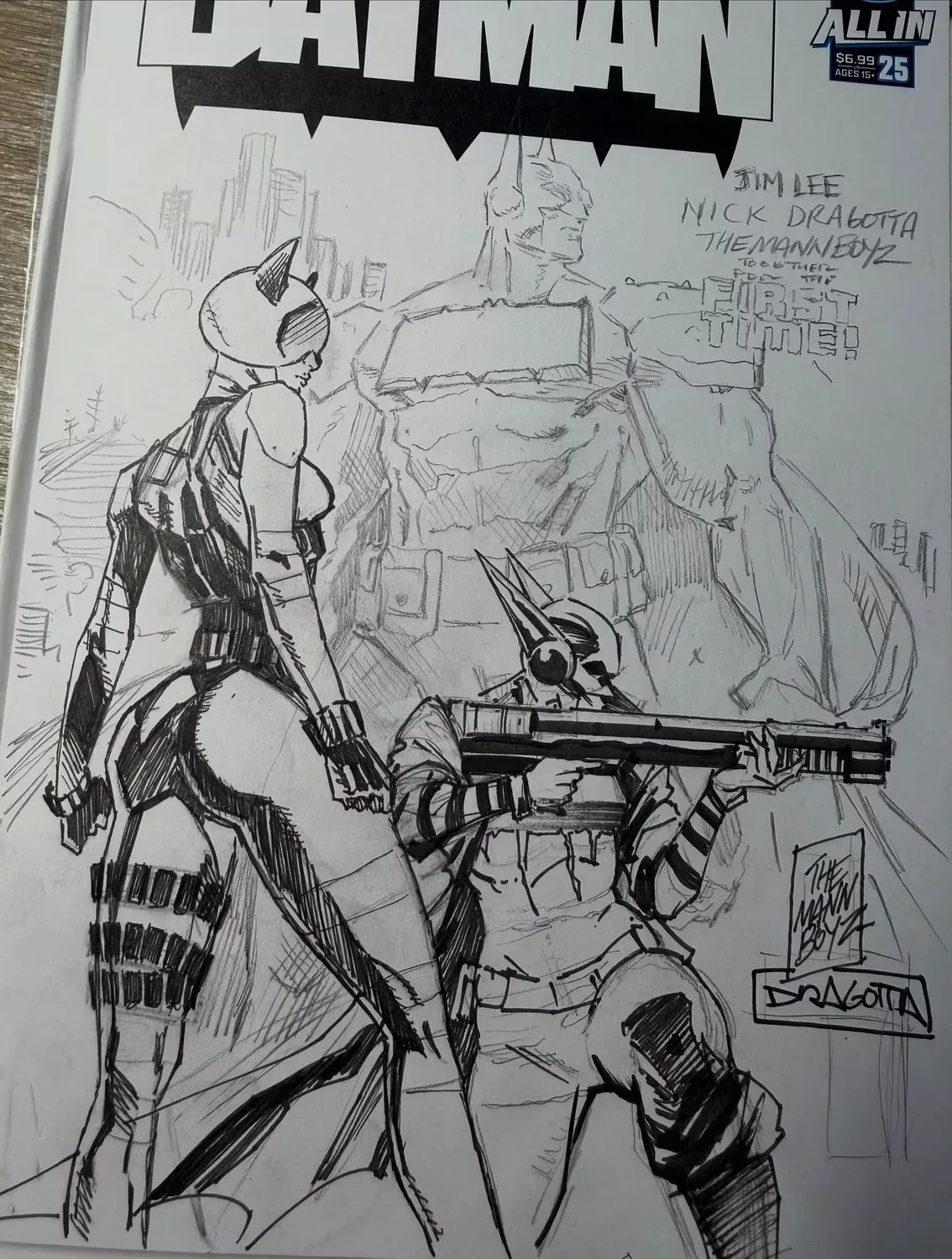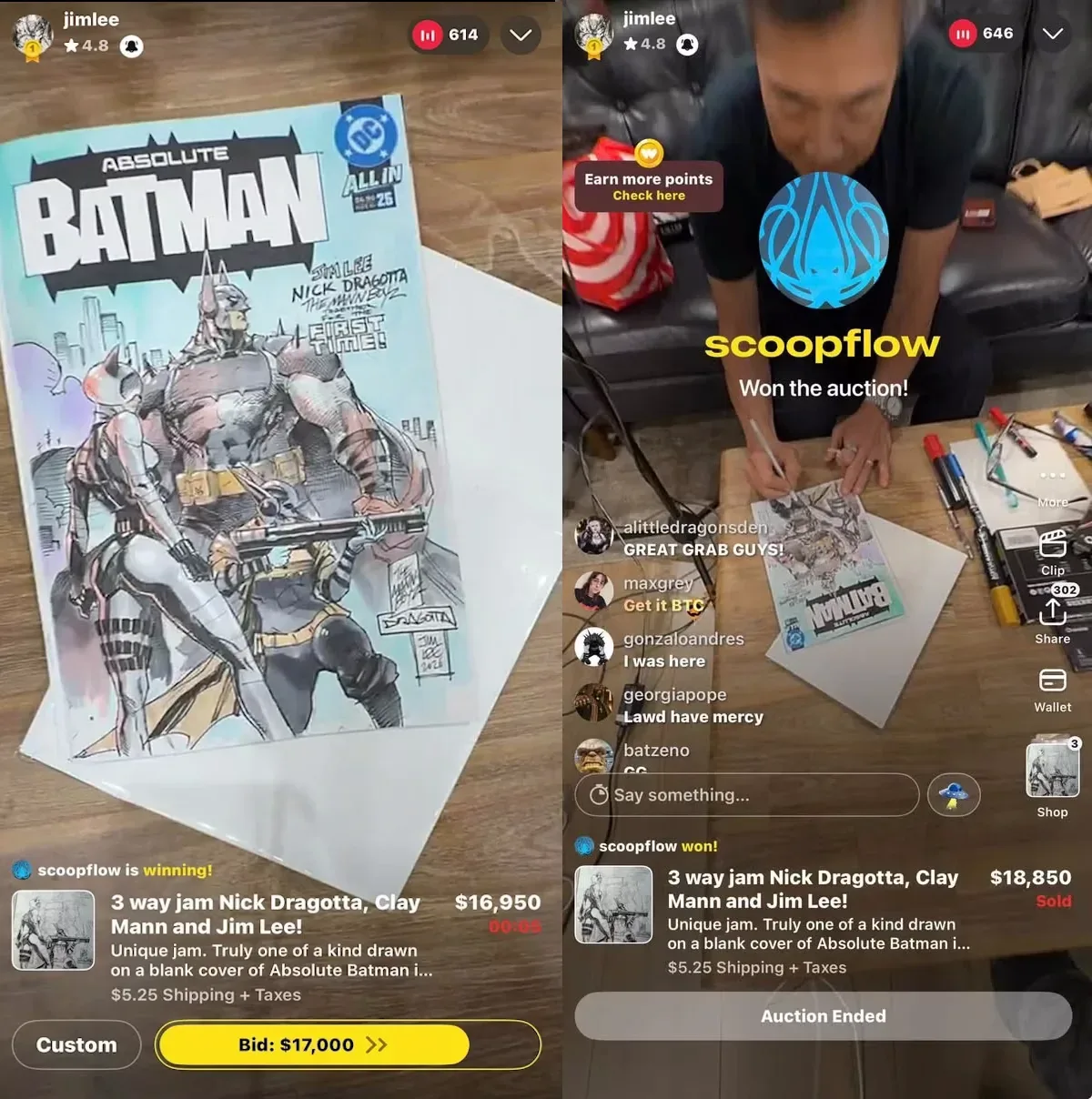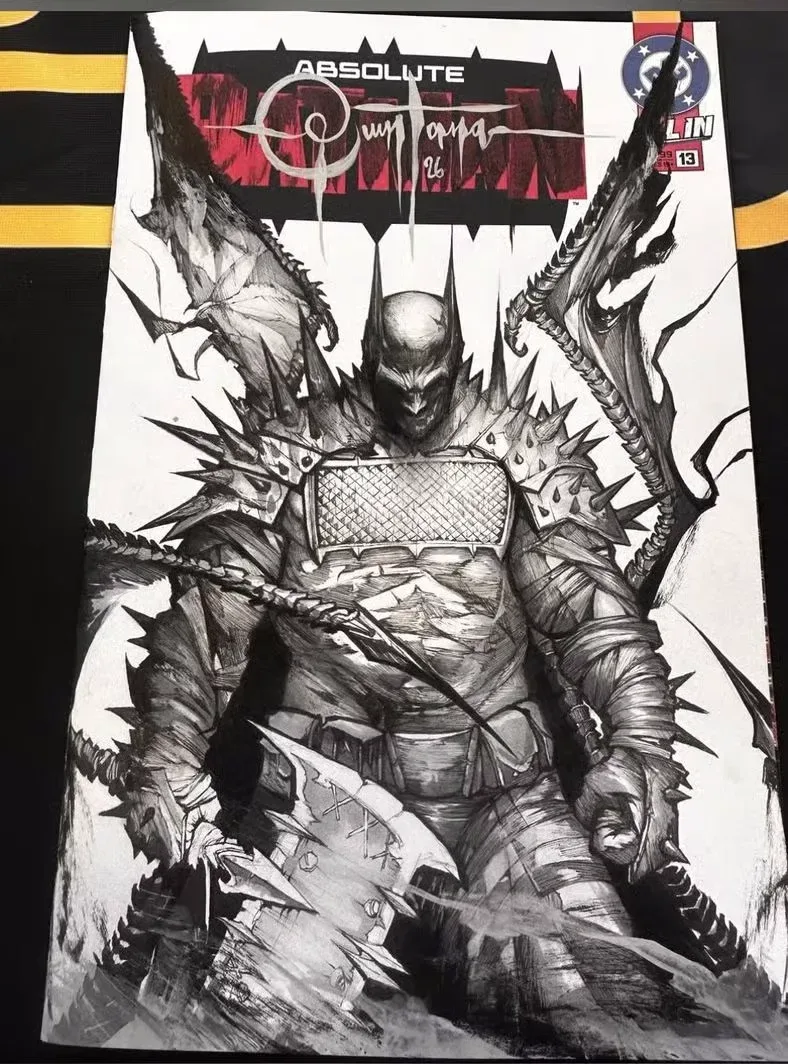
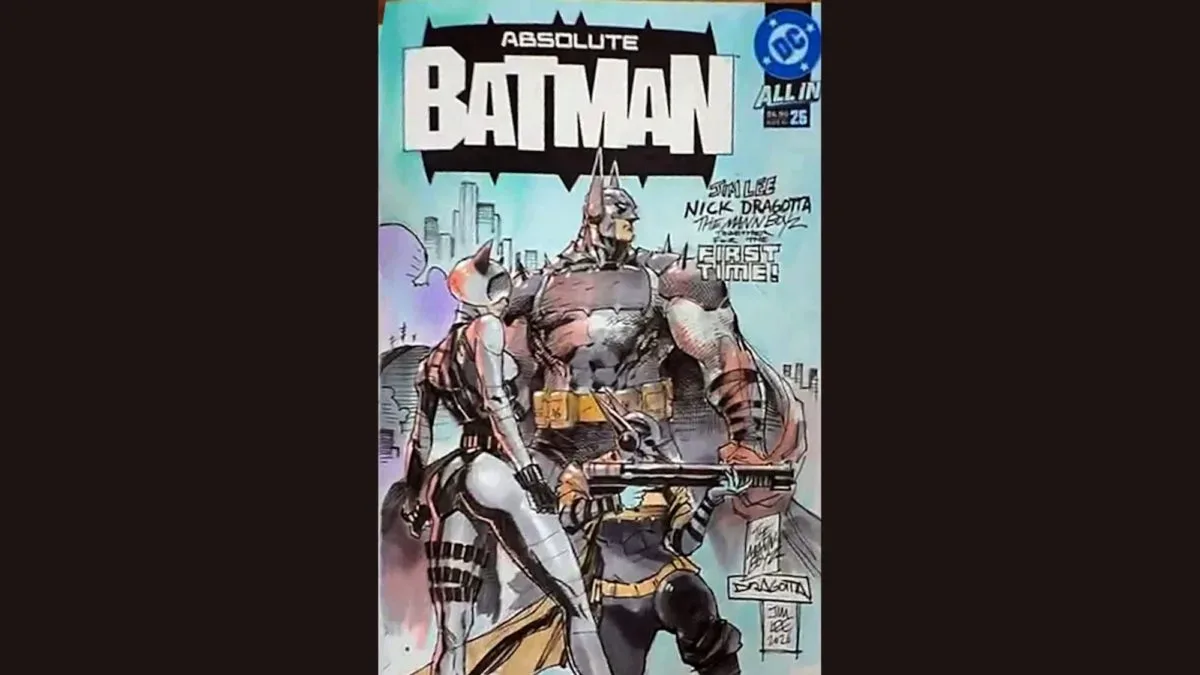
An Absolute Batman #25 sketch cover created by Nick Dragotta, Jim Lee and Clay Mann sold for $18,850 through a live Whatnot bidding session. The sale sets a new reported high for an Absolute Batman comic, narrowly passing the $18,550 paid for Dan Quintana’s Absolute Batman #13 sketch cover.
The buyer was identified as Scoopflow. What makes this particular issue unusual is not simply the price, but the number of major artists involved: Dragotta drew Batman, while Lee and Mann joined the cover as part of a three-way art jam. In comic-art terminology, a “jam” is a collaborative piece in which multiple artists contribute to one work. It is less like a standard variant cover, where one artist delivers a finished image for reproduction, and more like a single physical page with several creative hands on it.
A live art session became a high-stakes comic sale
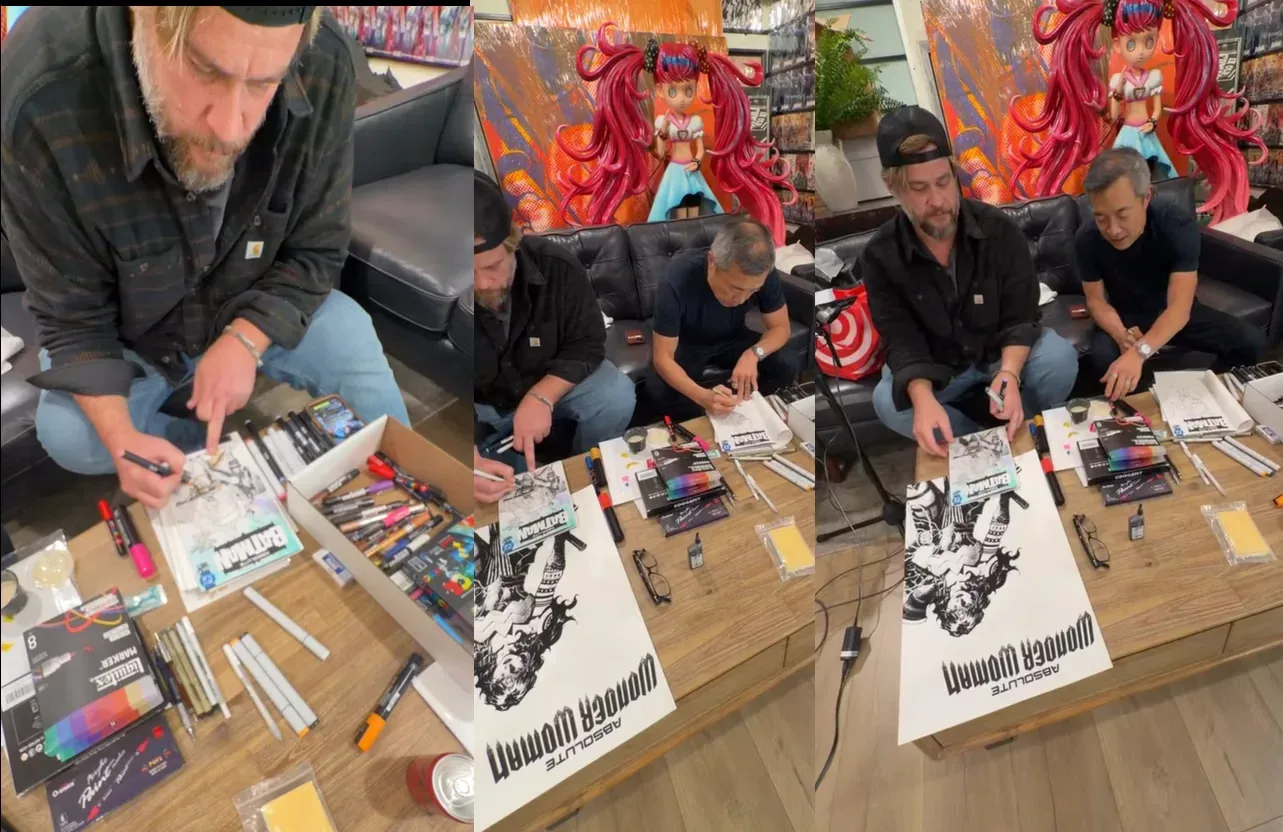
Lee promoted the session in advance as a live event that would be viewable on Twitch and bid on through Whatnot. He described the Absolute Batman #25 blank cover as a unique three-artist piece, with the group intending to discuss comics, music, original art and collectibles while the drawing took shape.
That format matters. The finished cover was not merely a comic selected from retailer stock after publication. Its appeal is tied directly to the event in which it was made, its physical singularity, and its connection to the participating artists. The bidding process also let interested collectors watch the work being created rather than encountering it later as a completed item with only a description and photographs.
Live-streamed creative events have become another way for fandom communities to turn process into part of an item’s story. A comparable digital-community model can be seen in projects such as ENDIX’s virtual expo, though a one-of-one comic-art sale has a much more direct collector and ownership component. In this case, the stream was both an art session and an auction setting.
What is a sketch cover?
A sketch cover is a publisher-produced comic with intentionally open cover space, often in black, designed to accept pencils and ink. Collectors can bring those covers to conventions, send them to artists through commission opportunities, or acquire a cover created during a special event. The comic remains an issue of the series, but its individualized cover turns it into an original-art object as well.
That distinction helps explain why sales of sketch covers should not automatically be treated like sales of ordinary copies of the same issue. A standard edition can have a large print run and many copies in circulation. A hand-drawn sketch cover, by contrast, is unique in its artwork even when the underlying comic is not. Its desirability may depend on the artist or artists, the subject, the quality and scale of the drawing, its condition, and the documented circumstances in which it was produced.
For this cover, the circumstances are unusually straightforward: it was presented as a live collaboration involving Dragotta, Lee and Mann, with Dragotta responsible for the Batman figure. That provides a clear creative narrative, rather than requiring a buyer to infer which artist did which portion of an older, unsigned collaborative piece.
The new Absolute Batman benchmark is close, not distant
The $18,850 result exceeds the prior reported Absolute Batman record by only $300. Quintana’s Absolute Batman #13 sketch cover had reached $18,550. The narrow gap is worth noting because it indicates that the new record did not arrive as a dramatic leap above the prior high; two distinct one-of-one Absolute Batman sketch covers have now landed in a very similar price range.
They are not interchangeable works, however. Quintana’s earlier cover was described as the more intensive and time-consuming process to create. The #25 sale instead carries a different proposition: a live, documented collaboration among three recognizable creators attached to one of DC’s most commercially prominent current comic lines.
For collectors, that is an important reminder of what an auction total does and does not establish. It records the amount paid by the winning bidder for this specific physical object in this specific bidding environment. It does not create a fixed price for every blank cover, every comic featuring Batman, or every piece by any one of the artists. One-of-one comic art can be highly sensitive to the exact image, contributors, provenance and audience present when it comes up for sale.
Why Absolute Batman is a particularly potent canvas
The strength of the underlying title is a major part of the story. Absolute Batman belongs to DC’s Absolute Universe, a line that reimagines familiar characters from the ground up. Scott Snyder serves as the line’s showrunner, and the wider initiative is part of DC All-In. The Absolute line includes Absolute Wonder Woman, Absolute Superman, Absolute Flash, Absolute Green Lantern and Absolute Martian Manhunter, with creators including Kelly Thompson, Jason Aaron and Al Ewing involved across the initiative.
Within that group, Absolute Batman has been the standout commercial force. The most recent issue was reported to have passed half a million sales, while the broader line has continued to place strongly on sales charts. That popularity gives a commissioned cover a larger base of potential interest than a sketch on a series with little current visibility.
It also gives the artwork two overlapping collecting identities. It is Batman material, which brings the durable recognition of DC’s flagship character. It is also Absolute Universe material, connected to a newer continuity whose premise is reinvention rather than straightforward continuation. Finally, it is an original collaboration tied to a specific issue and live occasion. None of those elements alone guarantees a major result, but together they create a much more specialized item than a conventional copy of Absolute Batman #25.
Original art, comic condition and documentation
For anyone following sales like this, it is useful to separate the comic-book component from the original-art component. A blank cover begins as a published comic, but once artists draw on it, the unique illustration becomes the defining feature. That can make details such as surface condition, marker or ink stability, signatures, personalization and handling especially relevant.
- Provenance means the documented history of an item: who made it, when, and how it moved from creator to owner. A live creation session can give a work a particularly visible provenance trail.
- One-of-one does not mean “rare variant.” It means no second physical cover has the exact same original drawing.
- Commissioned art is artwork made for a particular collector or occasion, rather than artwork produced as standard published interior or cover art.
- Blank cover stock refers to the publisher-made comic cover intended to take traditional art materials. It is a foundation for original art, not a mass-printed reproduction of that art.
Documentation is especially practical for a collaborative piece. A buyer may want to preserve the event listing, screen captures from the stream, payment records and any correspondence or certificates associated with the work. Those materials cannot turn an otherwise ordinary comic into original art, but they can help establish what the piece is and why several creators are connected to it.
What the $18,850 sale says—and what it does not
The sale demonstrates substantial demand for a specific blend of current comic popularity, Batman’s collecting reach, a live event and well-known artistic contributors. It also underscores that blank-cover commissions can become significant original-art collectibles rather than being treated only as convention souvenirs.
Still, the result should be read carefully. It is a reported record for an Absolute Batman comic, beating the previous Quintana sketch-cover mark, rather than a universal measure of Batman comic values or original comic-art values. The two top reported results are both individualized sketch covers, so their prices reflect singular works and cannot be cleanly mapped onto standard editions of the issues.
For the Absolute Universe, though, the auction provides another clear sign that enthusiasm around Absolute Batman extends beyond monthly sales. The series has become an attractive platform for high-profile original art, and the #25 three-artist jam now occupies the top recorded spot among its comic sales at $18,850.