PSA is reopening its Value Service Tier on October 29 at 8 a.m. PT, restoring a lower-priced submission route after the tier was paused for months. The return arrives alongside reduced estimated turnaround windows for the company’s Standard and Priority levels, with the changes applying to new submissions beginning October 28 at 8 a.m. PT.
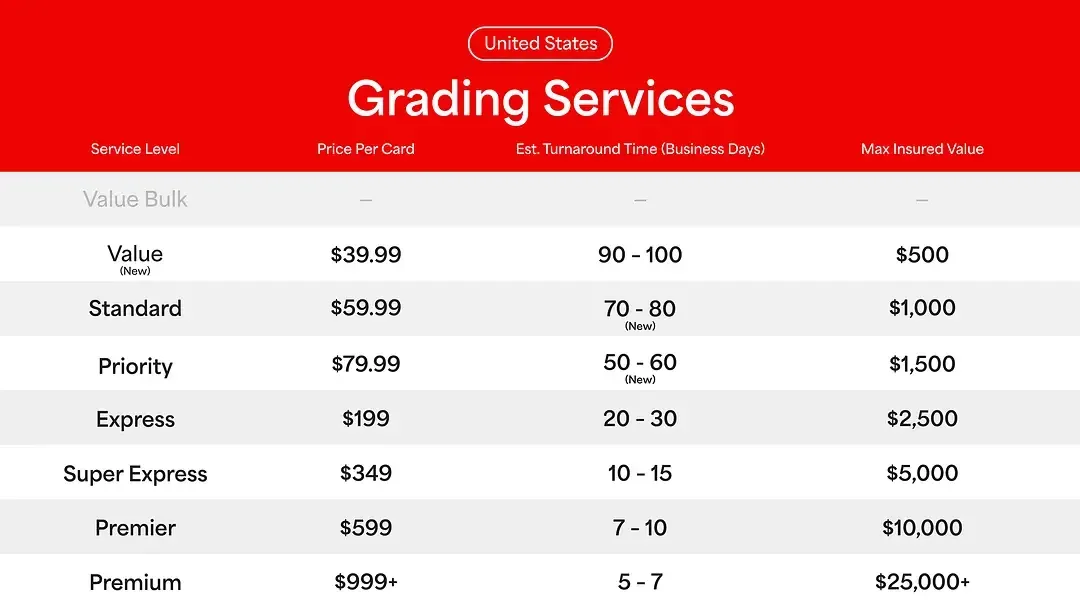
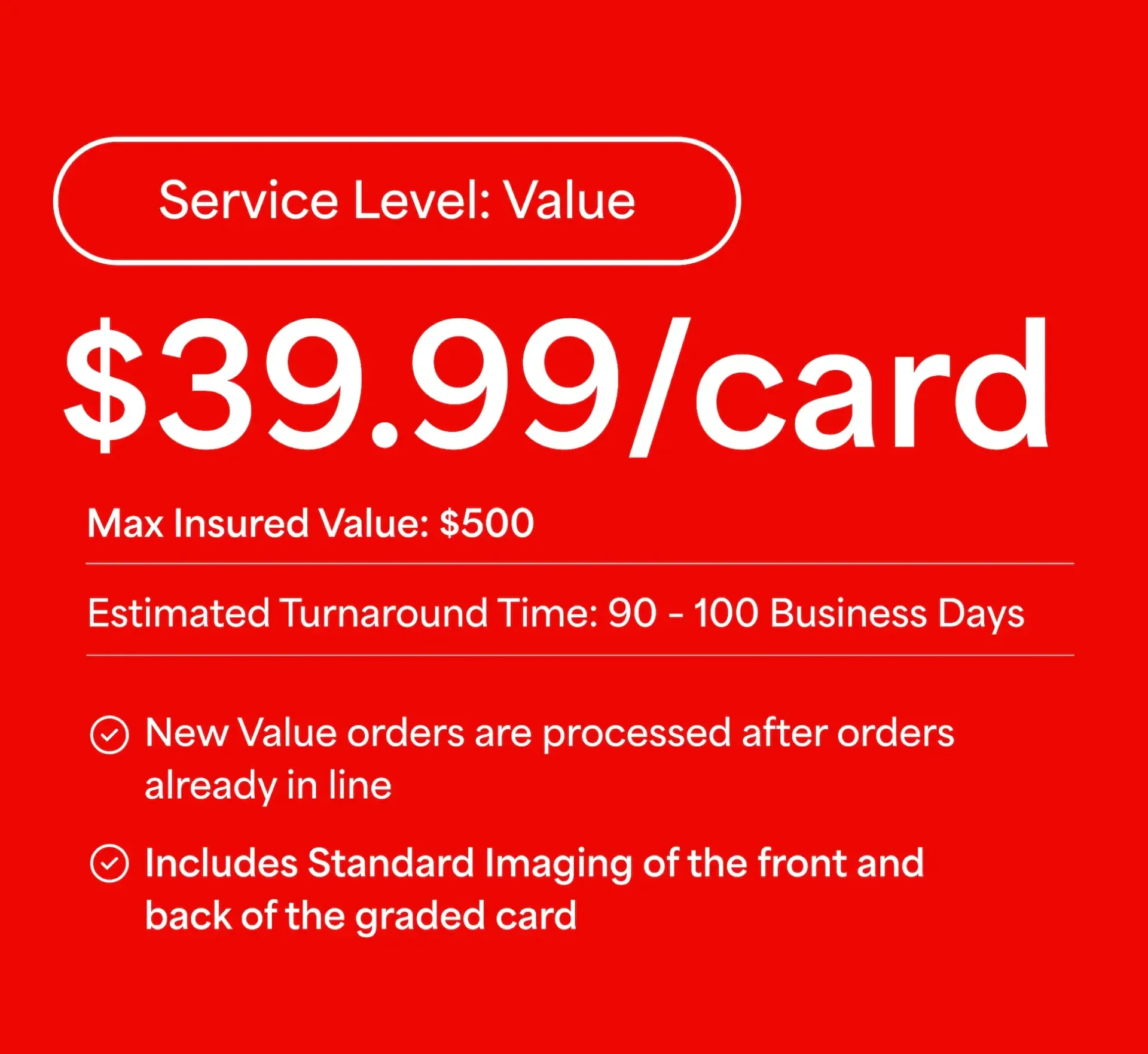
For collectors weighing whether, when and how to submit cards, the update is significant less because it promises an overnight clearing of the grading queue and more because it supplies a clearer set of choices. Value returns with a stated price of $39.99 in the United States, a $500 maximum insured value, and an estimated 90-to-100-business-day turnaround. Standard is now estimated at 70 to 80 business days, while Priority is estimated at 50 to 60 business days.
The service changes cover PSA’s U.S., Canadian, European and Japanese markets, although the Value estimate in Japan is 120 business days. Existing submissions remain subject to the terms in place when they were sent in. Those orders may move more quickly as capacity improves, but their delivery estimates are not being rewritten as part of this change.
What is changing, and when?
The timetable has two important moments. The shortened Standard and Priority estimates apply to orders submitted from October 28 at 8 a.m. PT. Value submissions become available a day later, Thursday, October 29, at 8 a.m. PT.
PSA has cut 20 days from each of the two stated windows for Standard and Priority. The revised estimates are:
- Priority: 50 to 60 business days.
- Standard: 70 to 80 business days.
- Value, U.S.: 90 to 100 business days, priced at $39.99, with a $500 maximum insured value.
- Value, Japan: 120 business days.
Business days are working days rather than calendar days, so collectors should not read a 90-to-100-business-day estimate as a three-month promise. The supplied figures are estimates, not guaranteed completion dates, and the company has specifically said it still has work to do on both existing orders and the accuracy of its projected turnaround times.
That distinction is especially relevant for anyone submitting a card tied to a fixed sale, show, gift, auction, or release date. A service-level estimate can help a collector plan, but it is not the same thing as a deadline. Where timing is the major consideration, the shorter Priority and Standard windows remain materially different from the returning Value option.
Value returns, but it is not a shortcut around the current line
The newly reopened Value tier will be processed after orders already with PSA. In practical terms, its reopening does not move back the expected delivery dates of submissions already in the company’s possession. It also means that the return of a lower-cost service should not be interpreted as a declaration that the backlog has disappeared.
Related coverage includes PSA Reopens Value Service as Backlog Drops to 7.2 Million and Turnaround Times Improve.
PSA puts its current backlog at 7.2 million units and is working toward an established estimate of 5 million units. Reaching that level is tied to a full reopening of the Value Bulk Tier. Value and Value Bulk are not interchangeable names: the update identifies the former as reopening now, while presenting the latter as the next step once the backlog is brought down further.
That is a useful dividing line for submitters. A relaunch of Value expands the menu of available individual service options, but it is not yet the broader reopening of Value Bulk. Collectors should therefore make decisions based on the specific tier available to them, its stated value limit, its cost, and its estimated waiting period—not on an assumption that every lower-priced grading avenue is immediately back.
Why the $500 insured-value limit matters
The $500 maximum insured value attached to U.S. Value submissions is one of the most consequential details in the update. An insured-value ceiling is a limit within the service’s stated coverage framework, so a collector considering Value should first determine whether their submission fits that threshold. It is not simply a label for a slower tier.
For cards believed to fall within that maximum, the $39.99 U.S. Value price offers a defined lower-cost route relative to an expedited choice. For cards that do not fit the stated limit, the Value tier is not the appropriate lane on the information provided. The right question is not merely, “Which tier costs least?” It is, “Which available tier matches this card’s insured-value position and my tolerance for the quoted wait?”
That calculation applies whether a collector is grading for preservation, display, sale preparation, or a personal registry. A grading submission commonly involves an authentication and condition assessment housed in a protective holder; the tier selection is the service and processing choice, not a prediction of the grade a card will receive. Lower price and longer estimated turnaround describe the Value service’s placement in the queue, rather than the quality or strictness of the grade itself.
Capacity has grown, but the scale of demand remains enormous
PSA says its graded-item output is up nearly 50% in 2026, helped by investment in capacity. It also says weekly items graded are up 150% compared with the 2020-to-2025 average. Those figures give important context to the shorter estimates: the company is not presenting the schedule adjustment in isolation, but as part of a larger attempt to expand throughput while working down pending submissions.
The longer-term volume illustrates just how unusual the present operating scale is. PSA says it graded 59 million items across the past three years. That total exceeds the 57 million items graded in the preceding 23 years. Such a comparison does not establish exactly how quickly any individual order will be finished, but it does explain why service availability, capacity and backlog management are central concerns for collectors.
“We have added an incredible amount of capacity, but we still have work to do, both on existing orders and ensuring our estimated turnaround times are accurate,” said Ryan Hoge, President of PSA and Grading at Collectors.
In the same statement, Hoge said feedback from collectors had informed the phased reopening of value services. The phased approach is evident in the details: Standard was introduced and the service levels were reorganized last month; Value now returns; Value Bulk remains dependent on the backlog reaching the company’s stated 5 million-unit target.
Practical takeaways for card collectors
The update does not automatically make Value the best option for every card. It does, however, restore an option for collectors who had been waiting for a lower-priced service. A disciplined submission plan starts with the limitations printed in the service information rather than excitement about a reopened tier.
- Confirm the submission date and time. New Standard and Priority estimates apply from October 28 at 8 a.m. PT; Value opens October 29 at 8 a.m. PT.
- Check the relevant geography. Value is opening in the U.S., Canada, Europe and Japan, but the Japan estimate is 120 business days while the U.S. announcement specifies 90 to 100 business days and a $39.99 price.
- Compare insured value with the Value ceiling. The disclosed U.S. limit is $500. That number should be part of the decision before a card is assigned to the tier.
- Use the estimate appropriate to the tier. Priority’s 50-to-60-business-day range is currently the shortest of the windows detailed here, followed by Standard at 70 to 80 and Value at 90 to 100 in the U.S.
- Separate new-order information from current-order expectations. Existing submissions keep the terms under which they were submitted, even if overall operating gains may help them move faster.
Collectors considering a card’s route to market should also keep the timing issue in proportion. Grading can be one part of a sale or collection-management decision, alongside condition, authentication, storage, insurance and the intended venue. The hobby’s market activity continues to span many kinds of material, from cards to historic comics such as Green Mask #1 heading to auction. But the service tier itself should be chosen from the facts applicable to the submitted item, rather than from the wider excitement around a collecting category.
What this does not change
Several boundaries in the update are worth keeping in view. The reopening does not change the projected delivery dates attached to current submissions. It does not constitute a full reopening of Value Bulk. It does not erase the 7.2 million-unit backlog. And it does not turn turnaround estimates into guarantees.
Instead, the move gives submitters more defined options at a time when PSA says output is rising and its backlog is moving toward the 5 million-unit level required for the next reopening stage. For collectors who fit the U.S. Value service’s $500 maximum insured value, the return of a $39.99 route may be the key development. For those whose main priority is speed, the revised 50-to-60-business-day Priority and 70-to-80-business-day Standard estimates are the more immediate change.
The central message is measured rather than absolute: capacity has increased, the available service choices are expanding, and estimates have improved for new orders. The remaining backlog and phased plan mean collectors still need to match their cards and timelines carefully to the tier that is actually open.