Define “retro revival” before measuring it
“Retro gaming” sounds like a market category, but it is better understood as a group of overlapping activities. As examples, a person might play an old game through a subscription, buy a newly manufactured cartridge, display an original console, bid on a sealed copy, study preserved source code, or use an emulator to investigate how an arcade machine worked. These activities can involve the same title, yet they do not demonstrate the same kind of demand. Treating them as one trend creates a misleading picture before any numbers are examined.
The phrase “retro revival” therefore needs a working definition. In this feature, it means the renewed visibility and support surrounding older games across several systems of access, ownership, commerce, and preservation. That definition does not claim that every one of those systems is expanding, or that the entire population has returned to older software. It describes a denser environment in which older games can be encountered in more ways than they could through the original retail cycle alone.
The first distinction is between active players and retro-specific players. The Entertainment Software Association reports 212.3 million U.S. people who play video games for at least one hour per week in its 2026 material, with an average player age of 37. Those figures establish that gaming is a durable, broad adult activity. They do not establish how many of those players use an NES, revisit a PlayStation 2 title, play arcade software, or choose a modern version of an older game. A broad player count is context, not a retro measurement.
A retro-specific player is someone whose activity can be identified as involving older games, older platforms, or a defined historical period. That identification might come from a survey with precise wording, platform usage data, catalog engagement figures, or sales data that separates reissues from new releases. Without such evidence, it is not possible to convert general participation into a claim about retro play. A person can be an adult player without being a retro player, just as a retro player may also spend most of their time with current releases.
Collectors form another category. A collector’s relationship to a game may center on ownership, material evidence, classification, or display rather than repeated play. Packaging, manuals, regional variants, manufacturing differences, promotional inserts, and provenance can matter even when the software is available digitally. A collection can preserve information about how a game was sold and understood, while providing no evidence about how often its owner plays it. Conversely, someone can play an old game regularly without owning any original hardware or physical copy.
Reissue buyers are not automatically collectors, either. A person purchasing a remaster, mini-console, licensed cartridge, or compilation may be acquiring convenience rather than historical objects. The product could offer a legally available version for a modern display, a bundled controller, portability, or a curated introduction to a platform. It may be used intensively, placed on a shelf, or never opened. Unit sales can show that a product moved through the market, but they do not by themselves reveal which of those relationships the buyer has to the past.
Subscription users add a further complication. A subscriber may have access to hundreds of older games without choosing any of them. Availability is not access in the practical sense, and access is not use. A title can be listed in a catalog, downloaded, launched once, and abandoned. A catalog may also attract people who would not have bought an individual reissue, but the cited service terms do not measure that behavior. Subscription figures therefore answer questions about the reach of an access system, not necessarily about the popularity of each included game or the number of committed retro players.
Auction participants are more narrowly visible still. An auction records a transaction involving a particular object under particular conditions. The object may be sealed, graded, unusually documented, or connected to a story that attracts press attention. The resulting price can be real and important without representing what ordinary copies sell for or what most collectors seek. Auction headlines are evidence of exceptional attention, not a census of ownership or a reliable measure of the wider market.
Institutional holdings operate according to different purposes. A library, museum, university project, or nonprofit archive may preserve a game because it has research value, represents a technical process, documents a cultural moment, or fills a gap in a collection. Institutions may hold software, source code, packaging, magazines, development material, or hardware. The presence of an item in a collection does not mean that it is publicly playable, commercially available, or widely desired by consumers. It demonstrates a preservation judgment and a documented act of collecting.
Preservation activity is broader than holding a playable copy. It can include copying files, preserving source code, recording platform information, documenting dependencies, maintaining hardware, studying operating systems, reconstructing emulation, and preserving manuals or development records. A preserved item may be inaccessible to the public because of rights, technical limitations, institutional policy, or the need to protect fragile material. Preservation is concerned with future understanding, not merely present convenience.
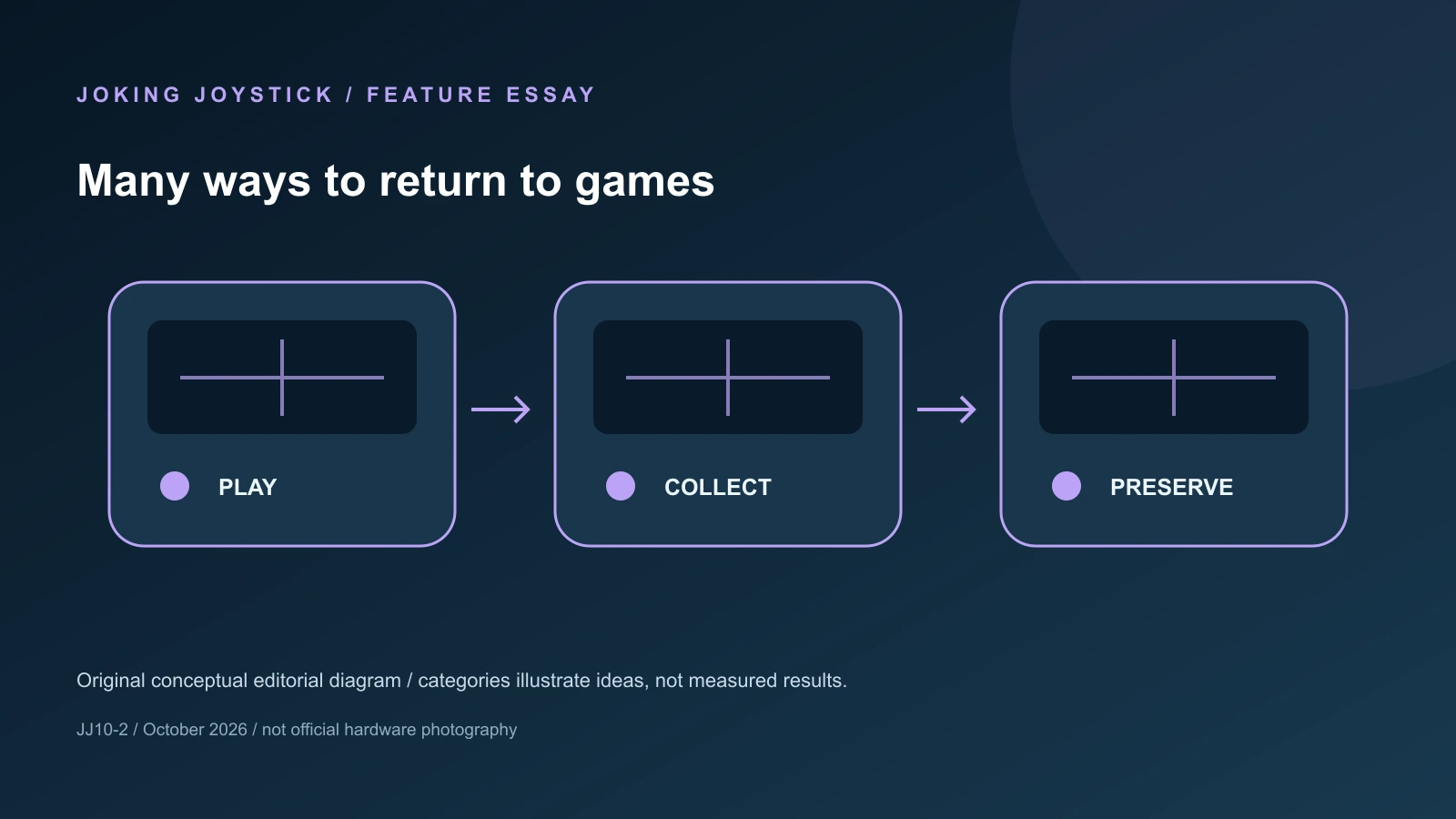
These categories can be mapped onto five different conditions. Availability asks whether a game is offered somewhere. Access asks whether a person can reach and use that offering under stated conditions. Ownership asks whether the person possesses a physical or licensed copy, with all the limits attached to that form of possession. Use asks whether the game is actually played and how often. Preservation asks whether the software and its surrounding evidence can remain interpretable over time.
The distinctions matter because each evidence type answers a different question. A manufacturer’s catalog demonstrates availability. A subscription account may demonstrate conditional access. A sales report may demonstrate purchases, but not continued play. A survey may describe behavior if its questions are specific enough. An archive can demonstrate that material has been collected, not that it has entered popular use. A technical project can demonstrate continuing maintenance without providing a player count.
“Rising again” is consequently a hypothesis, not a finding supplied by the phrase itself. To support it, a report would need several kinds of evidence: retro-specific participation measures, transparent reissue sales over time, catalog usage information, documented collecting activity, and accounts of preservation work. Those measures need not move together. Commercial access could widen while physical collecting narrows. Institutional preservation could intensify without more consumer play. A service could add games while engagement concentrates on a few familiar titles.
The useful question is therefore not whether retro gaming is universally growing. It is how older games are being made visible, reachable, ownable, playable, and preservable through different systems—and what each system leaves out. That framework prevents a demographic statistic, a new product, or an auction headline from standing in for an entire history.
An older player base does not prove retro demand
The 2026 figures from the Entertainment Software Association provide useful context. They report a large weekly U.S. player population and an average player age of 37. This suggests that gaming is not confined to children or teenagers and that participation can continue into adult life. But the figures do not identify the games being played. They do not separate current releases from reissues, arcade games from early-3D games, or occasional exposure from sustained retro activity.
Average age is especially easy to overread. An average compresses different groups into one number. It cannot show whether adults are playing older games, whether younger players are discovering them, or whether the same people are doing both. Nor does it reveal the route by which a game was encountered. A player may use a modern remake, a subscription version, an original cartridge, or a video of a historical game without those experiences being interchangeable.
The missing measurement is not simply “more data.” It is data designed around the question. A useful retro-specific survey would define its terms and ask respondents to identify platforms, release periods, or particular forms of access. It would distinguish replaying a game from trying it for the first time. It would separate owning an old system from using one, and using an original copy from using an authorized reissue. Without those distinctions, a response such as “I play older games” can mean almost anything.
Platform-level usage data could provide a different kind of evidence. If a service disclosed launches, playtime, or retention for its classic catalog, researchers could examine whether older games are being used and whether that use persists. Even then, the figures would belong to that service and its user base. They would not automatically describe cartridge play, emulation, physical collections, or other platforms. A transparent catalog report could answer a narrow question well while leaving the wider ecosystem unmeasured.
Reissue sales also require careful wording. A compilation’s units may include people buying several games in one package, people purchasing a product for its hardware design, and people who never open it. A remaster may attract existing fans, new players, or both. A mini-console may be sold as a gift or collectible. Sales can establish commercial circulation, but they do not on their own establish the frequency, duration, or motivation of play.
The same caution applies to subscription catalogs. Adding a classic platform to a membership service shows that the provider has chosen to license, emulate, package, or otherwise support it. It does not disclose how much time subscribers spend there. A large library may function as a selling point even if a small selection accounts for most use. A small library may have substantial engagement among a specialized audience. Catalog size is an inventory measure, not a behavioral one.
Motives should be kept equally open. Nostalgia is one plausible reason an adult might return to an older game, but it is not the only explanation and cannot be assumed to dominate without research. A player may prefer a particular control scheme or design rhythm. A game may be easier to fit into limited time. A friend may introduce it through local or online play. A modern release may be too expensive while an older title is included in a subscription. A player may be curious about a work that has become historically influential.
Convenience can matter even when nostalgia is absent. A curated service removes some of the effort involved in finding hardware, cables, displays, software, and instructions. A modern controller may make an old title approachable. A portable system can change when and where a game is played. A reissue can also provide an explanation, translation, save feature, or menu that makes a historical work legible to someone encountering it for the first time. None of these possibilities should be promoted to a universal motive without interviews or targeted research.
Social context complicates the generational story further. Older games can become shared reference points between people who did not grow up with the same technology. A well-known character may function as cultural shorthand, while an obscure game may attract attention through preservation or scholarship. Younger players can approach older software as a design archive, a challenge, a curiosity, or a source of material for new creative work. The category “retro player” may therefore include inheritance, discovery, replay, and comparison.
A stronger investigation would combine several tests. It would look for surveys that use explicit retro terminology; platform or service disclosures that identify engagement with older software; transparent sales reporting for reissues; and interviews that ask players why they choose those versions. It would compare claims across geography and time rather than treating one national survey as universal. It would also note whether the evidence concerns people, purchases, sessions, catalog entries, or preserved objects.
What broad demographics can establish is important but limited. They can show that adult gaming is ordinary and that the potential audience for older games is not restricted to the original generation. They cannot show that this audience is returning in larger numbers, that nostalgia is the dominant motive, or that every form of retro activity is expanding. The generational explanation is a starting hypothesis. It becomes reporting only when connected to retro-specific evidence.
Back catalogs turned old games into services
One of the clearest changes in modern retro play is that older games increasingly appear as features of continuing services rather than isolated products. Nintendo Switch Online and PlayStation Plus illustrate this shift, although they do so through different catalog structures and access rules. Their importance lies less in proving how many people play older games than in showing how companies have changed the conditions under which those games can be encountered.
Nintendo’s U.S. support material describes classic games as part of a membership service. The included libraries cover several historical platforms, while the Expansion Pack extends the range and includes additional platform-specific access. The service model makes the games available within an account relationship rather than presenting each title as a separate modern purchase. Nintendo also states that classic games included in the service are not sold individually through it.
That arrangement changes the meaning of access. A subscriber can reach a game without buying an original cartridge or a separately licensed digital copy. The barrier to discovery may be lower, especially for a person who already has the membership for other features. Yet the game is not owned in the same sense as a physical cartridge or an individually purchased license. The ability to use it depends on the membership and the service’s operating conditions.
Nintendo’s support information also distinguishes online membership from uninterrupted connectivity. Classic software can involve an offline-verification requirement, meaning that access away from a network is still governed by a service relationship. This is not the same as owning a self-contained copy. The distinction may be invisible during ordinary use, but it becomes important when discussing long-term availability, account status, hardware changes, or the future of a catalog.
The Nintendo catalog is curated rather than exhaustive. Its platform labels identify which historical systems are represented, but the presence of a platform does not mean that every important game from that platform is included. The cited Nintendo pages establish the available libraries and service structure, not the reasons particular titles were omitted. A service library is therefore a route into a period, not a complete record of it.
PlayStation Plus approaches the same broad problem through a U.S. Classics Catalog whose availability varies by country, membership plan, and time. PlayStation’s U.S. information distinguishes downloadable titles from titles available through streaming and notes that some games may be streaming-only or may leave the catalog. These qualifications make the catalog a changing access layer rather than a permanent shelf; they do not mean that every Classics title is delivered in both ways.
Streaming and downloading create different relationships to the software. A download can place files on the user’s device while remaining tied to account and membership rules. Streaming can make the game reachable without transferring the software in the same way, but it introduces dependence on network conditions, server operation, and the continued inclusion of the title. Neither model should be described simply as ownership. Each offers a particular form of licensed access.
Availability also varies geographically. The Nintendo and PlayStation information considered here is framed around U.S. support pages, so it should not be treated as a universal description of every country’s catalog. Game rights, platform offerings, release histories, and subscription terms can differ by region. Nintendo’s Switch 2-specific GameCube access is an especially clear qualification: it belongs to a particular hardware and service context, not to every Switch user or every version of the membership.
These systems make older games easier to encounter, but catalog size should not be confused with use. A provider may announce a substantial historical library without publishing launch counts, playtime, repeat sessions, or retention. The number of available titles measures the breadth of the offering. It does not tell us whether subscribers explore deeply, return to a few familiar games, or ignore most of the catalog.
Nor does a subscription catalog automatically preserve the games it offers. A service may provide a convenient current version while omitting source code, development files, original documentation, platform dependencies, and the conditions of the first release. If a title leaves, access may change. If the service ends, the catalog may no longer be available through that route. Commercial continuity and preservation continuity are related but distinct.
That distinction does not make subscription access unimportant. Services can bring obscure or historically significant software before audiences who would never assemble original hardware. Menus, search tools, save features, portability, and modern display support can reduce the practical friction of trying an old game. A subscription can also create a shared cultural space in which older titles are presented alongside current software, rather than isolated as specialist objects.
The service model consequently expands visibility while narrowing the terms of access. Users gain convenience and breadth, but they receive a curated selection governed by membership, platform, territory, technical delivery, and changing business decisions. The model can support active play and discovery without establishing ownership or guaranteeing permanent availability. It is best understood as an access system: powerful, scalable, and conditional.
This difference matters to the larger revival question. Official back catalogs demonstrate institutional investment in bringing older software forward. They do not, by themselves, prove universal demand or disclose how players behave once the software is available. To understand the revival, catalog expansion must be considered alongside usage evidence, reissue sales, collecting, and preservation. The service is one layer of the ecosystem, not the ecosystem itself.
Reissue programs are cultural selection
Every commercial reissue is also an act of selection. A company deciding which games to place in a subscription library, mini-console, compilation, remaster, or licensed cartridge is not reproducing the past in full. It is constructing a route through the past for a present audience. Possible selection pressures include recognizable intellectual property, rights availability, technical manageability, regional history, expected demand, and the cost of preparing a title for release, but the cited product pages do not establish which pressures determined any particular omission.
Nintendo’s classic-platform offerings show the scale of this curatorial approach. The service identifies several historical systems, including NES, Super NES, Game Boy, Game Boy Advance, Nintendo 64, Genesis, and Virtual Boy, with Switch 2-specific GameCube access described separately. Such a list can make a company’s history newly visible as a connected sequence of platforms. It should not be mistaken for a complete representation of what those platforms contained or what mattered to the people who used them.
Selection is unavoidable. A modern service has limited interface space, licensing capacity, technical support, and audience attention. Some games may require negotiations with outside rights holders. Others may depend on peripherals, specialized display behavior, unusual storage methods, or platform features that are difficult to reproduce. A title may be absent because its commercial prospects are uncertain, because its rights are complicated, or because its version history is difficult to document. Absence alone cannot show that the game was historically unimportant.
Recognizability can influence a catalog without being the only influence. Famous characters and established series can explain a product to consumers quickly. A well-known title may help sell a mini-console or attract subscribers who then encounter less familiar works. But the reverse can also happen: a commercially useful product may omit influential games whose rights, controls, or technical requirements are less convenient. A catalog reflects present conditions as much as historical significance.
SEGA’s Mega Drive Mini documentation illustrates another limit on the idea of a single official history. The manual portal concerns a regional product, and editions or included games can differ. A mini-console is therefore not simply “the Mega Drive” compressed into a box. It is a particular licensed selection prepared for a particular product and market. Comparing versions may reveal how regional memories and rights arrangements shape what becomes available, but one edition cannot stand for every player’s historical library.
The regional qualification is important because retro identities were never perfectly uniform. Games released in one market may have different titles, packaging, censorship, translations, or distribution histories elsewhere. A product that feels comprehensive to one audience may look partial to another. Commercial reissues can reconnect people with a shared platform while also smoothing over the differences that formed the original history.
Atari’s 2600+ represents a different reissue strategy. Atari describes the product as supporting 2600 and 7800 cartridges, providing HDMI output, bundling games, and using emulation software. This combines a relationship to original physical media with modern display compatibility and a newly manufactured device. The product is not an untouched restoration of an original console environment. It is a contemporary access layer that uses older cartridges within a modern technical and commercial design.
That design answers several practical problems at once. Existing cartridge owners can have a current route to software associated with older hardware. New users can receive a system and bundled games without locating an original console. HDMI connects the product to a display standard that older hardware did not use. Yet these conveniences do not erase the historical differences between the original machine and the modern implementation. The product’s officially described use of emulation is part of its identity, not a detail that can be ignored in the name of authenticity.
Mini-consoles, subscriptions, and cartridge products also select different relationships to ownership. A mini-console can resemble a physical historical object while containing a fixed software selection. A subscription can provide a large changing library without selling titles individually. A licensed cartridge can preserve the visible ritual of inserting media while relying on a modern console and contemporary output. Each format makes certain aspects of the past prominent and leaves others in the background.
Rights availability may influence what can be reissued, but the cited catalog and product pages do not establish the rights status of particular omissions. In practice, a title’s return can depend on present legal, technical, and business conditions rather than historical importance alone. That is an inference about the structure of reissue programs, not a finding that any specific company omitted a game for a specific rights reason.
Technical manageability may also affect which games fit a particular reissue format. A product built around standardized controls may not reproduce every feature of a game dependent on a specialized controller, network service, or unusual cabinet. The cited manufacturer pages do not show that any named omission resulted from such a problem, so this should be read as a possible constraint rather than an established explanation. The absence of a peripheral-heavy game from a product does not diminish its historical significance.
Commercial expectations inevitably enter the process, although a catalog page alone cannot tell us exactly how. A company’s investment in a product implies that it sees some workable combination of audience, rights, technical feasibility, and cost. It does not reveal the size of the audience or guarantee that the product will be used extensively. Nor does a successful product prove that every omitted game would have found the same market.
Reissue programs can therefore increase visibility while narrowing the past. They make selected games easier to find, explain, buy, or play, but they may privilege recognizable properties, manageable platforms, and clean rights histories. The solution is not to reject official catalogs. It is to read them as curated cultural maps. They show which parts of gaming history can be carried forward through a particular service or product, while archives, collectors, and researchers remain necessary to recover the material that commercial selection leaves out.
Collecting is ownership, classification, and material history
Collecting is often treated as a less active form of playing, as if a shelf of cartridges or boxed discs were simply a backlog of games waiting to be used. That description misses the collecting act itself. A collection is a decision about what belongs together, what distinctions deserve to be recorded, and which objects can communicate something about a period of production and use. Its evidence is material as well as digital. The collector is not necessarily trying to maximize playtime. They may be assembling a history of a platform, a publisher, a region, a format, a design movement, or a particular route by which software reached the public.
This makes collecting different from active play. Someone can repeatedly play an old game through a subscription or emulator while owning no historical object associated with it. Another person can own an original cartridge, manual, and box but rarely, or never, use the software. The two activities may overlap, but neither proves the other. Ownership establishes possession of an object or license; it does not establish frequency of use, emotional attachment, technical access, or preservation quality.
It is also different from price speculation. A collector may care about rarity or condition because those qualities help identify an object’s place in a production history. That concern does not automatically turn the collection into an investment portfolio. A regional release, an altered label, a packaging variation, or a manual printed for a particular market may be historically meaningful even when it attracts little auction attention. Conversely, an expensive object may reveal more about the behavior of a narrow market than about the game’s broader cultural importance.
Packaging is one reason a physical collection can retain information missing from a digital storefront. The Library of Congress and related archival materials document the value of packaging, manuals, magazines, and other associated materials as contextual evidence. Specific features—such as publisher information, localization, instructions, advertising, or registration material—should be established from the individual artifact rather than assumed for every release. A physical copy can therefore function as a document even when the software itself is available elsewhere.
Regional variants can make that record more complicated. The Library of Congress materials support treating packaging, documentation, magazines, and multiple media formats as contextual evidence, but they do not establish a universal list of differences for every release. A collection organized by region or edition can make documented distinctions visible, provided each distinction is verified from the individual artifact or an appropriate cataloging record rather than inferred from appearance alone.
Physical variations can carry similar information, but their meaning must be independently identified. Changes in labels, packaging, markings, print quality, or included documentation may support classification when cataloging or manufacturing evidence connects them to a production run, distributor, reissue, or region. The cited institutional sources support preserving such associated materials; they do not, by themselves, establish rarity, production chronology, or monetary value for a particular variation. Their importance here lies first in documentation and comparison.
Provenance adds another layer when it is documented. Knowing where an object came from, when it was acquired, or how it entered a collection can help establish context and distinguish a recorded historical object from an item whose history is unknown. Provenance does not automatically establish authenticity, rarity, or importance. It can, however, connect an object to collection records or related materials and make the limits of what is known more transparent.
Completeness should also be understood historically rather than reduced to a condition checklist. A box with its manual, inserts, catalogues, and other documented accompanying material may show more of the original sales package than a loose cartridge. That can make the set useful for studying how a product was presented. It does not mean that an incomplete copy is worthless as evidence. A loose item may still preserve a documented physical feature or format. Different states of completeness answer different research questions, and those questions should be stated rather than assumed.
Displayability is likewise an interpretive choice rather than proof of cultural importance. A displayed collection can make documented relationships among formats, publishers, regions, or platform generations easier to see. It can also determine which objects are visible to visitors and which remain in storage. That public-facing selection may influence memory and interpretation, but a display is not a complete account of a collection or a period. Its value depends on the objects chosen, the information supplied, and the limits acknowledged by the person or institution presenting them.
Institutional preservation guidance reinforces the limits of a collection made only from consumer objects. The Library of Congress identifies uncompiled source code, gold masters, distribution files, platform information, and related documentation as important preservation targets. Those materials may explain how a game was built, packaged, distributed, and made dependent on particular hardware. A shelf of retail copies can preserve evidence of the market while still lacking the files and technical records needed to interpret the software fully.
The Library’s videogame holdings demonstrate this broader approach. Games appear alongside packaging, documentation, magazines, and multiple media formats. That combination treats a game as part of a documentary environment rather than as a self-contained file. The Video Game History Foundation likewise describes work involving development assets, source-code preservation, archival collections, and contextual materials. These efforts do not suggest that every collector should reproduce an institutional archive. They do show why material context belongs in the history of games.
Physical ownership still has practical limits. A cartridge or disc can preserve a particular distribution object without guaranteeing that the required console, display, controller, operating system, or server remains available. An original copy may be difficult to use on contemporary equipment, and a modern reissue may provide easier access without preserving the original object’s context. Ownership and playability can therefore separate in both directions: a person may own historical evidence without an easy way to play it, or play an authorized version without possessing evidence of the original release.
The value of collecting is consequently not exhausted by use, completeness, or price. Collections classify material, preserve distinctions, and make the physical history of software available for comparison. They can show what a digital catalogue leaves out, while also revealing what they cannot preserve alone. A collection becomes most informative when its objects are treated as evidence with contexts, relationships, and limits—not simply as commodities waiting for a valuation.
Auction headlines are bounded evidence
Auction coverage gives retro gaming an unusually vivid kind of publicity. A single object is photographed, described, assigned a condition, placed in a narrative, and attached to a prominent result. The story is easy to repeat because it has the structure of an event: one lot, one date, one buyer or winning bid, and one striking number. That clarity can make the transaction seem more representative than it is. An auction is a documented market event, but it is still an event involving a particular object under particular circumstances.
One useful case is Heritage Auctions’ report of a sealed, graded copy of Super Mario Bros. selling for $3 million on June 12, 2026. Those details establish what the auction house reported: a specific game, in a sealed and graded state, produced that result at that sale. They do not establish the average price of copies of the game, the typical behavior of collectors, or the value of an ordinary example. The result belongs to the lot and the conditions under which that lot was offered.
The distinction matters because the object was not simply “a copy of Super Mario Bros.” in the broad sense. Its sealed state, grading, presentation, and narrative visibility formed part of what was being evaluated. A purchaser at that level was responding to a combination of software, packaging, documented condition, scarcity claims, and the significance attached to the object. The transaction therefore tells us that exceptional attention can gather around an exceptional example. It does not tell us how most people acquire, keep, or play the game.
Sealing can make an object notable because it presents a copy in an apparently unopened retail state. In this case, Heritage reported the lot as graded, and the grade formed part of the lot’s description. The auction release alone does not establish that the grading system is universally standardized or that grades make unrelated objects directly comparable. Provenance can give an item a traceable story, while rarity claims can distinguish it from other copies. None of those features should be treated as interchangeable.
Narrative also matters. A familiar game can attract attention because it is tied to a major character, a formative platform, or a widely remembered moment. The auction house’s presentation can make one copy stand for a larger cultural memory. That does not make the story false. It means that visibility is part of the transaction’s context. Objects that are easy to explain to a general audience can receive more coverage than equally interesting objects whose significance depends on obscure manufacturing, regional, or development history.
An auction result cannot establish liquidity. A sale demonstrates that a transaction occurred under the auction’s conditions; it does not show how quickly comparable objects could be sold, how many potential buyers existed, or how often sellers would find a similar result. Nor can it establish appreciation over time. A price at one date is not a time series. Without comparable records, consistent descriptions, and a defined population of objects, it cannot show a general upward or downward movement.
It also cannot establish typical collector behavior. The bidder who pursues a headline lot may be motivated by a private collection, institutional interest, personal history, display, competition, or a desire to own an unusually documented object. The auction record does not reveal how many other bidders participated, how many collectors ignored the lot, or how the winner uses it afterward. It provides a visible endpoint to a sale, not a survey of the people who care about the game.
Common copies are especially easy to disappear from auction narratives. They may circulate through ordinary retail, local sales, specialist shops, private exchanges, or remain in long-held collections without producing a public record. An exceptional sale cannot be used to infer the value of those copies. Their condition, edition, completeness, provenance, and regional identity may differ, and the market for them may operate through channels that do not generate prominent press releases.
The same caution applies to the word “rare.” Rarity can refer to a low original production run, limited distribution, a particular variant, a low number of surviving examples, or simply a small number of documented sales. These are different claims. A striking auction result does not prove any of them unless the supporting evidence is separately established. Nor does a common game become historically unimportant because it is common. A large surviving population may itself reveal something about distribution and cultural reach.
Auction houses are reporting their own events and presenting them for public attention. Their descriptions are valuable evidence of what was offered and what result was announced, but they are not the same as independent market research. An auction release may emphasize a record, a milestone, or the object’s cultural importance because those details help explain the sale. Readers should not confuse that promotional framing with a comprehensive study of prices, ownership, or demand.
There is also a difference between a transaction’s symbolic importance and its economic representativeness. A sale can demonstrate that a piece of game history has become legible to high-end collectors and a general audience. It can show that packaging state, grading, and provenance have become meaningful categories in a particular collecting environment. Those are useful observations. They remain narrower than a claim that retro gaming as a whole is expanding or that older games have become reliable investments.
Keeping the result bounded does not diminish its interest. The $3 million sale is evidence that one sealed, graded Super Mario Bros. copy commanded extraordinary attention on a specified date. It may invite questions about how games become luxury objects, how auction narratives shape historical memory, and why some physical states attract more notice than others. Those questions are richer than treating the figure as a forecast.
The responsible conclusion is therefore precise. The documented lot proves a transaction involving an exceptional object. It does not establish average prices, common-copy values, collector population, liquidity, appreciation, or typical use. Auction headlines can illuminate the upper edge of collecting culture, but they cannot stand in for the wider ecosystem of players, owners, reissue buyers, archives, and preservation projects.
Preservation is bigger than replay
Replay is the most immediate way to encounter an old game, but it is not the same as preservation. When a person launches an older title on a modern device, they may regain practical access to its rules, images, sounds, and narrative. That is valuable. Yet the playable version may not preserve the original build, the hardware conditions under which it ran, the dependencies that supported it, or the documentation that explained how it was made and distributed. Access can survive while historical information disappears.
The distinction becomes clearer when a game is treated as a layered technical object. Library of Congress guidance identifies source code, distribution files, platform information, and related documentation as important preservation categories. A modern system may reproduce enough of a game’s operation to make it usable, but it may do so through a different implementation. The resulting access can preserve a route to play without preserving every element of the original software and platform context; that final point is an editorial inference from the preservation framework.
Library of Congress guidance places particular importance on uncompiled source code, gold masters, distribution files, platform information, and related documentation. Each category answers questions that a consumer copy alone may leave open. Source code can show how the program was structured and what assumptions its developers made. A gold master can document a release build. Distribution files can preserve the way software was prepared for delivery. Platform information can explain the hardware and operating environment required. Documentation can connect technical components to production and use.
This is why “preserve the ROM” is an incomplete instruction. A preserved game image may retain important software content, but it may not explain which revision it represents, how it interacted with a specific machine, what peripherals were expected, or how the publisher distributed it. It may also omit source materials, development tools, manuals, packaging, advertising, and other evidence that distinguishes one release from another. The image is one part of a preservation record, not the whole record.
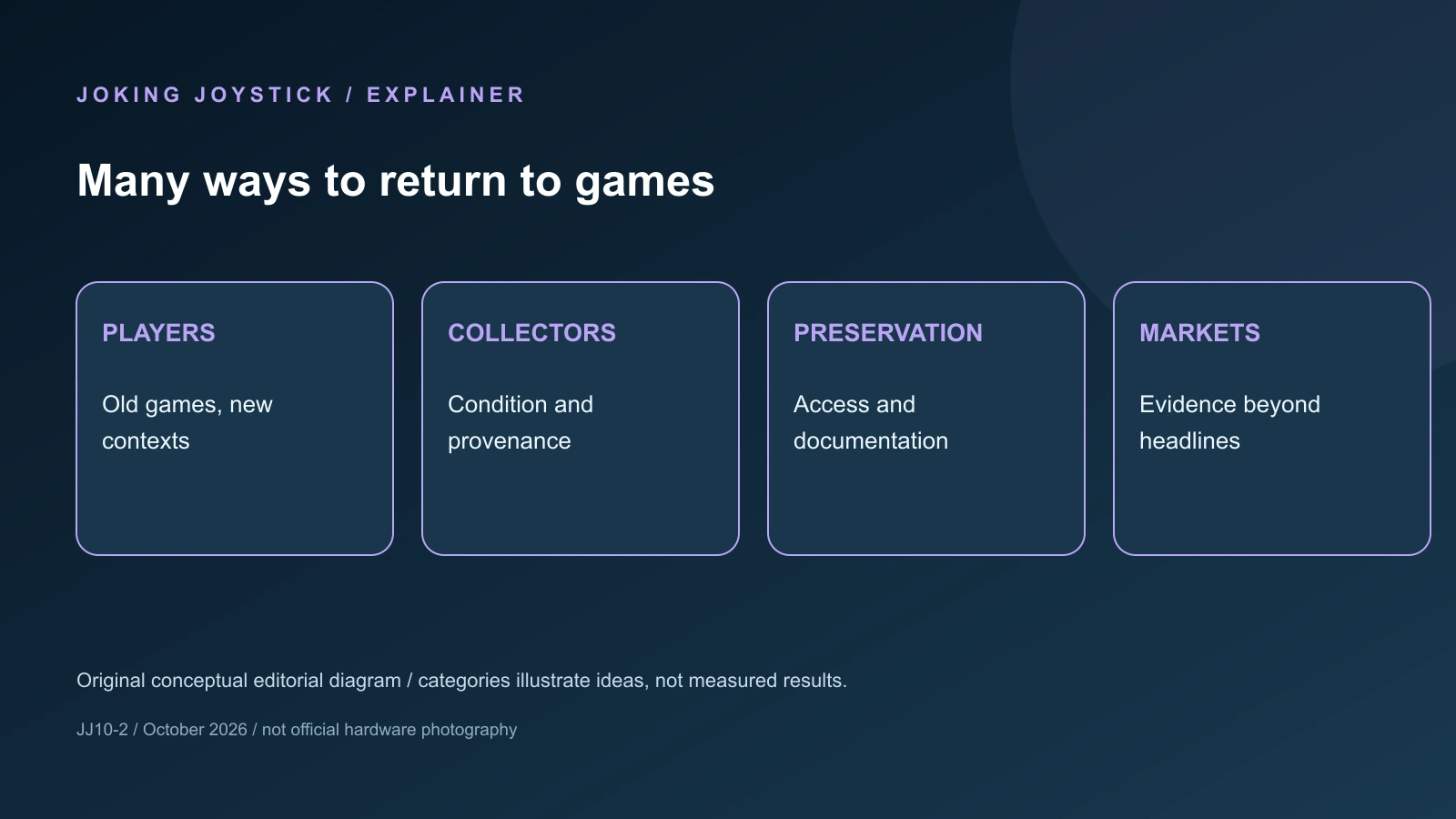
A preservation copy is a maintained representation of material intended to remain available for future study. Emulation is a technical method for recreating the behavior of one system on another. Migration is the movement or adaptation of data into a newer format or environment. Documentation records information about software, hardware, people, processes, and context. Public access is the set of conditions under which users can view, study, or play the material. These activities can support one another, but none is a synonym for the others.
An emulator can provide access without being the preserved game itself. It may recreate the behavior of a platform while relying on separately supplied media. MAME’s documentation and preservation goals support distinguishing the emulator, the supplied game material, and the historical hardware being documented. The emulator remains a new software layer, subject to its own revisions and limitations. A game image running through it may be playable while the original hardware, physical interfaces, and surrounding documentation remain separate preservation concerns.
Migration presents a different problem. Moving data from an obsolete medium into a current one can prevent immediate loss, but the new copy still needs identification, verification, metadata, and a plan for future interpretation. A file that survives without information about its origin, version, dependencies, or rights may become difficult to understand. Preservation is therefore not simply a matter of making a duplicate. It is also a matter of retaining the relationships that give the duplicate meaning.
Platform information can be essential to preservation because the Library of Congress guidance treats the proprietary platform or an emulated version as part of the relevant preservation problem when necessary. A game may therefore need to be understood in relation to the hardware and operating environment for which it was distributed. A modern reproduction may offer a practical route to use, but the cited guidance does not establish that it reproduces every original behavior. Without platform documentation, later researchers may have difficulty distinguishing the preserved software from the environment that originally supported it.
Operating-environment dependencies create a related problem. The Library of Congress identifies platform information and documentation as preservation concerns, which means that retaining a software file alone may not explain how it was intended to run. A current device may provide access through a different environment, but the available source packet does not support a detailed list of particular drivers, controllers, or peripheral behaviors for this feature. Those details should be added only when tied to a specific technical record.
Rights and access add a further layer. Institutional possession does not automatically create permission to distribute or display everything held. Archives may work under copyright rules, donor agreements, collection policies, technical safeguards, or other access conditions. A preserved item may therefore be available to researchers in a controlled setting rather than publicly playable on demand. This distinction concerns access policy, not evidence that the material lacks preservation value.
The Library of Congress’s videogame materials illustrate why preservation extends beyond software files. Games are held with packaging, documentation, magazines, and multiple media formats. Those surrounding objects can identify versions, explain reception, preserve advertising language, and show how the software was situated in a wider industry. They can also help researchers interpret a file whose original interface or distribution context has vanished.
There is a temptation to judge preservation by the simplest test: can someone play the game today? That test matters, but it measures present access rather than the survival of the complete historical record. A playable version may omit a regional release, a development build, an instruction manual, a peripheral, or an original display condition. Conversely, an archive may hold source code or documentation that cannot be released publicly but remains crucial to future research. Preservation does not promise universal convenience.
The more accurate goal is layered continuity. Software should be retained where possible, but so should the information needed to identify and interpret it. Hardware behavior, platform history, documentation, development material, packaging, and rights conditions all affect what future users can know. Replay is one successful outcome of that work, not its definition. A game can be preserved for study even when it is not publicly playable, and it can be playable in the present while much of its historical context has already been lost.
Archives preserve surrounding culture
Institutional and nonprofit archives expand the meaning of a game beyond the program that appears on a screen. Their collections can include code, tools, artwork, marketing, magazines, design documents, hardware records, interviews, and business material. This work matters to retro gaming because commercial catalogues usually present the past as a list of available titles. Archives can restore the relationships, omissions, and production circumstances that a storefront has no reason to show.
The Smithsonian’s account of the Preserving Virtual Worlds research project presents preservation as a problem of metadata, content representation, platform studies, code, operating systems, and emulation. Those categories point to a central difficulty: a game is not a detached cultural object that can be understood without its technical surroundings. Researchers need to know what a file contains, which platform it expects, how its components relate to one another, and what changes when it is moved into a new environment.
Metadata can be as important as the file itself. Preservation projects develop metadata and content-representation standards to identify digital artifacts and relate them to their historical context. Without such information, a preserved asset may survive but become hard to identify or compare. Metadata also helps distinguish a retail release from a prototype, a demonstration from a final build, or a later reissue from an original distribution object.
Platform studies add another perspective. They ask how a game’s technical foundation shapes what it can do and how it is experienced. Platform studies examine the relationship between a game’s technical foundation, operating environment, design and historical context. Preserving the game without preserving knowledge of the platform can erase part of the reason it took the form it did.
Code is valuable for related reasons, although the precise conclusions depend on what survives and how it is documented. The Smithsonian account places code and operating systems within preservation research, while the Video Game History Foundation identifies source-code preservation as part of its work. Those sources support treating source material as distinct from a finished executable. They do not establish that every recovered codebase reveals a particular development decision, unused feature, or team structure. Such claims require an artifact-level case study.
Development assets are another documented category in the Video Game History Foundation’s work. Their archival value depends on what the assets are, how they are identified, and what related records survive. The supplied sources support discussing development assets as material surrounding game production, but they do not establish that every raw art file, sound file, script, level file, or tool reveals a specific process or unused content. The feature should describe those materials as evidence requiring interpretation rather than as automatic explanations of how a game was made.
Marketing and other public-facing materials connect software to its circulation. The Library of Congress identifies packaging, documentation, and magazines among its videogame holdings, while the Video Game History Foundation describes archival and public-education work. These sources support treating such materials as evidence of how games were presented and discussed. They do not, without a specific case, prove an intended audience, competitive position, or complete account of a publisher’s historical claims. Those interpretations should remain qualified unless tied to a documented artifact or campaign.
The Library of Congress’s collections place games alongside packaging, documentation, magazines, and multiple media formats. That arrangement provides a practical example of archival context. Magazines, manuals, packaging and multiple media formats can provide contextual evidence whose significance depends on the individual artifact and its cataloging record. None of these materials replaces the game, but each can change how the game is interpreted.
The Video Game History Foundation describes a complementary range of work involving a research library, source-code preservation, development assets, archival collections, recovery projects, and public education. Recovery matters because historically valuable material may remain outside established public collections. Finding an item is only an early step. It must be identified, stabilized, described, and placed within an access policy before it can support sustained research.
Public education gives archival work a second effect. When a foundation, museum, or library explains how a game was made, marketed, or technically constrained, older software can become visible to people who would not have encountered it through a commercial catalogue. Context can create new reasons to study a game. A title may be understood as an example of a platform transition, a development practice, a regional market, a preservation problem, or a forgotten design experiment rather than simply an old product.
That increased visibility should not be confused with universal public access. Institutional holdings may be searchable without being downloadable. A collection may provide a reading room, appointment system, research copy, exhibit, or educational programme rather than unrestricted play. Rights, donor agreements, fragile media, technical dependencies, and staffing all affect what can be shown. The existence of an archive demonstrates preservation activity and research value; it does not guarantee that every item can be played by anyone.
Archives also preserve absence and uncertainty. A catalogue can record that a source-code recovery is incomplete, that a platform version has not been located, or that a box survives without its software. Such records prevent later writers from treating incomplete evidence as a complete history. They can also guide future work by identifying missing documentation, uncertain dates, alternate releases, and materials that deserve comparison.
This surrounding culture changes the meaning of retro revival. Official reissues make selected games easier to access, but archives can show what those selections leave out. Collectors preserve physical evidence, while institutional collections connect objects to production and distribution histories. Emulation projects document technical behavior, while platform research explains why that behavior matters. None of these activities is reducible to replay, sales, or display.
The result is not a single preservation system but an interlocking one. Code, operating systems, metadata, hardware information, magazines, development assets, tools, marketing, packaging, and playable versions answer different questions. Some materials support public discovery; others remain primarily research holdings. Together they make older games more legible as historical works. The archive’s contribution to the revival is therefore not merely to keep software available. It restores the evidence needed to understand what the software was, how it reached players, and why its history cannot be contained in a storefront listing.
Emulation is play technology and documentation
Emulation is often discussed as though it were simply a substitute console: choose a game, start it, and accept that a modern computer is standing in for older hardware. That description captures the user-facing result but not the preservation distinction. MAME describes its project as documenting and preserving hardware history through emulation work. For this feature, the supported point is that emulation provides a maintained technical representation of a platform; the exact behavior represented by any particular system or version requires separate technical documentation.
Arcade systems make the documentation problem especially visible because the historical object may include a machine, software media, controls, and other associated components. MAME’s stated purpose supports discussing the need to document hardware history, but the supplied pages do not establish a complete technical account of every arcade component or behavior. The feature should therefore avoid presenting a universal list of reproduced subsystems and instead emphasize that emulation projects may require continuing investigation of the platform being represented.
Output and input remain important questions, but they should not be turned into unsupported universal claims about every emulator. A preservation project may need to identify how the documented platform handled display, sound, controls, storage, or other components, yet the supplied MAME pages do not provide a case-level account of those mechanisms. The safe conclusion is narrower: preserving a platform may involve more than making a title launch, and claims about particular audiovisual or peripheral behavior require a primary technical source.
Versions also require identification. Historical software may exist in more than one release or data set, and an emulator project may document those variants separately. The supplied MAME material supports distinguishing the emulator from the original game media and recognizing documentation as part of preservation. It does not, by itself, establish a general catalog of regional builds, revisions, censorship changes, or hardware configurations. Those differences should be reported only when a specific project record or technical source documents them.
MAME is useful here because its stated purpose combines emulation with documentation and preservation of hardware history. That purpose places the project in a different category from a simple compatibility product. Its developers are not only trying to make a title launch. They are investigating and recording how machines worked, how their components interacted, and how software depended on those arrangements. A release such as MAME 0.289, listed on July 31, 2026, is therefore evidence of continuing maintenance and research. It is not a count of players, a sales figure, or a count of games preserved in a complete historical sense.
The distinction between emulator and game media is essential. MAME’s executable does not include the original ROMs or other game material. Those files are supplied separately by users, and their origin and permitted use depend on the relevant rights and circumstances. The existence of an emulator does not grant permission to obtain, copy, or distribute material that a user is not authorized to use. A technically available pathway and a lawful or documented source are separate questions.
That separation also clarifies what an emulator project can and cannot preserve. The emulator may preserve knowledge of hardware behavior, while a separately maintained software image preserves a particular release or data set. Documentation may identify the board, version, and dependencies. A museum or archive may hold physical media, a dump, source material, manuals, or photographs under access conditions that differ from those of an ordinary user. Preservation is distributed across these layers rather than contained in one executable.
Emulation is consequently an ongoing process rather than a declaration that a platform has been permanently solved. Developers may improve support for a peripheral, correct a timing model, identify a previously misunderstood chip, or distinguish one software version from another. Some systems are better documented than others. Some behaviors can be compared against surviving hardware or technical records; others remain uncertain. It is more accurate to describe an emulator as a maintained interpretation than as a perfect duplicate.
This does not make emulation historically inferior to original hardware. It changes the question being asked. A user seeking convenient access may value a stable interface, modern display support, save functions, or the ability to run several systems through one computer. A researcher may value the emulator’s source code, device models, version history, and explanatory documentation. A preservationist may care about whether the system’s dependencies and known behaviors have been recorded even when public play is restricted.
Emulation can also expose the difference between availability and preservation. A game that launches in a current environment is available for some form of play. That does not prove that its original build, regional variants, manual, cabinet, controller, display behavior, or distribution history survives. Conversely, an archive may preserve an image or technical record that is not made publicly playable. These outcomes are related but not interchangeable.
The continuing development of projects such as MAME matters because old hardware does not become automatically understood when commercial interest moves on. Documentation can improve, software versions can be reclassified, and previously obscure dependencies can become visible. Emulation is therefore both a play technology and a form of historical investigation. It opens a route to older software while reminding users that the route itself has been built through research, interpretation, supplied media, and ongoing revision.
FPGA hardware changes what “original” means
FPGA-based systems introduce a different way to reconstruct older platforms. Analogue’s documentation describes a developer-facing environment in which FPGA cores and bitstreams configure supported hardware functions. That terminology is sufficient for this feature’s comparison: it identifies a hardware platform for configurable digital designs without requiring a broader, unsourced definition of FPGA operation. The technical method is meaningful, but it does not settle the broader question of authenticity by itself.
Software emulation and FPGA-based recreation are different technical approaches with overlapping goals, but the supplied sources should not be used to make a complete architectural comparison. MAME documents an emulation project concerned with hardware history. Analogue’s OpenFPGA documentation describes cores, bitstreams, SD-card assets, and development workflows for configurable hardware. Both approaches involve engineering choices, versions, and incomplete historical information. Neither label, on its own, proves that a system reproduces every behavior of a historical machine.
Analogue’s OpenFPGA documentation makes the platform character of this work explicit. It describes development around cores, FPGA bitstreams, SD-card assets, and JTAG workflows. Those terms establish a developer-facing environment for creating, loading, and working with configurable hardware designs. The documentation does not require this feature to infer that every core has the same goals, accuracy, compatibility, or relationship to original hardware. The important point is that the modern device supports continuing technical work rather than representing a historically fixed product with no software layer.
That openness changes the meaning of the hardware product. The device is partly a platform for distributing and developing new configurations. Its history includes firmware, core revisions, documentation, and the decisions made by developers who target it. A user may value the ability to extend the system, while another may prefer a closed product with a selected library and fewer choices. Extensibility is therefore a feature with cultural consequences: it determines who can add interpretations of older machines and how those interpretations circulate.
Analogue’s Pocket support history reinforces the point. The company documents firmware updates, including Pocket firmware version 2.7 dated September 4, 2026, alongside manuals and other support resources. The existence of such updates does not establish that the device is identical to an original handheld, nor does it provide a measured claim about latency, compatibility, or accuracy. It does show that modern retro hardware remains an evolving software platform. Its behavior and capabilities can change through maintained system software, even though the physical device remains the same.
At the other end of the design spectrum, Atari’s 2600+ combines support for original 2600 and 7800 cartridges with modern HDMI output and officially described emulation software. That combination resists a simple classification. The cartridge is an original form of game media, but the machine reading it is a contemporary product. The display connection belongs to current equipment, and the system’s operation includes software components associated with emulation. It is neither merely a vintage console found unchanged nor merely a digital catalogue detached from physical media.
The useful question is what kind of continuity a person wants. One user may prioritize the original cartridge or card as an object and accept a modern reader as the practical route to play. Another may prioritize the behavior of the historical platform while using newly produced media. Someone else may want portability, HDMI output, a smaller device, community-developed cores, or a system that avoids maintaining an aging console. These priorities overlap, but they are not equivalent. “Original” can refer to the software object, the controller relationship, the machine’s logic, the display conditions, the physical ritual, or the surrounding context.
FPGA systems also show why accuracy claims require care. A core may model a platform in considerable detail, but a general statement that FPGA is identical to the original hardware would conceal questions about undocumented behavior, peripherals, video output, audio reproduction, firmware, and the particular core version involved. The technical method can reduce some kinds of abstraction while introducing others. Without controlled measurements or a clearly defined comparison, it is safer to describe the approach and its intended continuity than to announce a universal result.
Physical media support creates another distinction between access and preservation. A cartridge-compatible system can make an owned object useful with contemporary displays and connections. It does not necessarily preserve the original console, its power circuitry, its controller ports, its regional behavior, or the conditions in which players first encountered the software. Conversely, a system that uses a recreated or supplied software image may offer broad convenience without retaining the material history of a particular cartridge.
Firmware updates further complicate the idea of a permanent replacement. Analogue’s support pages establish that Pocket firmware is updateable and that the product has an ongoing support history. They do not, without a specific changelog, establish that an update adds a particular system, corrects a particular defect, revises an interface, or changes how software is loaded. The defensible conclusion is simply that the modern device has a maintained software layer whose versions belong to its own history and may matter to future documentation.
FPGA hardware therefore does not end the authenticity argument; it makes the categories more precise. It can be a reconstruction of logic, a reader for original media, a platform for community development, a modern display solution, or several of these at once. Its importance lies less in replacing one definition of the original than in revealing how many forms of continuity older games now receive. The question is not whether a device is simply real or fake. It is which layer of the past the device retains, which layer it reconstructs, and which layers it leaves elsewhere.
Modern play negotiates convenience and context
Older games may be easier to approach when documented features reduce some of the technical friction surrounding them. Atari’s 2600+ page, for example, documents HDMI output and cartridge compatibility, while Nintendo and PlayStation document subscription-based access to selected older software. These features can change the circumstances in which a game is encountered, but the cited sources do not establish universal effects on comfort, portability, or discovery.
Licensed subscription services provide one major route. Nintendo’s classic offerings are tied to an active membership, and its support information describes offline verification rather than permanent individual purchase through that service. The arrangement makes selected older games available within a continuing account relationship. It can lower the cost and effort of trying a title, while leaving access conditional on membership, platform support, and the service’s terms.
PlayStation’s Classics Catalog illustrates a related but more varied model. Its information distinguishes between downloads and streaming, with availability depending on country, plan, and time. Some older titles may be streaming-only, and titles can leave the catalogue. This creates a modern encounter that is licensed and convenient but not equivalent to ownership of a permanent copy. It also means that the catalogue’s current shape is a service decision rather than a comprehensive statement about which games deserve to survive.
Online functions can add specific access conditions around older software. Nintendo’s support information documents membership requirements and offline verification for its classic service, while PlayStation’s pages document streaming and membership conditions for applicable catalog titles. These features may support network-dependent access, but the cited pages do not establish the broader claim about cloud systems or every form of social use. Any discussion of multiplayer or other online functions should identify the particular product feature involved.
Modern displays and controllers create similar trade-offs. HDMI output can connect an older game to compatible modern displays, but the result need not reproduce the visual characteristics of the original display. A controller with a familiar button layout can make a game approachable, while a specialized peripheral, pressure response, light sensor, or physical control arrangement may be absent. The replacement solves a practical problem but can change the relationship between player and software.
Menus and downloads can shape discovery, but the cited service pages establish access terms rather than measured effects on player behavior. A catalog may present older games through a curated interface, and a download or streaming option may change how the software is reached. Features such as search, save functions, rewind, or suspension should be attributed to a specific platform or title before being used as evidence about modern play. The broader point remains that a current interface can differ from the assumptions of the original release.
Region is another source of difference. A service may offer a version with different language, censorship, title, content, or release timing from the one a player remembers. A modern system can make a game available while obscuring which regional build is being used. This is not necessarily a defect; different versions are legitimate parts of a game’s history. But the convenience of a single menu can conceal distinctions that collectors, archivists, and researchers consider significant.
Atari’s 2600+ demonstrates a hybrid form of modern play by pairing cartridge compatibility with HDMI and bundled software. It allows physical media and contemporary display equipment to coexist, while its officially described emulation software makes clear that the underlying platform is newly constructed. Analogue’s updateable systems similarly combine a modern device with firmware and, in the OpenFPGA environment, configurable cores and assets. These products do not restore every surrounding condition of historical play. They offer selected forms of continuity.
The spectrum runs from licensed access to reconstruction and archival reproduction. Licensed access places the player within a rights-holder’s current service or reissue. Reconstruction attempts to recreate a platform or its behavior through software, FPGA logic, or a new hardware design. Archival reproduction focuses on retaining and presenting a historical object or file with enough documentation to support study. One encounter can occupy more than one category, but no category should be treated as the universal definition of modern retro play.
Convenience can also affect social memory. A title that is easy to download may become more visible than an equally important game requiring obscure hardware or rights research. A bundled controller can suggest which form of play matters, while a streaming-only version can define access through network conditions. Modern systems do not simply reveal the past; they organize it. Their menus, compatibility choices, update policies, and omissions influence what new players regard as representative.
The result is a negotiation rather than a clean recovery. Modern play preserves some relationships, replaces others, and makes new ones possible. It can reconnect players with software while losing the original display, manuals, peripherals, regional setting, multiplayer conditions, or physical surroundings. That does not make the new encounter invalid. It means that its value should be described accurately: as convenient access, a technical reconstruction, an authorized reissue, a material replay environment, or a combination whose parts remain distinguishable.
A denser ecosystem, not one universal boom
The evidence assembled around retro gaming does not resolve into one measurement called “the revival.” It describes several activities that overlap without becoming interchangeable. People can play older games without collecting them, collect without playing, buy a reissue without joining a subscription, visit an archive without gaining public access to its holdings, or follow an auction without participating in the market. The apparent return of older games is therefore best examined as a change in infrastructure around them.
Broad participation data provides useful context but limited specificity. The Entertainment Software Association’s 2026 material reports 212.3 million U.S. people who play video games for at least one hour per week and an average player age of 37. Those figures indicate durable participation in games across a substantial adult population. They do not identify how many people are playing 8-bit, 16-bit, arcade, or early-3D software, nor whether older players are using original equipment, subscriptions, reissues, emulators, or modern recreations.
That missing distinction matters. A retro-specific player count would need a definition of retro, a geography, a time period, and a method for separating occasional exposure from regular play. Catalogue engagement figures would answer a different question from unit sales. Subscription retention would not equal ownership. Reissue sales would not reveal how often products are played. Without comparable measures, it is not possible to turn the many signs of activity into a single universal growth claim.
Official back catalogs nevertheless demonstrate industrial investment in selected older software. Nintendo’s membership-based classic libraries place historical platforms inside an ongoing service, while PlayStation presents a Classics Catalog whose contents and delivery methods can vary. Mini-consoles, licensed cartridge products, remasters, and other reissues turn historical software into current products. These programs increase availability and visibility, but they remain curated; the specific reasons for inclusion or omission are not established uniformly by the cited product pages.
Availability is not preservation. A catalogue may provide an easy route to a game while omitting its original manual, packaging, regional variants, development history, or platform dependencies. A reissue can be historically valuable as evidence of present-day selection while still narrowing the past to what can be licensed and marketed. The commercial return of a title tells us that a current institution has chosen to support it; it does not establish that omitted works are less important or that the entire historical library has been recovered.
Collectors contribute a different form of continuity. Packaging, manuals, regional variants, manufacturing differences, provenance, and related paper materials retain information that digital access often compresses or removes. A collection can preserve the material record of distribution and use even when the software is available elsewhere. It does not follow that every owner actively plays their collection, that every physical item is complete, or that possession guarantees a functioning route to play. Collecting is evidence of ownership and classification, not a proxy for a total population of players.
Auction headlines narrow the field further. Heritage Auctions’ reported sale of one sealed, graded Super Mario Bros. copy for $3 million on June 12, 2026 documents an exceptional transaction involving a specified object. It does not establish average prices, common-copy values, collector numbers, liquidity, or broad appreciation. Such a result shows how an unusually presented object can gather attention. It cannot stand for the behavior of everyone who owns, plays, studies, or remembers older games.
Preservation institutions answer still another question. The Library of Congress emphasizes source code, masters, distribution files, platform information, and documentation, while its videogame holdings include packaging, magazines, and multiple media formats. The Smithsonian’s preservation research treats metadata, platform studies, code, operating systems, and emulation as connected problems. The Video Game History Foundation describes source-code preservation, development assets, archival collections, recovery work, and public education. These activities show that a game’s history includes technical and cultural surroundings, not just the ability to launch a program.
MAME makes the same distinction from a different direction. Its continuing releases show maintenance of an emulator and documentation of hardware history, while its executable remains separate from the original game media. The project’s activity is evidence of technical and historical work, not a count of users or a guarantee that every associated title is preserved in full. A maintained emulator, a preserved software image, a documented cabinet, and a publicly playable game are related achievements with different boundaries.
Modern hardware adds another layer. Analogue documents updateable firmware and OpenFPGA support; Atari documents cartridge compatibility, HDMI output, and emulation software on the 2600+. Together, these examples show concrete additional routes by which older software can be used with current equipment. That is an editorial synthesis of documented product features, not a measured claim about demand, user numbers, or universal improvement.
Several important questions remain open. There is no single comprehensive count of retro-specific players across regions and platforms. Collector populations are difficult to measure because ownership ranges from casual retention to highly organized classification, much of it outside public records. Comparable global sales data for reissues is not consistently available across publishers, formats, territories, and access models. Subscription catalog engagement, emulation use, archival access, and modern hardware adoption likewise do not fit neatly into one public series.
“Rising again” is therefore most defensible as a description of denser support around older games. More routes now connect historical software with present players: licensed services, selected reissues, physical collections, auction narratives, archives, emulators, FPGA cores, and modern display hardware. Each route preserves or changes a different part of the past. The revival is not one universal boom and not one market event. It is an expanding set of encounters in which play, ownership, documentation, reconstruction, and preservation increasingly meet while remaining distinct.
Related reading and hardware searches
Check the exact item, edition, seller, compatibility, regional fit, price and availability before buying.
Affiliate disclosure: As an Amazon Associate, Joking Joystick earns from qualifying purchases. Search results do not guarantee stock or price.