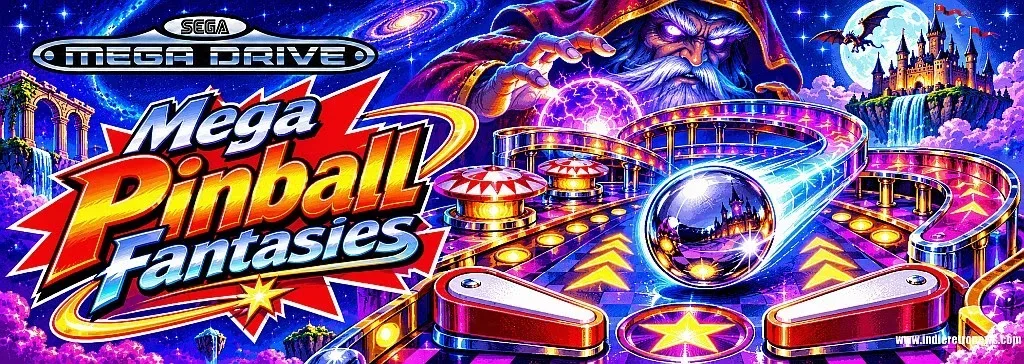
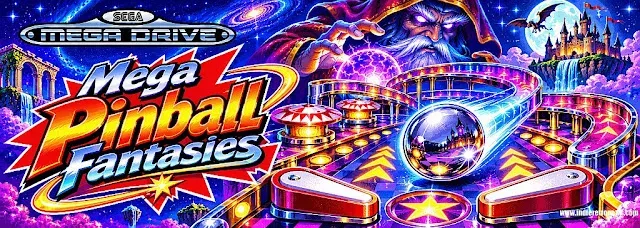
Mega Pinball Fantasies is in development for Sega Mega Drive hardware, with DavidGames recreating the 1992 pinball title originally made by Digital Illusions. The project began as a personal undertaking during pandemic lockdowns and has continued through years of research and development.
The stated goal is not to build a new pinball game merely inspired by an older favourite. Mega Pinball Fantasies is intended as a Mega Drive version of the original experience, complete with its four themed tables: Party Land, Speed Devils, Billion Dollar Gameshow, and Stones ’N Bones.
That makes the project especially notable for fans of the console. Pinball games live or die by how convincingly they communicate motion, timing, table logic and escalating objectives. Bringing a game associated with its 1992 release to Sega’s 16-bit machine is therefore a focused technical challenge as well as a piece of retro-game preservation-minded development.
Four very different tables are part of the plan
The four-table lineup is central to what Mega Pinball Fantasies is trying to preserve. Rather than framing pinball as one generic ruleset with a different coat of paint, each table has a distinct premise and atmosphere.
For more context, explore ‘Law & Order: SVU’ Reaches 600 Episodes by Looking Back at Benson and Stabler’s Unfinished History.
- Party Land uses a colourful amusement-park setting, placing the familiar pursuit of score within a bright carnival-style presentation.
- Speed Devils leans into racing and high-speed reflexes, making it the table most directly associated with rapid action.
- Billion Dollar Gameshow is built around the idea of a televised contest and enormous virtual cash prizes.
- Stones ’N Bones takes the collection in a darker direction, using an eerie supernatural-horror theme.
That thematic range matters in a pinball game. A table’s theme helps establish the personality of its scoring targets, feedback and on-screen progression, even when the player’s immediate tools remain the same: keep the ball alive, read the table, react quickly and build a higher score. The four environments also give players different visual and tonal breaks without departing from the game’s central pinball foundation.
Why a Mega Drive recreation is more than a change of platform
In this context, a port means adapting an existing game for different hardware. That does not automatically mean copying files or designs unchanged. Hardware platforms have their own technical boundaries and development methods, so a faithful port involves reproducing the important parts of a game’s play and presentation within the destination machine’s capabilities.
For a pinball simulator, that task is unusually visible. Players can immediately notice whether ball movement feels coherent, whether a table’s elements are readable at speed and whether the game communicates successful shots clearly enough to support repeat attempts. Even without changing the original table themes, a developer has to make a wide collection of decisions about how an older game should operate on the new system.
Related coverage includes Mega Pinball Fantasies Brings Four Classic Tables to Sega Mega Drive.
The announced project is positioned as a tribute to what the Mega Drive can do, rather than as a simple novelty conversion. Its appeal is consequently twofold: it offers another way to play a celebrated four-table pinball package, and it places that experience on a console whose identity is inseparable from the 16-bit era.
A project that grew from a personal effort
DavidGames began the work during the pandemic lockdown period as a personal project. The development has since involved years of research and work toward reproducing the game for the Mega Drive. That history gives Mega Pinball Fantasies a different character from a routine catalogue reissue: its premise is rooted in pursuing a specific technical and creative goal over an extended period.
It also helps explain why the emphasis is on the complete set of tables. A four-table pinball game is not simply four backgrounds attached to the same playfield. The intended recreation covers the amusement-park energy of Party Land, the racing focus of Speed Devils, the game-show spectacle of Billion Dollar Gameshow and the supernatural mood of Stones ’N Bones. Keeping all four together is important to preserving the breadth of the original package.
The project materials also state that no generative AI was used in the game’s development. That is a production disclosure rather than a description of gameplay, but it is part of how the developer is presenting the work: as a researched, hands-on recreation built for 16-bit hardware.
What pinball players should take from the announcement
The key attraction is the combination of familiar table design and a new hardware destination. Players drawn to score chasing will have four distinct themed spaces in which to pursue that loop. High-score chasing is the repeated effort to improve a recorded score by learning a game’s systems, controlling risk and extending a run; pinball is particularly well suited to it because every saved ball can turn into another scoring opportunity.
The table concepts suggest different flavours of that pursuit. Party Land offers a vivid amusement-park atmosphere, while Speed Devils foregrounds speed and reflexes. Billion Dollar Gameshow takes a prize-driven presentation, and Stones ’N Bones provides a more ominous alternative. The announcement does not detail scoring rules, modes, controls, release timing or distribution, so those elements remain unconfirmed.
For Mega Drive enthusiasts, the most practical point is that the game is being developed specifically to recreate this 1992 pinball experience on Sega’s hardware. It should not be mistaken for an announcement of a wholly original fifth table, a remake with newly described game modes, or a confirmed release date; none of those details have been established.
The larger retro appeal
Retro releases can serve several audiences at once. Some players want an opportunity to revisit a game or a genre through hardware they already love. Others are interested in the craft of seeing a specific game adapted to a different technical environment. Mega Pinball Fantasies has a clear place at that intersection.
Its four-table structure is also a sensible fit for repeat play. Pinball does not need a traditional campaign structure to produce longevity. Distinct tables, changing score goals and the ongoing struggle to avoid draining the ball can make a compact set of playfields compelling over many sessions. The announced themes ensure that the package is not visually or tonally one-note, spanning carnival colour, motorsport intensity, game-show excess and haunted imagery.
For now, Mega Pinball Fantasies is best understood as an in-development Mega Drive recreation with an ambitious scope: all four original tables, a long-running development story and a stated commitment to bringing the 1992 game’s experience to Sega’s 16-bit console. Details on when players will be able to get it, and in what form, have not been provided.