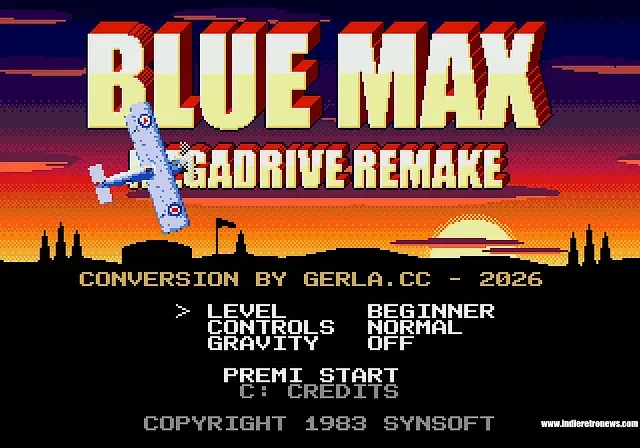
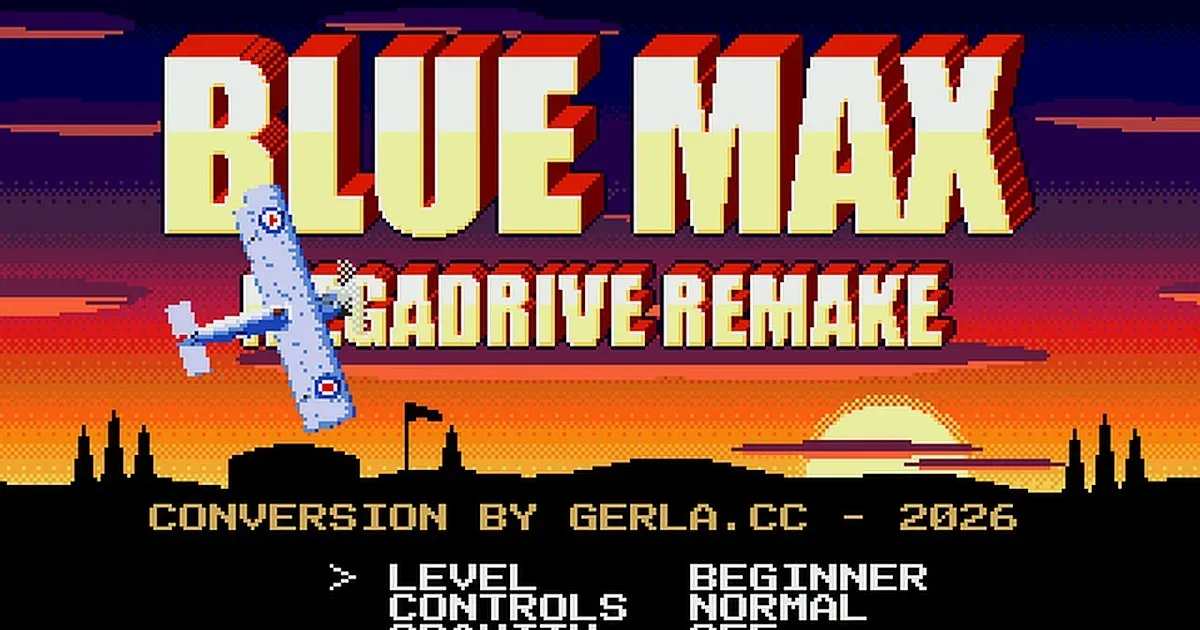
Blue Max: Megadrive Remake is a homebrew revival of a 1983 World War I flight game, rebuilt by developer gerla.cc for Sega Mega Drive and Genesis hardware. Its mission is not to turn the original’s biplane combat into a wholly different game: the project retains its defining loop of low-altitude bombing runs, aerial dogfights and risky visits to friendly airfields, while presenting that action through a new perspective and a technical overhaul designed around 60 frames per second.
The remake takes direct inspiration from Peter Adams’ Commodore 64 version of Bob Polin’s original Blue Max. Players pilot a classic biplane over terrain crossed by rivers, roads and bridges, pursuing enemy tanks, ships and buildings while also fighting hostile aircraft. The target is not simply destruction for its own sake. A rank progression frames the campaign, with the pilot beginning as a Kamikaze Trainee and aiming to earn the title of Blue Max.
A mission structure built around returning home
The central wrinkle in Blue Max: Megadrive Remake is that attacking targets is only part of the job. Bombing runs on the enemy city must be balanced against a return to friendly airfields. Those airfields provide fuel, repairs and ammunition, making them a practical part of flight planning rather than just scenery.
That creates a clear resource-management layer beneath the immediate flying. Ammunition limits how freely a player can engage targets and opposing aircraft. Damage affects the need to land for repairs. Fuel means lingering over hostile territory is not necessarily a winning move. Each successful pass can therefore make the next decision more complicated: press farther into the mission, or use an airfield to reset the aircraft’s supplies and condition.
For a game built around a relatively compact set of actions—fly, shoot, bomb, land—the airfield system gives terrain a purpose. Rivers, roads and bridges are not merely period-flavored map details when a pilot must navigate back to a safe landing area under pressure. The remake’s stated preservation of the original world and mechanics suggests that this rhythm remains fundamental to the new version.
What the Mega Drive rebuild changes
gerla.cc says the project has been rebuilt from the ground up to make use of Mega Drive and Genesis hardware. The headline technical target is a smooth 60 FPS presentation. Frames per second, often shortened to FPS, describes how many complete images a game displays each second. A 60 FPS target can make rapid screen movement and animation appear more fluid, an especially relevant goal for an action game where the player is steering an aircraft around moving ground targets and enemy planes.
The remake also introduces a fresh perspective and visuals rendered from 3D models. That wording matters: the game is presented as a Mega Drive/Genesis overhaul rather than a claim that the console is displaying modern polygonal 3D in the way later machines did. The supplied details identify 3D models as the basis for the visual rendering, without specifying the exact rendering process, camera angle or visual effects. What is clear is that the project is using those models to re-present the game’s aircraft and world while preserving its established combat premise.
This is a useful distinction for retro remakes. Faithfulness is not only about copying every visual choice or limitation of an earlier port. Here, it appears to mean maintaining the recognizable play structure—biplane sorties, ground attacks, rival aircraft and replenishment landings—while allowing a different visual viewpoint and smoother motion to change how that structure is read moment to moment.
Related coverage includes Blue Max: Megadrive Remake Rebuilds a 1983 Flight Classic for 60 FPS.
Difficulty and flight options could widen the runway
The remake offers three difficulty settings: Beginner, Advanced and Expert. No specific changes for each tier have been detailed, so it would be premature to assume they alter enemy behavior, damage, resources or scoring in any particular way. Their presence nevertheless gives players a straightforward way to choose an intended level of challenge before taking off.
There are also two significant flight customisation options. Players can toggle gravity on or off, and can select either Normal or Pilot control schemes. Flight physics refers to the rules a game uses to determine motion—how an aircraft responds to player input and environmental forces. In a stylized action flight game, those rules define the feel of turns, climbs, descents and recoveries as much as the plane sprite or mission map does.
A gravity toggle is an unusually direct option because it lets players decide whether gravity is part of the handling model. Switching between Normal and Pilot controls similarly signals that gerla.cc is making room for different comfort levels, though the specific input differences between those schemes have not been described. New players may value an easier path into an older design, while people familiar with the original can experiment with settings that better fit their preferred handling.
In practical terms, this flexibility may help the remake serve two audiences without pretending they want identical things. Someone drawn to the idea of a brisk Mega Drive aviation game can choose a more approachable configuration. Someone seeking a tougher, more deliberate run can move toward Expert difficulty and adjust the flight model accordingly. The important caveat is that the project’s available information does not establish which combination is closest to the Commodore 64 inspiration; it establishes choices, not a single definitive setting.
Homebrew gives an older platform a new assignment
Homebrew describes software independently created for a platform outside that platform’s original commercial release cycle. In this case, the term is meaningful because the game is being built specifically around the Mega Drive/Genesis, not merely presented as an old game being remembered. The project makes Sega’s 16-bit hardware the destination for a new interpretation of an earlier computer-era flight game.
That approach puts the focus on constraints and priorities rather than nostalgia alone. The developer is targeting 60 FPS, supplying multiple difficulty settings and exposing flight-physics options, all while retaining a game loop rooted in bombing, dogfighting, navigation and resupply. It is a design that keeps the original’s individual pressures intact: a player needs attack accuracy, situational awareness and enough discipline to get the biplane back to a friendly field.
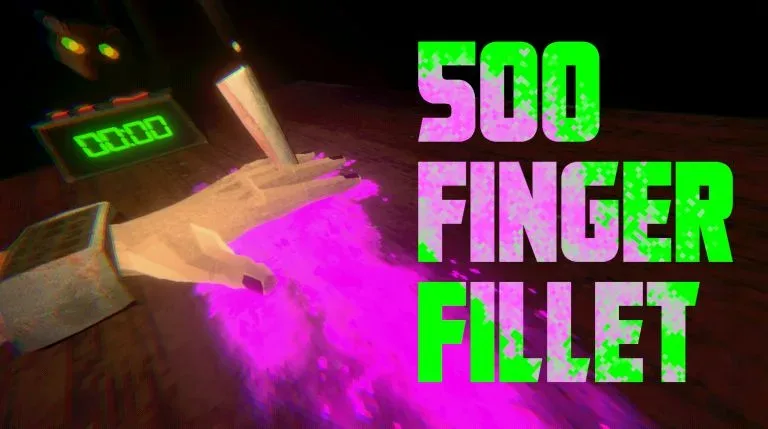
It also arrives at a time when unusual games continue to find an audience outside the biggest contemporary releases. For a very different example of a focused, high-concept game on PC, see this look at 500 Finger Fillet. The connection is not genre or platform, but the value of a clear central mechanical hook: Blue Max: Megadrive Remake is staking its identity on the tension between aggressive sorties and safe landings.
AI-assisted graphics disclosure
The project includes a specific disclosure concerning its graphics: AI was used for rotations of the 3D models. This is narrower than a general statement that every visual asset was AI-generated. Based on the information provided, the stated use applies to the rotational imagery associated with the models.
That disclosure gives players a concrete point of reference when considering the remake’s production approach. It does not, by itself, describe the tools involved, the models affected or the full workflow behind the game’s art. But it makes clear that AI-assisted work was part of producing the model rotations used in the project.
What is known—and what remains open
Blue Max: Megadrive Remake is defined by a fairly specific set of confirmed features: a ground-up Mega Drive/Genesis rebuild by gerla.cc; 60 FPS performance as a stated aim; a fresh perspective; visuals rendered from 3D models; Beginner, Advanced and Expert difficulty tiers; gravity on/off options; and Normal or Pilot controls. Its gameplay retains biplane missions involving enemy tanks, ships, buildings and aircraft, with friendly airfields needed for fuel, repairs and ammunition.
There are still plenty of unanswered details. The available material does not specify release timing, distribution, price, cartridge plans, compatible hardware revisions, the exact mechanics of the difficulty tiers, or how the two control schemes differ. It likewise does not provide a full feature list for the rank system or mission structure. For now, the strongest picture is of a carefully targeted homebrew remake: a World War I arcade-flight formula rebuilt for Sega’s 16-bit machine, where the road to Blue Max begins with a biplane, a payload and enough fuel to make the return trip.