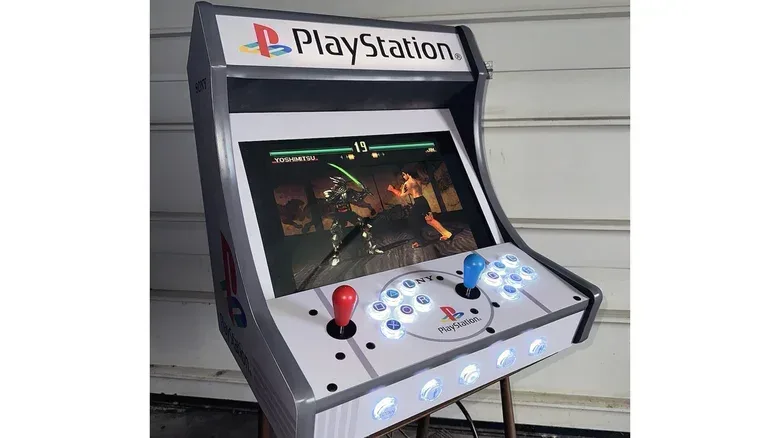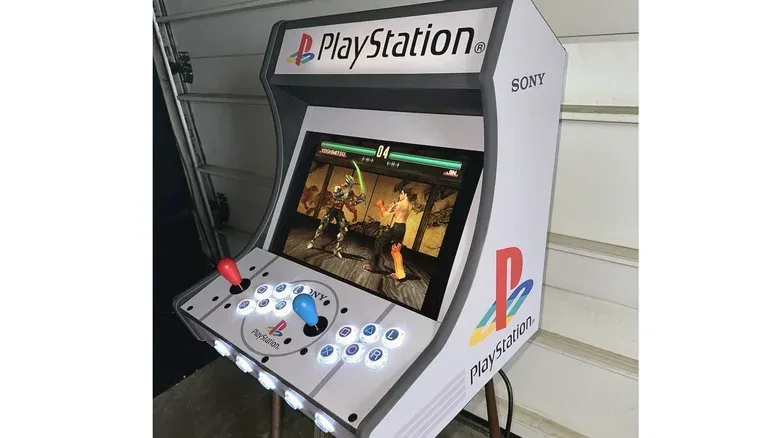
There is something immediately persuasive about a PlayStation-themed arcade cabinet. The gray shell, familiar button symbols and bright marquee invite an alternate-history question: what if Sony had put its first console in arcades as boldly as it put it in living rooms?
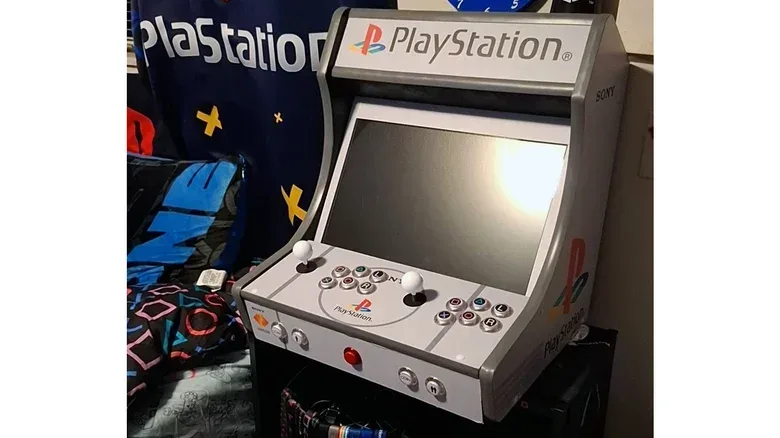
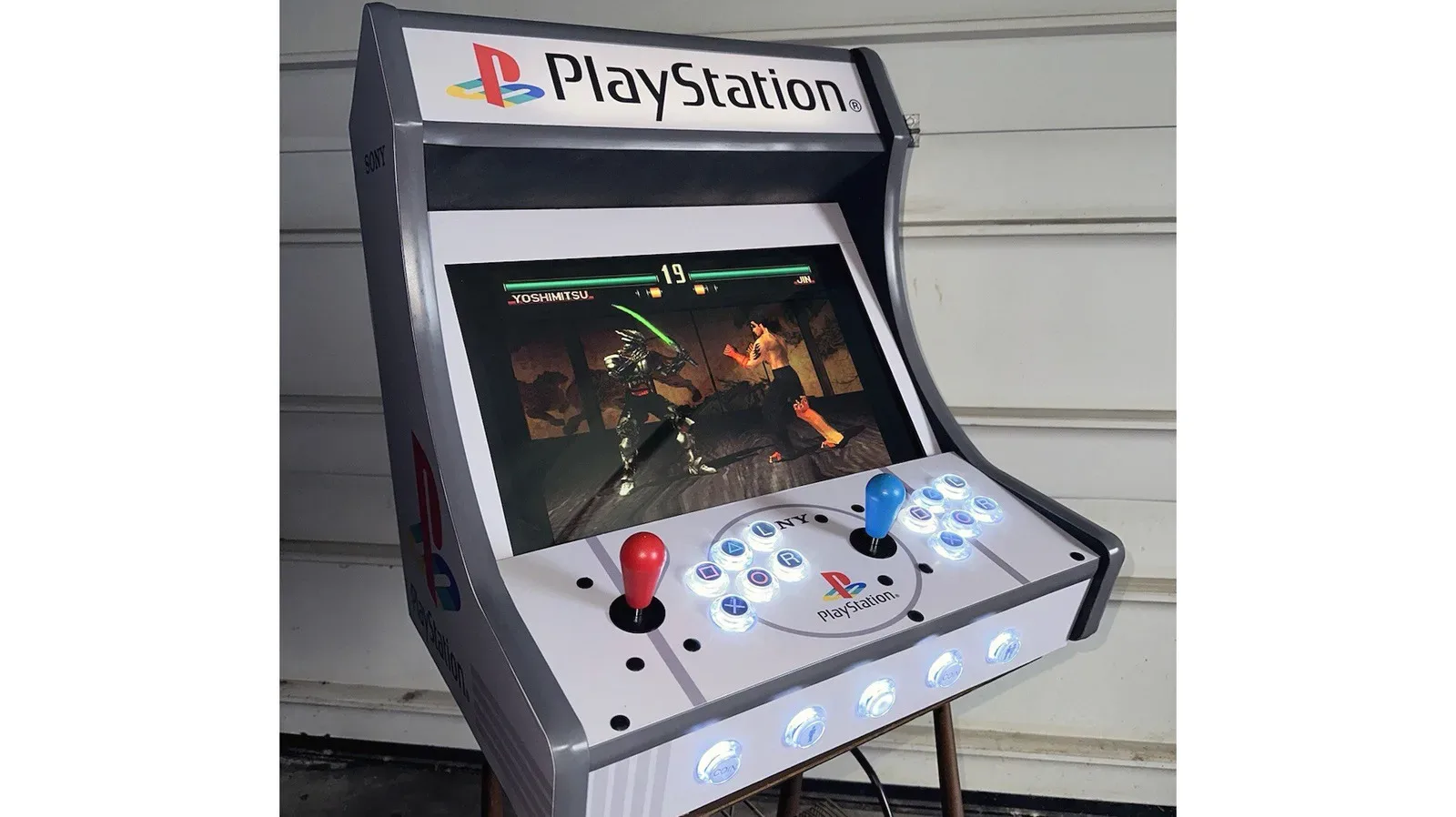
One fan-built machine leans all the way into that fantasy. It is dressed in PlayStation branding and built around a Raspberry Pi 4 running RetroPie, with a 19-inch LCD, LED lighting, two 4-inch speakers, and arcade-style joysticks and buttons. In photographs, the laminated vinyl artwork does much of the heavy lifting. It is an undeniably handsome object.
But it is also listed at $1,030, plus $120 shipping, before a possible $100 upgrade from 128GB to 512GB of storage. At that number, buyers should look past the skin-deep appeal and ask a much less romantic question: does an arcade cabinet actually make sense as a way to play PlayStation games?
The answer is not a simple no. It could be a fun display piece, and it may suit a focused selection of games extremely well. But as a broadly useful PlayStation machine, the cabinet’s fundamental design makes major compromises. Its biggest problem is not that it is expensive. It is that the arcade format does not match much of the library it is meant to celebrate.
The cabinet is not a PlayStation product
First, the obvious distinction matters. Despite the logos, this is not an official Sony machine. It is a hobbyist-built cabinet using a Raspberry Pi 4, a small computer that can run software designed for emulation. The software named for this build is RetroPie, an open-source package that groups emulators and related tools for Raspberry Pi-class hardware.
Emulation means software recreates the behavior of another system so games made for that system can run on different hardware. It can be a flexible way to preserve the experience of older platforms, but flexibility is not the same thing as authenticity—or convenience. A good emulation setup still depends on the display, controls, configuration and the game files used with it.
That is why a cabinet can contain capable-enough hardware yet remain an awkward way to access its intended games. The Raspberry Pi is only the computer inside the box. The enclosure and its controls dictate what playing feels like, and those choices are far more consequential here than the glowing PlayStation button art.
The control layout clashes with the console library
The original PlayStation controller was designed around a D-pad, four face buttons, four shoulder buttons, Select and Start. Later PlayStation pads added two analog sticks. A typical arcade panel, by contrast, is purpose-built for games played with a stick and a compact cluster of face buttons.
Related coverage includes This Fan-Made PlayStation Arcade Cabinet Looks Incredible, but Its Design Makes Little Sense.
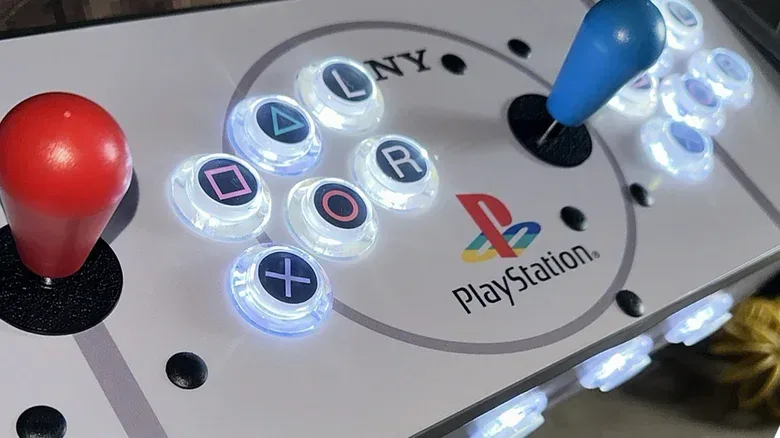
This cabinet provides one joystick and six action buttons for each player. That sounds generous if the mental image is a fighting game, but it does not reproduce the standard PlayStation controller. In particular, the missing shoulder-button arrangement and absent dual analog sticks are not minor omissions for a platform whose major releases were designed for a home console pad.
That mismatch has a practical result: the machine may be fine for games whose inputs naturally fit the panel, while being difficult or unsuitable for titles that need a fuller controller. Simple 2D platform games such as Mega Man, along with fighting series including Tekken, Street Fighter and Mortal Kombat, are the clearest candidates for an arcade presentation.
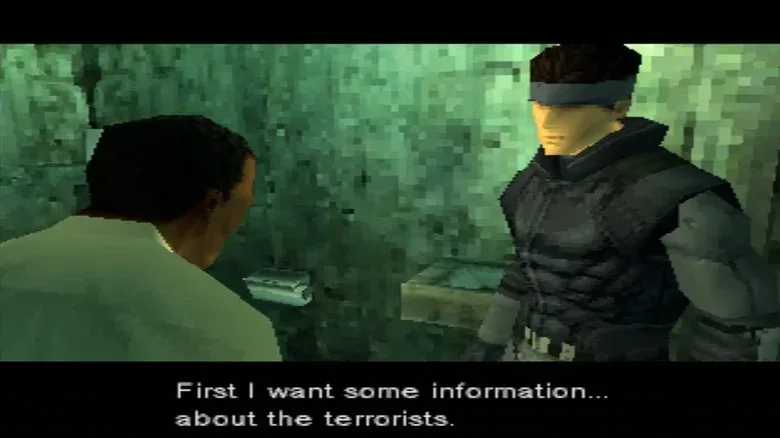
Games such as Metal Gear Solid and Resident Evil illustrate the other side of the problem. Their console-oriented controls do not neatly map to a single stick and six buttons. And that is before considering the many PlayStation games that benefited from—or expected—analog inputs.
A buyer can reasonably enjoy a cabinet built for a deliberately narrow playlist. The issue is the implied promise of a PlayStation arcade experience at large. PlayStation was a console ecosystem with games across 2D, 3D, fighting, adventure and lengthy role-playing genres. An arcade panel is not a universal controller for that ecosystem.
Arcade parts do not solve a console-control problem
The listing describes Sanwa-clone joysticks and buttons. That tells shoppers the parts are modeled after a recognizable arcade-control style, but it does not turn the layout into a PlayStation pad. Quality of switches and sticks may matter to players who prefer arcade controls, especially for fighting games. It cannot create buttons that are not present, nor can it make a standing cabinet naturally comfortable for every kind of console game.
This is a useful rule for retro hardware shopping: assess the input layout before admiring the parts list. A cabinet may have buttons that feel great while still being the wrong controller for the games under consideration.
A widescreen panel changes the picture
The display is the next important compromise. PlayStation games were made for 4:3 televisions, the near-square image shape associated with CRT sets of the era. The cabinet uses a widescreen LCD. When a 4:3 game is shown correctly on a widescreen panel, there will generally be unused space at the sides, commonly called pillarboxing.
Pillarboxing is not an error; it preserves the intended proportions. The worse alternative is stretching the image to fill the full screen, which makes characters, menus and environments look wider than they were designed to look. A machine can therefore fill its widescreen panel only by distorting the original image, unless its software offers another presentation approach.
There is also a difference between having an arcade-style screen and recreating a late-1990s PlayStation setup. The latter was usually a seated, controller-in-hand experience. The cabinet asks the player to stand in front of an LCD. That may be perfect for short rounds of Tekken. It is much less persuasive for a 40-hour Final Fantasy journey.
None of this says every retro game must be played in precisely its original physical conditions. It does mean buyers should separate aesthetic nostalgia from functional nostalgia. The cabinet resembles an imagined PlayStation arcade past. It does not necessarily reproduce how the games themselves were designed to be used.
“Thousands of games” raises support and legal questions
The seller promotes the cabinet as ready to plug in and play with thousands of games and no configuration required. That claim should invite careful scrutiny. Emulators are software, while ROMs are digital game copies and BIOS files are system software used to help reproduce a console’s behavior. Those elements carry legal and licensing questions that are not erased because a machine has been assembled inside a polished cabinet.
A retail product advertised with a vast, preloaded game catalog can be especially problematic when the seller is not the rights holder. Prospective owners should also think beyond the initial transaction. If a listing disappears or its contents become a point of dispute, obtaining support for a complex preconfigured machine could become harder.
The stated return policy adds financial friction. Returns are accepted, but the buyer pays return shipping and faces a 15% restocking fee. On a large cabinet with $120 outbound shipping, that is significant downside for anyone who discovers that the games they wanted most do not suit the controls or screen.
For a purchase at this level, the useful pre-order questions are basic:
- Which specific games does the buyer expect to play most often?
- Can each game’s needed buttons and analog inputs be used comfortably on this panel?
- Will the buyer accept 4:3 image presentation with side bars instead of a filled widescreen display?
- Is the cabinet mainly a playable decoration, or the primary way the buyer wants to play PlayStation games?
- Does the return policy remain acceptable once shipping and the restocking fee are considered?
Better fits depend on the actual goal
If the goal is playing PlayStation games with the controls those games expect, a Raspberry Pi or mini PC paired with an appropriate controller makes more sense than an arcade cabinet. It is likely to cost far less and preserves the basic seated, controller-led arrangement that much of the library assumes. For readers weighing compact-computer options, the wider performance context around mini PCs and PC gaming hardware is worth keeping in mind, although the key issue here is the controller rather than raw graphics power.
DuckStation is another emulator named as an option for compatible devices. The advantage of using a device a player already owns is straightforward: money goes toward the controller and display experience rather than a giant novelty enclosure.
For enthusiasts who want a hardware-oriented route, Retro Remake’s Superstation One is priced at $249 and uses an FPGA chip to recreate original PlayStation hardware behavior. FPGA, short for field-programmable gate array, refers to a chip that can be configured to reproduce hardware logic. That is a different approach from software emulation, though it does not make an arcade layout automatically appropriate for every PlayStation game.
And for people who specifically want an arcade cabinet, officially licensed Arcade1Up machines are presented as costing roughly half as much as this PlayStation-themed build. That format is naturally more convincing when it contains games made for arcade controls in the first place, including fighting games such as Street Fighter II and Mortal Kombat.
A conversation piece, not a complete PlayStation solution
The fan-built cabinet succeeds at its most superficial—and not insignificant—task: it makes people look. The PlayStation visual language is strong enough that a fictional arcade cabinet feels strangely plausible at a glance. That is the joke and the charm.
But a $1,030 conversation piece, plus shipping, needs to survive the conversation that follows. Its control panel excludes inputs fundamental to a large portion of the PlayStation catalog. Its widescreen LCD does not naturally match the 4:3 games it runs. Its standing arcade form is poorly suited to long console adventures. Finally, its preloaded-game marketing creates questions no buyer should ignore.
As a themed centerpiece for a game room, aimed at short sessions of select platformers and fighters, it has a coherent identity. As an all-purpose way to revisit PlayStation, it is a beautiful machine that asks buyers to pay premium money for avoidable compromises.
Shop the products
Check current price, model and availability at the retailer.