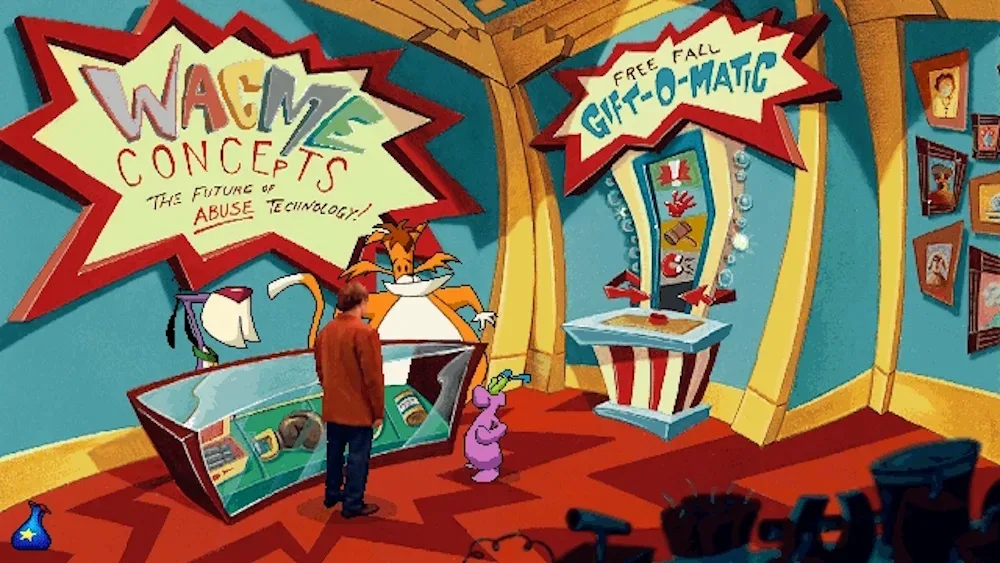
Toonstruck has reached its 30th anniversary, a useful occasion to revisit one of PC adventure gaming’s stranger accomplishments. Burst Studios’ only adventure game paired filmed performance from Christopher Lloyd with hand-drawn cartoon worlds, then asked players to navigate its absurd universe through traditional point-and-click puzzles. It arrived in 1996, in an era often associated with LucasArts and Sierra, yet it took a distinctly maximalist route: part cartoon parody, part fantasy quest, and part live-action technical experiment.
Its premise is purposely ridiculous, but not casual about its own weirdness. Lloyd plays Drew Blanc, a cartoonist stuck producing the sugary Fluffy Fluffy Bun Bun Show when his imagination is plainly focused on a much stranger creation: the purple, unruly Flux Wildly. Pressured by his boss to invent more bunnies, Blanc instead finds himself pulled through his television and deposited in Cutopia, a cartoon city. From there, the game sends him alongside Flux toward Zanydu and the Malevolands, where Count Nefarious is transforming cute things into evil versions of themselves.
The names tell players exactly what kind of game this is. Toonstruck does not merely include cartoon characters in a conventional adventure setting; it frames cartoon logic as the entire operating system of its world. Its humor, locations, villainy and puzzles are built around exaggerated animation traditions, making it feel less like a game that borrowed a cartoon look and more like a cartoon trying to contain a game.
A live-action actor inside a drawn world
The central visual idea is easy to describe and difficult to execute convincingly: live-action video, commonly abbreviated as FMV for “full-motion video,” is combined with hand-drawn animation. FMV refers to recorded moving footage included within a game, rather than visuals rendered in real time by the hardware. In Toonstruck, that means Lloyd’s filmed Drew Blanc has to inhabit environments and scenes populated by animated characters.
The results are not always seamless, but that imperfection is part of what makes the production memorable. The live-action/cartoon combination evokes the approach of Who Framed Roger Rabbit, another project featuring Lloyd. In the context of a 1996 adventure game, however, the effect was particularly unusual. Rather than using video just for cutscenes or an opening movie, Toonstruck makes its hybrid construction fundamental to its identity: Blanc is visibly an outsider in a world governed by ink-and-paint nonsense.
That setup also lets the game make Blanc’s creative frustration into its story engine. He is not simply transported to a magical kingdom. He is transported into the kind of feverish character-driven cartoon expression that his work life has denied him. Flux Wildly, the character Blanc wishes he could be drawing, becomes his guide and partner. The result is a knowingly meta premise: a creator is swallowed by the creative impulse he has been forced to suppress.
An exceptional cast carries the chaos
Christopher Lloyd’s presence gives the game an immediately recognizable lead, but Toonstruck is also remarkable for the depth of its voice cast. Dan Castellaneta voices Flux Wildly, while Tim Curry supplies the voice of Count Nefarious. The game additionally includes David Ogden Stiers, Dom DeLuise and Jeff Bennett in smaller roles.
That roster matters because the game’s whole proposition depends on personality. Point-and-click adventures can spend extended stretches on inventory combinations and dialogue exchanges. If the characters do not sustain the scene-to-scene experience, elaborate art alone will not carry the player through. Here, the vocal performances support a style that takes deliberately silly material seriously enough for the jokes and stakes to land.
The animation similarly draws from a broad cartoon vocabulary associated with early 20th-century work, with affectionate nods to the heightened, irreverent energy associated with Tex Avery as well as Disney’s more polished traditions. The game’s achievement is not that it commits to one cartoon aesthetic. It is that it treats conflicting cartoon sensibilities as fuel for its world. Cute things can be menacing, a place called Zanydu can be a homeland, and an evil count can make an entire region sound like a melodramatic gag.
Adventure-game puzzles, with the expected caveat
At its core, Toonstruck belongs to the point-and-click adventure tradition. Players explore screens, speak to characters, collect objects and use those objects in the right places to unlock progress. The form rewards observation, experimentation and an ability to follow the particular internal logic of its fictional world.
That last point is especially important with a cartoon-themed adventure. A puzzle’s solution may not be realistic in the everyday sense; it may instead follow a comic exaggeration, a visual joke or an intentionally ridiculous chain of cause and effect. When this works, the player feels like they are participating in the game’s animated logic rather than simply applying an item to an obstacle. When it does not, the genre’s old frustrations can emerge: a solution can seem obscure until the crucial connection is discovered.
The game is regarded as having strong puzzles overall, albeit with a few rough spots. That is a fair framing for anyone approaching it today. Players interested in a preservation-minded revisit should be ready for a 1990s adventure-game mindset, where progress can demand patient conversation review, careful examination of environments and a willingness to try unusual inventory combinations. It is not a fast-moving action game wearing a cartoon costume; its pleasures are in the scenes, the performances and the eventual click of a solution becoming clear.
Some material has aged badly
Celebrating an older game also means being candid about content that can make a modern return less comfortable. Toonstruck contains a moment in which Flux uses an ableist slur. It also includes an S&M-themed barnyard sequence that sits awkwardly beside much of the game’s cartoon tone. Neither element needs to define every aspect of the work, but prospective players should know they are present.
That tension is part of the reality of revisiting comedy from this period. The game’s broader personality is founded on anarchic cartoon excess, but excess does not automatically age gracefully. A contemporary player can appreciate the technical ambition, the cast and the creative design while also recognizing where its humor crosses into material that feels ill-judged or jarringly out of place.
A difficult production and a sequel that never arrived
Toonstruck was not the beginning of a long Burst Studios adventure-game catalogue. It was the studio’s only game in the genre. Its development was fraught, and although a sequel was intended, the original’s commercial failure meant that continuation did not arrive.
That makes the game’s survival in conversation more notable. Not every expensive-looking, celebrity-starring multimedia production from the CD-ROM era remained easy to access decades later. Toonstruck has endured because its concept is unusually specific. It is neither merely a showcase for filmed actors nor merely a conventional cartoon comedy. Its identity comes from the collision between those approaches, with a disaffected human artist walking through a world of aggressively animated nonsense.
It also offers a reminder that the history of adventure games is wider than the genre’s two most frequently invoked names. LucasArts and Sierra are rightly central to discussions of that period, while Westwood and Revolution also made their marks. But an outlier such as Toonstruck demonstrates how much experimentation occurred around the edges of the major studios: bold productions that did not necessarily become commercial hits, yet still left a distinctive creative footprint.
Playing it on modern PCs
Access is considerably less awkward now than it has been through much of the game’s lifetime. The game was once an uneasy fit for DOSBox and could refuse to cooperate with operating systems beyond Windows XP. The Steam version now uses ScummVM, allowing the game to boot cleanly without requiring players to manually navigate those older compatibility hurdles.
ScummVM is a modern compatibility engine associated with classic adventure games. In practical terms, its value here is simple: it helps older software designed around long-obsolete PC environments run on current systems. That kind of accessibility is a major part of preservation. A game cannot meaningfully remain part of the medium’s living history if playing it requires expertise in aging operating systems, legacy configurations and workarounds that many people will reasonably skip.
Compatibility and preservation claims around old software can often be muddled, so it is worth separating convenience from ownership and technical proof. For a wider look at how to assess platform and emulation assertions critically, see this examination of evidence behind console security and emulation claims. In Toonstruck’s case, the immediate practical benefit is that Steam buyers have ScummVM handling the game’s modern-PC launch process.
The listed Steam price is $20. That is a substantial ask for a three-decade-old game, particularly for players who judge older releases chiefly by their age rather than their rarity or scale. On the other hand, Toonstruck is approximately 10 hours long, a considerable length for an adventure game of its period, and its hand-drawn art, filmed lead performance and substantial voice cast make it an unusually elaborate package.
Why the anniversary matters
Thirty years on, Toonstruck remains easy to describe in one sentence and hard to replace in practice. It is a point-and-click adventure starring Christopher Lloyd as a cartoonist trapped inside a drawn universe alongside a purple character voiced by Dan Castellaneta, opposing a Tim Curry villain who is corrupting cute things. No other familiar game has quite that collection of ingredients, and its willingness to fully commit to them is its lasting strength.
Its legacy is not built on a sequel, a long-running franchise or broad commercial success. It rests on an eccentric execution of a big idea: mix a live performer with expressive animation, cast it extraordinarily well, and build an adventure around cartoon chaos rather than trying to sand that chaos down. The rougher puzzles and dated content remain part of the complete picture, but so does the ambition. For fans of classic PC adventures, Toonstruck is an important reminder that the genre’s most memorable experiments were not always its biggest hits.