Adventure games found an ideal partner in the Nintendo DS. The system could display related information across two screens, turn a stylus into a detective’s tool, or let players hold the machine like a paperback mystery. Its best adventure releases were not merely visual novels or puzzle collections: they made investigation, deduction and narrative discovery feel interactive. Nintendo’s own DS material described games such as Hotel Dusk: Room 215 and Another Code: Two Memories as adventures built around mystery-solving and touchscreen interaction.
This ranking weighs five qualities: the strength and momentum of the central mystery, the quality and fairness of its puzzles, how naturally it uses the touchscreen or dual screens, the originality of its structure, and how clearly it remains identifiable as an adventure game rather than a conventional role-playing or action title. Regional names matter here. Another Code: Two Memories is called Trace Memory in North America, while Professor Layton and the Lost Future is known as Professor Layton and the Unwound Future there. Last Window also has important regional limitations. The list favors games whose hardware ideas support the investigation instead of simply appearing as optional control gimmicks.
10. Time Hollow
Time Hollow begins with a wonderfully direct premise: the stylus can draw portals into the past, allowing events to be examined and altered. That idea gives the touchscreen a role beyond selecting dialogue or moving a cursor. The player is not simply reading about a mystery; the act of opening a portal becomes the means of investigating it. Nintendo’s European catalog classifies Time Hollow as both a puzzle and adventure game, making it a clear fit for this list rather than an inclusion based only on its visual style.
Its time-travel structure creates an appealing sense of cause and effect. Clues can be understood by looking backward, while the game’s multiple endings encourage attention to the consequences of intervention. Time Hollow is shorter and less mechanically broad than the games above it, and some of its puzzles are closer to story gates than fully developed logic challenges. Still, it is one of the DS’s clearest examples of hardware and premise reinforcing each other. It earns its place for making stylus interaction central to the fiction rather than decorative.
- Best for players who want a compact supernatural mystery with stylus-driven investigation.
- The multiple endings reward careful attention to how past events are changed.
9. Another Code: Two Memories
Released in North America as Trace Memory, Another Code: Two Memories is a compact mystery about Ashley Robbins searching for her missing father on Blood Edward Island. Its appeal comes from atmosphere as much as complexity. The island feels like a place layered with family history, old secrets and physical clues waiting to be connected. Nintendo’s official description emphasizes Ashley’s investigation and the use of the DS touchscreen to inspect and manipulate the environment.
The DS hardware supplies several memorable interactions. The two screens can present related information, while the touchscreen lets players examine objects and manipulate parts of the environment. Some puzzles ask the player to treat the system itself as part of the challenge, an approach that can feel inventive even when individual solutions are simple. The adventure is not especially long, and players seeking dense deduction may find its answers lightly signposted. It remains an important DS experience because it understands that a mystery game can make the act of looking feel tactile.
The original DS game should also be kept separate from Another Code: Recollection, the 2024 remake collection for Nintendo Switch. The remake changes presentation and structure, so a guide or comparison for the newer release should not be assumed to match the Nintendo DS version.
- Choose it for a short, atmospheric investigation rather than a huge campaign.
- Check the regional title before looking for guides or physical editions.
- Do not confuse the original DS adventure with the later Switch remake collection.
8. Professor Layton and the Spectre’s Call
Professor Layton and the Spectre’s Call, also known as Professor Layton and the Last Specter in North America, is a prequel about Layton’s first meeting with Luke. Its central mystery is built around a supposedly destructive spectre haunting the town of Misthallery, but the game’s real strength is how it layers the main case with optional diversions.
Nintendo’s official material describes more than 170 puzzles, alongside side activities that include managing a fish, assembling a miniature train and exploring the town for additional challenges. That breadth makes the game feel like a complete puzzle-adventure rather than a sequence of required riddles. The tradeoff is familiar to the series: the story often exists to carry the puzzle catalogue forward, and not every brainteaser has the same elegance. For players who enjoy a generous mixture of mystery, conversation and optional challenges, this is one of the DS’s fullest Layton packages.
It ranks below the stronger Layton entries because its mystery is less emotionally forceful and its optional content can make the campaign feel diffuse. Its value is breadth. Players who want a large collection of stylus-based challenges wrapped in an approachable supernatural case will find more to do here than in the shorter adventure games near the bottom of this ranking.
- Best for players who want a large puzzle count and substantial optional content.
- Its prequel status makes it a useful starting point for Layton’s relationship with Luke.
- Expect a broad puzzle-adventure package rather than a tightly focused detective story.
7. Ace Attorney Investigations: Miles Edgeworth
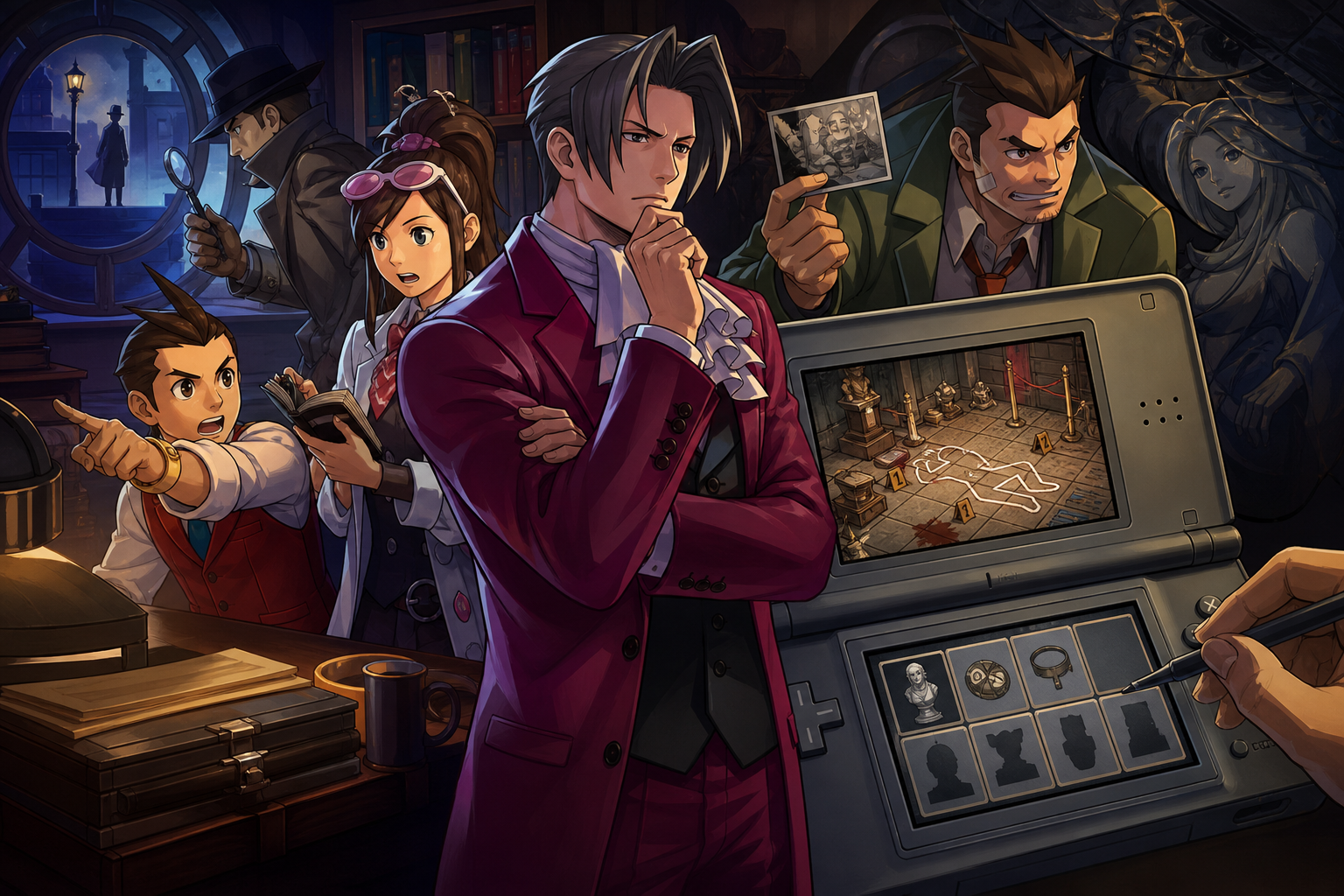
Ace Attorney Investigations changes the usual Ace Attorney rhythm by moving the action away from the courtroom. Miles Edgeworth examines crime scenes, questions witnesses and assembles chains of evidence while moving through locations from a more direct investigative perspective. The result is still strongly narrative-led, but the player’s job is to build a case before a trial can even become relevant. Capcom’s contemporary description specifically framed the game as a move from the courtroom to crime scenes, with players examining evidence and exposing contradictions.
The Logic system asks players to connect facts and expose contradictions, while the crime-scene format gives evidence collection a stronger physical presence than in a standard dialogue-heavy adventure. The game’s genre classification also supports its place here: the ESRB describes it as a puzzle-adventure game centered on investigating and solving crimes. It is less interested in touchscreen novelty than some DS exclusives, but that restraint helps the investigation structure remain readable.
Ace Attorney Investigations can feel linear, and its long conversations may not suit players looking for free-form exploration. It ranks here because it successfully translates a famous courtroom formula into a detective adventure with its own identity. It is the best choice on this list for players who want evidence chains and crime-scene reasoning without abandoning the series’ colorful character writing.
- Choose it for evidence chains, crime scenes and Edgeworth’s perspective.
- Do not approach it expecting the courtroom cadence of the original Ace Attorney games.
- Its DS release is distinct from the later Ace Attorney Investigations Collection.
6. Professor Layton and the Curious Village
Professor Layton and the Curious Village established the formula that made puzzle-adventure games one of the DS’s defining story genres. Layton and his apprentice Luke travel to St. Mystere to investigate the inheritance of the late Baron Reinhold, meeting eccentric residents and uncovering a mystery hidden beneath the village’s strange customs.
The campaign combines more than 135 puzzles with touchscreen input, optional hint coins and a steady flow of discoveries. Nintendo’s official listing presents the game as a mystery adventure with more than 135 puzzles, confirming that the puzzle count is part of the game’s documented identity rather than an inflated retrospective estimate. The puzzles range from logic and arithmetic to lateral-thinking problems, so the experience benefits from variety even when a particular challenge feels more like a brainteaser than a clue.
The story is deliberately approachable, with animated scenes and a theatrical cast that make progress feel rewarding. Later games expand the formula, but Curious Village deserves recognition for balancing a clean mystery structure with a puzzle system that made the DS feel like a portable puzzle book. It is the strongest introductory entry because its central case is easy to follow and its mechanics are established quickly.
- A strong entry point for players new to Professor Layton.
- Expect variety rather than a single consistent puzzle style.
- The mystery provides structure, but not every puzzle is directly tied to the investigation.
5. Nine Hours, Nine Persons, Nine Doors
Nine Hours, Nine Persons, Nine Doors, commonly abbreviated as 999, sits between visual novel, escape-room game and mystery adventure. Nine people are trapped aboard a sinking ship and forced to participate in a deadly game governed by numbered doors. The story unfolds through extended dialogue and branching decisions, but progress also depends on solving escape-room puzzles. The ESRB classifies the Nintendo DS release as an adventure game and describes its escape-focused puzzle structure, supporting its inclusion even though it is more text-heavy than a conventional point-and-click title.
That combination is the game’s major achievement. The puzzles are not merely interruptions between scenes: doors, rooms and objects reinforce the larger questions about identity, memory and trust. Different routes and endings encourage replay, while the narrative gradually changes the meaning of earlier information. Its presentation is more text-heavy than Hotel Dusk or Ghost Trick, and some puzzles can be uneven or dependent on careful item examination.
The original Nintendo DS release also has an important edition limitation. In North America, 999 was released for DS by Aksys, while later versions appeared on other platforms with changes and additions. A player comparing walkthroughs should identify the version first, because the DS presentation and later releases do not always handle navigation and route progression identically. Nevertheless, 999 demonstrates how a DS adventure can use branching structure to turn replay into investigation rather than simple repetition.
- Best for players who enjoy long-form mystery fiction and escape-room problem solving.
- Its branching routes are essential to understanding the full narrative.
- Confirm which release a guide covers before following route or puzzle instructions.
4. Professor Layton and the Lost Future
Professor Layton and the Lost Future, titled Professor Layton and the Unwound Future in North America, sends Layton and Luke into a mystery involving a future version of London. The time-travel premise gives the adventure a larger dramatic scale than Curious Village, while the investigation remains grounded in the series’ familiar pattern of conversations, exploration and stylus-solved puzzles.
With more than 165 puzzles and additional activities, it offers a substantial campaign without abandoning the approachable structure that made Layton popular. Nintendo’s official page identifies the game’s large puzzle catalogue and its time-travel mystery, while the regional title difference explains why North American and European guides use different names for the same DS release.
The time-travel story also gives the game a stronger sense of escalation: clues are not merely revealing who committed an isolated crime, but questioning how the characters’ choices shape the world around them. Some puzzles are tangential to the main mystery, as they are in other Layton games, but the larger emotional arc gives this entry extra momentum. It is the best Layton choice for players who want the formula paired with a more ambitious narrative.
Its ranking reflects the balance between puzzle variety and story momentum. The game does not reinvent the Layton structure, but it uses that structure confidently and gives the investigation a more dramatic destination than the earlier entries.
- Use the regional title when searching for manuals, guides or physical copies.
- The time-travel premise and dramatic stakes make it a good choice after Curious Village.
- The original DS game is separate from later Layton releases on other systems.
3. Last Window: The Secret of Cape West
Last Window: The Secret of Cape West follows Kyle Hyde through a Los Angeles apartment building in 1980. Developed by Cing, it presents its mystery as an interactive novel, with residents, private histories and apparently unrelated incidents gradually forming a larger picture. The vertical DS orientation reinforces the sense that the player is holding a paperback detective story. Nintendo’s contemporary material connected the game directly to Hotel Dusk and emphasized its film-noir mystery structure.
Investigation involves examining rooms, questioning neighbors and making decisions that can influence how conversations unfold. The chapter-based novel feature gives the game an unusual literary texture, while the building’s residents provide the kind of character-driven tension that distinguishes Cing’s work. Last Window is not a conventional action adventure, and its pacing depends heavily on reading and conversation.
It also did not receive a North American release. The game was released in Japan and Europe, with the European release arriving on September 17, 2010. That limitation is part of its place in DS history, not a reason to mistake it for a standard U.S. cartridge release. The European edition is therefore especially important to identify when discussing legitimate English-language access or regional compatibility.
Last Window ranks above the Layton and 999 entries because its investigation, setting and presentation are unusually unified. It asks for patience, but the reward is a mystery that feels shaped around the DS’s book-like form rather than merely adapted to it.
- Best for players who prefer noir atmosphere, dialogue and character secrets.
- The regional release history is essential: North American players will not find a standard local release.
- Its slow conversational pace is a defining feature, not a technical shortcoming to be worked around.
2. Hotel Dusk: Room 215
Hotel Dusk: Room 215 is Cing’s most immediately distinctive DS adventure. The system is held sideways like a book as former detective Kyle Hyde investigates a mysterious hotel and questions its residents. Hand-drawn character portraits, muted presentation and a carefully observed setting create a mood closer to a paperback noir novel than a conventional handheld game. Nintendo announced the European release for April 13, 2007 and specifically highlighted the vertical, book-like presentation and touchscreen controls.
The hotel works because each conversation feels like another door into the past. Hyde’s questions can build trust, expose lies or close off information, so interrogation is not simply a matter of selecting the most aggressive response. Touchscreen investigation supports the fiction without overwhelming it: rooms, objects and people become pieces of a slow-moving case. Nintendo’s coverage described the game as an interactive mystery novel, a useful distinction from a standard puzzle game.
Its pacing is patient, and players who want constant puzzle action may find the long conversations demanding. For everyone else, the restraint is the point. Hotel Dusk understands that an adventure can make atmosphere and human contradiction as important as formal puzzle mechanics. The dual-screen arrangement is not merely a visual novelty; it changes how the player holds and reads the game.
It narrowly misses the top position because its mechanical challenge is less consistently inventive than Ghost Trick’s. As a mystery novel brought to life through DS hardware, however, it remains one of the system’s most coherent and memorable designs.
- Choose it for noir writing, interrogation and a strong sense of place.
- The book-like orientation is central to the experience, not just a display gimmick.
- Expect a conversation-heavy adventure with a deliberately measured pace.
1. Ghost Trick: Phantom Detective
Ghost Trick: Phantom Detective is the Nintendo DS adventure that most completely unites story, animation and interaction. Created by Shu Takumi, the original creator of the Ace Attorney series, it follows a dead protagonist who can manipulate objects from the afterlife and attempt to prevent deaths. Nintendo’s announcement described Sissel as a spirit without his memories whose powers can alter events and save the living.
The investigation is supernatural, but its puzzles are concrete: move through a chain of objects, alter a scene and discover what is really happening. The game’s animated objects and characters make every solution feel like a small piece of theatre. The player is constantly learning how a room works, what each person intends and how a seemingly minor action can change the outcome.
Ghost Trick was released in Japan on June 19, 2010, followed by Western releases in January 2011. Nintendo announced the European launch for January 14, 2011, so those regional dates should not be collapsed into one universal release date.
Its inventive puzzles, memorable cast and escalating revelations make it the strongest overall DS adventure. The touchscreen is not used in isolation; it is part of a broader design in which the player watches, manipulates and reinterprets the same scene. That makes the hardware feel inseparable from the mystery. Ghost Trick earns the top spot because it turns every major story revelation into a new way of playing.
- Best for players who want a tightly authored supernatural mystery with animated puzzle solutions.
- Its object-based puzzles reward observing how an entire scene fits together, not just searching for one highlighted clue.
- Remember that the Japanese and Western DS releases arrived in different years.
The Nintendo DS remains unusually convincing as an adventure platform because its hardware supports the genre’s basic verbs: inspect, question, compare, draw, remember and decide. Hotel Dusk and Last Window use the sideways screen like a novel, Layton turns the stylus into a pencil, Ghost Trick makes objects part of a supernatural chain reaction, and 999 uses the system to connect branching fiction with escape-room spaces.
Regional naming and availability matter when revisiting these games. Trace Memory and Another Code: Two Memories refer to the same original adventure, while Lost Future and Unwound Future are regional names for one Layton entry. Last Window is especially difficult for North American players because it never received a standard release there. Some Layton downloadable puzzle services were also affected when Nintendo Wi-Fi Connection support ended on May 20, 2014, so older promotional descriptions should not be read as guarantees that every extra remains obtainable today.
Taken together, these games show why the DS produced such a distinctive adventure catalogue. Some are compact and experimental, others are sprawling puzzle collections, and several are effectively interactive novels. Their common thread is not a single formula but a willingness to make the console’s unusual shape part of the mystery.