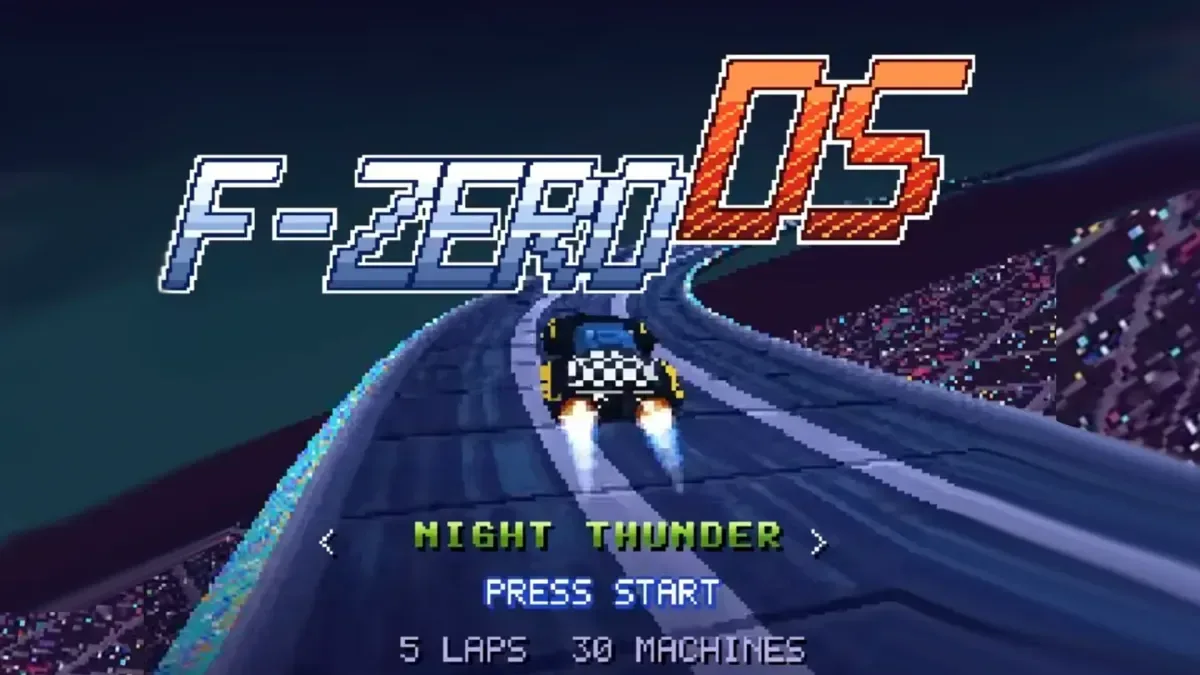
A fan-made F-Zero DS project is taking a particularly compelling approach to a question Nintendo never officially answered: what might the series have looked like if it had received a dedicated Nintendo DS entry? The work-in-progress prototype, being developed by Justin Prine as a one-person project, is designed to run on original DS hardware and uses the handheld’s two displays as part of the racing interface rather than as a superficial novelty.
At this stage, the project is explicitly a prototype, not a finished game or a confirmed release. Still, the available footage outlines a clear design direction: fast futuristic racing on the main display, paired with useful driving information on the touch-screen display. Prine has also outlined ambitions beyond the current build, including additional course themes, stock courses, peer-to-peer multiplayer for a web version, and a course editor inspired by the Nintendo 64DD.
A DS-native answer to an unrealized F-Zero idea
The premise behind F-Zero DS is straightforward but tantalizing. Rather than adapting an existing entry to another machine, the project is framed as a “what if” game: an attempt to imagine a version made around the Nintendo DS itself. That distinction matters. The DS was defined by its twin-screen layout, with the lower display also accepting stylus input. A game built around that hardware can distribute information and controls in ways a single-screen racer cannot.
F-Zero’s last major console installment cited in the project’s background is F-Zero GX, released for GameCube in 2003. The series’ long absence from that kind of full-scale console follow-up has left room for fans to picture alternate paths it could have taken. A DS installment is an especially natural one to imagine because racing games benefit from persistent information: track layouts, position, lap timing and rivals can all matter at a glance, even when a high-speed course demands the player’s full attention.
The prototype’s interface appears to turn that potential into its main organizing idea. The top display handles the race view, while the bottom screen houses an array of supplementary data. This is not merely a second place to repeat the same image. It aims to keep the core driving view clearer by moving status information away from the action.
What the prototype footage shows
The lower screen shown in the prototype includes a map, the player’s location, elapsed time and race rank. Crucially, it also incorporates a rear-facing view that functions much like a reverse mirror. In a high-speed racing game, that can help a player monitor pursuing machines without needing to obscure the forward route.
That rear display is one of the project’s most DS-specific ideas. Conventional racing interfaces often place a small mirror or rear-camera feed in a corner of the main screen. On the DS, separating that feed onto the second panel offers more room for it while leaving the forward driving view less crowded. Whether the final design proves comfortable in practice remains unknown, but the concept makes practical use of the hardware layout rather than simply displaying a static menu below the race.
Why separating race data can matter
In racing games, the HUD, short for heads-up display, is the on-screen layer that communicates information such as placement, timing and map position. The HUD must be readable quickly, but it also competes with the track itself for screen space. That tension is particularly important in a game modeled on F-Zero’s rapid, futuristic style, where track awareness is likely to be the priority.
Related coverage includes Fan-Made F-Zero DS Prototype Brings High-Speed Racing to Nintendo's Dual Screens.
A two-screen arrangement can reduce that conflict. The upper screen can emphasize the route ahead, while the lower screen becomes a dedicated dashboard. The player can consult the map or rank between moments of intense steering, rather than constantly parsing multiple small elements over the race view. The prototype’s use of a rear-facing feed follows the same principle: awareness of what is behind the vehicle is available without overtaking the forward perspective.
There is also a trade-off. Looking down at the lower screen takes attention away from the action above. The effectiveness of the final interface would therefore depend on the clarity of its icons, the frequency with which information must be checked, and whether the game’s handling gives players enough room to glance between displays. The footage establishes the intended structure, but a prototype cannot yet settle those usability questions.
Course selection and creation use both displays differently
The dual-screen concept extends beyond the races. Course selection is shown using the top screen for featured video material and the lower screen as the selection menu. That division gives the player a presentation area above and a navigation area below, mirroring how the DS could separate visual preview from direct input.
More ambitiously, Prine says a course maker is in development. The concept is described as 64DD-inspired, a reference to the Nintendo 64 Disk Drive peripheral. In this context, the phrase signals an editor-minded feature: giving users tools to create their own courses rather than limiting them to a fixed selection.
For a DS-oriented project, a track editor is an intuitive fit. The stylus offers a direct method of interacting with menus and arranging elements on the lower screen. The available details do not specify exactly how players will build or share courses, what objects the editor will contain, or whether creations will work on every planned version. Those are important unknowns. But the stated goal suggests the project is reaching beyond a small visual demonstration toward tools that could support player-made content.
Course creation can be especially meaningful for a futuristic racer because track design determines so much of the experience. Turns, hazards, elevation, width and visual theme all shape how a course reads at speed. An editor would let players explore those design choices themselves—provided the eventual feature is completed and made available.
Planned features remain plans, not promises
Prine has identified several areas intended for future development: more course themes, stock courses, the 64DD-style course maker and peer-to-peer multiplayer for a web version. The distinction between what is visible now and what is planned is important. The current public material demonstrates a prototype; it does not establish that every listed feature is complete, nor does it provide a timetable.
Peer-to-peer multiplayer generally refers to a connection model in which players connect directly with one another rather than relying exclusively on a central server to host the match. Here, it is specifically described for the web version. No further technical details have been provided about how it would work, how many players it would support, or when it might be playable.
Likewise, the project being capable of running on real DS hardware does not automatically answer how people may eventually access it, whether it will have multiple builds, or what hardware configurations will be supported. Retro and homebrew projects can have very different distribution and compatibility paths, so it is sensible to treat those questions as open until the developer provides firmer details.
Why original-hardware support is notable
Designing for original hardware gives the project a clear identity. The Nintendo DS is not simply a lower-powered screen arrangement; its dual displays, stylus input and physical form factor inform the layout being proposed here. A rear view, map and timing panel can feel more like a small racing dashboard when they occupy a separate screen beneath the main race.
At the same time, the project’s potential appeal is not limited to collectors with a working DS. The stated web-version multiplayer plan indicates broader ambitions, although the details are still limited. Interest in older platforms and their modern software ecosystems also continues to evolve; for related context, Azahar’s recent device-support change shows how quickly compatibility discussions can shift around retro-focused hardware.
That wider landscape does not guarantee an F-Zero DS release on any particular device or service. It does, however, underline why a project built around distinctive older hardware can attract attention: the DS remains a machine whose design is difficult to replicate with a single conventional display.
What to watch next
The most encouraging part of the prototype is that its key idea is already visible. F-Zero DS is not presented merely as a familiar racer with DS branding; it is trying to make the handheld’s two screens useful in races, menus and potentially track construction. The lower display’s map, rank, timing, position and rearward view form the project’s central pitch, while the planned editor points toward a more expansive version of that concept.
For now, the responsible expectation is modest: this is an in-development fan project with prototype footage, a solo developer and a list of stated goals. There is no release date or confirmed final feature list in the information available. But as a demonstration of how F-Zero could have been tailored to Nintendo’s dual-screen handheld, it offers a focused and promising interpretation of an avenue the official series never took.