For years, the idea of a Nintendo DS version of Halo has occupied a strange space between prototype lore and gaming’s collective false memory. Images and discussion of a DS demo circulated in the 2000s, leaving behind just enough evidence to make the project feel tantalisingly plausible but not enough to settle every question around it.
Now, Halo modder Steve Roth is working on a playable fan recreation built around what can be established about that elusive demo. Footage shared with YouTube creator Nostalgic Aubrey offers an early look at the project, which aims to reproduce the original concept’s look and dual-screen presentation rather than turn Halo into a wholly new DS game.
That distinction matters. This is not presented as a recovered official release or a newly confirmed commercial project. It is a reconstruction: an effort to use surviving descriptions, imagery and discussion around the demo to create a version that people can actually see in motion and, potentially, play in the future.
Why Halo DS became such a persistent mystery
The original story has never had a simple, single answer. n-Space said it had worked on a demo for a couple of months. Matt Casamassina had played the demo. Bungie’s position, meanwhile, was that it was likely something a development team intended to pitch, rather than an official release that had entered a full production pipeline.
Those accounts leave room for several interpretations, but they agree on the central point: something resembling a Halo pitch or demo for Nintendo DS existed. What remains unclear is how far the idea progressed, what formal status it had, and what a finished version might have included.
That uncertainty is exactly why the project endured. A playable build is easy to place in history: it has a release date, a final feature list and a retail box. A pitch, prototype or short-lived demo is harder to pin down. It can become a snapshot of an alternate route the industry might have taken—one that audiences saw just enough of to keep wondering about it.
The old Halo DS material also appeared to share visual and technical DNA with GoldenEye 007: Rogue Agent on DS. That led to speculation that the Halo material may have been a reskin or modification of that game. Roth’s work embraces the connection at the engine level, making it a practical foundation for a recreation while preserving the character of the rumored demo.
Built on the GoldenEye DS engine
Roth’s version uses the GoldenEye: Rogue Agent DS engine. In simple terms, a game engine is the technical framework that handles core functions such as rendering environments, accepting player input, drawing menus and running game logic. Reusing an existing engine is not merely a shortcut; in this case, it also aligns the fan project with the evidence and speculation surrounding the original Halo DS material.
Related coverage includes Halo DS Fan Project Recreates a Long-Rumored Demo.
The project has required work on recompiling the Rogue Agent material. Recompiling generally means taking software code or assets through a build process so they can become a functioning executable again. AI has been used to some extent in that recompilation process. The available information does not detail the precise scope of that use, so it should not be treated as a description of how the entire game was made. The more important point is that the playable recreation is being assembled through a combination of technical restoration work and Roth’s Halo modding experience.
Roth has added Halo 2 assets to create a working version. Assets are the usable pieces that populate a game: visual models, textures, interface elements and other content used to give a project its particular identity. Their presence helps the recreation read as Halo while it runs within an engine associated with a different DS shooter.
That combination also explains why the result should not be judged as though it were trying to match the original Xbox presentation. The top-screen graphics are understandably far removed from Halo as it appeared on Xbox hardware. The point of the recreation is fidelity to the DS demo’s apparent concept, not a miniature version of the console game with identical visual detail.
The DS screens are central to the recreation
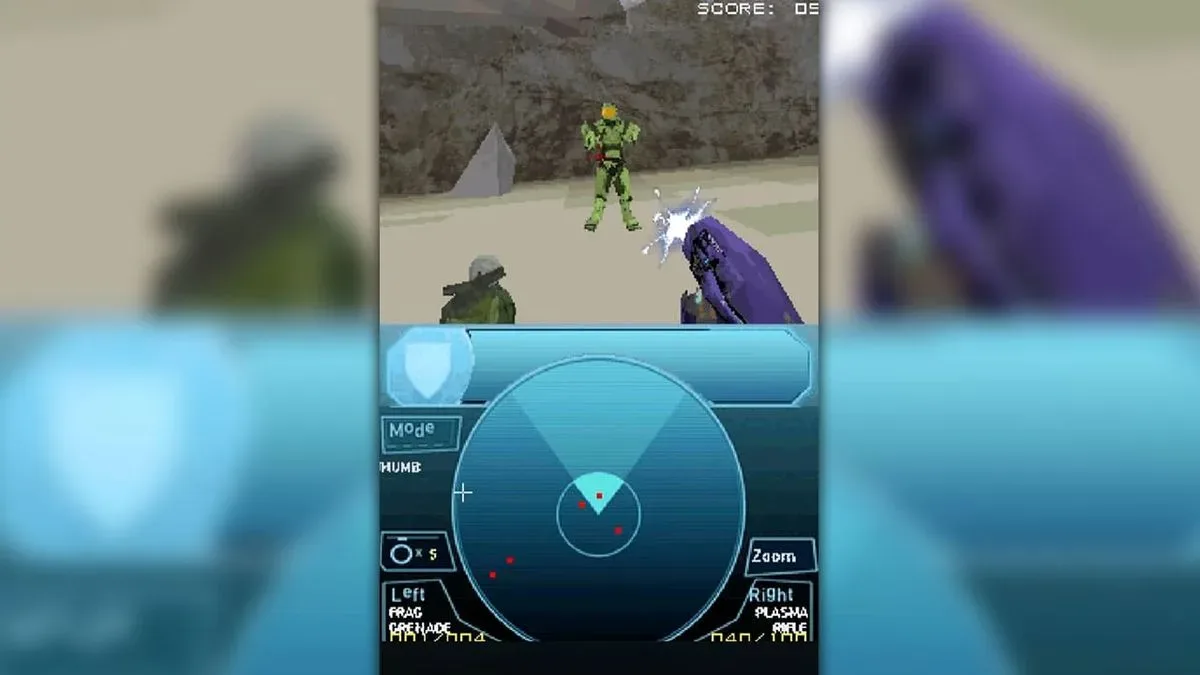
One of the clearest details in the footage is the use of the Nintendo DS’s second screen. The lower display functions as a motion tracker, echoing the role of Halo’s familiar radar-style awareness tool. It is also used to view weapons, statistics and menu choices.
That is more than a decorative callback. The original DS hardware was defined by the relationship between its two screens, with the lower panel serving as a touchscreen as well as a separate display. A first-person shooter designed around that format could divide information across the system rather than stack every indicator on the action screen.
For this Halo recreation, the arrangement keeps combat-facing information on the upper display while moving reference material and menu functions below. The practical implication is a presentation closer to the rumored demo than a conventional single-screen port would provide. It is also a reminder that adapting a game to a handheld is not only a question of reducing graphics. The interface, screen layout and control assumptions all have to change with the machine.
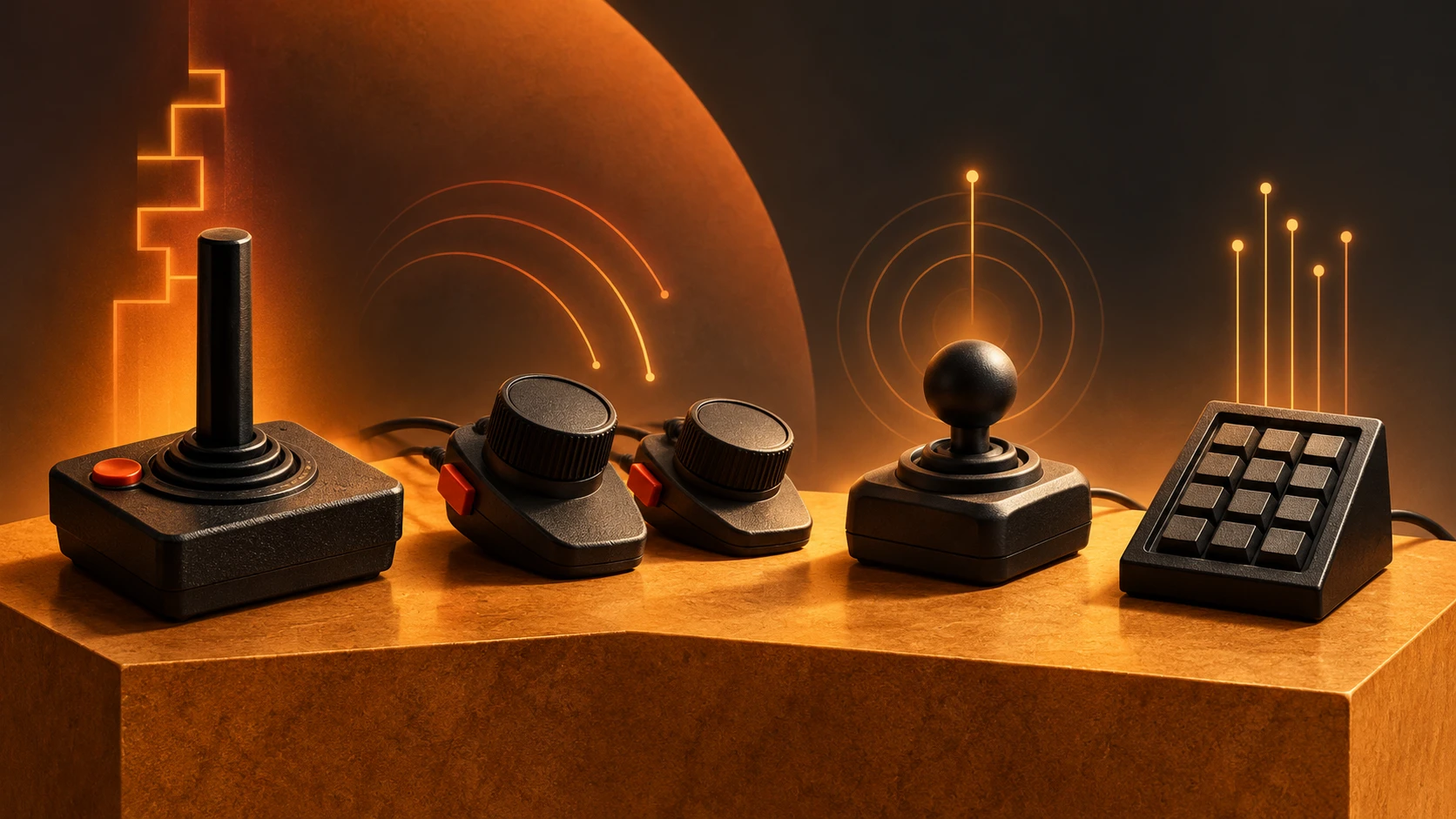
That broader relationship between hardware and play is part of why controller and interface design is worth preserving alongside software. The evolution from simple inputs to specialized layouts has repeatedly changed how games present information and actions; our look at Atari controller history traces an earlier chapter of that ongoing design story.
A reconstruction is not a recovered prototype
It is tempting to call every project involving an old rumor “preservation,” but that word needs care here. A recovered prototype is an original historical build: software made at the time by the people involved in the original effort. A reconstruction instead creates a new playable work from evidence about that earlier material.
Roth’s project belongs in the second category. Its value lies in interpretation and accessibility. It can demonstrate how the available clues fit together, show how Halo’s interface might have worked on DS, and make the abandoned concept easier to understand than a handful of old images ever could.
At the same time, it cannot resolve every historical unknown on its own. Any details not documented in the surviving material necessarily involve development choices made for the recreation. That does not undermine the project. It simply means players should approach it as an informed fan-made reconstruction, rather than definitive proof of every feature an original Halo DS game would have contained.
That line is particularly important for projects based on fragments. The closer a recreation appears to the remembered material, the easier it becomes for viewers to blur the distinction between “this is what survived” and “this is a thoughtful modern attempt to complete what survived.” Clear labeling protects the historical record while still allowing talented modders to bring an unfinished idea into playable form.
What has and has not been shown
The current footage is a meaningful milestone because it demonstrates a functioning version of the concept, including the distinctive bottom-screen utility. It gives the long-rumored demo a shape beyond old discussion and makes its technical premise easier to assess.
However, several practical details remain unknown. There is no stated completion date, no confirmed map count and no confirmed point when the public might be able to play it. There is likewise no basis yet to describe a final feature set, supported hardware or distribution plan.
- Known: Steve Roth is making a playable Halo DS fan recreation based on available information about the old demo.
- Known: It uses the GoldenEye: Rogue Agent DS engine and incorporates Halo 2 assets.
- Known: The lower DS screen is used for the motion tracker, weapons, statistics and menu selections.
- Unknown: When, or whether, a completed public version will be available.
- Unknown: How many maps or additional modes the final project may include.
Why this matters to Halo and DS fans
The appeal is not just novelty. Halo is closely associated with Xbox, while the DS was built around a radically different set of technical and interface constraints. Seeing those worlds meet—even through a fan reconstruction—offers a useful look at the compromises and creative choices a handheld adaptation might have required.
It also gives a second life to an idea that appears never to have reached a formal retail release. Gaming history is full of projects that were pitched, prototyped, reworked or quietly left behind. Most do not receive enough public material to inspire a recreation. Halo DS did, and the result is a rare opportunity to move from rumor into something concrete without pretending the unanswered questions no longer exist.
For now, the footage is the available evidence of progress. The project may yet remain a compact proof of concept, or it could develop into a larger playable recreation. Until Roth shares more, the sensible expectation is simply that a famously elusive corner of Halo history is being rebuilt with an unusually close eye on the DS demo people remember.