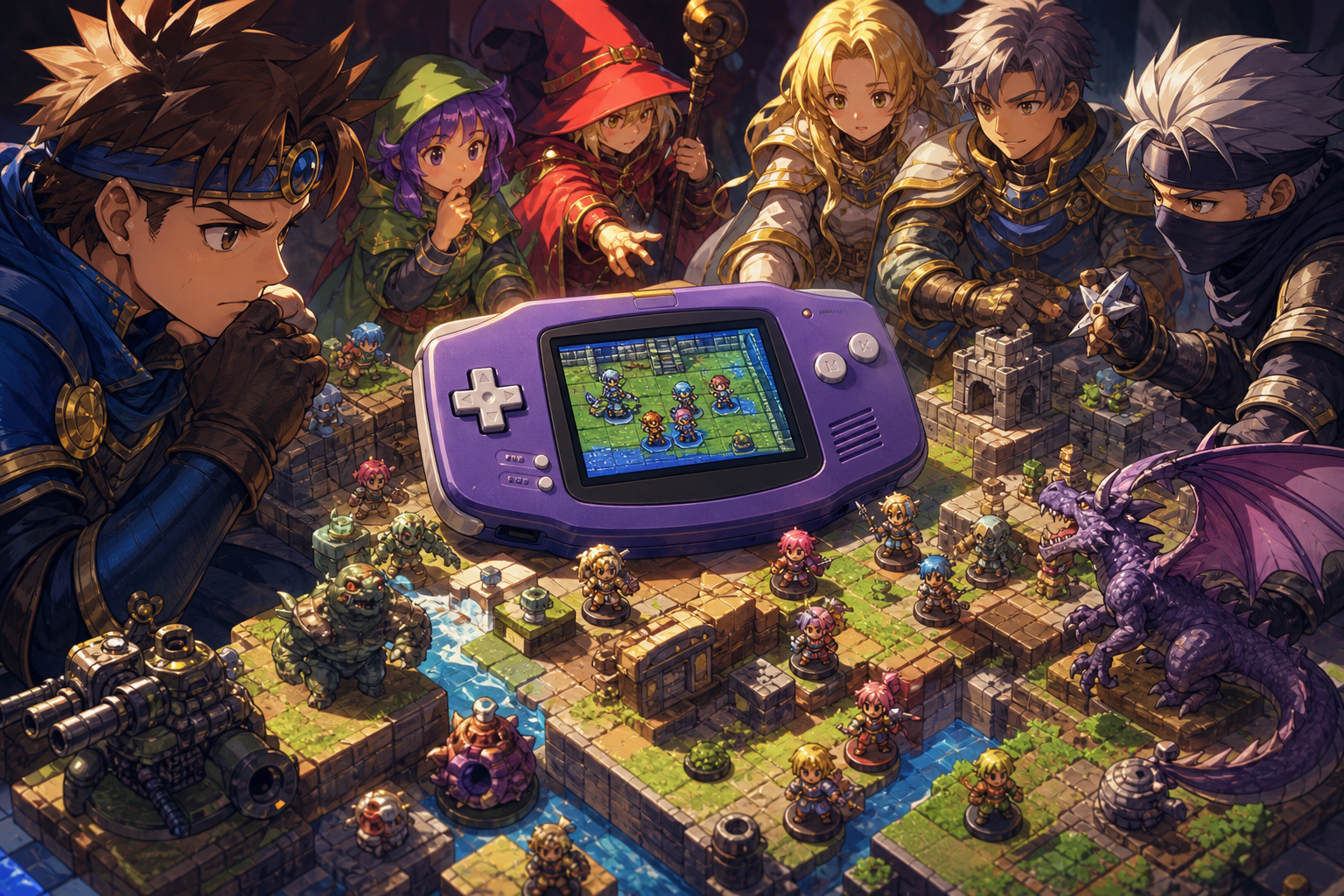
This ranking covers strategy games released for Nintendo Game Boy Advance, including turn-based military strategy, tactical role-playing games and real-time strategy. It does not count conventional role-playing games as strategy titles simply because they include equipment choices, party planning or difficult combat. That is why Final Fantasy I & II: Dawn of Souls and the Advance versions of Final Fantasy IV, V and VI are not included, while Final Fantasy Tactics Advance is eligible because its battles, classes and laws are built around tactical positioning.
The order weighs tactical depth first, followed by campaign variety, clarity of rules, replay value, accessibility and each game's distinctive use of the handheld. The list uses North American naming where relevant: the first localized Game Boy Advance Fire Emblem was released simply as Fire Emblem and is commonly distinguished from later entries as The Blazing Blade. Super Robot Taisen: Original Generation is included because it received a North American release, unlike many Japan-only games in the wider franchise. Advance Wars and its sequel are treated as separate games because their campaigns, commanders, units and map content differ.
10. Mech Platoon
Mech Platoon is the most unusual choice here because it attempts real-time strategy on hardware better known for turn-based battles. Players establish bases and laboratories, build robot units, improve their forces and fight over objectives while dealing with the pressure of an active battlefield. Salvaging enemy parts gives the campaign an extra layer beyond simply producing stronger machines.
That real-time structure creates its appeal and its main limitation. It offers a different rhythm from Advance Wars, but the small screen and handheld controls make simultaneous construction, movement and combat less immediately readable than a turn-based map. The campaign also lacks the broad strategic vocabulary of a full-sized PC strategy game. It belongs near the bottom because it is less polished as a complete strategy system, not because the experiment is uninteresting. Choose it if you want the GBA's strangest strategy concept and enjoy learning around interface restrictions.
- Best for players who want real-time battles, base building, salvage and mech construction.
- Tradeoff: less clarity and strategic breadth than the strongest turn-based entries.
9. Super Robot Taisen: Original Generation
Super Robot Taisen: Original Generation provides a mecha-focused tactical role-playing game without relying on the licensed anime crossover cast associated with much of the wider franchise. Its North American release uses original characters, pilots and machines, giving English-speaking players a more accessible route into the series' grid battles. Missions combine unit placement, weapon selection and character development with transforming robots and oversized attacks.
Its strongest appeal is the interaction between pilot growth and machine deployment. Players are not merely moving interchangeable pieces; they are assembling a force whose personalities and capabilities affect how a mission feels. The narrower setting can also be a limitation. Someone looking for the broad crossover fantasy of other Super Robot Taisen games may find this more self-contained presentation less exciting. It is a good fit for mecha fans who want character-driven tactics rather than a straightforward military simulation.
- Best for players drawn to original mecha, pilots and mission-based tactics.
- Tradeoff: its setting is more specialized than the fantasy and military games ranked higher.
8. Rebelstar: Tactical Command
Rebelstar: Tactical Command brings squad tactics closer to the action-point model associated with computer strategy games. Individual soldiers move, aim and attack within a shared tactical environment, so positioning and line of fire matter as much as choosing a weapon. A soldier who spends too many action points moving may be unable to respond later, while a careless advance can expose the squad to attacks from several directions.
That focus on individual operatives gives Rebelstar a different texture from games built around massed armies or fantasy classes. The battles ask players to think about cover, angles and turn economy rather than simply exploiting a unit counter. Its presentation and overall scope are more modest than the GBA's flagship strategy games, and the campaign does not offer the same breadth of long-term customization. Still, it is an excellent pick for players who prefer careful squad movement and tactical firefights over grand maps and production systems.
- Best for fans of action points, line-of-fire decisions, cover and small-unit tactics.
- Tradeoff: the campaign and presentation feel more limited than the leading entries.
7. Shining Force: Resurrection of the Dark Dragon
Shining Force: Resurrection of the Dark Dragon adapts the classic formula of town exploration, recruitable characters and grid-based battles for Game Boy Advance. Between fights, the party gathers information, visits settlements and expands its roster; on the battlefield, characters occupy clear roles shaped by weapons, spells and class progression. That structure makes it one of the friendliest introductions to tactical role-playing on the system.
The game is comparatively straightforward, which is both its strength and its weakness. New players can understand the map and party roles without first studying a dense web of systems, but experienced tacticians may find fewer competing priorities than in Tactics Ogre or Fire Emblem. The GBA version also adds story material, characters, cards and interface changes, so it should be treated as its own edition rather than an exact substitute for the Mega Drive original. Pick it for an approachable fantasy campaign with a strong sense of adventure between battles.
- Best for newcomers who want exploration and accessible grid combat.
- Tradeoff: tactical complexity is lighter than in the more demanding role-playing strategy games.
6. Final Fantasy Tactics Advance
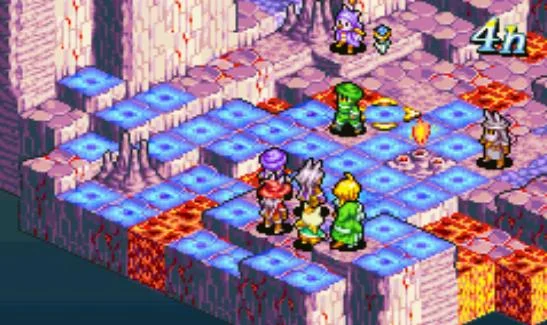
Final Fantasy Tactics Advance combines isometric battles with clan management, multiple playable races and a job system that encourages experimentation. Characters can learn abilities through equipment, change jobs and develop into specialized or hybrid roles. Because the clan grows over a campaign rather than simply gaining fixed levels, building a useful team becomes an ongoing strategic project.
Its defining feature is the Judgment system. Battle laws can restrict actions such as particular weapon types, spells or status effects, forcing players to rethink familiar plans. Those restrictions make otherwise routine encounters more distinctive and reward a flexible roster, but they can also feel arbitrary when a preferred tactic is suddenly unavailable. The game's colorful presentation and extensive customization support repeated experimentation, although its story and map structure are less severe than the mainline Fire Emblem games. It is the best choice here for players who enjoy job combinations and tactical problem-solving under changing rules.
- Best for job experimentation, clan building, multiple races and varied tactical constraints.
- Tradeoff: battle laws can frustrate players who prefer unrestricted solutions.
5. Fire Emblem: The Sacred Stones
Fire Emblem: The Sacred Stones gives the series a more flexible campaign structure than its predecessor. A world map connects story locations and optional battles, allowing players to train units, explore side content and decide when to pursue the main campaign. Branching class promotions also let certain characters develop along different paths, making roster planning less rigid.
That flexibility does not remove Fire Emblem's defining pressure. Units can be lost permanently, so a poor decision may affect the rest of the campaign rather than merely costing a turn. Named characters, support relationships and weapon advantages make every deployment personal, while optional encounters can help a struggling army recover. The freedom to train and choose promotions makes Sacred Stones more welcoming than the harsher entries, but it can also reduce the intensity for veterans who prefer strict resource pressure. It is the strongest GBA Fire Emblem for players who want room to experiment.
- Best for players who want character-driven tactics with optional battles and branching classes.
- Tradeoff: its flexibility can soften the tension created by permanent loss.
4. Tactics Ogre: The Knight of Lodis
Tactics Ogre: The Knight of Lodis is the densest campaign on this list. Its squad battles support extensive class experimentation, while story decisions and alignment-related systems give the wider campaign consequences beyond winning individual maps. Quest content and a versus mode add reasons to keep exploring the system after the main sequence of battles has taught its basic rules.
The depth comes with a cost. Class requirements, equipment decisions and unit development can make the game feel opaque until its systems become familiar, and its combat-heavy structure leaves less room for the town exploration found in Shining Force. Players who enjoy building squads around specialized roles will find plenty to consider, while newcomers may need patience before their decisions feel intentional rather than accidental. Original Game Boy Advance link and multiplayer features are part of its historical identity, though modern play environments may not reproduce every original connection option. Choose it for the most elaborate campaign decision-making in the ranking.
- Best for players who want class depth, alignment choices and a substantial tactical campaign.
- Tradeoff: its systems are less immediately welcoming than Advance Wars or Shining Force.
3. Advance Wars 2: Black Hole Rising
Advance Wars 2: Black Hole Rising expands the first game's clean military framework with new commanding officers, additional campaigns and a larger strategic playground. Ground, air and naval units still depend on terrain, fuel, range, production and capture objectives, but the sequel gives commanders more distinctive powers and asks players to account for their effects when planning an attack. New units such as the Neotank and long-range missile silos further broaden the available solutions.
The result is a broad and replayable package. Missions can reward careful captures, clever production choices or the efficient use of a commanding officer's power, while multiplayer and map-creation tools extend the formula beyond the campaign. It ranks just below the original because its added systems and scenarios are not always as immediately elegant as the first game's introduction. That is a minor complaint against a game with more variety, not a sign that it lacks depth. Pick it when you already understand Advance Wars and want a larger set of strategic problems.
- Best for players who want more commanders, scenarios, units and map-making variety.
- Tradeoff: the added breadth is slightly less clean as a first introduction.
2. Fire Emblem: The Blazing Blade
Released in North America simply as Fire Emblem, The Blazing Blade is one of the GBA's most effective examples of character-driven tactical design. The weapon triangle makes matchup planning legible, but victory still depends on movement, terrain, map objectives and the different strengths of named units. Support conversations deepen relationships and can improve battlefield cooperation without reducing the roster to anonymous statistics.
Permanent character loss gives every attack a serious cost. A risky advance may secure an objective but leave a valued unit exposed, while a cautious formation can preserve the army at the expense of time or position. That pressure makes the campaign memorable, although players who dislike restarting after a mistake may find it demanding. Its tutorial structure and strong cast make it a better entry point than the system's reputation suggests. Choose it for the best balance of approachable rules, emotional investment and meaningful battlefield consequences.
- Best for named characters, permanent loss, weapon matchups and focused map design.
- Tradeoff: mistakes can force difficult decisions about whether to continue or restart.
1. Advance Wars
Advance Wars earns the top position through exceptional clarity. Its turn-based maps reduce military strategy to readable interactions among terrain, movement, production, capture objectives and unit counters. Infantry take cities, tanks pressure ground forces, aircraft threaten exposed targets and naval units control particular spaces; none of these rules is difficult to understand, but their interaction produces difficult decisions.
Commanding officer powers add personality without obscuring the underlying system, while the campaign, training, challenge and multiplayer structures provide a steady supply of different tactical questions. Units are generally expendable resources rather than permanent characters, so failure encourages analysis instead of emotional roster protection. That distinction makes Advance Wars a useful companion to Fire Emblem: one asks how to preserve a team, while the other asks when sacrificing a unit creates the best position.
Its replay value comes from optimization. A map that seems solved can reveal better capture orders, production priorities or timing on a second attempt. The military theme is more abstract than a simulation, and players seeking deep character stories should look elsewhere, but as a handheld strategy game it is unusually teachable, flexible and rewarding. It remains the best starting point and the strongest all-round choice on the GBA.
- Best for clear rules, terrain puzzles, unit counters and repeatable map optimization.
- Tradeoff: its abstract military cast offers less character development than the tactical role-playing games.
The right choice depends on what kind of decisions you want to make. Start with Advance Wars for elegant military puzzles, Fire Emblem for the pressure of protecting named units, Tactics Ogre for dense campaign systems, or Final Fantasy Tactics Advance for job experimentation. Shining Force offers a gentler fantasy route, while Rebelstar and Mech Platoon provide more specialized squad and real-time alternatives.
The important distinction is not whether a game contains battles; nearly every role-playing game does. These ten qualify because positioning, production, class design, action points, objectives or campaign choices are central to how they are played. That variety is what makes the Game Boy Advance strategy library unusually strong for a handheld system.