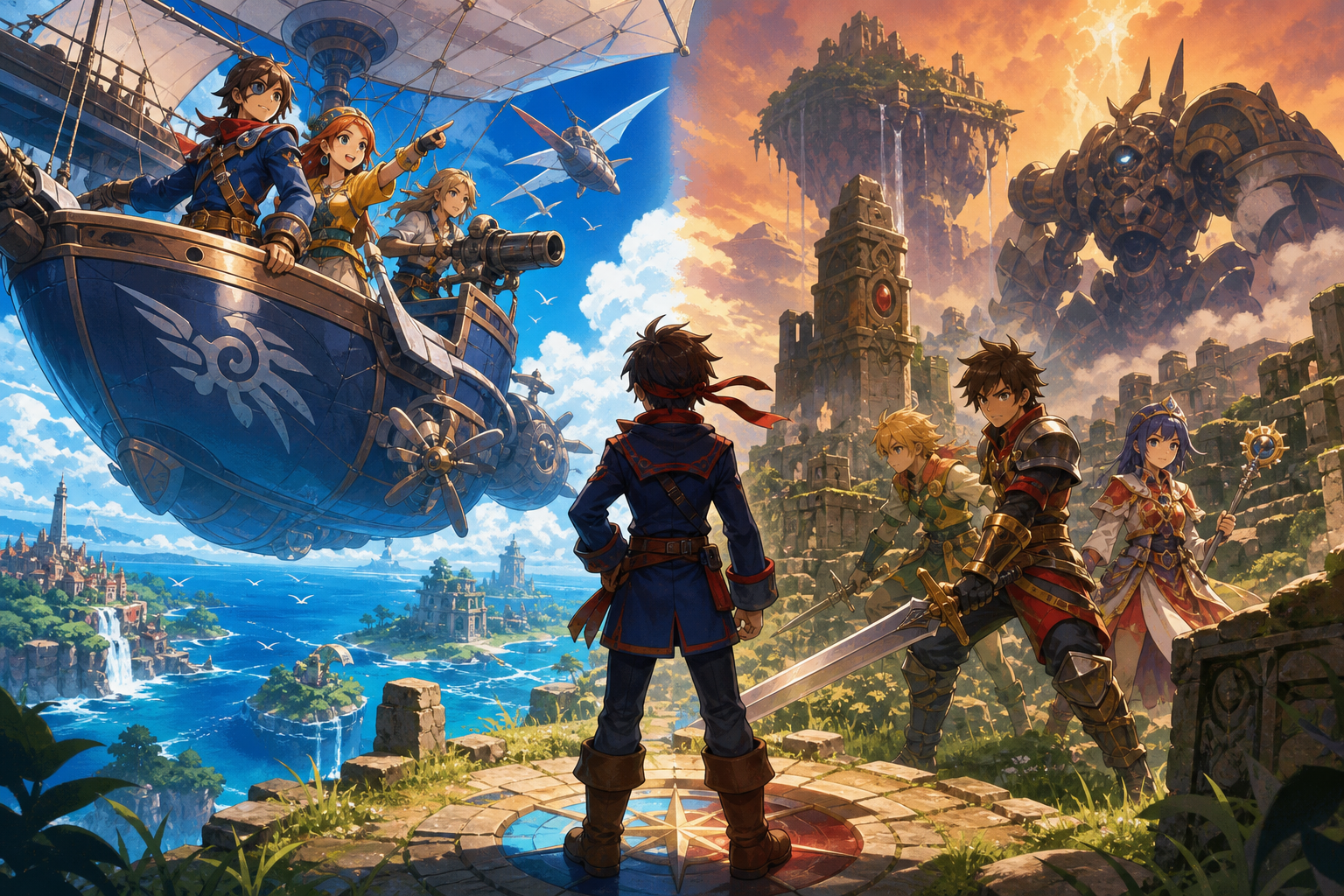
Skies of Arcadia and Grandia II are both substantial Dreamcast role-playing games, but they ask you to pay attention to different things. Skies of Arcadia wants you to look beyond the next objective, search the skies and gradually build an expedition around your crew and ship. Grandia II is more focused: its route is easier to follow, while its battles ask for closer attention to timing and enemy intentions.
For a first long Dreamcast RPG, the best choice is not simply the game with the stronger battle system or the larger world. It is the game whose interruptions, navigation and progression habits sound enjoyable rather than tiring. Choose Skies of Arcadia if you want a voyage built around discovery. Choose Grandia II if you want a more concentrated journey where combat is the main mechanical attraction.
The decision in one sentence: choose the adventure loop first
Skies of Arcadia is the better match for a player who wants an RPG to feel like an expedition. Its airship opens access to multiple regions, and exploration is not merely travel between story scenes. The compass can react when a discovery is nearby, hidden locations reward curiosity, and discoveries can be recorded and reported through the Sailors’ Guild. Optional crew members and ship improvements give the world a sense of ongoing expansion. The result is an adventure loop built from travelling, searching, fighting and returning with something new to add to the journey.
Grandia II is the better match for a player who wants the game to keep pointing toward the next meaningful destination. Its towns, field areas and dungeons are arranged along a more directed route. That structure leaves less room for getting lost, but it also means fewer moments where the player wonders whether an unmarked corner contains something worth finding. In exchange, Grandia II gives more of its attention to its initiative gauge, ability development and the tactical decisions made inside individual fights.
Neither preference is a lesser way to play an RPG. A player who dislikes repeated detours may find Skies of Arcadia’s freedom distracting, while someone who enjoys charting a route may find Grandia II too restrained. Start with the kind of attention you want to give the game, then use the battle system as the deciding factor between the two.
- Pick Skies of Arcadia for discovery, airship travel and optional world interaction.
- Pick Grandia II for a clearly signposted route and more concentrated combat decisions.
- Do not treat the recommendation as a universal quality ranking; the two games prioritize different kinds of engagement.
What each original Dreamcast edition actually contains
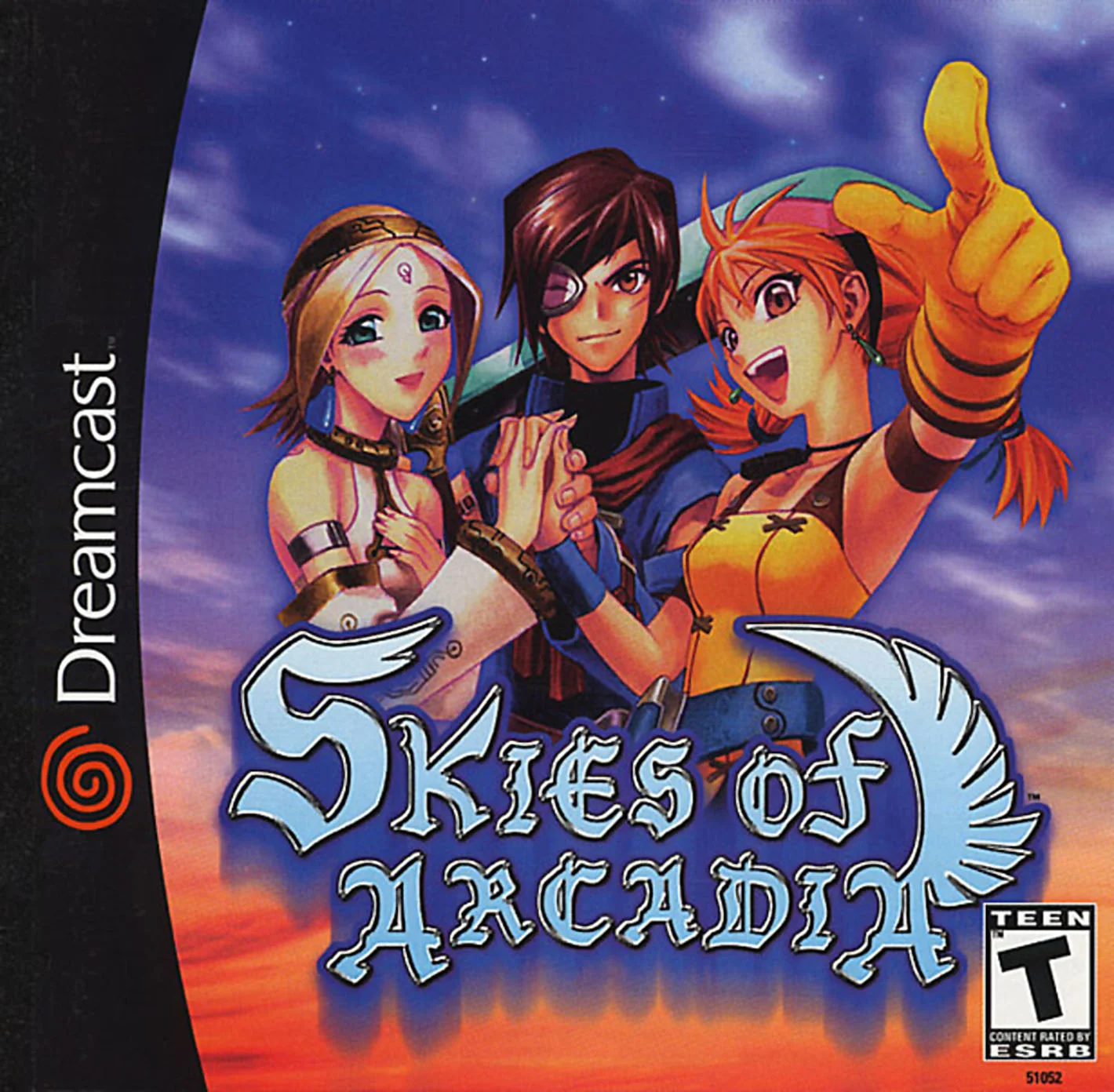
Edition details matter when choosing a physical Dreamcast RPG. The original Dreamcast release of Skies of Arcadia uses two game discs. Its manual tells the player to save before changing discs, so disc changes are part of the intended progression routine rather than an accidental complication. That makes a complete physical copy especially important for a collector planning to play the game on original hardware.
Grandia II’s original Dreamcast format is different. The game itself is on one GD-ROM, while the North American package also includes a separate music CD. It should not be described as a two-disc RPG in the same sense as Skies of Arcadia. The soundtrack disc is an extra package item, not a second game disc that advances the story.
This distinction also helps prevent advice from later versions being mixed into an original-edition comparison. Skies of Arcadia Legends on GameCube is not the same release as the Dreamcast game, and later versions of Grandia II may differ in presentation, options or save behavior. If you are buying or organizing a physical copy, check the region, game disc count and package contents before assuming that another edition’s guide applies.
For a first adventure, the practical effect is modest but real. Skies of Arcadia asks you to plan for a disc swap during a long campaign. Grandia II keeps the game data on one disc, although its North American package may include the soundtrack CD for collectors who want the complete original bundle.
- Skies of Arcadia Dreamcast: two game discs.
- Grandia II Dreamcast: one game GD-ROM, with a separate soundtrack CD in the North American package.
- Keep GameCube Legends information and later Grandia II releases out of an original Dreamcast play plan.
Exploration and navigation: voyage versus directed route
Skies of Arcadia makes navigation part of its identity. The airship is not just a faster way to move between towns; it is the player’s platform for surveying the world. Different regions open as the adventure develops, and the skies contain encounters, hidden locations and discoveries that may sit away from the obvious story path. The compass provides a useful sensory clue: when a potential discovery is near, it turns rapidly, prompting the player to investigate and confirm it with the action button.
Discoveries give exploration a record-keeping purpose. They can be entered in a journal and reported to the Sailors’ Guild, which means finding something is not always the end of the activity. A rival explorer can reduce the value of an unreported discovery, adding a light pressure to return and document what you found. This is not a survival system or a strict deadline, but it does make the player think about what to do with information gathered during travel.
Grandia II’s navigation is easier to read. Towns, fields and dungeons lead toward the next story beat, and the player is usually making a local decision about which path or room to inspect rather than charting a broad route across an open sky. There can still be reasons to explore, but the game’s structure does not make surveying the world its central activity.
That difference determines who will feel comfortable early on. Skies of Arcadia rewards a player who enjoys stopping the main route to investigate a suspicious gap or a compass reaction. Grandia II is kinder to a player who wants exploration to clarify the route rather than redefine it. If you often lose momentum when an RPG presents several possible directions, Grandia II’s more focused design is a genuine advantage.
- Use Skies of Arcadia’s compass as a prompt to inspect nearby sky space rather than ignoring unusual movement.
- Report discoveries when practical if you want the exploration system to feel complete.
- Choose Grandia II if you prefer local exploration around a known destination instead of broad route-finding.
How each game teaches its systems
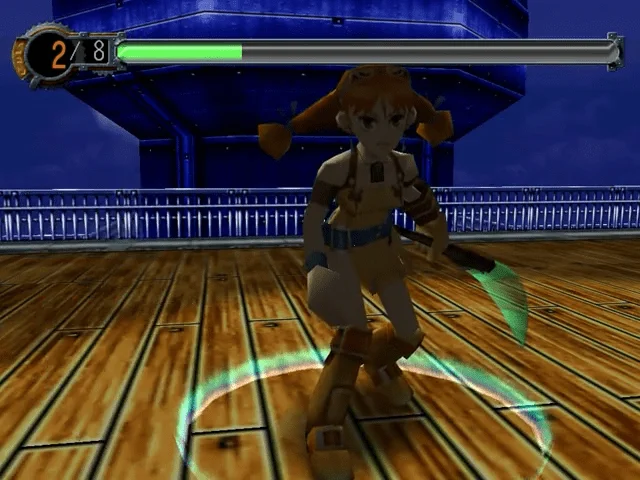
Skies of Arcadia introduces a wide collection of ideas that become more important as the journey grows. Normal character battles use weapons, magic and special moves, while ship battles operate as a distinct mode. The shared Spirit Point gauge connects several combat choices, and the color relationships among weapons and magic give a first-time player a manageable lesson in matching attacks to weaknesses and situations.
The challenge is that the game does not stop at ordinary party combat. Ship upgrades, crew abilities, discoveries and travel decisions gradually add more layers. A new player can understand each piece separately and still need time to understand how the pieces support one another. That learning curve suits someone who enjoys discovering the game’s operating logic while playing, but it can make the opening stretch feel busier than a conventional first RPG.
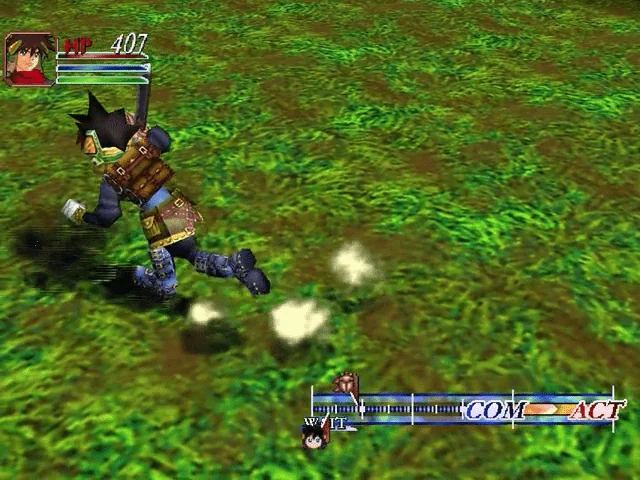
Grandia II teaches its central idea more directly. The initiative or IP gauge shows characters and enemies advancing toward command points. Combat remains command-based, not fully real-time, but the position of an action on the gauge matters. A well-timed attack can interrupt or cancel an enemy action, while a slow ability may be vulnerable to disruption. The player is therefore learning to read both the command menu and the unfolding battle order.
This creates a sharper early feedback loop. When a player notices an enemy preparing a dangerous action and chooses an ability that reaches it in time, the system explains its own appeal. Grandia II still has skills, magic and progression choices to learn, but the IP gauge gives those choices a common rhythm. For someone new to Japanese-style RPGs, that clarity can be more welcoming than Skies of Arcadia’s broader collection of connected systems.
- Skies of Arcadia teaches several systems gradually and rewards curiosity about how they interact.
- Grandia II’s IP gauge makes timing and interruption the central lesson from the beginning.
- Remember that Grandia II is command-based with timing, not a conventional real-time action battle system.
Battle-system momentum: Spirit Points against the IP gauge
Skies of Arcadia’s standard battles are comparatively easy to understand at the command level. Choose attacks, magic or special techniques, watch elemental color relationships and manage the party’s shared Spirit Point resource. That shared gauge means powerful options compete for the same pool, so using a special move early can affect what remains available later in the fight. The system encourages resource awareness without requiring every action to be calculated on a timeline.
Ship battles provide the larger tactical change. Commands are assigned to positions on a battle grid and interact with a battle timer. Each character can perform one action per turn, while the player chooses the round in which that action occurs. Cannons also behave differently: some fire and hit in the same round, while others let the player separate firing from impact. Crew commands add another layer, including abilities that can restore Spirit Points or repair the ship.
Grandia II places more pressure on moment-to-moment decisions in ordinary combat. The IP gauge lets the player see actions developing, and cancellation becomes a valuable response to enemy behavior. The correct choice may be a quick, modest technique rather than the most powerful spell available, especially when a wider or slower attack would arrive too late. The best turn is therefore determined by timing, target position and the likely consequences of allowing an enemy command to complete.
The choice is between two kinds of tactical satisfaction. Skies of Arcadia is more about assembling a useful set of resources across character and ship systems. Grandia II is more about reading the present battle and changing the order of events. Players who enjoy planning before a confrontation may prefer Skies of Arcadia; players who want every fight to present a small timing puzzle may prefer Grandia II.
- In Skies of Arcadia, watch the shared Spirit Point pool before spending on repeated special actions.
- Treat ship battles as their own mode with separate planning concerns.
- In Grandia II, inspect the IP gauge before committing to a slow or expensive action.
- Use interruption as a response to enemy intent, not merely as a damage option.
Party learning and progression choices
Skies of Arcadia keeps party development relatively readable at first. Equipment, weapons, armor and color-based relationships give characters recognizable roles without forcing the player to build an elaborate skill tree immediately. The wider progression comes from the adventure around the party. Recruitable crew members affect ship functions, and their abilities can change what the vessel is capable of doing in and out of battle. This makes the crew feel connected to the voyage rather than existing only as combat statistics.
That breadth also means not every optional system deserves equal attention from a first-time player. Discoveries, crew recruitment, ship improvements and the VMU-linked Pinta Quest mini-game all sit around the core adventure, but they do not need to be treated as one mandatory checklist. Pinta Quest can return items, gold and experience to the main game, yet it requires 83 VMU blocks for its executable. It is an optional enhancement, not a requirement for understanding the main RPG.
Grandia II gives progression a more explicit build-and-assignment layer. Skills use Skill Points, magic uses Magic Points, and Mana Eggs organize the game’s magic choices. Skill and magic resources earned after battles can be developed through star levels, so the player must decide which abilities deserve investment. Character techniques remain associated with party members, while magic assignments create room to shape how those characters contribute.
The tradeoff is control versus simplicity. Skies of Arcadia lets the player grow into a larger expedition and makes the crew part of that feeling. Grandia II gives a player more immediate responsibility for how abilities develop and how quickly or broadly they function. If you enjoy making a plan for a party build, Grandia II offers more visible choices to adjust. If you would rather gain tools through the journey and use them without constantly redesigning the party, Skies of Arcadia is less demanding.
- Skies of Arcadia’s crew affects the ship as well as the broader adventure.
- Grandia II separates Skill Points from Magic Points and uses Mana Eggs for magic development.
- Do not mistake Pinta Quest’s VMU requirements for a requirement to finish the main game.
Pacing and encounter friction
Skies of Arcadia’s broad route can produce a distinctive kind of drag. The same freedom that makes the world feel large also invites extra travel, and the original Dreamcast version is associated with frequent random encounters. A player who enjoys levelling, testing elemental choices and checking remote spaces may accept those interruptions as part of the voyage. A player who wants to move directly from one story scene to the next may experience them as repeated breaks in momentum.
The game’s pacing is therefore tied to its fantasy of travel. Exploring the sky, looking for a discovery and dealing with another battle are not separate activities in the design. They are meant to make the journey feel inhabited. That approach works best when you are willing to let the route breathe. It works less well when you view every optional stop as lost time.
Grandia II’s directed structure reduces that navigational friction. You spend less effort deciding where the larger journey should go, and the game can place its learning emphasis on dungeons and combat. Its battles still take time, particularly when the player studies the IP gauge or experiments with abilities, but those decisions feel more directly connected to the next challenge rather than to a self-appointed detour.
The useful question is not which game is faster. Exact completion-time claims would hide the real difference. Ask whether you would rather lose momentum because a random encounter interrupts travel or because a battle presents an interesting tactical problem. Skies of Arcadia makes travel the larger commitment; Grandia II makes combat the more concentrated commitment.
- Choose Skies of Arcadia if frequent encounters are acceptable as part of exploration.
- Choose Grandia II if you want the route to remain the main source of forward momentum.
- Do not import encounter changes from Skies of Arcadia Legends into the Dreamcast comparison.
Save habits, VMU space and disc changes
Save planning is one of the clearest practical differences between these Dreamcast RPGs. Skies of Arcadia allows saving anywhere during normal sky travel, while villages and dungeons generally use dedicated save points. That means the player should not assume that a convenient save is available immediately before every transition on foot. The manual also instructs the player to save before changing discs, making a deliberate save part of the disc-swap routine.
The game save file uses 27 VMU blocks according to the Dreamcast manual. The optional Pinta Quest executable uses 83 blocks, which is a much larger demand. A player using original hardware should check available VMU space before deciding to add that mini-game. It is sensible to keep the main save protected and treat optional VMU content as a separate storage decision rather than deleting an active campaign casually.
Grandia II does not involve Skies of Arcadia’s two-game-disc swap. Its original Dreamcast game data remains on one GD-ROM, while the soundtrack CD found in the North American package is separate from the game. That makes the physical routine simpler, although careful saving is still appropriate before an unfamiliar dungeon or major battle.
These habits are especially relevant for a first long RPG. A player who frequently stops after a short session should prefer a game whose save pattern matches that routine. Skies of Arcadia is comfortable when you remember the difference between sky travel and on-foot areas. Grandia II is easier to approach casually because it avoids the disc-change routine and does not make optional VMU content part of its identity.
- Save before changing Skies of Arcadia discs.
- Expect free saving in the sky but dedicated save points in many villages and dungeons.
- Reserve VMU space for the main save before adding Pinta Quest.
- Treat Grandia II’s soundtrack CD as package material, not a second game disc.
Who should start with Skies of Arcadia
Start with Skies of Arcadia if your ideal first RPG is a journey that keeps widening. The airship gives the game a clear identity, while discoveries and hidden locations make the world feel like something to investigate rather than merely cross. You can pursue the story, but the design repeatedly gives you reasons to look aside: a compass reaction, an unusual patch of sky, a possible recruit or a ship-related improvement.
It is also a strong choice if you like party adventures where the group’s identity matters beyond a list of statistics. Crew members contribute to the ship, ship battles have their own command logic, and the broader expedition gradually becomes a project. These systems make the game feel more like a voyage with an organization behind it than a sequence of disconnected dungeon visits.
The tradeoff is tolerance for friction. You need to accept frequent encounters, occasional detours and a progression structure that can feel more layered as new systems arrive. You also need to remember that the Dreamcast edition has two game discs and a save routine that changes depending on whether you are travelling through the sky or walking through a settlement or dungeon.
For a first RPG, Skies of Arcadia is best for the player who wants the world to invite questions. If “What is over there?” sounds more appealing than “How quickly can I reach the next objective?”, its exploration-led design is the better introduction.
- Choose it for airship travel, discoveries and optional detours.
- Choose it if crew and ship systems sound like meaningful parts of an adventure.
- Prepare for random encounters, save-point habits and a two-game-disc campaign.
Who should start with Grandia II
Start with Grandia II if you want the game to teach you through combat. Its IP gauge makes the battle order visible, and interruption gives you a reason to care about when an action lands rather than only how much damage it causes. The system has enough depth to reward practice, but its central question is easy to understand: which command should happen next, and can it stop the enemy from completing its own action?
Grandia II is also a better fit for players who prefer a directed route. Towns, fields and dungeons provide a clearer sequence of destinations, so the game spends less of your attention on broad navigation. That can make it a comfortable first long RPG for someone who wants to learn party development and dungeon rhythm without also managing a large network of optional travel decisions.
Its progression still asks for judgment. Skill Points, Magic Points, Mana Eggs and star-based development mean that your choices influence how abilities perform and when they become practical. Wider attacks, faster actions and interruption potential can matter as much as raw power. The game is approachable, but it is not shallow; it simply places its complexity in a more concentrated area.
Pick Grandia II when you want a campaign that keeps the main route visible and gives battles the strongest reason to pay attention. The cost is less self-directed exploration and a smaller sense of building an expedition beyond the immediate party. For many first-time players, that is not a limitation but a useful source of focus.
- Choose it for the IP gauge, interruptions and action timing.
- Choose it if a directed route reduces the stress of navigation.
- Invest in skills and magic with a purpose instead of spreading resources automatically.

Spoiler-light recommendation matrix
For exploration, Skies of Arcadia is the clear choice. Its airship, discoveries, hidden locations and recruitable crew make looking around part of the game’s main appeal. Grandia II offers places to inspect, but its route is built more around reaching the next story location.
For combat learning, the answer depends on what “learning” means. Skies of Arcadia’s color relationships and Spirit Point management are easier to describe in broad terms, while ship battles add a second combat mode with battle-grid rounds, timers and crew abilities. Grandia II has the stronger immediate tactical lesson because the IP gauge shows how timing, interruption and action speed affect the result.
For navigation, Grandia II is the safer first recommendation. Its directed fields and dungeons reduce the chance that a new RPG player will lose the main thread. Skies of Arcadia is more rewarding for someone who sees navigation as a form of play.
For pacing, Grandia II is more consistent if you want forward movement and combat to define the rhythm. Skies of Arcadia has a more expansive rhythm, but random encounters and optional searching can interrupt a player who prefers efficiency.
For save tolerance, Grandia II is simpler overall. Skies of Arcadia remains manageable if you remember its save-point rules, protect enough VMU space and save before disc changes. Those are practical habits, not reasons to reject the game, but they matter when choosing a first long campaign.
The final split is straightforward: choose the system you want to think about most. If the answer is the world, take Skies of Arcadia. If the answer is the battle timeline, take Grandia II.
- Exploration: Skies of Arcadia.
- Combat timing: Grandia II.
- Navigation clarity: Grandia II.
- Ship-and-party adventure breadth: Skies of Arcadia.
- Save and format simplicity: Grandia II.
- Best choice for discovery-led play: Skies of Arcadia.
- Best choice for focused tactical play: Grandia II.
For a first Dreamcast RPG, Grandia II is the easier recommendation when you want a clear route and a battle system that immediately explains why timing matters. Its IP gauge, interruption tools and focused progression give a new player a firm mechanical center.
Skies of Arcadia is the better first choice when the fantasy of the adventure matters more than convenience. Its sky travel, discoveries, crew and ship battles create a broader journey, provided you accept frequent encounters, occasional detours and more deliberate save planning. Pick the game that matches where you want your attention to go: across the world with Skies of Arcadia, or across the battle timeline with Grandia II.