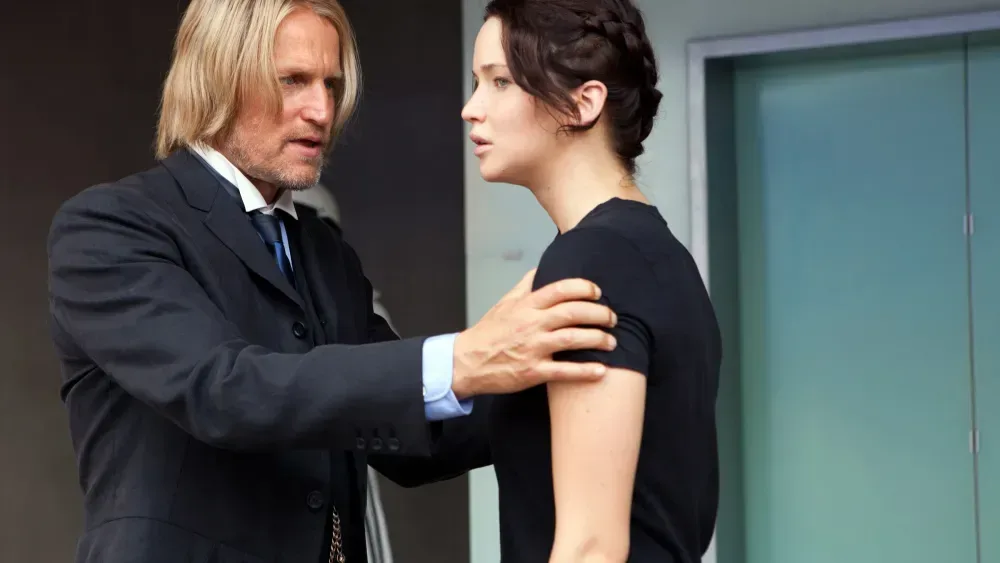

Woody Harrelson nearly missed out on the role that would make him a central adult presence in The Hunger Games films. Speaking alongside Joseph Zada, who plays a younger Haymitch Abernathy in The Hunger Games: Sunrise on the Reaping, Harrelson said he turned down the part twice before director Gary Ross convinced him to reconsider.
It was not a case of Harrelson dismissing the material. He said he had read the books and thought they were “really good.” His uncertainty was narrower, and more revealing: he was not sure Haymitch gave him enough to do. Harrelson later characterized that evaluation as an “arbitrary, odd way” to judge the opportunity.
That hesitation matters because Haymitch ultimately became one of the franchise’s essential connective characters. He is the hard-living mentor whose experience with the Games places him in a position to guide Jennifer Lawrence’s Katniss Everdeen and Josh Hutcherson’s Peeta Mellark. The role asks for more than a single-note authority figure: Haymitch has to be funny, guarded, compromised and, when the story calls for it, deeply purposeful.
Harrelson’s account also offers a useful reminder that actors do not always decide on a job by measuring a character’s page count, action scenes or apparent narrative importance. A role’s eventual impact can come from chemistry with a cast, the director’s larger interpretation, and the possibilities that emerge across a continuing series. Those factors can be difficult to see when an actor is only assessing the first script or the character’s immediate workload.
The phone call that settled it
Ross, who directed the 2012 first film, made the decisive appeal directly. Harrelson recalled the filmmaker telling him that he had no second choice for Haymitch and urging him to take the part. After roughly 10 minutes on the phone, Harrelson agreed.
“I can’t imagine not having had this experience in my life and knowing these people,” Harrelson said while looking back on the decision.
That reflection shifts the story beyond a simple casting near-miss. Harrelson is describing the personal value of a long-running creative relationship: the colleagues he met, the work that followed, and the place Haymitch came to occupy within a hugely successful dystopian franchise.
What is a franchise role? In film, a franchise role is a character built to return across related installments rather than exist in one self-contained story. The practical appeal for performers can extend beyond recurring employment. Returning characters develop history with audiences, gain additional dimensions as circumstances change, and can serve as the emotional bridge between separate chapters or generations of a fictional world.
Related coverage includes Woody Harrelson Says He Initially Passed on Haymitch Twice.
Haymitch is particularly suited to that function. His past carries weight in the original story, while the new prequel turns the character’s earlier life into the focus. That structure makes Harrelson’s participation in Sunrise on the Reaping more than a familiar-face cameo: it connects the older mentor audiences know with the younger version played by Zada.
A return to Haymitch’s earlier story
The Hunger Games: Sunrise on the Reaping takes place 25 years before the original Hunger Games series and follows Haymitch’s origin as he is forced to compete in the second Quarter Quell. A Quarter Quell is a special edition of the Games held at a major anniversary, with altered terms that distinguish it from the regular competition.
Prequels face a distinctive storytelling challenge. The audience may already know where a character ends up, so suspense cannot rely only on whether that person survives or reaches a familiar destination. Instead, the drama rests on the route: the choices, costs and relationships that explain how the later version of that character was formed. A younger Haymitch therefore is not simply an imitation of Harrelson’s performance; Zada’s job is to portray a version of the character who has not yet become the man seen in the original films.
The cast also includes McKenna Grace, Ralph Fiennes, Jesse Plemons and Elle Fanning. Francis Lawrence directed Sunrise on the Reaping. His history with the series is extensive: following Ross’s first film, he directed Catching Fire, Mockingjay – Part 1, Mockingjay – Part 2, The Ballad of Songbirds and Snakes and now Sunrise on the Reaping.
That continuity behind the camera is significant. A returning director can carry forward the visual and dramatic language of a series while approaching a different era within its timeline. It does not mean every installment is identical; the value is a working familiarity with the world, its tone and the scale of its conflicts. For a prequel built around a character previously played by Harrelson, that continuity can help balance recognition with a story that must stand on its own.
Original cast members add continuity
Harrelson returned for the new film, and Jennifer Lawrence and Josh Hutcherson also made small appearances. Their participation brings performers associated with the original central trio back into a story principally set decades earlier.
Lawrence described the experience of returning as “unbelievable” during an appearance on Call Her Daddy. She said it was emotional to work again with the same crew, including an assistant director she had worked with repeatedly, as well as Hutcherson and Harrelson.
Her description points to an often overlooked aspect of a major film series: continuity is not only a matter of characters and costumes. Film crews, department heads and long-term collaborators can carry shared experience from one production to another. When performers return, they are often stepping back into a network of working relationships as much as a fictional setting. For audiences, that can make a brief appearance feel meaningful even when it does not dominate the plot.
There is a parallel here with the broader screen industry’s reliance on sustained creative communities, a subject also visible in coverage of film programming, language work and career pathways. The people who make films shape their continuity as surely as the recognizable names in front of the camera.
Why Harrelson’s initial concern is so interesting now
Harrelson’s remark that there might not be enough to do is candid precisely because the finished franchise gave Haymitch such a durable place in its ensemble. It demonstrates the gap between a prospective role and a role viewed in hindsight. Before production, an actor has to make a judgment with incomplete information: how scenes will play, how a director will use them, whether a supporting part will gain force through editing and performance, and whether later films will expand the character’s significance.
None of that means an actor’s hesitation is irrational. It is a practical creative question. Supporting roles can be underwritten, and a performer has limited time for projects. Harrelson’s later self-criticism instead suggests that his original metric did not account for what the complete experience would become.
Ross’s intervention was therefore more specific than generic persuasion. By telling Harrelson he could not imagine another actor in the part, the director framed Haymitch as an interpretive fit rather than merely an available slot in a blockbuster cast. The story underscores how casting is often a matter of a filmmaker’s conviction that a particular performer can supply qualities that are not fully stated on the page.
A strong opening for the prequel
Sunrise on the Reaping opened to $120 million at the box office last weekend and is currently in theaters. The figure gives the new chapter a substantial opening while it expands a property whose original films made more than $1 billion.
Box-office openings are a measurement of a film’s initial theatrical ticket sales, not a complete verdict on its long-term reception or ultimate run. Even so, a $120 million start establishes that the new Haymitch-focused chapter arrived with significant audience interest. That interest may come from several overlapping points of entry supported by the film’s setup: viewers curious about the earlier story, fans returning to a familiar world, and audiences drawn by the prospect of seeing original cast members again.
For Harrelson, the timing gives an old decision fresh context. The role he twice declined became a defining part of his connection to the series, and the franchise has now returned to Haymitch’s past with Harrelson participating in the new film. His experience is a neat piece of Hollywood counterfactual history: one short call helped secure a performance that would become inseparable from the screen version of Panem.