
Spoilers follow for the ending of The Hunger Games: Sunrise on the Reaping.
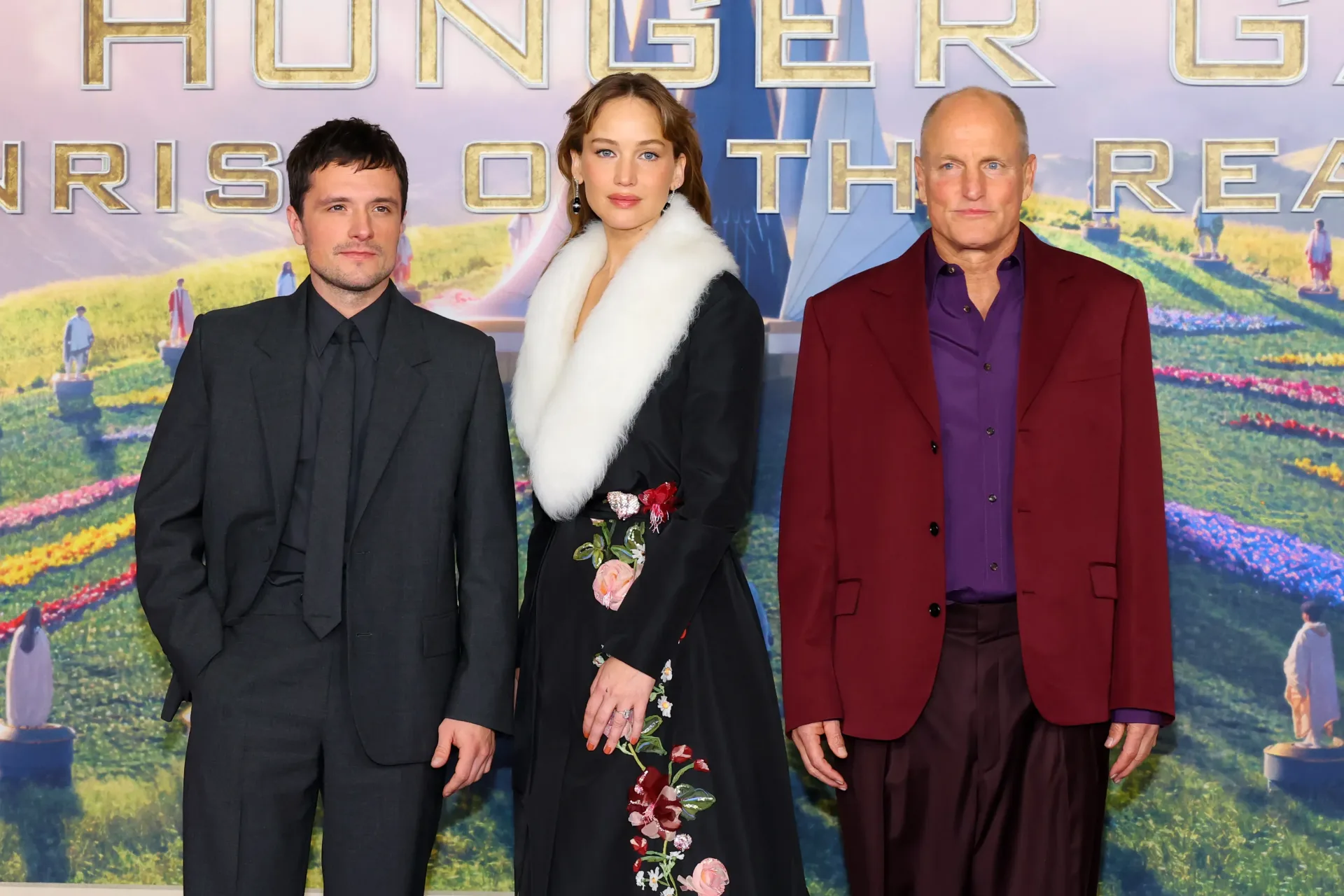
The Hunger Games: Sunrise on the Reaping is built as a prequel around Haymitch Abernathy before he became the haunted mentor known from the original films. But its closing stretch does not leave the larger saga in the past. Jennifer Lawrence, Josh Hutcherson and Woody Harrelson return for an epilogue scene as Katniss Everdeen, Peeta Mellark and adult Haymitch, respectively.
The appearance brings the central performers from the earlier film series back together on screen for the first time since 2015’s Mockingjay – Part 2. It also follows the structure of Suzanne Collins’ 2025 novel: although the main narrative concerns the younger Haymitch, the book’s epilogue moves forward to the era after the events of Mockingjay.
That distinction matters. A prequel normally asks viewers to look backward, supplying context for familiar people or objects. This ending instead performs a two-way connection. It frames Haymitch’s younger life as the emotional foundation for the man Katniss and Peeta know, then carries that character’s pain beyond the period in which the main story takes place.
What happens in the final jump forward
The epilogue finds Katniss and Peeta living peacefully in Victors’ Village after Mockingjay, with Haymitch as their neighbor. They greet him and wish him a happy birthday before he heads to a meadow to remember Lenore Dove, his late love, played in the prequel by Whitney Peak.
Haymitch says hello to the geese, recalling something he and Lenore Dove did when they were children. It is a small action, but it is the point of the scene: the movie finishes not with another spectacle of the Games, but with a private ritual of remembrance. Katniss and Peeta’s presence makes the moment a reunion for audiences, while the meadow gives Haymitch’s earlier loss a lasting place in his adult life.
Lawrence and Hutcherson’s roles in the sequence are consequently brief but structurally important. They are not there to redirect a story centered on Haymitch. They establish where the surviving characters eventually arrive: in a quieter version of Victors’ Village, sharing a neighborhood after the events that changed Panem. Harrelson’s return supplies the direct bridge between that life and the young Haymitch portrayed for most of the film by Joseph Zada.
Haymitch’s past is the real purpose of the cameo
The main prequel story follows Haymitch through the Second Quarter Quell, a Hunger Games event he wins at enormous personal cost. His later isolation is already a key part of the character audiences know. Sunrise on the Reaping adds personal history around that isolation rather than treating it as a simple character trait.
Related coverage includes Jennifer Lawrence, Josh Hutcherson and Woody Harrelson Return in Sunrise on the Reaping.
Burdock Everdeen and Asterid March are among Haymitch’s closest connections while he is young. Burdock is his best friend, while Asterid is Burdock’s girlfriend. After Haymitch wins the Second Quarter Quell, the pair attempt to support him. He pushes them away, however, and withdraws into drinking alone in Victors’ Village after the losses he has endured.
The film later shows Burdock and Asterid holding their baby daughter, Katniss. Haymitch watches from hiding and locks eyes with the infant. The image gives the shared location of Victors’ Village a different emotional texture. In the original story, Haymitch is Katniss’ difficult but indispensable mentor. Here, he is also a damaged neighbor watching the earliest days of the girl who will eventually become central to Panem’s future.
This is not presented as a claim that Haymitch knows the role Katniss will one day play. Rather, it is a generational link for the audience. The scene puts a young Katniss near the man whose life will later intersect so closely with hers, while preserving the separation between their circumstances at that point in time.
The mockingjay pin connection
Asterid also connects to Maysilee Donner, played by Mckenna Grace. Maysilee is identified as the original owner of the mockingjay pin that eventually reaches Katniss. That detail gives the familiar symbol a more personal chain of association across the prequel and the original series.
The pin has obvious visual importance in the broader franchise, but the connection described here is specifically about its passage between people. It ties Katniss’ eventually iconic accessory to Maysilee and to the social world around Haymitch, Burdock and Asterid. The result is a recurring object that works as a thread between characters who live in different phases of the story.
These kinds of references can be easy to mistake for mere recognition cues. In this case, each one is attached to the prequel’s central concern: what Haymitch loses, who remains close enough to try to help him, and how the people around him are connected to Katniss’ family years before she becomes a tribute.
Why the ending goes beyond a nostalgia beat
The trio’s return is certainly designed to be recognizable. Lawrence, Hutcherson and Harrelson played the characters through the 2010s films, and their appearance reunites the most familiar faces of that era. Yet the epilogue’s function is more specific than simply revisiting them.
It confirms that the young Haymitch story and the post-Mockingjay future are part of one continuous emotional arc. The young man who turns away from Burdock and Asterid after surviving the Second Quarter Quell becomes the adult who can live near Katniss and Peeta, even as he continues to mourn Lenore Dove. The ending does not erase his grief or suggest a neat recovery. It gives him companionship nearby and a place to remember.
For viewers who know only the films, the scene also clarifies why a prequel focused on Haymitch can end with Katniss and Peeta without becoming their story. They embody the later world in which Haymitch is still present. For readers of Collins’ novel, the adaptation’s choice to retain the time jump keeps its conclusion aligned with the book’s epilogue.
There is a practical viewing implication, too: the final sequence is deliberately built around franchise continuity and emotional payoff. Anyone avoiding details about the post-Mockingjay setting or Haymitch’s connection to Lenore Dove should wait to read further until after seeing the movie. Those who do watch through the epilogue will find that it revisits old characters in service of the new film’s tragedy, not as a replacement for it.
Sunrise on the Reaping therefore uses its final minutes to join several timelines at once: Haymitch’s youth, Katniss’ infancy, the origins of the mockingjay pin, and the peaceful period after Mockingjay. The recurring geese are perhaps the quietest of those links, but they land the point most directly. Even after the Games and the losses surrounding them, Haymitch holds on to a memory of Lenore Dove—and the film lets that memory be the last connection across the franchise’s generations.
For more film-industry calendar context, see Bentonville Film Festival’s announced 2027 dates.