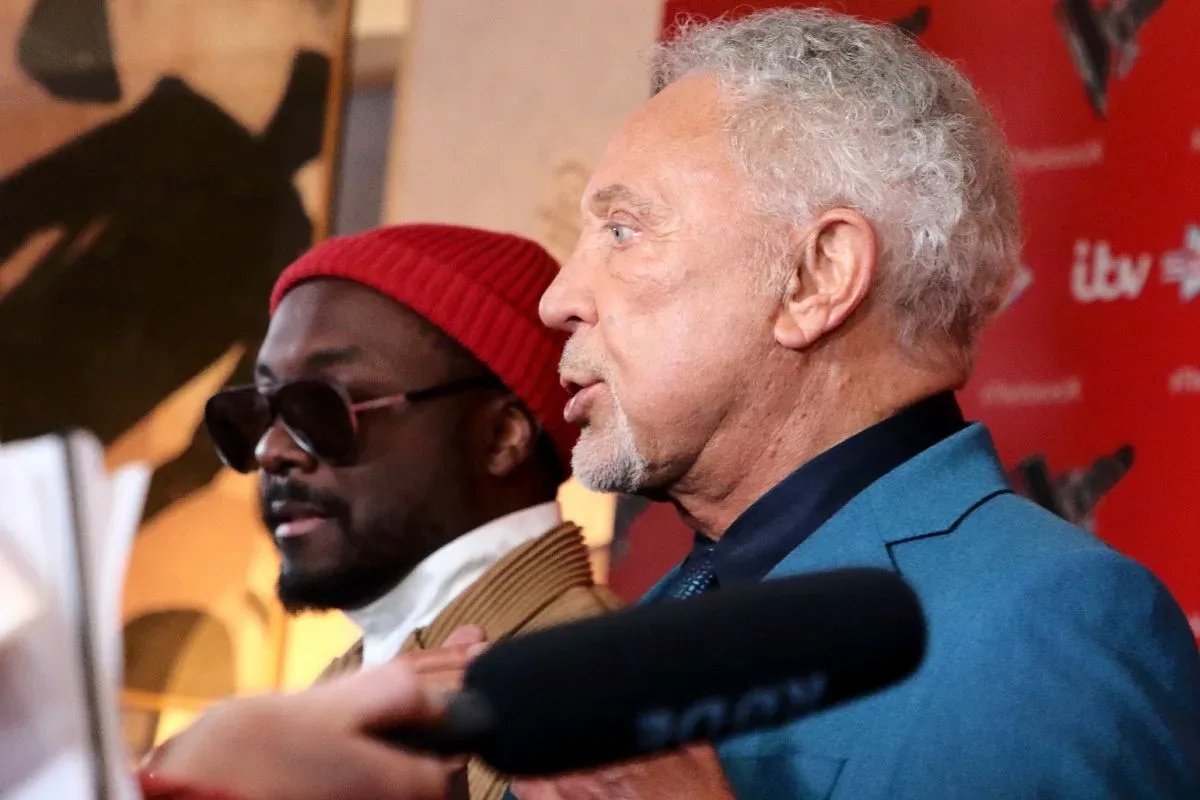
The Voice UK is preparing for a coaching-panel change that has landed with considerably more emotional force than the usual talent-show reshuffle. Sir Tom Jones, the Welsh singer whose catalogue has crossed generations, has said he is leaving the programme after being offered a reduced arrangement rather than full involvement from the beginning of a new run. Will.i.am, his long-standing fellow coach and the last remaining original coach on the programme, offered a brief but unmistakable public response: crying emojis beneath Jones’s Instagram post.
That tiny reply carries the weight of a much larger on-screen relationship. Talent competitions routinely rotate judges to manufacture a sense of novelty, and viewers are accustomed to announcements framed as exciting reinventions. Yet Jones has been one of the faces audiences associate with The Voice UK from its earliest days. His exit therefore feels less like a routine chair swap and more like the removal of a familiar load-bearing piece from the set.
A proposed smaller role was not enough
Jones, now 86, indicated that the proposal would have allowed occasional appearances without making him part of the programme from the start. He declined that arrangement. In his public message, he put the situation in blunt, self-aware terms, writing: “There’s never a good time to fire an 86-year-old who’s still pretty good at his job.”
The point is not simply that a veteran performer wanted to retain a television role. Jones’s objection speaks to the difference between a cameo and a job with genuine creative participation. A coach on The Voice UK is there for the blind auditions, helps form a team, offers musical perspective over the course of the competition, and becomes part of the story viewers follow. Dropping in later would be fundamentally different from sharing that full season-long responsibility.
ITV’s explanation has been described as relating to financial difficulty with insurance. At the same time, Jones said producers had also discussed refreshing the coaching line-up. Those explanations can exist side by side in practical television planning, but their combination has unsurprisingly fuelled scrutiny. “Refresh” is a familiar industry word, broad enough to cover budget, format, audience strategy, scheduling and the pursuit of younger faces. It also raises obvious questions whenever an established older figure is the one being moved aside.
Why the Jones and will.i.am pairing mattered
Will.i.am’s emoji response is not a lengthy statement, but it makes clear that the change is personal as well as professional. He and Jones have been a recognisable part of the programme’s identity, balancing sharply different musical backgrounds and public personas. One is a Black Eyed Peas frontman and producer with a pop, hip-hop and technology-minded profile; the other is a singer whose recording and touring career stretches back more than six decades. That contrast was not merely decorative. It helped sell the premise that a contestant could receive useful guidance from more than one corner of the music business.
For a format built around coaches turning chairs, the coaches themselves eventually become part of the product. They provide continuity from episode to episode and season to season, but they also build a shorthand with viewers: who advocates for a big vocal, who champions an unusual voice, who offers warmth, who brings the joke, and who seems likely to fight for a contestant. Jones’s presence offered an especially clear version of that continuity.
This is why a social-media reaction made entirely of tears can register as a proper goodbye. There is no need to turn it into a definitive account of will.i.am’s feelings or the show’s internal decision-making. It simply shows a colleague publicly recognising that a durable partnership is ending.
Related coverage includes Will.i.am Reacts as Tom Jones Leaves The Voice UK Coaching Panel.
More than a legacy booking
Calling Jones a legacy act can be technically true and still miss the important part. His achievements are not background decoration for a television bio. He has sold more than 100 million records, won a Grammy Award and was knighted by Queen Elizabeth II in 2006 for services to music. Songs including It’s Not Unusual, What’s New Pussycat?, Delilah and Green Green Grass of Home remain instantly identifiable cultural fixtures.
He has also maintained a major performing life well beyond the period when nostalgia might have become his only commercial function, with a long Las Vegas history and continued touring. That distinction matters in a coaching environment. A contestant is not only meeting someone associated with an enormous archive of hits; they are meeting a performer with an unusually long view of what it takes to sustain a career, interpret a song, command a stage and adapt to changing audiences.
None of that automatically means television should never alter its cast. Programmes change, contracts end and the entertainment business is not a seniority system. But the public response reflects a reasonable view that experience is not the opposite of relevance. In a show where contestants seek authority and confidence, the perspective of an artist who has navigated decades of change has an obvious value.
Fans see a wider question behind the panel change
Reaction online has been immediate. Petitions seeking a reconsideration have circulated, while model and artist Jeny Howorth wrote publicly, “How Bloody Dare They! I only watched because of you.” Such comments are expressions of fandom, not a measurement of the whole audience. Still, they show why the decision has become a talking point rather than disappearing into the normal churn of casting news.
Fans who have spent years watching a format tend to form attachments not just to contestants and performances, but to the reliable rhythm of particular personalities. That is especially true of shows that return on a seasonal basis. The question becomes less “Who will occupy the chair?” and more “What version of the show is left once the familiar chemistry is gone?”
Television has repeatedly faced that challenge: a franchise tries to reach viewers who have not yet made it part of their routine without alienating the people who kept it alive. A new line-up could eventually establish a fresh dynamic. But removing an institution is not the same as adding a name. The latter may create headlines; the former changes the emotional architecture of the programme.
For audiences interested in the way familiar casts shape entertainment brands, there is a parallel in how presenter line-ups can be used to signal continuity and change at major events, as seen in the expanding 78th Emmys presenter roster. The stakes are different, but the basic lesson is similar: recognisable people bring accumulated meaning with them.
The awkward language of a “refresh”
The most difficult aspect of this story is the collision between business language and human meaning. A network can say it enjoyed working with Jones over nine years, and that can be sincere. Jones can also feel that a limited, occasional role is not a respectful substitute for being engaged from day one. Both positions can be expressed publicly, but they do not erase the disappointment created by the outcome.
“Refresh” is particularly slippery because it presents change as inherently healthy without explaining what, specifically, needed changing. It does not tell viewers whether the concern was cost, insurance, scheduling, the desired age of the panel, a different creative direction, or some blend of all of those factors. In the absence of detail, people supply their own interpretation—and the age gap between Jones and the likely idea of a refreshed line-up will be impossible to ignore.
Jones’s own phrasing has cut through the corporate vocabulary because it is direct. At 86, he did not present himself as someone seeking a ceremonial farewell. He presented himself as someone who believed he remained capable of doing the work. That framing is likely to resonate with many viewers regardless of whether they have watched every season.
A major transition for The Voice UK
The next edition of The Voice UK will reveal whether a new coaching group can create its own rapport and persuade audiences that this is an evolution rather than an amputation. New talent, new mentoring styles and a changed group dynamic are all possible benefits of a reset. They should not be dismissed before the panel is even seen in action.
But it is equally fair to recognise what cannot be replicated by simple casting arithmetic. Jones brought a history that no replacement could duplicate, while will.i.am’s tearful public acknowledgement underlines that the departure also closes a defining coach relationship. The show may be able to refresh itself. What it cannot do is pretend that the chair Jones leaves behind was ever just a chair.