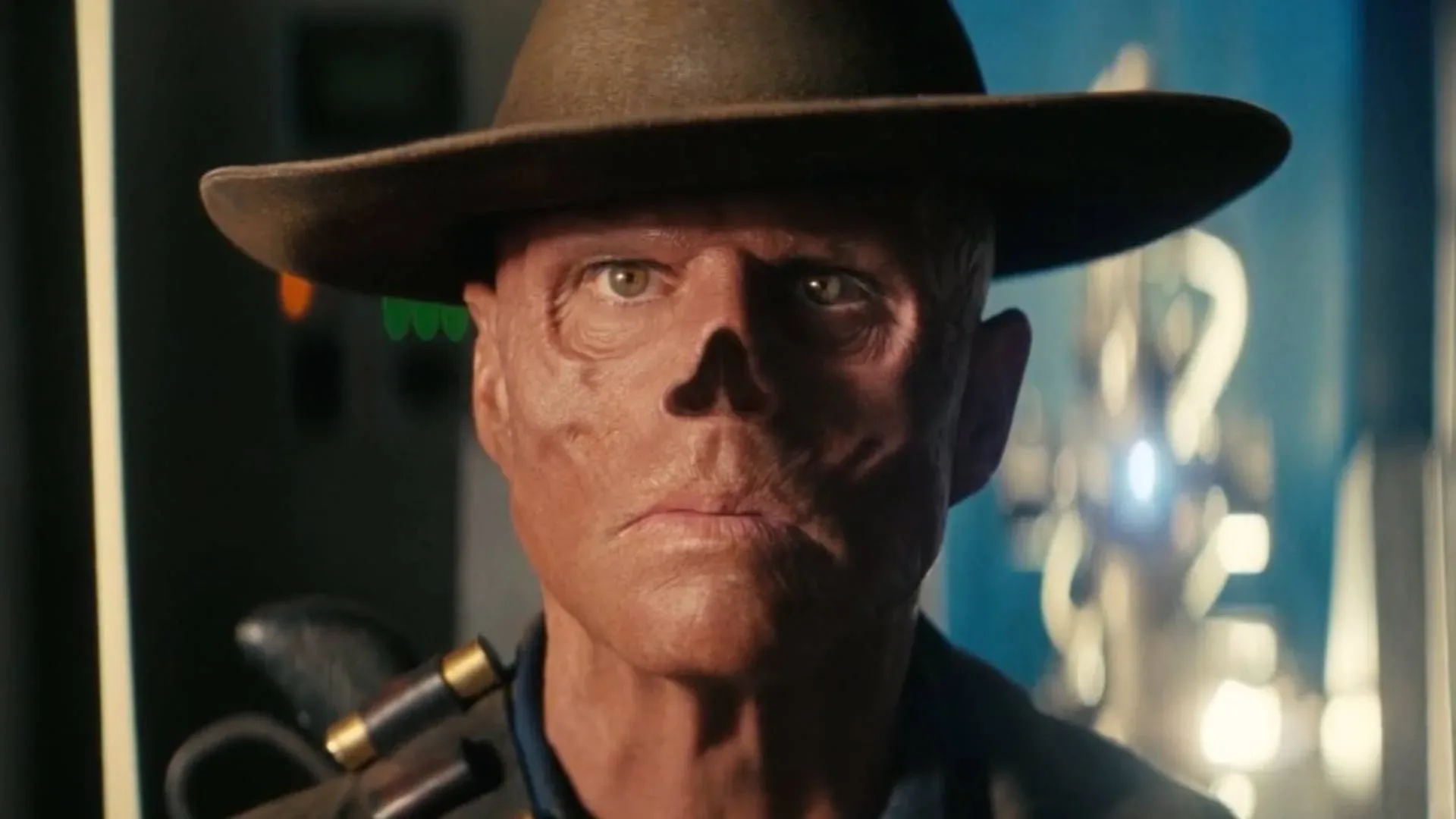

Fallout season 3 has a huge emotional question waiting beneath its irradiated deserts, Vault secrets and violent detours: what happens when the Ghoul finally gets close to the thing that has kept him moving for two centuries?
Walton Goggins, who plays the Ghoul, has framed the next phase of the character’s story less as a simple missing-person pursuit and more as a confrontation with the consequences of hope. The season 2 ending established that the Ghoul’s missing wife and daughter were alive, while also leaving him with a new direction: they were taken to Colorado for unexplained reasons, and he is following that trail.
That revelation matters because it changes the premise of his journey. For most of the story, a search for long-lost family can operate as a powerful but distant motivation. A character can pursue an answer without having to deal with the actual human reality at the end of the road. Season 3 appears set to push the Ghoul much nearer to that reality.
A goal that may be harder than the hunt
Goggins has posed the core idea in personal terms: imagine discovering that loved ones you had not seen in an extraordinarily long time were still alive. The important question is not merely whether that reunion happens, but what it would do to the person who has endured the absence.
For the Ghoul, the time scale makes that question especially severe. Goggins described the character as having looked for this outcome for 200 years. That is not a normal unresolved grief, nor a short-term mission that can be cleanly completed with a map marker and a victory sting. It is a purpose that has apparently survived the collapse and rebuilding of the world around him.
In storytelling terms, this is the difference between a plot objective and a character objective. The plot objective is concrete: find the family, learn why they were taken to Colorado, and uncover what has happened to them. The character objective is more difficult to resolve: determine whether the man who has survived for so long can still live with the truth once he reaches it.
Goggins indicated that the creative team spent much of the season considering precisely that question. He also suggested that the binary outcome—whether the Ghoul finds his family in season 3 or does not—is not, by itself, the most meaningful part of the arc. The larger issue is how pursuit, loss and possible fulfillment alter him.
Why confirmation changes the Ghoul’s motivation
The season 2 ending did not provide a complete explanation. The Ghoul learned that his wife and daughter were alive, but the reasons they were taken to Colorado remain unknown. That leaves an active mystery for season 3 rather than a finished answer.
Related coverage includes Fallout Season 3 Will Put The Ghoul's 200-Year Search to the Test.
Still, confirmation is fundamentally different from uncertainty. Before it, a search is shaped by the possibility that it may be futile. After it, the search gains urgency, but it also gains risk. The Ghoul is no longer only chasing memory. He is pursuing people who may have had lives, experiences and transformations wholly beyond his reach.
That is where Goggins’ comments point toward the most compelling tension in the next season. A reunion, if it occurs, would not automatically restore what was lost. Two centuries cannot be waved away by the fact that a person survived. The Ghoul may obtain proof that his family exists and still find that the relationship he wants is impossible to recover in the form he imagines.
None of that confirms a specific plot event, and Goggins deliberately did not say whether a discovery will happen. But his framing makes clear that season 3 is interested in the emotional aftermath of a lifelong—or rather, centuries-long—quest, not only its mechanics.
Colorado is a destination, not an explanation
The Colorado lead provides a tangible direction for the Ghoul’s story, yet the information currently available is deliberately incomplete. The family was taken there for reasons not yet disclosed. That distinction is worth keeping in mind as anticipation builds: Colorado is a clue and a destination, but it is not an explanation of what happened, who was responsible or what the Ghoul will encounter.
It also means viewers should be cautious about treating the Ghoul’s hunt as a promise of an uncomplicated reunion. The show has supplied a major piece of information—his family is alive—while withholding the context that gives that fact its full meaning. Season 3 has room to explore both the mystery of their removal and the much more personal question of what the Ghoul expects to find.
The character’s challenge may therefore be twofold: reach the people he has been seeking, and recognize that reaching them may force him to reassess the identity he built around searching for them.
What is known about Fallout season 3’s timing
There is no firm, officially established release date in the information presently available. Kyle MacLachlan, who plays Hank, told a fan that season 3 could arrive in May or June of the following year. The wording is important: it is a possible window shared in a fan interaction, not a confirmed release plan.
There is even less clarity beyond season 3. Goggins has said he does not have information about a fourth season. An Instagram post from the actor was also read as sounding more like a farewell to the series than some viewers expected, though it does not settle the show’s future on its own.
For now, the supported takeaway is straightforward. Fallout season 3 is expected to continue the Ghoul’s pursuit of his wife and daughter, with Colorado positioned as the next major lead. Whether he reaches them remains unconfirmed. More importantly, Goggins’ comments suggest that a successful search would not be the end of the story; it would be the moment when the character has to face what 200 years of longing have made of him.
Why this arc matters to Fallout as a game adaptation
Fallout’s television story exists alongside a game legacy in which world-building, personal objectives and uncertainty frequently overlap. The Ghoul’s season 3 material reflects that kind of structure: a seemingly direct objective carries unanswered questions, and the answer is likely to matter because of the choices and identity it pressures rather than simply because it solves a mystery.
That crossover between game-rooted worlds and television storytelling remains a major point of interest across the wider entertainment business. For another example of the way screen projects can spark conversation about potential game expansions, see discussion around a possible Blade Runner 2099 AAA game.
In Fallout’s case, the immediate focus is not on a new feature, release promise or wider franchise roadmap. It is on one man’s motivation. The Ghoul has had the endurance to survive 200 years of searching. Season 3’s sharper question is whether he has the emotional capacity to survive an answer.