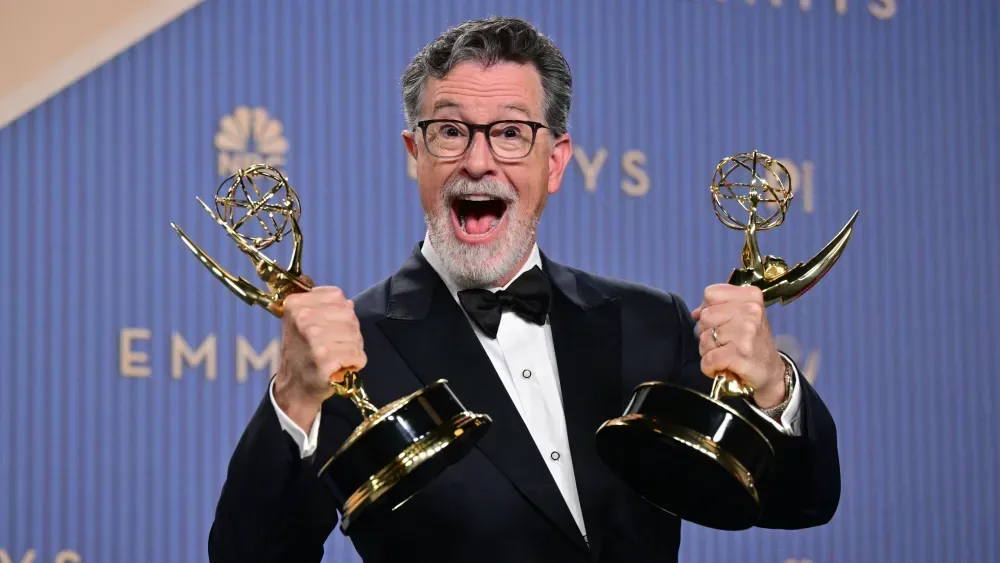
Stephen Colbert’s run on The Late Show With Stephen Colbert received a conspicuous final flourish at the Emmy Awards: the series won outstanding variety series after CBS had already canceled it. The award recognized the program’s final season, which ended in May, and gave the team a moment of celebration after its production had concluded.
Colbert’s response centered less on an obituary for his own show than on the continued importance of late-night television as a format. He said he believed free speech remained healthy, drawing a distinction between criticism or professional consequences and a situation in which someone is jailed for speaking. It was a compact but meaningful framing from a host whose program regularly combined comedy, politics, interviews and topical commentary.
His larger point was optimistic: late night, in his view, is still funny and still necessary. Colbert also spoke warmly about the people working across the field, citing “Jimmy and Jimmy and John and John and Seth and everybody else.” The intentionally broad roll call captured the communal nature of an often competitive TV category. These shows compete for viewers, awards and cultural attention, but they are also made by writers, performers, directors, crews and guests who know the distinctive demands of putting current comedy on television at a relentless pace.
A final-season win in a crowded field
The Late Show With Stephen Colbert took the top variety-series honor over an unusually formidable slate of nominees: Comedy Central’s The Daily Show, ABC’s Jimmy Kimmel Live!, HBO Max’s Last Week Tonight With John Oliver, and NBC’s Saturday Night Live. Every contender represents a different version of modern comedy television, from nightly desk monologues and sketch comedy to weekly satirical analysis.
That context makes the win especially notable. The award was not simply a retrospective pat on the back for a departing series. It was a vote for the final season’s overall work amid programs with immense histories and deeply established award credentials. For the people who built The Late Show day by day, it also affirmed that a show’s identity is never limited to the familiar face at the desk.
Colbert explicitly redirected attention toward that wider team after the ceremony. He highlighted the writers, director, technical director, camera and lighting departments, plus the digital team. He also referred to the creative-arts honorees who had been recognized earlier in the Emmy cycle. The sentiment matters because late-night TV can look deceptively simple from a living-room couch: a host, a desk, a guest chair, a band, perhaps a carefully timed cutaway. In reality, it is an elaborate production machine built to respond quickly to a changing news cycle while retaining a recognizable tone and visual rhythm.
The show’s award count underscores that breadth. Before the main ceremony, it had won four honors during the first Emmys weekend:
- Outstanding Writing for a Variety Series
- Outstanding Directing for a Variety Series
- Outstanding Technical Direction and Camerawork for a Series
- Outstanding Lighting Design/Lighting Direction for a Series
- Outstanding Picture Editing for Variety Programming (Segment)
With outstanding variety series added afterward, the final season finished with five Emmy wins. The individual craft prizes offer a more precise view of what was celebrated: the writing that shapes a show’s voice; direction that turns live-or-live-feeling material into television; camera and technical execution; lighting; and editing, especially for segments that need to land their jokes and arguments cleanly. The top award then brings those departments together under one series-wide recognition.
Related coverage includes Stephen Colbert Celebrates Emmy Win for ‘The Late Show’ After CBS Cancellation.
Colbert answers political questions with a dodge and a joke
The aftermath of the cancellation naturally brought questions about whether the program’s political approach played a part. Asked whether he believed President Donald Trump was responsible for the cancellation, Colbert did not provide a direct answer. Instead, he pivoted with a comic bit about the interviewer’s dress and then claimed to be deaf in the ear hearing the question.
When Bari Weiss came up, Colbert again declined a substantive response, saying that he had never heard of her and adding, “I hear great things.” The remarks fit the familiar Colbert instinct to answer a loaded entertainment-industry question in characteristically evasive, joke-forward fashion rather than turn an awards-night exchange into a declaration about motives behind the network decision.
There is a useful boundary to maintain here. CBS canceled the series, and the final season ended in May. Beyond those facts, Colbert’s on-camera responses did not establish a cause for the cancellation. His remarks instead put the spotlight on what he wanted to celebrate that night: the show’s people, its accumulated work and a continuing belief in the value of the late-night space.
Why the crew recognition is central to this Emmy moment
A late-night show’s final episode or final season is often discussed as a host’s farewell, because the host serves as the public center of the project. Colbert’s comments made a different case. The Emmy outcome belongs to a large group of people whose names may scroll by quickly at the end of broadcasts but whose work determines whether the program can function at all.
Writing teams need to transform the day’s events into material that reflects a specific host and a specific show. Directors and technical crews must coordinate cameras, audience reactions, performers, interviews and pre-produced pieces. Lighting needs to flatter an instantly recognizable studio environment while accommodating different guests and segments. Editors shape pieces that may have been assembled under serious deadline pressure. Digital teams help a program live beyond its original TV airing, where a single monologue clip or segment can reach viewers who did not watch the broadcast in real time.
That is why a final-season Emmy for variety series carries a different kind of weight from an isolated performance trophy. It recognizes an operating ecosystem. Colbert said it was incredible to be reunited with colleagues he had not seen for four months, and that reunion supplied much of the emotional texture behind the win. The show had ended; the people responsible for it were together again; their work was being honored on one of television’s largest stages.
The wider Emmy ceremony also supplied several moments focused on television history and the people whose work has shaped it. For more from the same awards season, see our coverage of Michael J. Fox receiving the Bob Hope Humanitarian Award at the Emmys.
Late night’s future is bigger than any one desk
Colbert’s comments did not pretend that a canceled flagship program is inconsequential. A long-running late-night series is a major creative workplace, a platform for guests and musicians, and a regular ritual for its audience. Its end changes the television landscape. Yet his answer resisted treating the end of his own series as evidence that the genre itself is finished.
Instead, he described late night as a living collaborative culture. That is a sensible lens for understanding the category represented by the nominees. There are nightly formats, weekly formats, sketch institutions and satirical programs; each approaches current events differently, and each relies on a distinctive relationship with audiences. The form has been repeatedly reshaped by streaming, social video and the fragmentation of traditional viewing habits, but it has remained a place where television responds to the present with speed, personality and satire.
The result is a fittingly layered ending for The Late Show With Stephen Colbert. Its final season ended in May after the CBS cancellation, but its work was still honored months later across writing, direction, technical craft, lighting, editing and the flagship variety-series category. Colbert left the awards conversation sounding grateful rather than defeated, and focused on colleagues rather than speculation. For a show whose daily mission was to turn the noise of the moment into a shared laugh or pointed observation, that final recognition gives its team an unmistakable place in the year’s television record.