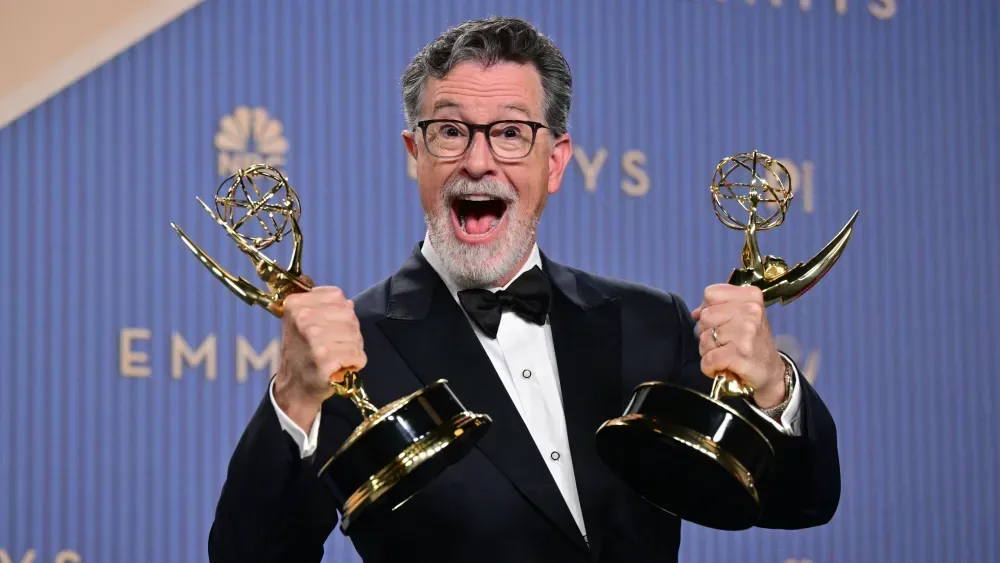
Stephen Colbert has offered a notably unambiguous answer to a question many viewers may have been asking since The Late Show With Stephen Colbert ended in May: does he miss late-night television? “Nope!”
Appearing on Jimmy Kimmel Live! shortly after his show’s final-season Emmy victory, Colbert began by acknowledging the good memories attached to the format. But when Jimmy Kimmel asked whether he ever thinks about returning to it, the former host’s answer was immediate and concise.
That bluntness does not appear to mean Colbert has turned against late night as a medium. Rather, his remarks draw a sharp line between valuing the work and wanting to resume its daily routine—particularly the task of absorbing, processing and satirizing the news every day.
An Emmy sends off a final season
The Late Show won outstanding variety series for its final season, its first victory in that category. The field included The Daily Show, Jimmy Kimmel Live!, Last Week Tonight With John Oliver and Saturday Night Live.
The award gives the series a particularly clear closing marker. CBS had announced its cancellation, and the program concluded in May. A final-season win does not change that outcome, but it does establish that the show’s work was recognized among television’s major variety programs at the point it signed off.
There is an inherent oddity to a farewell victory: it is both a celebration and a reminder that the winning season is the last one. In Colbert’s case, that tension also framed the subsequent conversation. He could speak warmly about his years in the format while making equally clear that the day-to-day burden of doing it is not something he longs to recover.
What Colbert says he left behind
Colbert described the nightly-news component of the job in deliberately extreme comic imagery, comparing its routine to being exposed to a radioactive pool and then sent in front of a camera to pass that radiation on at a “nonlethal” level. The joke lands because it names a genuine structural feature of topical late night: the host and writing staff must continually turn a rapidly changing news cycle into a show that is coherent, current and funny on an extremely short timetable.
Topical comedy is comedy built around timely public events, personalities and cultural conversations. Its advantage is immediacy. A monologue can help audiences process the day’s biggest story right when attention is at its peak. Its downside is that the work cannot simply wait until the subject feels pleasant, settled or easy to discuss. The material arrives whether it is amusing or exhausting, and the next program still has to be made.
Related coverage includes Stephen Colbert Says He Does Not Miss Late Night After ‘The Late Show’ Ends.
Colbert said he no longer has to think about the news every day. Kimmel, who saw him at the Emmys, said Colbert seemed like a different person—happier and healthier. Colbert’s response was comic, but it also explained why a host could be grateful for a career and relieved to be free of its central pressure at the same time.
That distinction matters. “I don’t miss doing this” is not the same claim as “this work has no value.” Colbert’s comments point to the workload and emotional exposure of the host’s chair, not an argument that late night should disappear.
Support for the format, even from outside it
Colbert explicitly defended the place late-night programming still holds on television. He said he considers it funny and vital, and named fellow hosts and shows he continues to enjoy watching, including the two Jimmys, John Oliver, John Stewart, Seth Meyers and others in the field.
He also connected the format to free expression, saying that an inability to speak because one could be jailed would be a violation of free speech. His formulation is precise in one important respect: he described an extreme form of state coercion, not a guarantee that anyone in entertainment will be free from criticism, commercial consequences or disagreement.
In that context, late-night television can be understood as a public-facing comic forum. Hosts and their teams make arguments through jokes, interviews and commentary; audiences can agree, disagree, switch channels or answer back. Colbert’s point is that the ability to make those arguments remains meaningful.
His praise also recognizes the communal side of an often individual-branded business. A late-night program is associated with its host, but it is produced by a large group of writers, performers, producers and crew members. Colbert called the opportunity to work with such people “the greatest gift,” a comment that sits comfortably beside his lack of desire to return to the daily grind.
Why the answer is more than a retirement quip
It would be easy to reduce “Nope!” to a tidy punchline. The fuller exchange gives it more shape. Colbert remembers the format fondly; he is pleased to see its remaining hosts continue; and his final season has just received the industry’s top variety-series recognition. Yet he does not want the responsibility of permanently monitoring the news cycle again.
That is an unusually useful description of the contradiction at the heart of topical television. Its best qualities—speed, relevance, a dependable nightly response to the world—are closely tied to its most taxing demand: there is always another day’s world to respond to.
The recent movement and pressure around unscripted and entertainment production makes that broader TV landscape feel especially unsettled. For another example of how production decisions can reshape familiar television institutions, see our coverage of the reported move of American Idol production to Georgia.
Colbert’s own next step was not addressed in these remarks, so there is no basis to treat his answer as a broader announcement about future projects. What is clear is narrower and more revealing: after the end of The Late Show, he is able to celebrate late night’s value without wanting to return to the position it demands.
A final-season legacy without a promise of a return
The outstanding variety series award places The Late Show alongside a group of programs that represent several approaches to contemporary comedy television: nightly talk, weekly satire, sketch comedy and a legacy news-comedy institution. Colbert’s comments, meanwhile, suggest that the format’s endurance should not be confused with an obligation for any one person to keep carrying its weight.
For viewers, the practical takeaway is straightforward. Colbert has not said that late night has lost its purpose. He has said that he is content to watch it from a distance after years of helping make it. The final Emmy win gives that departure a celebratory note; the “Nope!” gives it a boundary.