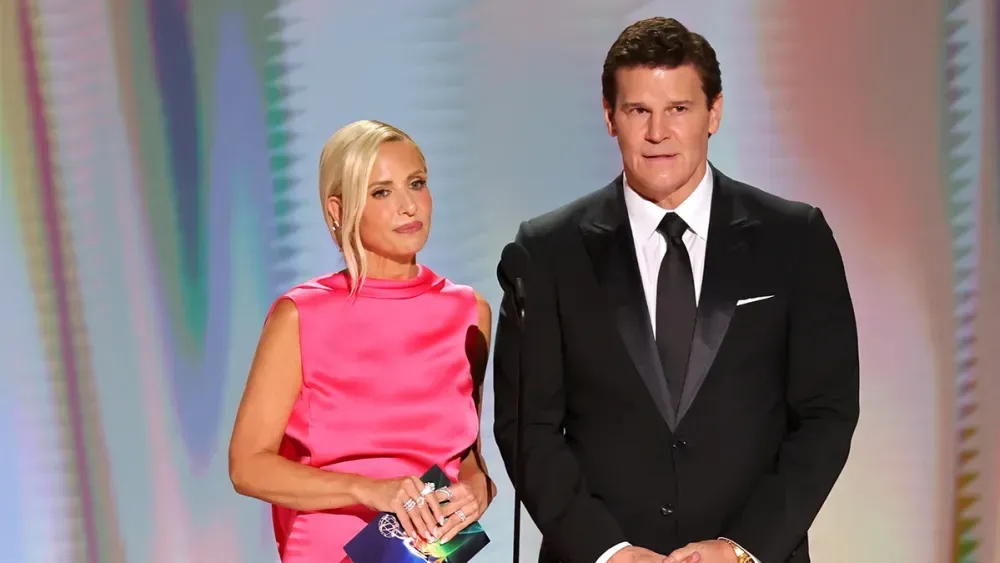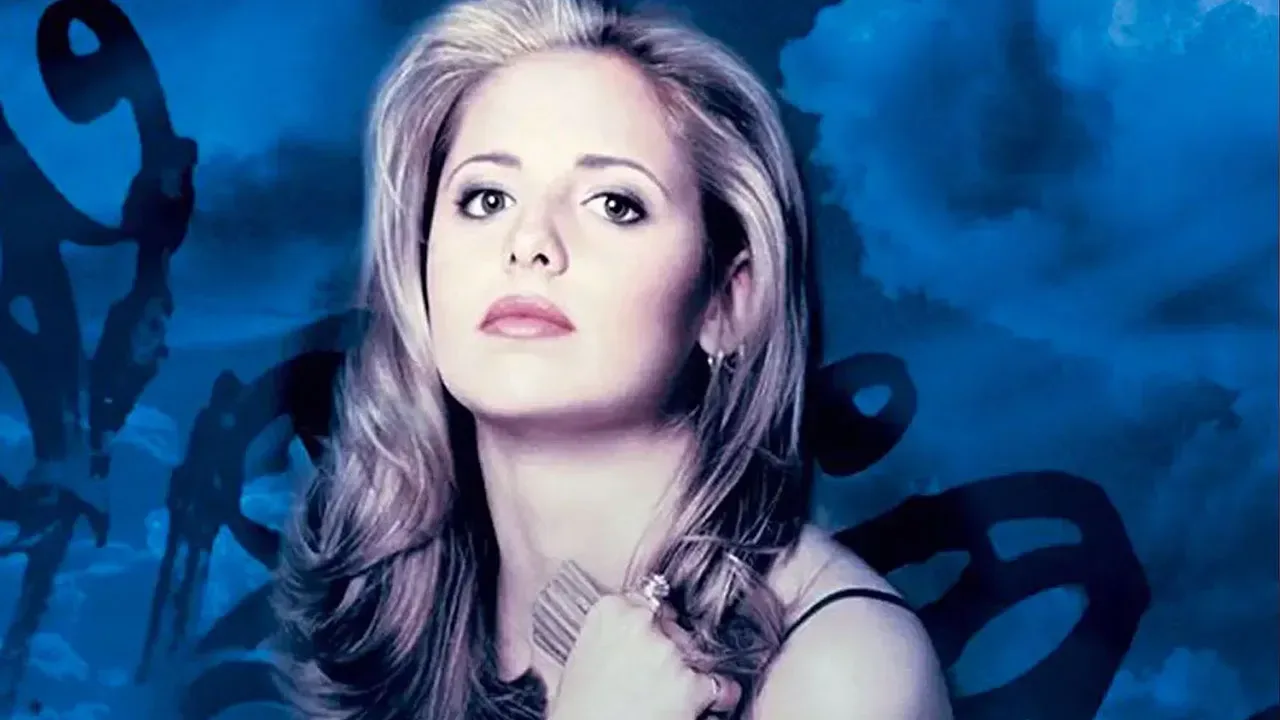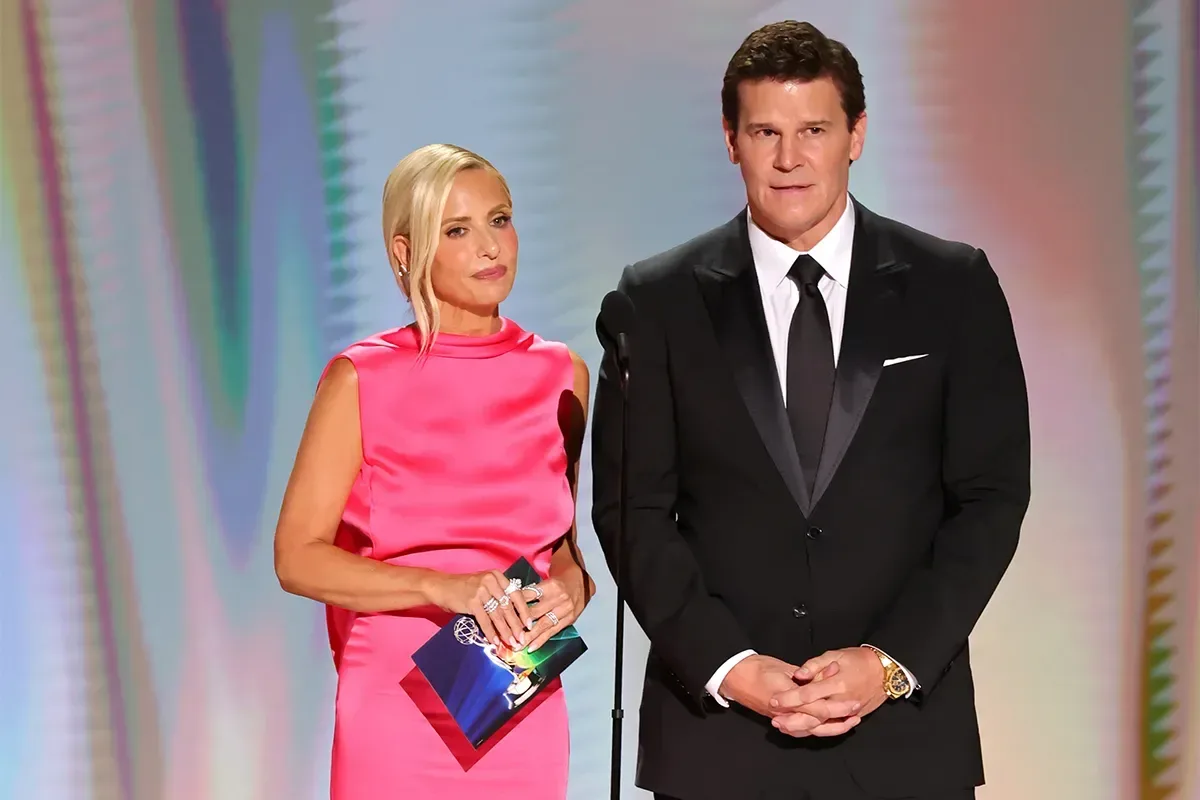
Some TV reunions arrive with a carefully prepared montage, a standing ovation and enough orchestral swell to wake a sleeping Hellmouth. Sarah Michelle Gellar and David Boreanaz went in a different direction at the 2026 Emmy Awards: they walked onstage at Los Angeles’ Peacock Theatre, immediately started teasing the foundational absurdity of Buffy the Vampire Slayer, and reminded everyone that the Buffy-and-Angel relationship has always carried a slightly wild age-gap footnote.
Gellar and Boreanaz appeared together as presenters on Monday night, bringing the Slayer and the vampire with a soul back into the same spotlight for a compact but memorable reunion. Their exchange balanced affectionate franchise humor with a pointed acknowledgment that a hoped-for continuation involving Buffy and Angel is not moving ahead.
For viewers who grew up with the series, it was a familiar dynamic: Buffy’s practicality meeting Angel’s eternal, guilt-ridden melodrama. On an awards-show stage, the pair used that history well. Gellar summarized the premise in broad strokes—a young woman fated to fight supernatural evil who falls for a remorseful vampire—then made sure the audience appreciated the less romantic mathematical detail: Angel was 241 years old.
It is the kind of joke that only works because the performers have decades of shared cultural context behind it. Buffy the Vampire Slayer was never merely about monster fights or tortured declarations under night skies. Its appeal came from how confidently it could pivot between horror, comedy, tragedy and high-school chaos, sometimes within the same scene. Gellar and Boreanaz’s Emmys banter tapped directly into that mix.
A joke with sequel-series baggage
The reunion’s sharpest laugh came when Boreanaz said he had always imagined Buffy and Angel would ultimately end up together. Gellar’s answer—essentially, that audiences will not get to learn the answer—carried more weight than a standard awards-night punch line.
Earlier in 2026, a proposed Hulu follow-up had been expected to bring Gellar back as Buffy Summers, this time in a mentor role for a new Slayer. That project was not picked up. The moment onstage therefore read as a knowing acknowledgment of an unresolved question that has followed these characters for years, while also recognizing that the newest possible chapter is no longer happening.
That does not erase the story audiences already have. Buffy and Angel’s central romance played out in the first three seasons of Buffy the Vampire Slayer, with Boreanaz continuing to make guest appearances through the 2003 finale. Angel then took his own path in Angel, the spinoff that ran from 1999 through 2004. But the relationship has always invited discussion precisely because it did not settle into a neat, permanent answer.
That ambiguity is part of the property’s staying power. Buffy and Angel were never written as a simple endgame couple; their connection was repeatedly shaped by sacrifice, distance, competing duties and supernatural rules designed to make happiness an occupational hazard. A tidy resolution would have changed the texture of both shows. The Emmys exchange did not solve the question, of course. It made a joke out of the fact that the question is still alive.
Related coverage includes Sarah Michelle Gellar and David Boreanaz Reunite at 2026 Emmys.
There was another unmistakable piece of 2026 context around the ceremony itself. Awards-season coverage also included plenty of red-carpet discussion, including the attention surrounding Zendaya’s crystal Prada Emmys look. Yet Gellar and Boreanaz showed how an appearance can become a headline without a costume reveal or a new trailer: put two defining genre-TV stars together, hand them a microphone, and let nearly three decades of fan memory do the rest.
A moment that also made room for remembrance
The presenters did not leave the reunion solely in nostalgia mode. Gellar also acknowledged the difficult losses experienced by the wider Buffy cast and crew in the last two years, saying that she and Boreanaz were fortunate to have known and worked alongside so many remarkable people.
The words followed several major losses connected to the series. Nicholas Brendon, who played Xander Harris, died in March at the age of 54. Anthony Head, whose Rupert Giles served as Buffy’s Watcher across all seven seasons, died in June at 72. Michelle Trachtenberg, who joined the series in season five as Buffy’s younger sister, Dawn Summers, died in February 2025 at 39.
That brief acknowledgment added a more human dimension to what could otherwise have been treated as an uncomplicated pop-culture throwback. Long-running series create an unusual kind of shared history. Fans remember characters, episodes and lines, but the people who made the work also spent years building a creative community. When reunions happen decades later, they can naturally hold joy and grief at the same time.
Buffy has always had an ensemble identity even when Buffy herself was its center. Alongside Gellar, Boreanaz, Brendon, Head and Trachtenberg, the series featured Alyson Hannigan, James Marsters, Charisma Carpenter, Emma Caulfield and Eliza Dushku. The cast expanded and shifted over seven seasons, but the show’s friendships, alliances and fractures were inseparable from why its supernatural stories landed.
From 1997 genre series to Emmys-stage legacy
Buffy the Vampire Slayer began in 1997 and ran for seven seasons. Gellar played Buffy Summers, the titular Slayer whose destiny required her to confront vampires, demons and forces of darkness while trying to maintain something resembling a life. Boreanaz’s Angel began as her love interest and quickly became one of the show’s most consequential figures, in part because his history and curse made romance fundamentally unstable.
Its influence is easier to see now because many later genre series embraced the same refusal to choose one tone. It could make a monster into a metaphor, give a side character a devastating arc, then pivot to a ridiculous bit of dialogue before the credits. The formula was not simply “teen drama plus vampires.” It was a character-driven fantasy world with room for comedy, fear and pain—and with enough confidence to make its mythology increasingly strange.
The show’s relationship with the Primetime Emmys was real, if limited compared with its wider impact. Buffy the Vampire Slayer received 14 Primetime Emmy nominations during its run. In 1998, it won for outstanding makeup for a series and outstanding music composition for a series for dramatic underscore. Angel later earned a 2000 nomination for outstanding makeup for a series, though that award went to The X-Files.
Those achievements matter because they reflect crafts that were central to the franchise’s credibility. The monsters had to be convincing enough to support the emotion; the score had to know when a scene needed menace, melancholy or momentum. The shows’ effects and music helped turn comic-book-scale storytelling into something that could still feel intimate.
The award they came to present
Gellar and Boreanaz were onstage to present the Emmy for outstanding lead actor in a limited or anthology series or movie. Matthew Rhys won the award for The Beast in Me.
It was a straightforward presenter assignment, but casting the two actors together gave it a larger afterlife than the category alone. The Emmys frequently rely on famous pairings to trigger recognition, and few late-1990s and early-2000s genre pairings come with a more immediate emotional shorthand than Buffy and Angel. Their characters’ history is so well established that even a quick joke about a 241-year-old vampire can carry an entire room.
The moment also underscored the difference between a cancellation and an ending. The planned Hulu revival not being picked up means there will be no new project from that particular route. It does not retroactively change the seven seasons of Buffy, the five seasons of Angel, or the attachments audiences formed with those stories. Gellar and Boreanaz did not promise anything new, and their exchange offered no reason to infer a future production. What it did offer was smaller and, in its own way, more fitting: two actors recognizing a famously unresolved romance, making each other laugh, and honoring the people with whom they shared a long television legacy.
For one Emmys segment, the Slayer and her tragic vampire were back on the same stage. The apocalypse was not cancelled, no prophecy was decoded, and no final answer arrived for Buffy and Angel. But the reunion proved that the connection between the performers, the characters and the audience remains remarkably durable.