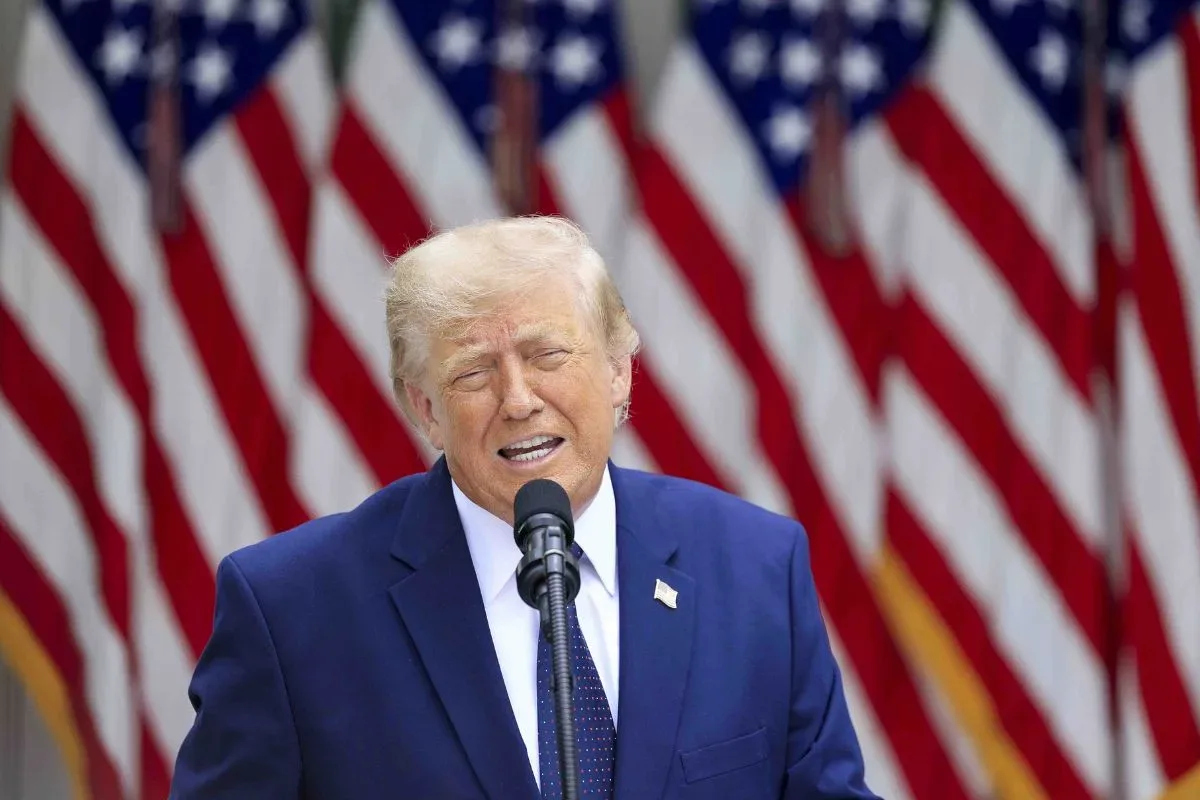
There are political stories, there are celebrity-style stories, and then there are the strange intersections where a hairstyle becomes the entire internet’s unofficial group project. Donald Trump’s appearance at Joint Base Andrews before a Bedminster golf weekend landed squarely in that third category. Photographs showed the president boarding Air Force One with hair that appeared noticeably darker brown and less voluminous than the familiar blond-toned look associated with him for years.
The images spread rapidly on September 7, 2026, and the response followed the modern online playbook with astonishing efficiency: side-by-side comparisons, punch lines, disbelief, arguments over lighting, and a renewed avalanche of wig speculation. The visible change was enough to make the look a pop-culture conversation, even though the larger question people kept asking—whether Trump wears a hairpiece—still has no confirmed answer.
That uncertainty is important. A hair color or style shift, particularly in photographs taken under different conditions, is not proof of a wig, a procedure, or a specific product. The broader discussion has been driven by appearance and interpretation, not independently verified evidence establishing what caused the change.
A New Shade, an Instant Meme Cycle
The Joint Base Andrews photos caught attention because the contrast appeared sharp. Trump’s hair looked darker than the yellow-blond or light auburn look that has long become part of his highly recognizable public image. It also appeared flatter or less puffed up than in certain recent appearances. For an online audience trained to notice every alteration in the visual branding of public figures, that was more than enough material.
Journalist Aaron Rupar reacted online by asking what was happening with Trump’s hair. Writer Molly Jong-Fast made the simple observation-joke that Trump had become a brunette. Attorney George Conway also mocked the change, tying the hairstyle to a joking reference to the 25th Amendment. Comedian Samantha Ruddy framed it as a basic desire for a change.
None of those posts resolves anything about the hair itself. They do show why the images traveled so quickly: the joke works even for people who have paid little attention to the long-running rumors. Trump’s hair has become a persistent visual shorthand in politics and late-night comedy alike. Any departure from the established silhouette invites people to treat a mundane grooming question as if it were a major character redesign in a long-running franchise.
It is the kind of reaction that makes image-based political discourse resemble fandom. Viewers catalog eras, debate continuity, compare screenshots, and decide that one unexpected photo represents a permanent redesign before the next appearance has even happened.
The Summer’s Hair-Style Timeline
The darker appearance did not arrive in isolation. It capped a stretch of public appearances in which Trump’s hair was already drawing unusual attention. On August 5, during a speech in Las Vegas, he appeared with a fuller and more voluminous look. That image sparked a new burst of theories online about whether a hairpiece could be involved.
On August 14, Trump himself made a comment about “puffing up” his hair with certain products. Ten days later, an event at the White House marking the start of the school year offered another variation: a flipped side part that was again noticeably different from the classic look observers expect.
Then, at a Rose Garden dinner for Republican lawmakers, Trump directly rejected the wig claims. He referred to a windy 2024 campaign rally in Ohio and said he had been dealing with rumors about his hair for years. His denial came only three days before the Joint Base Andrews photographs added darker color to an already busy run of hair discourse.
Put together, the sequence helps explain why a change that might otherwise have been dismissed as lighting, styling product, dye, or a quick salon decision became an event. The audience was primed to look. The Las Vegas volume, the later side part, Trump’s own reference to styling products, the public denial, and then the darker look all created a running series of visual moments.
What Is Known—and What Still Isn’t
It is fair to say the photos prompted discussion because Trump’s hair appeared darker and less voluminous at Joint Base Andrews. It is also fair to say he has repeatedly denied wearing a wig. Going beyond that requires caution.
A review of the Las Vegas imagery by Snopes concluded that the available photographs did not provide a way to either verify or eliminate the possibility of a hairpiece. That is a sensible boundary for the conversation. Pictures can invite guesses, but they cannot reliably settle every detail of someone’s grooming routine, especially when angles, wind, product, camera processing, and lighting can transform how hair reads on screen.
Some online discussion also points back to a reported 1989 scalp procedure described in a biography that cited court testimony from Trump’s first wife. That historical claim is often folded into current speculation, but it does not establish what produced the appearance in any particular 2026 photograph. A decades-old account and a recent viral image are not interchangeable evidence.
Trump has contested wig rumors publicly for a long time. In 2015, during an event in South Carolina, he invited a supporter onstage to tug his hair as a demonstration that it was real. That moment became part of the folklore surrounding the question, and it also illustrates why the topic keeps returning: the rumor has existed for so long that every new hairstyle is interpreted through it.
Why Hair Keeps Becoming a Political Sideshow
For prominent politicians, appearance is inseparable from recognition. A suit, a gesture, an expression, or a hairstyle can become visual identity at a scale most people never experience. Trump’s hair is particularly entrenched in the public imagination because its shape and color have been repeatedly caricatured, parodied, discussed, and reproduced for decades.
That makes even a potentially minor adjustment unusually conspicuous. In a less famous person, a darker color might earn a compliment, a question from a colleague, and then disappear into the day. In Trump’s case, the change becomes a high-speed referendum on authenticity, age, image management, and ideology, with memes serving as the loudest language in the room.
The reactions also sorted into familiar political camps. Critics used old and new images to emphasize the apparent shift and make fun of it. Supporters generally treated the discussion as frivolous or overblown. Both responses are predictable, but neither one answers the factual question of whether the appearance resulted from dye, styling, lighting, a hairpiece, or some combination of ordinary factors.
That gap between what photographs show and what online communities claim to know is worth keeping in view. The definite takeaway is not a diagnosis of Trump’s hair. It is that a darker, flatter-looking style at a highly visible travel departure was enough to reignite one of the internet’s most durable political-running gags.
The Joke Is Bigger Than the Hairstyle
There is a reason the meme cycle did not need a detailed explanation to take off. The joke depends on contrast: a public figure known for an iconic, unusually recognizable look appeared briefly with a different shade and shape. The transformation was visible enough to fuel comedy, but ambiguous enough to keep the comment sections going.
In that respect, the episode belongs to the broader world of pop-culture image watching, where people scrutinize everything from red-carpet changes to on-screen costume details. The difference is that a president’s visual presentation arrives with a political audience already attached. What could be a low-stakes makeover discussion instead becomes an endless thread of competing interpretations.
For readers who enjoy the ways technology changes how pictures travel and get interpreted, our look at sending Android photos and videos to an iPhone without wrecking the details is a useful reminder that image quality and processing can matter before a comparison post ever reaches a timeline.
For now, the viral photos establish only the visible shift that set the conversation off: darker-looking brown hair, less apparent volume, an Air Force One departure, and an internet ready to turn a cosmetic question into a week’s worth of content. Trump’s long-standing denials remain part of the record. The wig claim remains unverified. The memes, as usual, required no such certainty.