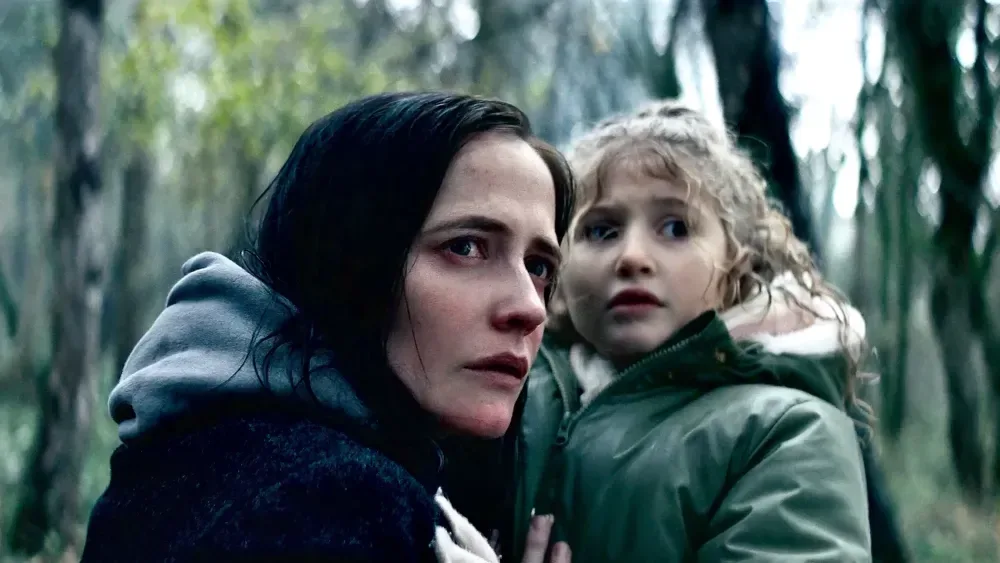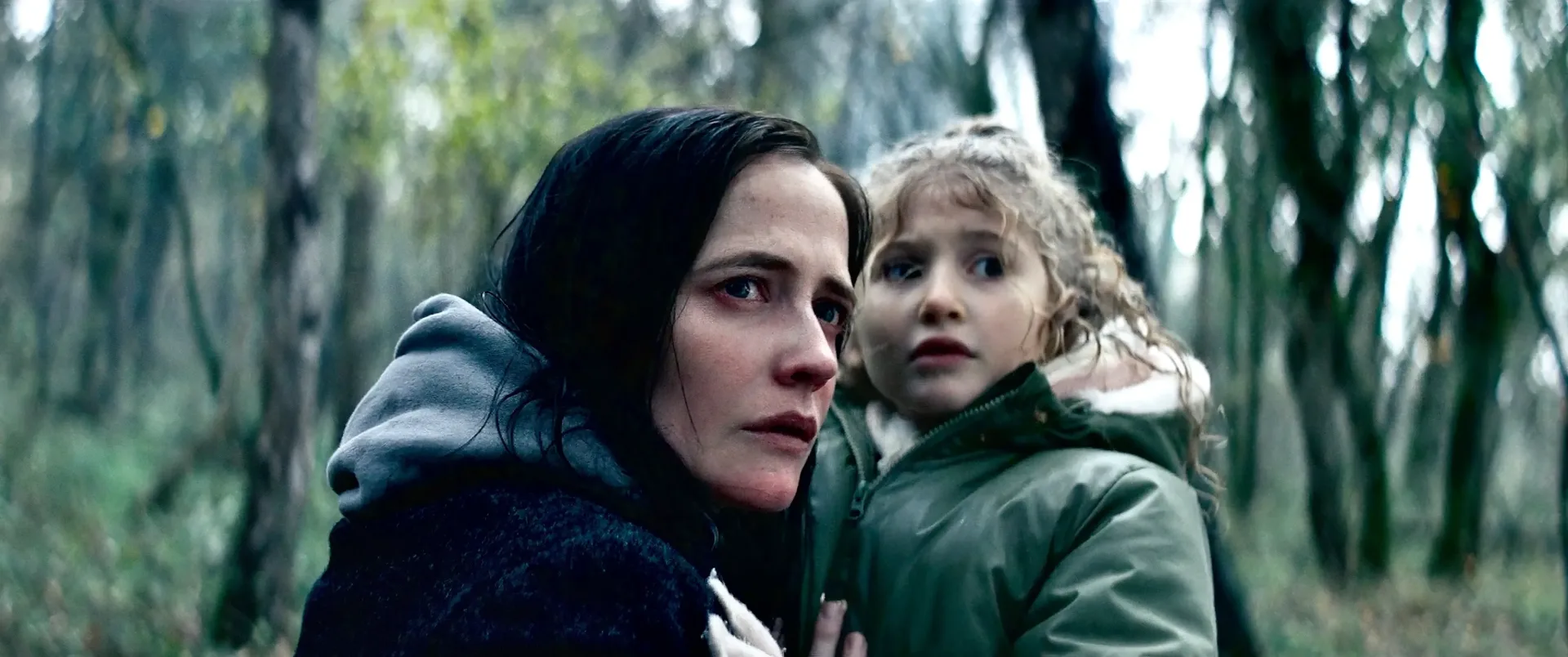
Bahman Ghobadi’s Trees Are Watching arrives with the bones of an unusually promising folk-horror story: Kurdish superstition, an old home altered by modern construction, a child detecting things adults cannot, and a carved chair whose apparent movements turn domestic space into a threat. Eva Green leads the film as Darya, a woman returning to Mardin, Turkey, with her Deaf, nonverbal daughter Connie, played by Neva Kuş, to undertake anthropological research.
But the film’s striking premise and committed performers are reportedly set against a deeply divisive formal choice. Much of its imagery, including flashback material and later connective shots, uses generative A.I. visuals. That decision does not merely register as a technical curiosity. It changes the texture of the film, creates a disconnect with its live-action performances, and raises questions about creative labor, training data and audience disclosure—particularly for a movie whose own story is concerned with memory, objects and human lives lingering inside physical forms.
Trees Are Watching premiered in the Centerpiece section at the Toronto Film Festival on September 17, 2026. It runs 106 minutes and contains English, Kurdish and Turkish dialogue. The Turkish production is directed and written by Ghobadi, with cinematography credited to Saba Mazloum and Touraj Aslani. Martin Scorsese is listed as executive producer.
A homecoming shaped by a Kurdish legend
The film begins in the past, with three Kurdish girls discussing a belief that people may be reborn as trees and then continue a second existence as furniture. That is a potent horror conceit because it turns ordinary surroundings into possible repositories of identity, grief and unfinished conflict. A tree is no longer just scenery; a chair is no longer simply something made from wood. Both can become evidence of a life that has changed state without fully disappearing.
Years later, Darya returns from abroad to the region with Connie. Their rented home is a modern addition to the place where Darya’s childhood friends, Nihal and Spin, once lived. Two tall trees stand outside. Inside, the household dog reacts violently to an ornate chair, while Connie says the furniture is moving on its own. As strange noises reach Connie through her hearing aid, the chair increasingly functions as the film’s central apparition: a possible vessel for a spirit tied to Darya’s history.
Connie’s perspective is important to the setup. Rather than treating her hearing aid as a simple plot device, the premise positions sound as a source of unease and access: she receives unsettling signals that the adults around her cannot easily interpret. Kuş’s performance is described as especially energetic and vivid, helping build tension in scenes where the supernatural begins to press against the everyday.
The plot then expands through flashbacks concerning Nihal and Spin, two sisters raised by a troubled, controlling mother. Their fearful understanding of spirits and of objects in contemporary spaces gives the folkloric premise a more intimate setting. The material also reaches toward a parallel with Darya’s own challenges as a parent, including her use of unspecified medication. Yet the thematic relationship between the girls’ childhood and Darya’s family life is presented as underdeveloped, even as Green works to give Darya emotional force beyond the sparseness of the script.
The performances and staging carry the strongest human presence
There is a clear distinction between the parts of Trees Are Watching that rely on performers and carefully composed live-action staging and the portions built from generative imagery. Green’s work as Darya is one of the film’s central assets. Her character has to balance research, motherhood, return-home anxiety and the destabilizing possibility that childhood trauma is becoming physically present. That is a demanding set of emotional pressures for any performer, especially when the narrative’s explanations and flashback structure do not always line up cleanly around her point of view.
Related coverage includes ‘Trees Are Watching’ Has Striking Performances but Stumbles on A.I. Horror.
The younger cast is another major strength. The actresses playing Nihal and Spin reportedly make the past-tense scenes feel alive, giving their characters the fear and vitality of children growing up under a domineering parent. The supernatural belief is therefore not treated only as a detached piece of lore. It becomes part of how the sisters understand danger, family and the unstable boundary between old traditions and modern life.
Ghobadi and cinematographers Mazloum and Aslani also find unsettling compositions in direct encounters between characters. One recurring approach turns an expected over-the-shoulder image into a view that peers over a character’s scalp, obscuring mouths during conversation. The effect can make the audience uncertain not only about the people whose faces are partially withheld, but about the dialogue itself. In horror, concealing a mouth can be more unnerving than concealing eyes: speech is still heard, but the visible proof of who is talking and how they are talking is interrupted.
That visual grammar suits a story about uncertain testimony, recovered history and haunted objects. It also demonstrates why the film’s reported dependence on A.I.-generated imagery has drawn such a severe response. The live-action material is said to show a director attentive to bodies, faces, space and dramatic framing. When the film shifts into images that lack the same sense of physical coherence, it risks undoing the tension those elements establish.
What “generative A.I.” means in this case
Generative A.I. refers to systems that produce new-seeming text, images, sound or other media from patterns learned during training. In a film context, it can be used to make imagery that resembles an illustration, an effects shot or an establishing view without photographing the final result in the conventional way. An establishing shot is a shot that orients viewers in a setting before or during a scene; connective tissue refers to short material that links moments, locations or plot beats together.
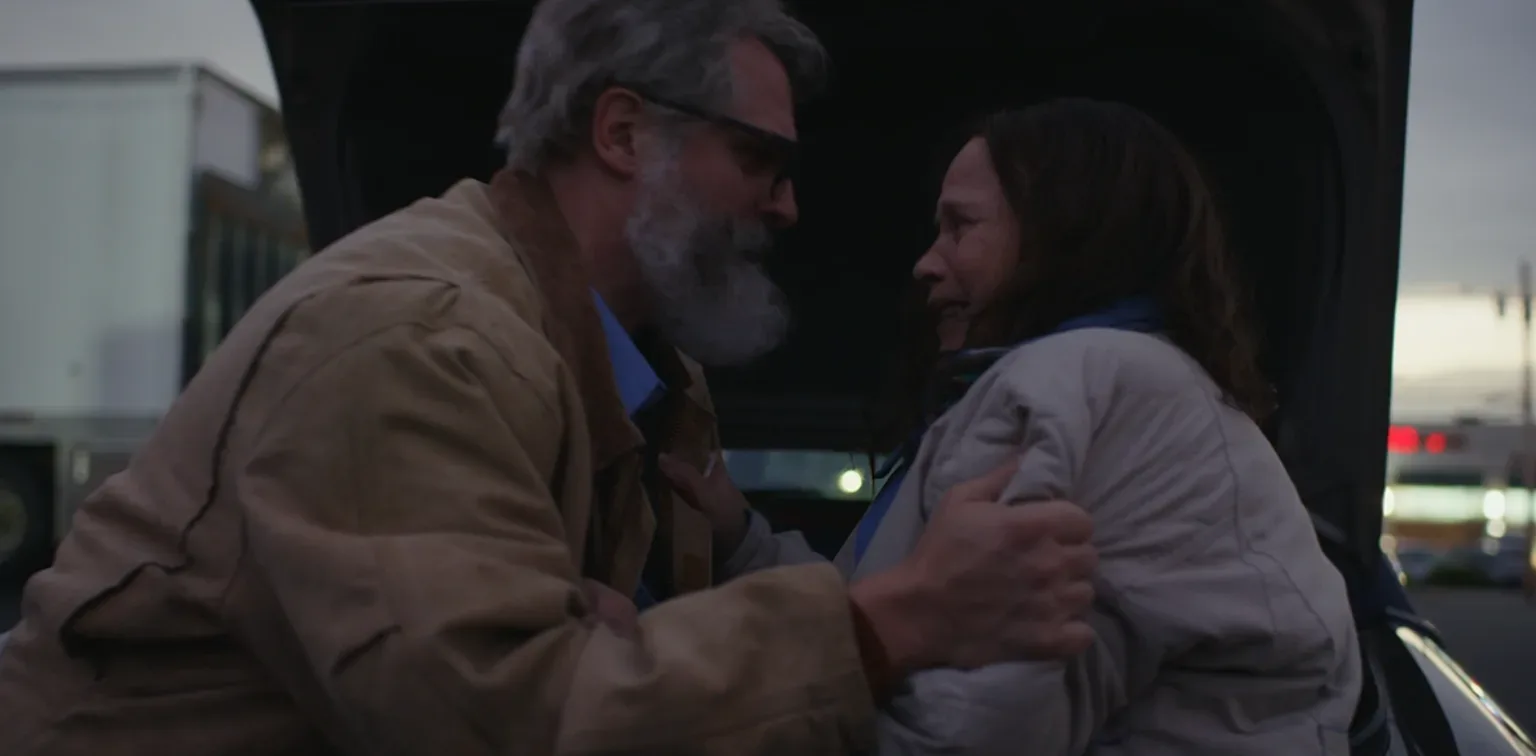
Those functions are not trivial. A landscape shot may establish geography, tone and rhythm. A brief image bridging two scenes can make a transition feel natural rather than abrupt. In Trees Are Watching, the reported A.I. use extends beyond isolated asides: it includes folklore-related flashbacks and, later, establishment and transition material. One cited example involves overhead imagery of Darya driving toward a police station while moving past long stretches of felled trees.
That matters because the more a film asks generated imagery to carry spatial orientation and narrative movement, the harder it becomes to regard it as a brief stylized interruption. Instead, it becomes part of the movie’s fundamental visual language. If its textures, perspective or continuity clash with photographed footage, viewers may stop following the drama and start scrutinizing how the image was made.
For a horror movie, artifice can be useful. Distortion, discontinuity and unfamiliar motion can all create dread. But the objection here is not simply that the imagery looks strange. It is that it reportedly feels disconnected from the film’s human performances and from the precision visible in its live-action staging. The result is described as less like a purposeful surrealist rupture than an intrusion that makes shots feel assembled from incompatible sources.
Environmental imagery meets an environmental contradiction
The sequence of felled trees also places the movie in an awkward position. On one level, cut trees are symbolically relevant to a story in which trees are associated with rebirth and transformed lives. They can suggest destruction, displacement and the violent severing of a bond between a person, place and object.
On another level, the film’s use of imagery associated with generative A.I. complicates any environmental reading. The technology has been criticized for substantial water use and environmental impact. That does not automatically prevent a story from engaging with environmental themes, but it does make the visual choice difficult to separate from the message when tree-felling appears in the narrative itself. A film can certainly depict ecological damage while using modern production tools; the issue is the tension created when a work’s symbolic concern appears to collide with concerns surrounding the method used to portray it.
It is also a reminder that “digital” does not mean consequence-free. Audiences often encounter generated imagery as a screen-level aesthetic question—does it fit, and does it look convincing? Yet the broader debate includes the labor behind creative work, the data used to train systems, questions over copyrighted material, and the physical resources used by computing infrastructure. Those are not details that an audience can necessarily identify from a trailer or a ticket listing.
Why disclosure is becoming part of the conversation
The response to Trees Are Watching raises a practical question for festivals and distributors: should audiences be told when a film uses generative A.I., and how prominently?
Disclosure would not settle every ethical or artistic dispute. It would, however, let viewers make an informed decision before paying for access. That is particularly relevant when generative material is extensive enough to affect the movie’s style rather than appearing as a tiny post-production element. A clear notice could also distinguish different uses: concept development, limited visual alteration, or fully generated sequences. Those are meaningfully different practices, even though they are often grouped under one broad A.I. label.
For viewers, the larger lesson is not that every technically unconventional horror film should be rejected. Horror has always made room for broken images, unreliable perspectives and deliberately artificial surfaces. The useful question is whether the method strengthens the story’s specific fears. In this case, the strongest reported material comes from actors inhabiting a house, a family history and a local superstition with tangible stakes. When the movie relies instead on generated images to explain, expand or transport the narrative, its mystery reportedly becomes more literal and less persuasive.
That makes Trees Are Watching a frustrating case rather than an empty one. Its ingredients are distinctive: Kurdish folklore, a returning researcher, a mother-daughter relationship, gifted young performers and a chair that turns domestic design into a threat. Green, Kuş and the performers playing the sisters appear to supply the human detail that the premise demands. Ghobadi’s live-action compositions show a capacity for unnerving visual ideas as well.
Yet the central concern is that the film gives away too much of that advantage. Repeated explanatory epilogues reportedly weaken the ambiguity around the chair and the past, while the increasing use of A.I.-generated material fractures the atmosphere. The result is a folk-horror film whose most compelling promise lies in its physicality—wood, rooms, faces, sound and inherited fear—but whose most controversial decision pulls it away from those tactile strengths.
For more screen-focused pop-culture coverage, read our look at how Anchors Aweigh uses MiniDV nostalgia to unsettle its protagonist.