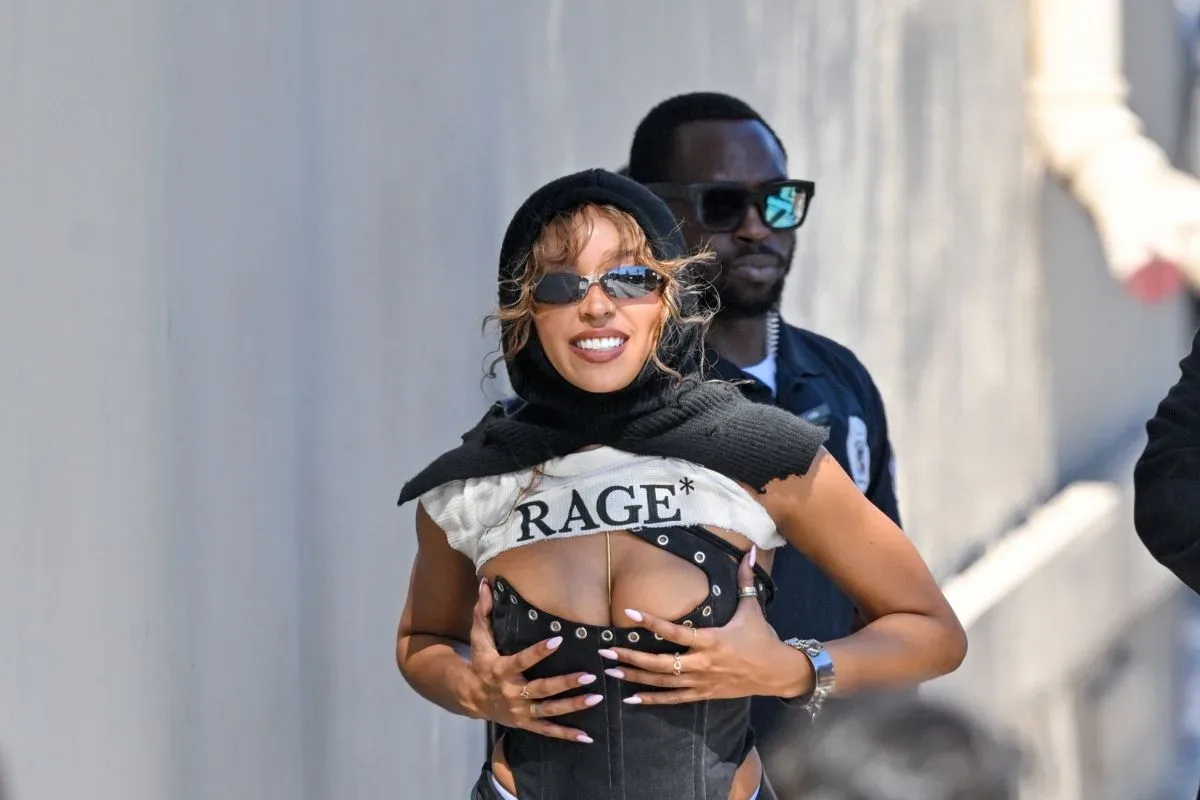
Tinashe did not hedge when Election Day replies turned a voter-turnout message into an argument over whether an artist owes political neutrality to paying fans.
The singer posted, “VOTE OR DIE ! LETS GO AMERICA,” followed by 12 blue heart emoji. The hearts were widely read as a show of support for Democrats, and several conservative followers objected. One response argued that she was pushing away her “red audience” and questioned why the blue hearts were included. Tinashe’s answer was brief: “Yall can go ✌️.”
In a separate exchange, another user wrote off the election as an illusion. Tinashe replied, “Lame !!!!” And when a critic stressed that Republican listeners had spent money supporting her work despite political disagreements, then said they would stop listening, she offered an equally unambiguous answer: “I do not care.”
The social-media clash is not simply a disagreement about emoji. It centers on a familiar expectation placed on entertainers: that retaining the broadest possible audience should mean avoiding positions that could offend fans on the other side of a political divide. Tinashe’s replies reject that premise. Her message was that those listeners are free to leave rather than entitled to a less partisan version of her public voice.
A voting message becomes a dispute over fandom
“Get out the vote” language is generally an appeal for participation, not necessarily an endorsement of a candidate or party. In this case, though, the blue hearts shaped how followers interpreted the post. Blue is commonly associated with the Democratic Party in US electoral culture, so critics treated the post as more than a generic reminder to cast a ballot.
That context explains why the replies quickly shifted from voting itself to audience loyalty. The objecting users were not only disputing Tinashe’s politics; they were arguing that commercial support from people with opposing beliefs should encourage her to keep those beliefs out of the artist-fan relationship.
Tinashe did not accept that trade-off. “Yall can go” makes the boundary especially plain. It does not ask unhappy listeners to reconsider, attempt to find common ground, or separate the music from the political statement. It says departure is an acceptable outcome.
Her “I do not care” response sharpens the same point. A listener can decide not to buy music, attend a show, or follow an artist. An artist can also decide that avoiding such a loss is not worth softening a political view. Neither choice settles the underlying political disagreement, but together they show that the relationship is voluntary rather than a bargain requiring silence.
Related coverage includes Tinashe Dismisses GOP Fan Backlash Over Election Day Post.
This was consistent with Tinashe’s earlier election-year activity
The position did not emerge out of nowhere. Before the 2020 presidential election, Tinashe publicly argued that another Donald Trump term would hurt groups she believed his administration had not protected. Her endorsement was direct: “Vote for Joe Biden, period.”
She also took part in Election Day activity that year at SoFi Stadium in Inglewood, California, while the venue operated as a vote center. At the time, she said she wanted to encourage fans to vote and involve younger people in the process.
Those earlier moments matter because they distinguish a longstanding public stance from an improvised online response. The new exchange may have been sharper in tone, particularly toward fans raising the issue of spending money on her career, but electoral participation and Democratic support have both been part of her public commentary before.
There is a difference between an artist making a political point and an artist asserting that political disagreement has no practical effect on their career. Tinashe has not claimed the latter. Some critics explicitly said they would stop listening. Her response instead indicates that the possibility of lost listeners does not alter what she wants to say.
Independent success gives the argument a particular backdrop
The timing also arrives during an important stretch in Tinashe’s independent career. Popstar, released September 25, became her first Top 10 album on the Billboard 200, debuting at No. 6. That surpassed the No. 17 high reached by her 2014 album Aquarius.
She has also announced an 18-date North American tour scheduled to begin April 14, 2027, in Dallas. The run follows three sold-out “3 Nights With A Popstar” shows in Chicago, Brooklyn, and Los Angeles.
Those facts do not prove that one online dispute will help or harm ticket sales, streaming, or album performance. The available information does not establish that. What it does show is why some replies framed the disagreement in economic terms: Tinashe has a visible commercial moment underway, and critics wanted to emphasize that fans can express disapproval through their spending choices.
But success can also change the perceived stakes of speaking plainly. An artist in the middle of a major album cycle and an upcoming tour has more attention around every public statement. The reaction therefore becomes part of the broader conversation surrounding the music, even if it is not part of the music itself.
For fans, the practical distinction is useful. A performer’s political speech is not a requirement that every listener agree with them. Nor does being a listener require an artist to maintain ideological neutrality. People may continue listening, disengage, or discuss the disagreement; Tinashe’s replies make clear that she is not seeking to preserve support by disguising her preference.
Politics is present in the recent work, too
The Election Day discussion also has a connection to themes in Tinashe’s current material. On “Crash Out,” she sings, “The American dream is outdated.” In an October profile, she discussed the tension between the promise of that dream and the lived reality that many people experience.
The American dream is a broad cultural idea rather than a fixed political program. It commonly refers to the promise that hard work can bring stability, advancement, and opportunity. Saying that ideal is outdated challenges the gap between the promise and the conditions people actually encounter. That is a social observation, but it naturally overlaps with politics because elections, public policy, and political leadership are all places where people argue over those conditions.
That does not mean every lyric needs to be read as a campaign statement. It does mean that Tinashe’s Election Day comments are not wholly disconnected from the subjects she has recently put into her art and interviews. The friction between a national ideal and everyday reality is a thread she has already raised.
For a pop artist, this is also a reminder that “apolitical” is often a more complicated label than it sounds. Music can avoid naming parties and candidates while still engaging with social expectations, power, money, identity, or national narratives. Conversely, a short explicit post about voting can generate far more immediate backlash than a lyric, because it asks people to respond to a real-world political event rather than interpret a song.
What Tinashe’s response does — and does not — say
The clearest reading of her replies is narrow: Tinashe does not want to dilute her Election Day message to keep Republican fans comfortable. She answered direct complaints with direct language, and she expressed no concern about listeners who said they would walk away.
- It does say: she is comfortable stating a Democratic-leaning political position publicly and does not view critics’ past spending as grounds to retract it.
- It does say: she considers voting significant enough to push back against people who dismiss elections altogether.
- It does not say: that every person who enjoys her music shares her political beliefs.
- It does not say: what measurable effect, if any, the argument will have on her album, tour, or audience.
- It does not say: that political conflict is the only subject of her current work or public persona.
That distinction is worth keeping in view when online conflicts get compressed into slogans. A handful of exchanges can travel widely and invite sweeping claims about an entire fanbase, but the documented events here are more specific: a voting post, blue hearts interpreted as Democratic support, objections from conservative followers, and an artist who declined to appease them.
In entertainment, political comments often prompt demands that a musician choose between conviction and commercial caution. Tinashe’s answer is that she has made her choice. As her independent run continues with a Top 10 album and a 2027 North American tour ahead, the immediate dispute leaves a simple record: voter participation mattered to her more than keeping every politically opposed listener onboard.
The broader celebrity-and-politics conversation is unlikely to cool down anytime soon, as shown by other recent debates over public figures and political engagement, including a separate discussion around a proposed White House visit and the Knicks. Tinashe’s contribution to that larger pattern, however, is unusually concise: fans who object to her stance are not being asked to stay.