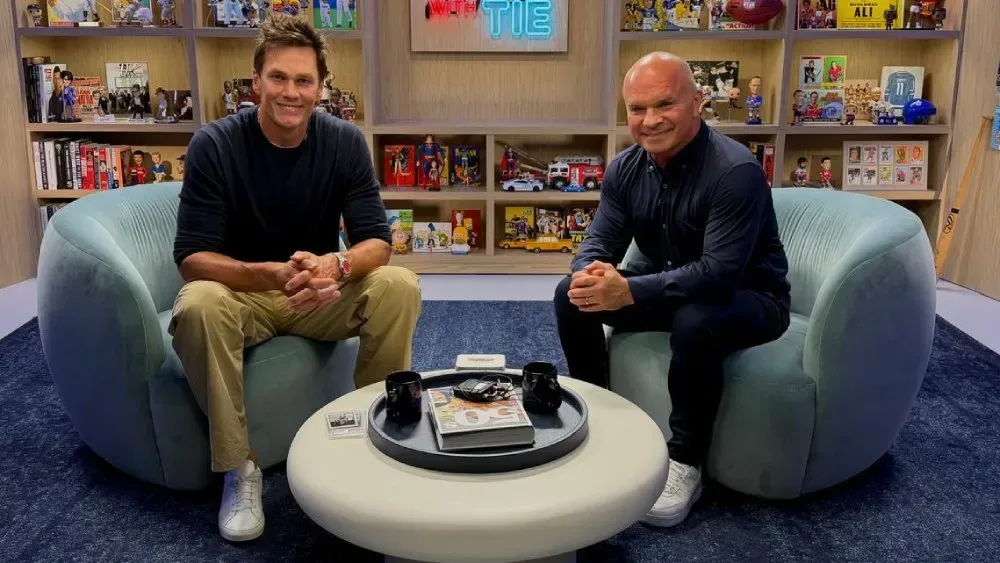
Former NHL player Tahir “Tie” Domi has moved from the rink to the interviewer’s chair with Keeping It Real With Tie, a 12-episode conversation series that debuted on November 17. Tom Brady is the inaugural guest, setting the tone for a lineup built around established relationships rather than a single-sport focus.
The announced guests span sports, entertainment and business: Wayne Gretzky, Ray Lewis, Mark Wahlberg, Alex Rodriguez, Cindy Crawford and Mark Messier are all slated to appear. That range is central to the project’s premise. Domi is best known for hockey—and, specifically, for a famously physical playing identity—but the show is positioned as an opportunity to hear the personal histories and professional experiences of people from several public-facing fields.
The series will air first on DAZN, the sports streaming service, before becoming available on YouTube, Spotify and other podcast platforms. That release path matters because it gives the project two distinct forms of reach: an initial home alongside live sports programming, then broader access for viewers and listeners who use video and audio platforms for interview shows.
From NHL enforcer to interviewer
Domi played 17 NHL seasons, including time with the New York Rangers and Toronto Maple Leafs, and retired in 2006. His playing career made him one of hockey’s most recognizable tough guys. He holds the NHL’s all-time career record for fights, with 333.
That statistic will understandably be part of the public’s first association with Domi, but it is not the identity the new show intends to dwell on exclusively. Keeping It Real With Tie is framed around the person beyond that reputation: his friendships, the people he has encountered across different industries and the stories that shaped them.
In hockey, an enforcer traditionally refers to a player whose role includes physical deterrence and protecting teammates, often through confrontations that can lead to fights. The term describes an old and highly visible part of the sport’s culture, though it does not capture the whole person or necessarily explain what a former player does after retirement. Domi’s series takes that public image as a starting point and redirects attention toward conversation.
“Where I come from, there’s no BS, you show up, you work hard and you take care of your people,” Domi said in a statement. He described the project as unscripted conversations with friends about what got them to where they are.
“Unscripted” in this context does not mean unstructured. It signals a format that prioritizes candid discussion over a heavily staged performance. With a host whose guest list is rooted in personal connections, the potential appeal is not merely hearing familiar biographies repeated, but seeing where shared history leads a conversation.
A guest list designed to cross audiences
Starting with Brady gives the show an immediately recognizable sports figure whose career reaches far beyond a single fan base. Adding Gretzky and Messier brings the series back toward Domi’s hockey world, while Lewis and Rodriguez broaden the athletics component to football and baseball.
Wahlberg and Crawford, meanwhile, signal that the program is not being presented as a hockey-retirement project aimed solely at NHL followers. Both are public figures whose careers connect to entertainment and business, fitting the wider ambition stated for the series. The guest mix also creates room for different kinds of discussion: competition, fame, work habits, reinvention and the relationships that persist when a career changes shape.
There is a useful distinction between an athlete interview show and a show hosted by an athlete. The former can be confined by the guest pool and subject matter. The latter can use sport as the host’s entry point while following connections outward. Domi’s announced roster suggests the second model. Hockey remains foundational, but not restrictive.
That approach is especially meaningful for DAZN. The service said the series reflects its push for original programming that brings fans closer to sports personalities and the stories around them. Live competition is the immediate attraction of a sports platform; original interviews can give audiences something to watch between events and let them engage with athletes in a setting where there is no score, roster decision or postgame time limit.
A family project that began with social storytelling
The path to the series began during the COVID-19 pandemic, when Domi quarantined with his daughter, Avery Domi. She is an executive producer on Keeping It Real With Tie. During that period, Domi began sharing stories on Instagram, and the response helped reveal an audience for his storytelling outside traditional broadcast appearances.
Avery Domi said that turning those stories into a show felt like a natural next step, and emphasized the value of making it together. That family connection offers a clearer origin story than a simple celebrity-brand launch: the project developed from informal storytelling during a shared period at home, then expanded into a professionally released series.
Social platforms are often where a public figure’s voice becomes more immediate. A short post can test whether audiences respond to a personality rather than only the career that made that person famous. In this case, the Instagram response helped point toward a longer format. The 12-episode structure can provide room that short social clips cannot: space for a guest to explain a turning point, contradict a public assumption or move from a funny anecdote to a more reflective answer.
That transition from social storytelling to an interview series is also a reminder that platform choice changes the experience without changing the core material. A short post is built for speed and quick recognition. A streaming episode can support a fuller exchange. Podcast availability can make the same conversation easier to follow while commuting, working or exercising. The expansion to YouTube, Spotify and other podcast platforms gives people multiple ways to meet the show on their preferred screen—or without one.
What DAZN Originals is trying to add
DAZN’s role is more than distribution. The company is using originals, meaning programming made for or commissioned by the service rather than live event coverage, to complement its sports offering. Its stated goal is to connect fans with the personalities and stories that make sports compelling.
For viewers, that can be a practical distinction. A live game has a fixed start, an uncertain result and an expiration point once the final whistle goes. An interview is more durable: it can be discovered after its debut, revisited when a guest is in the news or watched by people who never saw that guest compete. This makes personality-led shows a useful companion to a live portfolio.
Domi’s connections also give DAZN a route to audiences who might arrive for a Brady, Wahlberg or Crawford episode rather than for hockey. That does not guarantee that every viewer will become a regular sports-streaming customer, but it explains the strategic appeal of a wide guest roster. The show can act as an introduction to Domi for younger or non-hockey viewers, while longtime hockey followers get a new setting in which to see a player they already know.
Sports media increasingly has to account for the fact that fans follow people as much as leagues. A viewer may seek out an episode because of a particular guest, then stay because the host’s style creates a different dynamic than a formal press interview. The key variable is credibility: guests need to be willing to share more than rehearsed answers. Domi’s emphasis on genuine conversations and existing friendships is the series’ answer to that challenge.
What viewers can reasonably expect
The information announced so far supports a few clear expectations. The series has 12 episodes. It begins with Tom Brady. It will include guests from sports, entertainment and business. It starts on DAZN and later reaches YouTube, Spotify and other podcast services.
What should remain open is the exact shape of every conversation. No episode-by-episode rundown, release schedule beyond the premiere, running time or detailed subject list has been specified. That uncertainty is worth preserving rather than treating the show as though it were a standard career retrospective. The appeal may come precisely from the conversations going in directions that are not fully mapped in advance.
For Domi, the show is a chance to reframe a public identity forged in an unusually combative role. For his guests, it is a chance to sit with someone who approaches the exchange as a friend and peer rather than solely as a commentator. And for DAZN, it is another example of how a sports service can build programming around the lives and perspectives surrounding competition.
Interview projects such as this also sit within a wider entertainment mix where personality, platform and format all matter. The industry’s appetite for varied forms of creator-led storytelling can be seen elsewhere in discussions about why short films still matter; Domi’s project makes the opposite case for longer-form conversation, with its value resting on time spent listening.
Keeping It Real With Tie arrives with a straightforward promise: familiar people, an interviewer with a very different public history, and room for stories beyond the accomplishments listed on a résumé. Its success will depend on whether those relationships produce the candor suggested by the title. The setup, however, is distinct: an NHL record-holder for career fights using his network to make space for conversations rather than confrontations.