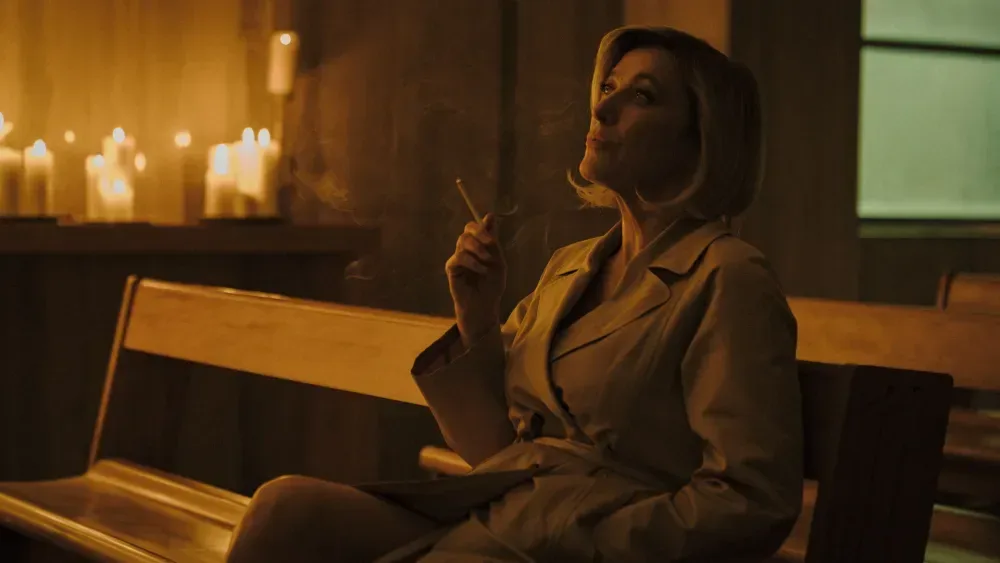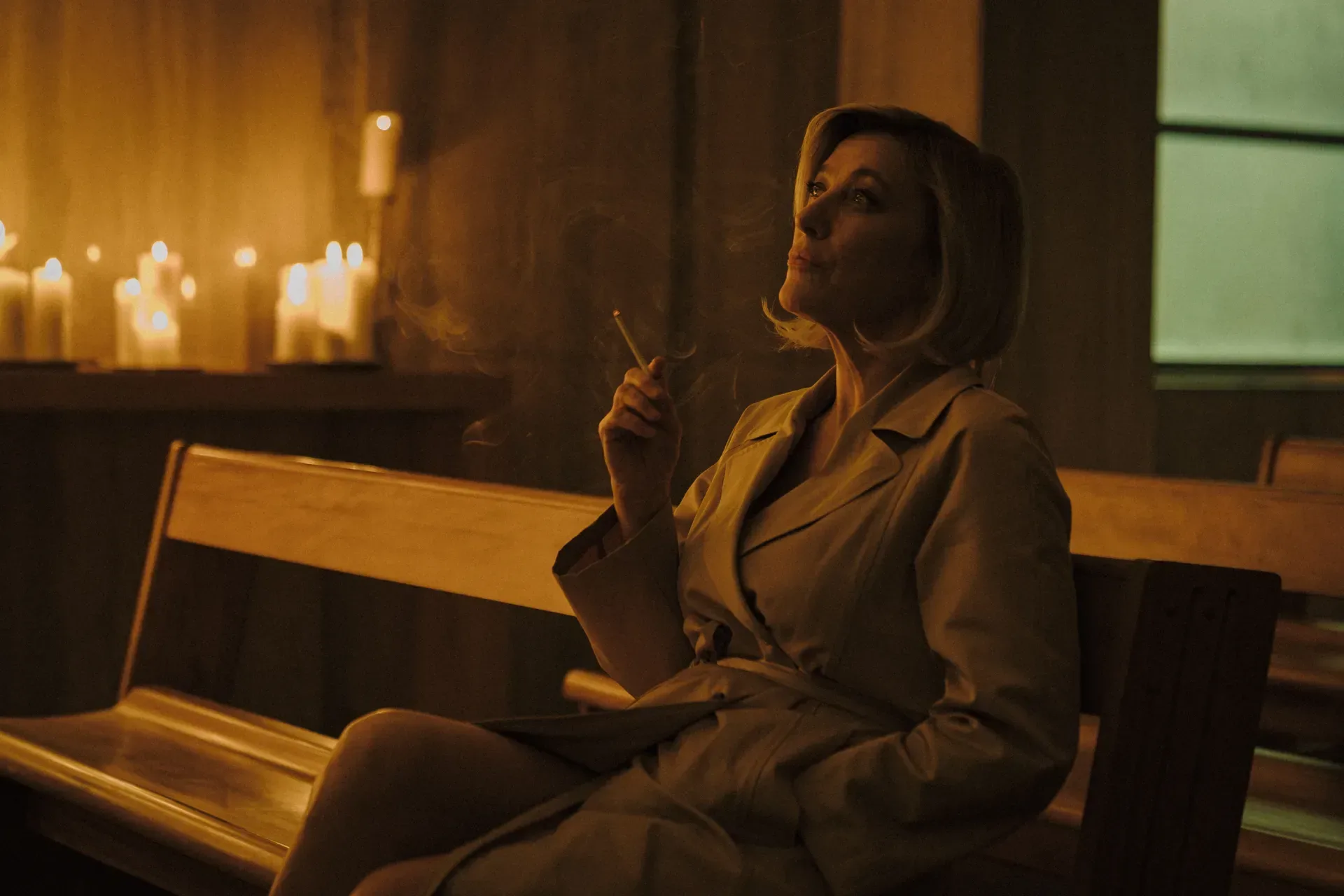
There is a particular kind of screen devil who arrives with smoke, thunder and an immediate willingness to announce the end of all things. The Spiral, Paolo Strippoli’s new Italian-language horror feature, chooses something more unnerving: a devil who looks composed enough to be attending an important appointment. Valeria Bruni Tedeschi plays an unnamed figure known in the original title as “The Stranger,” and her immaculate presentation becomes one of the movie’s sharpest visual jokes. Camel trenchcoat, neat bob, red lips and a cigarette held with intimidating precision: this is Lucifer reframed as a film-noir operator with an eye for tailoring.
The elegant menace is central to a story built on a cruelly simple temptation. Jasmine Trinca plays Anna, a mother forced into a nightmare decision after a catastrophic injury threatens the leg of her young daughter Alice. In a chapel, at the point where fear has overwhelmed reason and prayer seems to have gone unanswered, Anna meets the Stranger. The visitor offers an impossible rescue for Alice, but it comes with a bodily price to be paid by Anna’s older child, Tobia. Anna accepts. The aftermath stretches over years, turning one panicked choice into an expanding family catastrophe.
That premise puts The Spiral squarely in the Faustian-horror tradition, but Strippoli approaches it with the volume turned high. The film is a 115-minute Italy-France-Belgium production, co-written by Strippoli and Salvatore De Chirico, and it favors aggressive sensory impact over restrained supernatural suggestion. Its pleasures are vivid, vulgar and deliberately oversized. The devil does not need to loom from the shadows when she can enter a scene dressed to dominate it.
A disaster begins in the air, then follows a family home
The opening establishes the film’s maximalist temperament before its family drama is fully in view. A passenger grips an airplane armrest as extreme turbulence shakes the cabin, while a cyclone forms beyond the window. Sound designer Quentin Collette reportedly fills the sequence with overlapping natural and unnatural shrieks, making the experience feel less like conventional rough weather than a full-on warning from the universe.
That spiral in the clouds introduces an image that recurs throughout the film. It is immediately striking, though the picture’s symbolic vocabulary does not always develop into a correspondingly intricate narrative argument. Still, Strippoli knows how to make an ominous shape, a storm or a sound cue land with force. A rain-drenched Rome then provides the setting for Anna’s visit to her adult daughter Alice, played by Romana Maggiora Vergano. Anna urgently wants to confess a longstanding family secret. The timing, naturally, is awful.
From there, the story moves back about 25 years to Bari. Anna and her husband Walter, played by Adriano Giannini, appear to be at the center of a polished, affluent household. Young Alice, portrayed by Gabriella Telegrafo, has even been cast in a Barilla pasta commercial. It is an image of commercial-ready domestic perfection, and Strippoli wastes no time crushing it. During a garden party on the family estate, the household bull terrier attacks Alice with brutal and inexplicable violence. Doctors save her life, but the threat of amputation becomes real.
The terror here is recognizably parental. Even viewers who do not buy into every grand gesture of the supernatural plot can understand the desperate impulse that leads Anna to the chapel. The Stranger does not have to perform a lengthy seduction. She simply finds a parent at the most vulnerable possible moment, understands exactly where the wound is, and offers an answer that should be rejected but cannot easily be dismissed.
Valeria Bruni Tedeschi supplies the movie’s wicked pulse
Bruni Tedeschi’s Stranger is the film’s most memorable element. Her performance gives the character a composed, almost administrative chill. She is not merely an embodiment of abstract evil; she feels like someone who has spent an eternity drawing up contracts and is delighted to clarify the terms. Whenever the plot returns to the logic of Anna’s bargain, the film regains momentum through the Stranger’s cool, camp authority.
That quality matters because the picture’s core subject is so potentially grim. The bargain causes lasting physical consequences for Tobia, played as a child by Alessandro Carbonara, and the story uses those consequences in ways that raise uncomfortable questions around ableism and body-shaming. The film may be inviting viewers to regard these attitudes as part of the devil’s cruelty, perhaps with an edge of commentary on image-consciousness and Catholic guilt. But the material can also feel insufficiently explored, especially given the severity of what happens to the family.
That tension defines much of The Spiral. It is frequently fascinating as a piece of horror design, but less persuasive as a fully developed moral tragedy. Strippoli has an instinct for visual excess and emotional pressure, yet the screenplay does not always give its provocations enough space to deepen. The devil’s deal is horrible in concept; the film’s task is to make that horror accumulate in spiritual, ethical and emotional terms, not just in escalating grotesquerie.
A showcase for Italian horror craft
Even when the storytelling starts to circle its own premise, the craft remains a major attraction. Production designer Marcello Di Carlo gives the chapel an especially memorable identity, combining showy Italian modernist design with forceful Catholic imagery. It is exactly the kind of place where a desperate prayer could curdle into something transactional. Cristiano Di Nicola serves as cinematographer, while Federico Palmerini edits and Rob provides the music; together, those creative departments support a movie whose aesthetic often does the heavy lifting.
Strippoli’s fourth feature is also his first to appear in the Venice Film Festival’s main competition. It follows The Holy Boy, his third film, a horror work centered on small-town trauma, faith and fear. The Holy Boy had previously played in an out-of-competition Venice section and was regarded as a more probing and frightening effort. The Spiral may be the splashier movie, but it does not necessarily surpass that earlier film in thematic depth.
Still, the newer feature makes a strong case for Strippoli as a director capable of bringing a distinctly European flavor to contemporary elevated genre cinema without sanding off the pulp. This is not solemn prestige horror pretending to be above the pleasures of bad omens, damaged bodies and a fabulously dressed Satan. It wants to be lurid. It wants to be loud. It wants each renewed appearance of the Stranger to feel like a poisonous little reward.
That sensibility gives the film an odd kinship with other recent genre projects that embrace tonal extremity rather than a strictly straight-faced approach. For another example of a wildly different but similarly committed high-concept ride, see our look at Alpha Gang. The connection is not story or style so much as willingness: both point toward pop cinema that takes a bizarre setup seriously enough to play it big.
Flashbacks make the spiral feel smaller
The film is divided into chapters named for various family members. In principle, that format suggests a shifting perspective on the deal and its long-term wreckage. In practice, the viewpoint does not transform substantially from chapter to chapter. The structure therefore risks becoming more decorative than revealing.
There is also a built-in challenge to the framing device. Beginning with adult Alice and Anna’s approach to confession announces that the past will soon be excavated. Once the key secret emerges comparatively early, the flashback design can lessen rather than intensify the suspense. The question is no longer simply what Anna did; it is whether the film can make every later turn feel like a new and meaningful deformation of that first decision.
The Spiral does not always meet that challenge. It can feel as though its narrative coils inward rather than widening the implications of its bargain. The family’s suffering piles up, but it does not consistently gain greater moral resonance. The movie is more confident in spectacle than in escalation.
Yet spectacle has value when it is this assured. Strippoli’s control of atmosphere, production design and sound gives even the weaker stretches a jolt of wicked momentum. Trinca grounds Anna in authentic maternal panic, while Giannini and the younger ensemble help establish the fragile image of a family that thought it was safe. Above all, Bruni Tedeschi turns every contractual revisit from the devil into an event. Her Stranger knows that damnation is disappointing if it is not also properly accessorized.
Festival profile and key credits
The Spiral screened in competition at the Venice Film Festival and is also set for the Toronto Film Festival’s Midnight Madness program. Its original Italian title is L’estranea. The cast includes Jasmine Trinca, Romana Maggiora Vergano, Adriano Giannini, Valeria Bruni Tedeschi, Gabriella Telegrafo, Mariandrea Cesari, Andrea Genovese, Alessandro Carbonara and Andrea Rossini.
- Director: Paolo Strippoli
- Screenplay: Paolo Strippoli and Salvatore De Chirico
- Cinematography: Cristiano Di Nicola
- Editing: Federico Palmerini
- Music: Rob
- Running time: 115 minutes
- Language: Italian
For viewers drawn to stylized supernatural melodrama, The Spiral offers a compellingly excessive package: family dread, religious imagery, a diabolical transaction and an antagonist whose wardrobe could make eternal punishment look like a prestige fashion campaign. Its script may not give every spiral, flashback and physical consequence the weight it needs, but Strippoli’s horror instincts are too energetic to ignore. The result is less a perfectly calibrated tragedy than a gleefully ornate nightmare with a superbly dressed devil at its center.